8 Promptwatch alternatives for agency and in-house AI visibility

You’ve probably hit one of two walls with Promptwatch. Either a new client doesn’t fit your current plan, or a client’s buyers use an engine your plan doesn’t track. Those limits matter little for a single brand. They start to bind once you report AI visibility across a client book.
If any of that sounds familiar, the eight Promptwatch alternatives below are worth a look.
Promptwatch alternatives at a glance
Key takeaways
- For a multi-client agency: SE Visible by SE Ranking tracks four core AI engines on every plan with fixed prompt allowances and 3 to 10 projects.
- For an enterprise buyer: Profound pairs a free 7-day trial with custom Enterprise pricing, which suits teams that buy through procurement.
- For variable research volume: Ziptie builds the plan from your own prompt volume, and Rankscale rolls unused credits over on paid plans, capped at 2–3× the monthly allowance.
- For a single brand: Peec AI’s Starter and Scrunch AI’s Core are both scoped to one brand, and Scrunch also limits Core to one country.
| Tool | Best for | AI engines covered | Pricing model | Entry plan allowance | Starting price |
|---|---|---|---|---|---|
| SE Visible | Agencies reporting AI visibility across several client brands | Four, the same on all plans, with more to come | Fixed prompt tiers | 200 prompts and 3 projects (Basic) | $99 per month, billed monthly |
| Peec AI | Brand teams that need unlimited seats, and agencies on its agency track | 3 chosen from six included engines | Fixed prompt tiers for brands; agency plans meter in credits | 50 prompts and 1 project (Starter) | $95 per month, billed monthly |
| AthenaHQ | Teams that want GA4 and Search Console beside AI data | 11 models on Starter | Credits | 300 credits (free tier); 3,600 credits (Starter) | Free tier; Starter at $295 per month, billed monthly |
| Profound | Enterprise buyers purchasing through procurement | Up to nine on Enterprise | Sales quote for brands; self-serve Agency Growth plan | 50 prompts daily for 7 days (Trial) | Free 7-day Trial; Enterprise custom |
| Rankscale | Teams that need engines well beyond the common set | 17+ | Credits | 120 credits for Essentials, 2 brand dashboards | $17 per month (Essentials) – annual billing only |
| Otterly AI | Small prompt sets with ChatGPT ads in view | 4 by default, 3 more as paid add-ons | Fixed prompt tiers plus engine add-ons | 15 prompts, 1 workspace (Lite) | $29 per month, billed monthly |
| Scrunch AI | Single-brand in-house teams in one market | 4 on Core, 9 on Enterprise | Fixed prompt tiers | 125 prompts in 1 brand workspace (Core) | $250 per month, billed monthly |
| Ziptie | Teams whose prompt volume varies by client | Chosen when you build the plan (up to 7) | Usage-based build | Build your own (prompts, refresh, engines) | From about $42.75 per month |
Why teams look for alternatives to Promptwatch
Promptwatch is an AI-search visibility tracker sold on fixed monthly plans, and its review signal is solid: 4.6/5 on G2 from 21 reviews. Check out our Promptwatch review for more details on how the platform works and what it covers.
The strain shows when one account has to carry a client book. Its entry plan is built around one brand, while Business is priced for teams that already know they need five projects.
These are the pressure points, from the plan sheet and from reviewers:
- One project on the entry plan: The entry plan is $95 per month, billed monthly, for 1 project and 50 prompts.
- A $579 step to five projects: Professional covers 2 projects and 150 prompts at $245 per month, billed monthly. The next plan with 5 projects is Business at $579 per month, billed monthly. At that price, Business works out to $115.80 per project per month, against $95 per month for the single project on the entry plan. Agencies can switch to Promptwatch’s separate agency plans instead, but those start at $199 per month.
- Engine caps on brand plans: Each project on a Brands plan tracks 4 of Promptwatch’s 11 AI platforms.
- Usage runs down fast: Reviewers say agent credits deplete quickly and that prompt tracking stays expensive. Both problems compound across a client book.
- Organic data sits elsewhere: Promptwatch connects to Google Search Console, but reviewers want to see where the brand appears in organic results next to its AI answers.
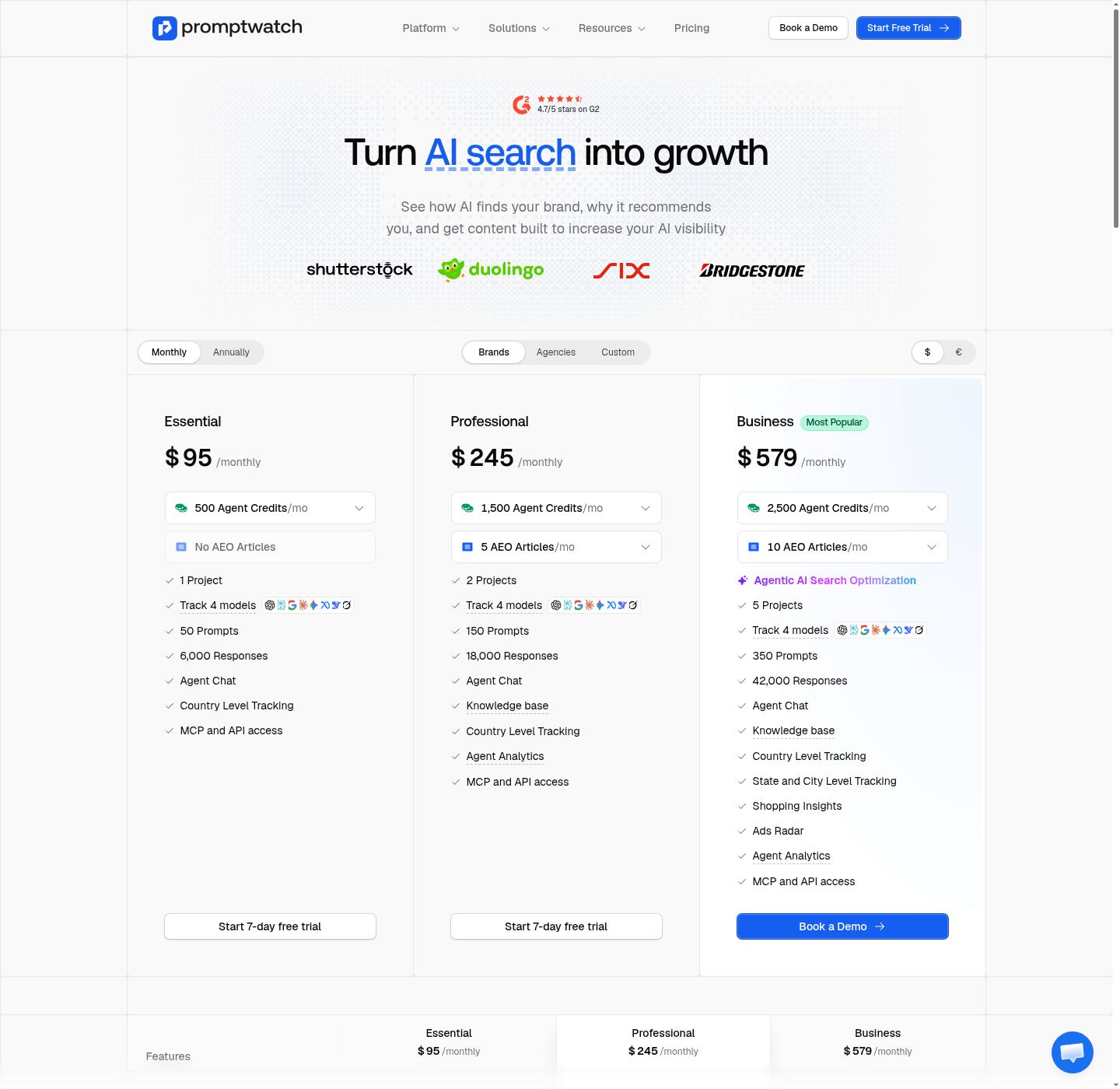
Most of these trace back to a plan structure built around one brand, and they bind hardest when you report on many clients at once.
If you are still mapping the wider category, our roundup of AI visibility tools covers tools outside this comparison.
1. SE Visible
SE Visible by SE Ranking is a standalone AI brand-visibility platform that monitors four answer engines with more on the roadmap. With fixed prompt allowances, the cost of adding a client is known before the month starts.
Standout features
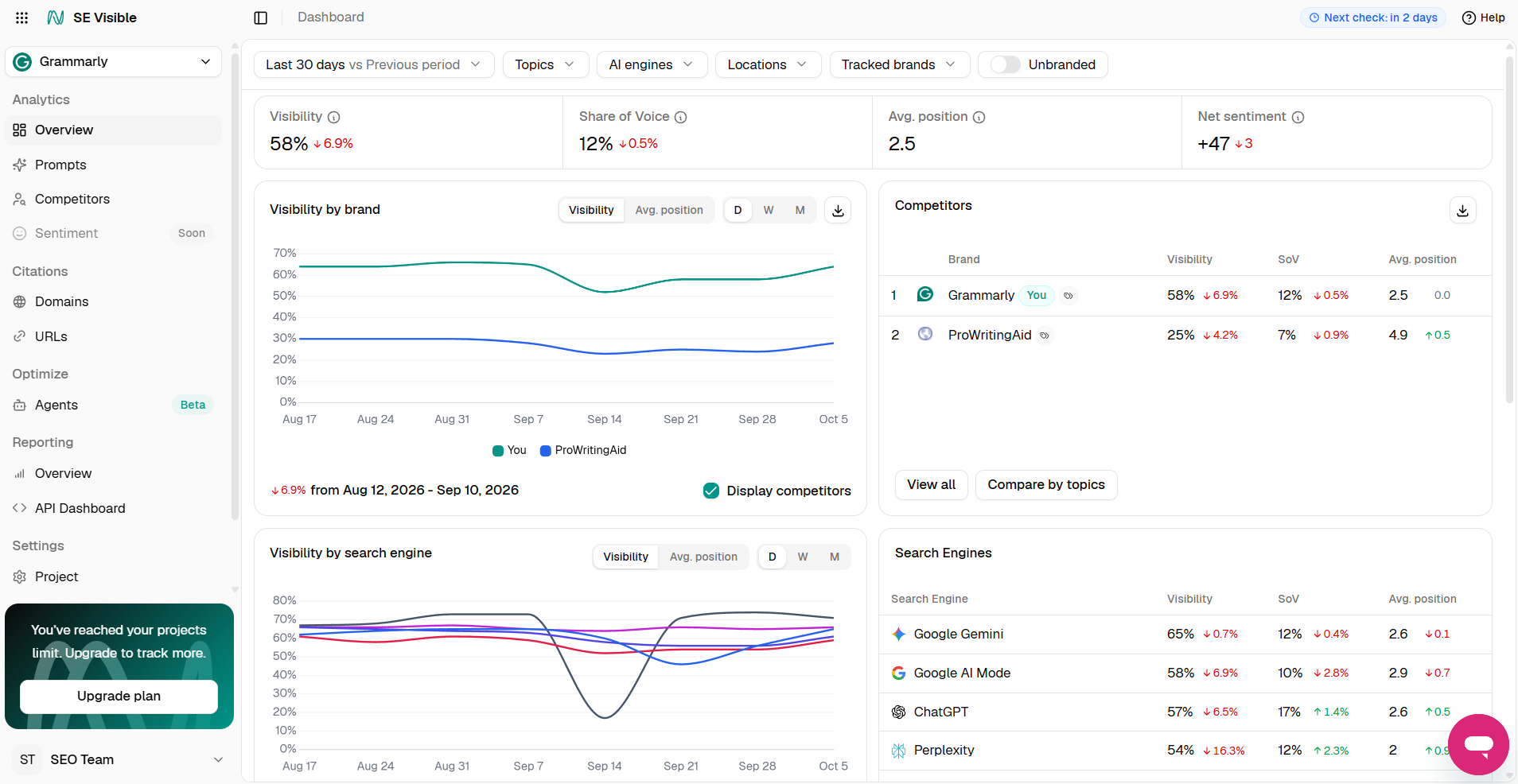
- Brand Visibility dashboard: Highlights the headline metrics a client readout opens on, from visibility score and share of voice to net sentiment.
- Competitor gaps: Lists the prompts and topics where competitors are cited and you are not, which you can turn into next month’s work list.
- Net sentiment score: Tracks AI brand sentiment as a Net sentiment score: the share of positive mentions minus the share of negative ones, from −100 to +100.
- Source Analysis: Shows the domains and URLs that appear most often in AI answers about your brand.
- Data Studio connector: Builds self-refreshing client dashboards through the Data Studio connector.
A monthly client readout maps onto these views: the dashboard carries the headline movement, and the competitor gaps become the recommendations. Sentiment sits beside visibility because mentions can grow while their tone slips.
Best for: Agencies and in-house teams reporting on several brands that want fixed prompt allowances.
Pros
- Real browser sessions: Collects responses through a real browser session in the graphical interface, not API, so the data reflects what a person sees in the chat window.
- Unlimited users: Invite unlimited users, so client contacts can join a project without a seat count.
- No engine add-ons: All plans track the same five engines with no engine add-ons and no model tiering, so the plan price is the engine price.
- API on every plan: An API is available on all plans, so programmatic access isn’t reserved for an enterprise tier.
- SEO tools through SE Ranking: SE Visible is built by SE Ranking, so the SEO side of a client report can come from the same team. Use SE Ranking for rankings, technical audits, content creation, and SE Visible for mentions and sentiment in AI answers. Together they give you visibility across Google results and AI answers.
Cons
- No Grok or Copilot: For now SE Visible tracks four AI systems, with more to come, including Microsoft Copilot.
- No PDF export yet: CSV export; there is no PDF export yet.
Pricing
Basic is $99 per month, billed monthly ($79 per month, billed annually), for 200 prompts and 3 projects. Core is $189 per month, billed monthly ($151 per month, billed annually), for 450 prompts and 5 projects. Plus is $355 per month, billed monthly ($284 per month, billed annually), for 1,000 prompts and 10 projects. Annual billing saves 20%. All plans include a 10-day free trial with no credit card required.
2. Peec AI
Peec AI is a Berlin-headquartered company founded in 2025 that has raised roughly 29 million dollars. Its Starter plan matches Promptwatch’s entry plan at $95 per month and 50 prompts but adds unlimited users, and Advanced lists 5 projects at $495 per month against $579 for Promptwatch’s Business plan.
Standout features
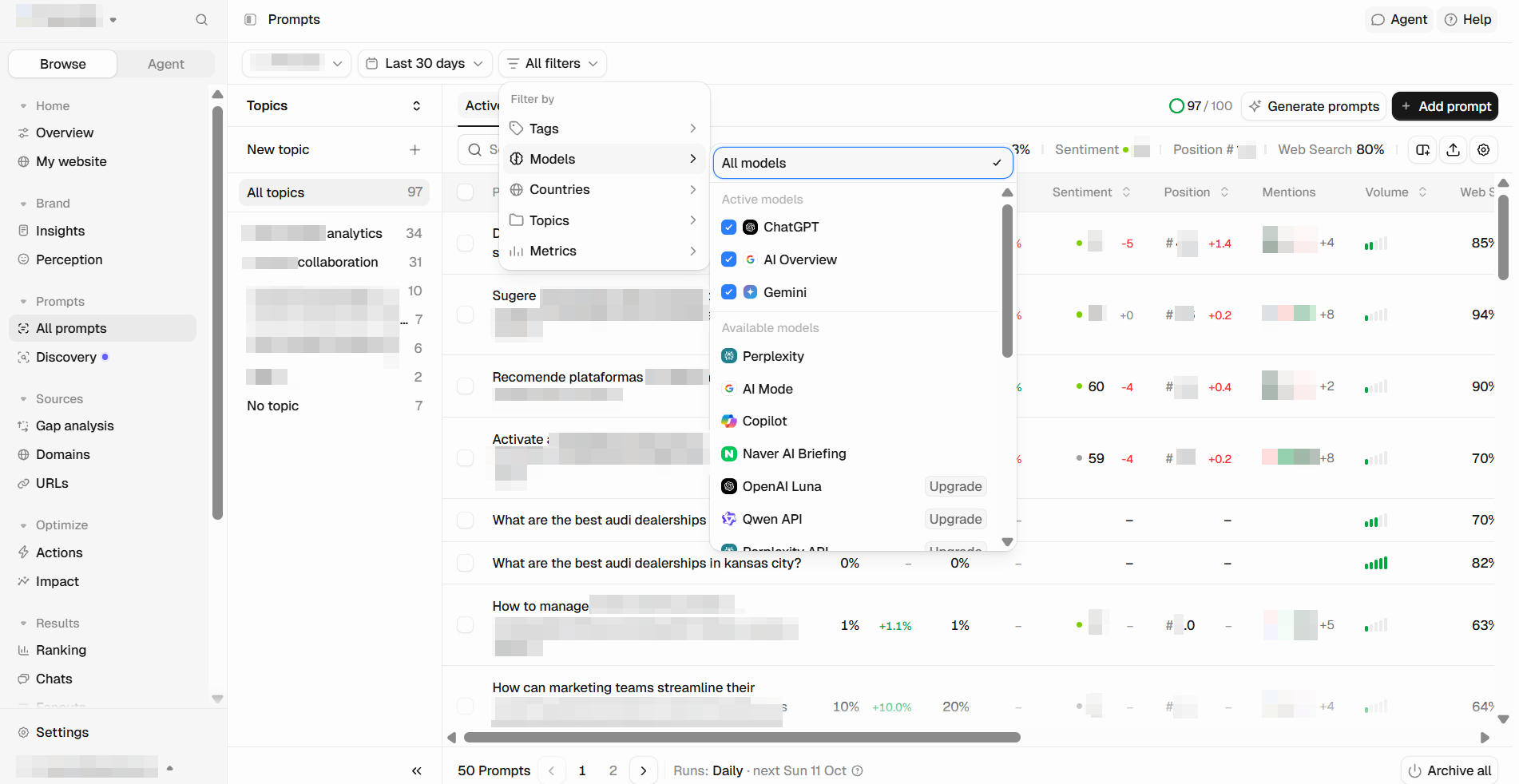
- Three of six engines: Every plan lets you pick 3 engines to track from the same 6 included options, Microsoft Copilot and Google AI Mode among them.
- Crawlability check: Checks a domain’s robots.txt against 40+ named AI bots from 20+ vendors.
- MCP server: Included in every plan and connects Peec AI data to Claude and Cursor, plus VS Code and Windsurf, through the Peec AI MCP server.
For an agency, the crawlability check works as a pre-sales tool as much as a tracking one. You can show a prospect which AI bots their robots.txt turns away before any contract starts, which is a concrete opener for a GEO pitch.
Each brand plan below Enterprise lets you pick 3 of the six included engines, so settle which three matter for each client before the first reporting cycle, because switching the mix later breaks the trend line you report on.
The MCP server pays off for teams that already query their data from Claude or other tools. If Peec AI is already on your shortlist, our Peec AI alternatives comparison covers the tools it is usually weighed against.
Best for: Brand teams that report from one or two projects with many seats, or agencies after a credit-metered plan with unlimited client seats.
Pros
- Unlimited seats: All tiers include unlimited users, so adding client contacts does not change the bill on either track.
- Review signal: Holds 4.7/5 on G2 across 21 reviews.
- MCP server on every plan: Users can connect Peec AI data to AI assistants they use.
Cons
- Paid extra models: Adding a tracked model beyond your three costs $35 per month on Starter and $85 per month on Pro, rising to $165 per month on Advanced.
- One project on Starter: Starter holds 1 project, and the agency plans start at $245 per month for 3 client projects, so a fourth client means Growth or Advanced at $495 per month.
Pricing
Starter is $95 per month, billed monthly, for 50 prompts, 3 engines of your choice and 1 project. Pro is $245 per month, billed monthly, for 150 prompts and 2 projects. Advanced is $495 per month, billed monthly, for 350 prompts and 5 projects, with multi-country tracking and a Data Studio integration. On the agency track, the entry plan is $245 per month, billed monthly, for 10,000 credits, about 111 prompts and 3 projects.
3. AthenaHQ
AthenaHQ answers the organic-data gap Promptwatch reviewers raise by connecting to Google Analytics (GA4) and Google Search Console, plus Shopify and Webflow, on both Starter and Enterprise. It is an AI visibility platform that meters usage in credits, with a free entry tier and a paid Starter plan below Enterprise.
Standout features
- 11 models on Starter: Starter tracks 11 AI models, with Claude and Grok on the list alongside DeepSeek and Meta AI.
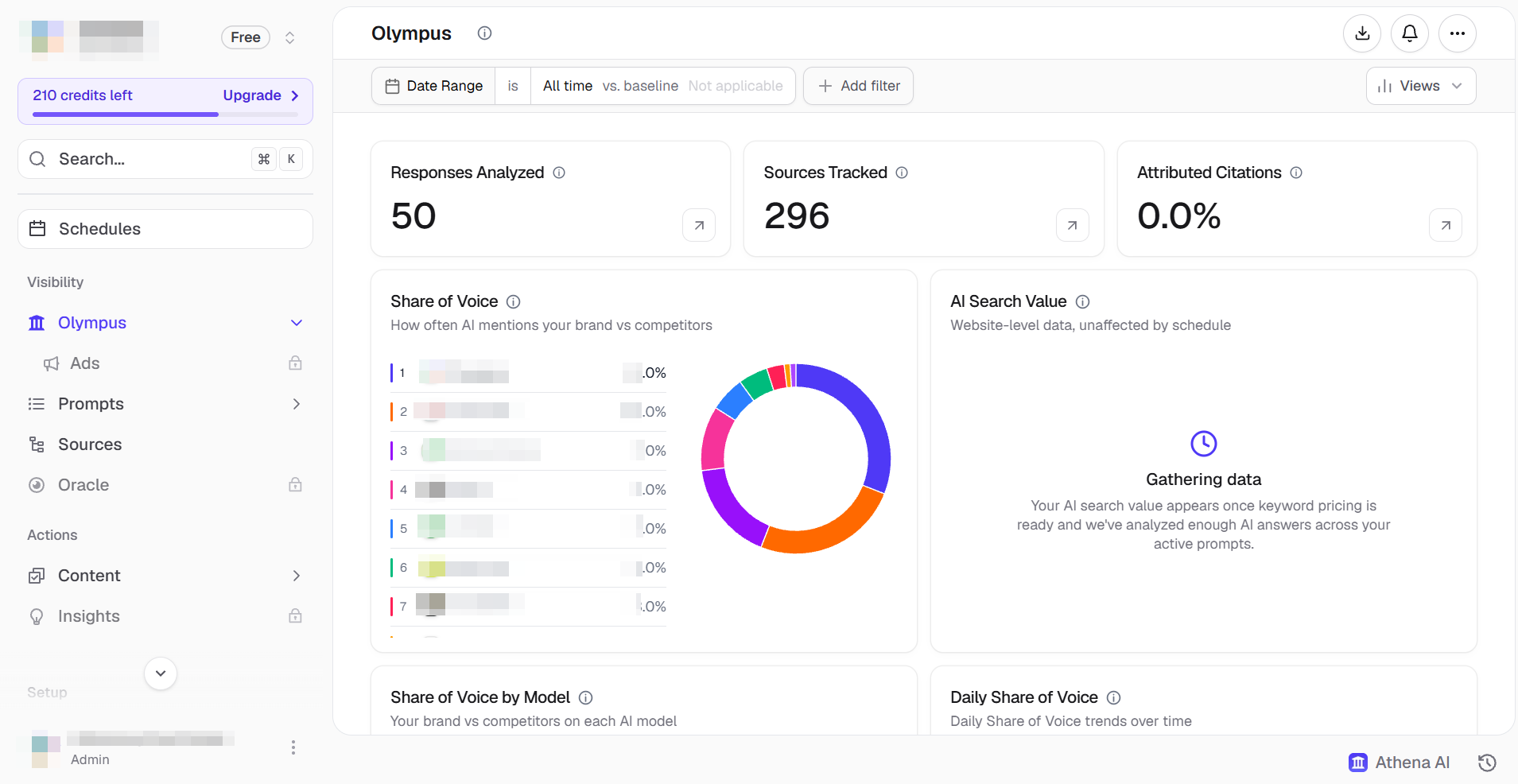
- Enterprise analysis tools: Enterprise adds Oracle discrepancy detection, which flags false AI claims about your brand, and the Athena Citation Engine (ACE), which predicts whether a page is likely to be cited.
- Prompt volume estimates: Every paid plan shows how often a prompt is searched on AI platforms, so you can prioritize prompts by demand.
AthenaHQ bills one credit per AI response, so a plan’s prompt count depends on how many engines and runs each prompt uses. Price one month of your prompt set in credits before comparing it with a prompt-based plan.
The free tier is a cheap way to run the test: 300 credits are too few for a client book, yet they show how fast a realistic prompt set draws the balance down.
If your reporting depends on the API, get the add-on price before comparing Starter’s $295 per month with plans of other Promptwatch alternatives that include API access. If you need Oracle discrepancy detection or ACE, request an Enterprise quote from the start rather than planning to upgrade from Starter, since both are Enterprise-only.
Best for: In-house teams and agencies that want AI visibility read beside site traffic and search queries, and that need Claude or Grok in the engine list.
Pros
- Strong review signal: Rated 4.9/5 on G2 from 39 reviews, the highest score in this comparison.
- No add-on fee for models: AthenaHQ includes all models it tracks from the Starter plan.
Cons
- Paid add-ons for API and extra credits: API access and extra credits are billed on top of the Starter subscription, with add-on pricing on request.
- Busy interface: Crowded interface that takes time to learn.
Pricing
The free entry tier includes 25 dollars of free credit, covering 300 credits. Starter is $295 per month, billed monthly, with 3,600 credits included.
4. Profound
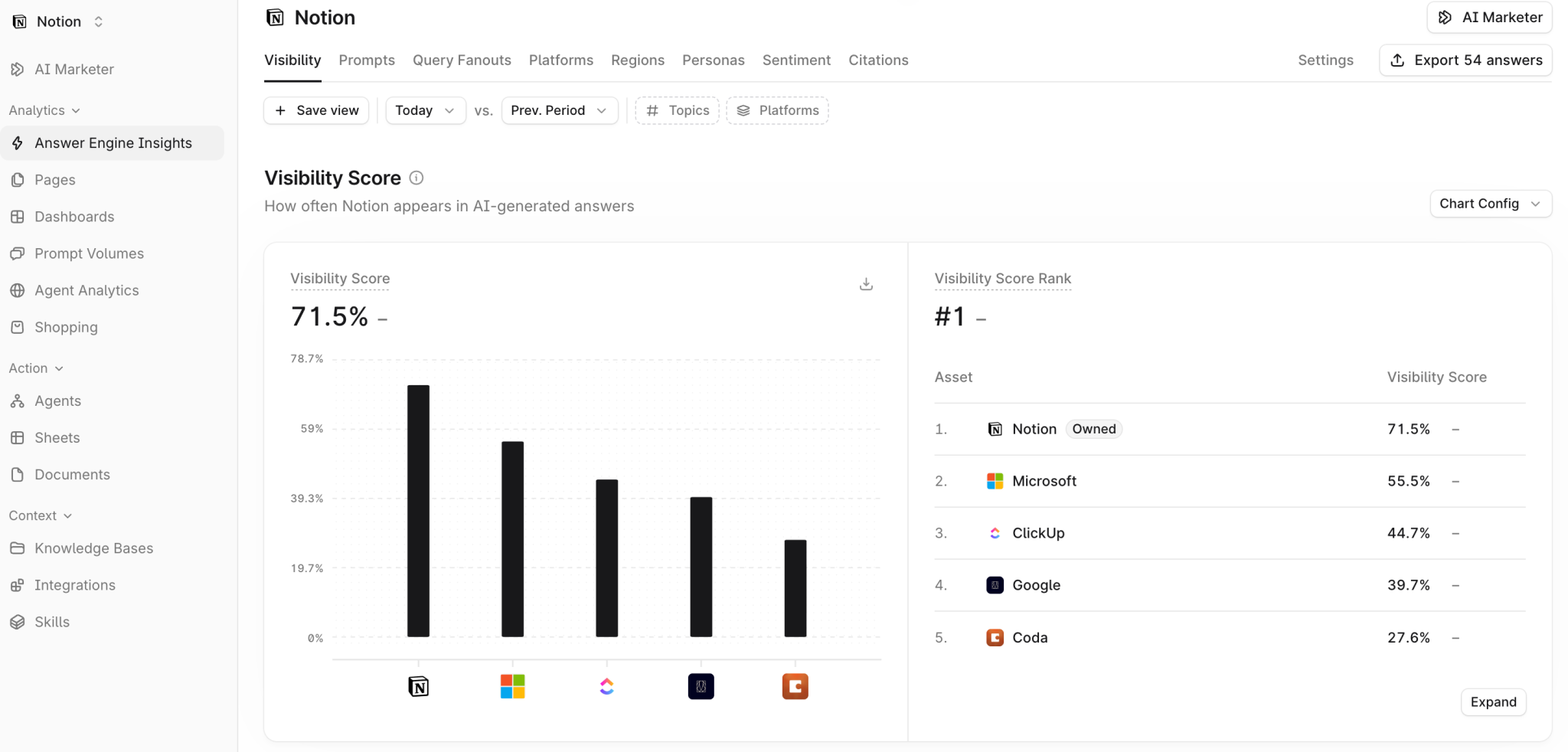
Profound is built around an AI Marketer, a credit-based agent that researches and writes with knowledge of your brand. Its brand plans are a free Trial and a quote-based Enterprise tier, while agencies get a self-serve Agency Growth plan that comes with 400 AI Marketer credits per month.
Standout features
- Up to nine answer engines: Enterprise can track up to nine answer engines, Microsoft Copilot and Anthropic Claude among them, plus Exa Search.
- Agent Analytics integrations: Tracks AI-sourced traffic through integrations with Cloudflare and Vercel among others, on the Trial as well as on Enterprise.
- ChatGPT Shopping tracking: Shows how products appear in ChatGPT’s shopping results. Available on Enterprise only, not on the Trial.
A 7-day Trial is shorter than one monthly reporting cycle, and for a brand team what follows it is an Enterprise quote. That fits a brand team buying through procurement, where a custom quote and a contract are the expected route anyway.
Agencies that add clients month by month have the self-serve Agency Growth plan instead, which sizes the AI Marketer by client workspace at $399 per month each, so the cost of each new client is known before you pitch.
Trial users receive a recommended prompt set based on their industry and cannot customize their prompts, so use the week to judge data quality: compare those answers with what you see when you run similar prompts by hand.
Then weigh the AI Marketer: if you want an agent drafting content from the visibility data, Profound is built around exactly that, and if you only need tracking, the agent is a layer you may not use. For a wider view of the options, our Profound alternatives comparison goes further.
Best for: Enterprise brand teams that buy through procurement, plus agencies that want an AI agent per client workspace.
Pros
- Content production: Users can create AEO content with Profound based on the citation data via Agents.
- Shopping visibility for ecommerce clients: ChatGPT Shopping tracking shows how products appear in ChatGPT’s shopping results. For a retail client that’s a separate surface worth reporting on.
Cons
- Steep onboarding: New users will need to time to feel comfortable with the platform.
- No data out of the Trial: The Trial keeps no history and offers no exports or API, so a week of results stays inside the tool; Enterprise adds CSV and JSON exports.
Pricing
The Trial is free and runs 50 unique prompts daily for 7 days across ChatGPT, Gemini and Google AI Overviews. Enterprise is priced by custom quote. On the agency side, Agency Growth is self-serve ($99/month), and each client workspace costs $399 per month.
5. Rankscale
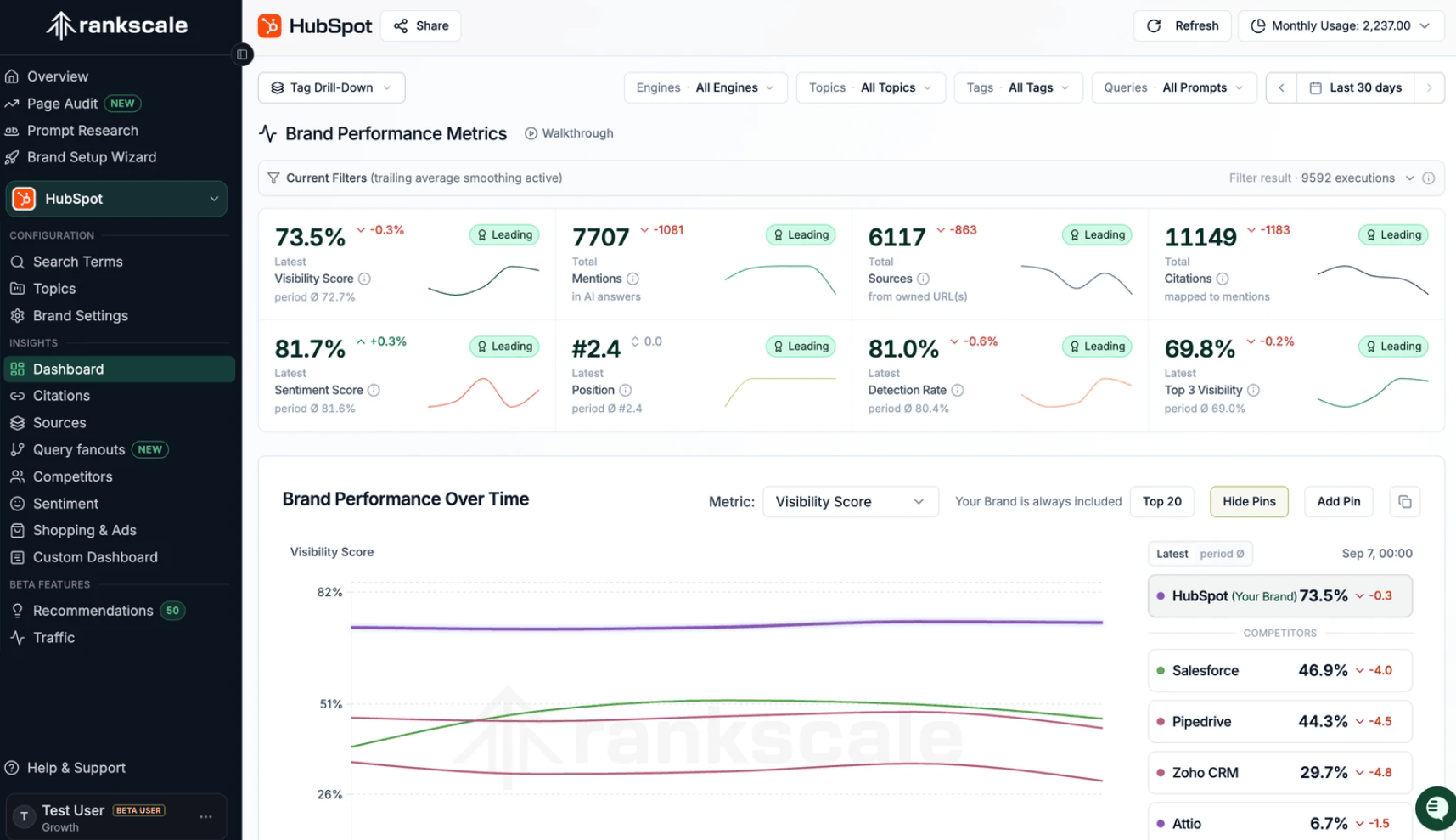
Rankscale bills each prompt run per engine, typically 0.25 credits, so more engines or more frequent checks use up a plan faster. Plans start with Essentials at $17 per month, billed yearly, for 120 credits. Pro costs $99 per month for 1,200 credits, and unused credits roll over up to a cap from Pro upward.
Standout features
- 17+ engines on all plans: Tracks more than 17 AI engines on all plans, with Claude and DeepSeek among them, plus Mistral and Grok.
- REST API and white-label: Growth and Enterprise add full REST API access and white-label dashboard links.
- MCP connection: Connects AI assistants such as Claude and Cursor to your Rankscale data through MCP.
Credits are easier to budget once you convert them into answers. At a typical 0.25 credits per engine check, Pro’s 1,200 credits track up to 4,800 answers a month, against 6,000 responses on Promptwatch’s entry plan.
If your current plan counts prompts, multiply your prompts by the engines you track and by your monthly refreshes to get the number of answers you actually use, then compare that figure with the plan’s monthly allowance.
From Growth up, white-label dashboard links put your agency’s branding on client reports. Track only the engines each client’s buyers actually use. Extra engines add answers to review and use up credits, but they don’t change your decisions.
Best for: Agencies and brand teams that need engines well beyond the common set, such as Mistral or DeepSeek, and can budget in credits.
Pros
- Credit rollover: Unused monthly credits roll over, up to 2x on Pro and Pro+ and up to 3x on Growth and Enterprise, so a quiet month for one client is not lost.
- Flexible check frequency: Each search term can run daily, weekly, or monthly, so clients can run prompts weekly and use fewer credits.
Cons
- Engines cost up to 8x more: A Claude check costs 2 credits and a DeepSeek check costs 1, against 0.25 for ChatGPT or Perplexity. Adding them to a client’s mix quickly cuts the credits a plan covers.
- White-label starts at $385: Pro and Pro+ dashboard links carry Rankscale’s branding. Removing it requires Growth at $385 per month.
Pricing
Essentials costs $17 per month, billed yearly only, for 120 credits a month. Pro costs $99 per month for 1,200 credits, covering up to 4,800 AI-engine answers, and includes 10 brand dashboards and a 7-day free trial.
Pro+ costs $229 for 3,000 credits and 25 dashboards along with 12,000 AI answers. Growth costs $385 for 5,500 credits and 50 dashboards. Enterprise costs $780 for 12,000 credits and 100 dashboards. The monthly plans cost 15% less when billed yearly.
6. Otterly AI
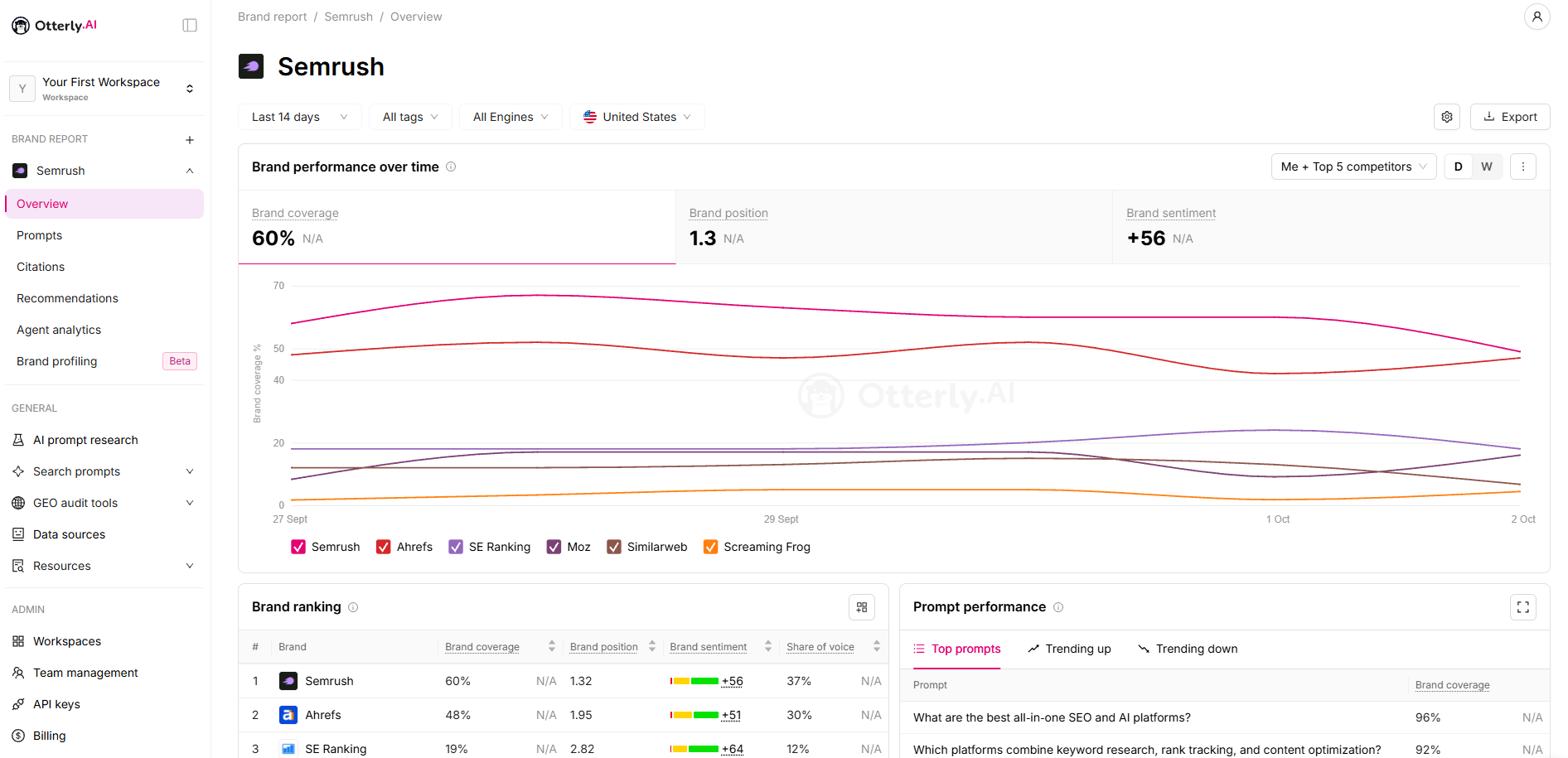
Otterly AI puts ChatGPT Ads Tracking on all plans, entry tier included. It sells small fixed prompt tiers and prices extra engines as add-ons.
Standout features
- Developer access and Agent Analytics: Standard plans and above add API and MCP access plus Agent Analytics.
- Agency Partner program: Agency Partners on Standard or Premium get pitch workspaces, which run custom audits for prospects before they sign.
- GEO URL audits: Checks how well a page is optimized for AI search and accessible for AI bots, with 1,000 audits a month on Lite and up to 10,000 on Premium.
Otterly’s base plans track four engines: ChatGPT, Google AI Overviews, Perplexity and Copilot. Adding AI Mode, Gemini and Claude raises Lite from $29 to $76 per month and Standard from $189 to $416. If only Claude matters to a client, Standard plus Claude costs $298 per month. So, compare Otterly AI’s entry tier with anything else, because a like-for-like comparison with a tool that includes those engines means adding their cost to the base plan.
ChatGPT Ads Tracking shows which of a client’s tracked prompts trigger sponsored placements in ChatGPT and which competitors are bidding on them. It’s included on every plan at no extra cost.
For more on how the platform compares to competitors, see our Otterly AI alternatives guide.
Best for: Agencies and in-house teams that track a focused prompt set and want ChatGPT ads tracked from the entry tier up.
Pros
- API and MCP access: Both come with Standard and above, along with Agent Analytics, so client dashboards can pull data automatically.
- GEO audits included: URL audits check how well a page is optimized for AI search and how accessible it is to AI bots. Even Lite includes 1,000 audits a month.
Cons
- Engines as add-ons: Four engines come by default, and Claude, Google AI Mode and Gemini are paid add-ons.
- One workspace on Lite: Lite includes 1 workspace, while Standard includes unlimited workspaces, so separate client environments start on Standard.
- A big step between tiers: The jump from Lite to Standard is large, and small agencies might feel how this stretches their software budget.
Pricing
Lite is $29 per month, billed monthly, for 15 search prompts across 4 AI engines. Standard is $189 per month, billed monthly, for 100 search prompts. Premium is $489 per month, billed monthly, for 400 search prompts. Annual billing saves 15%, and a 7-day free trial is available before committing.
7. Scrunch AI
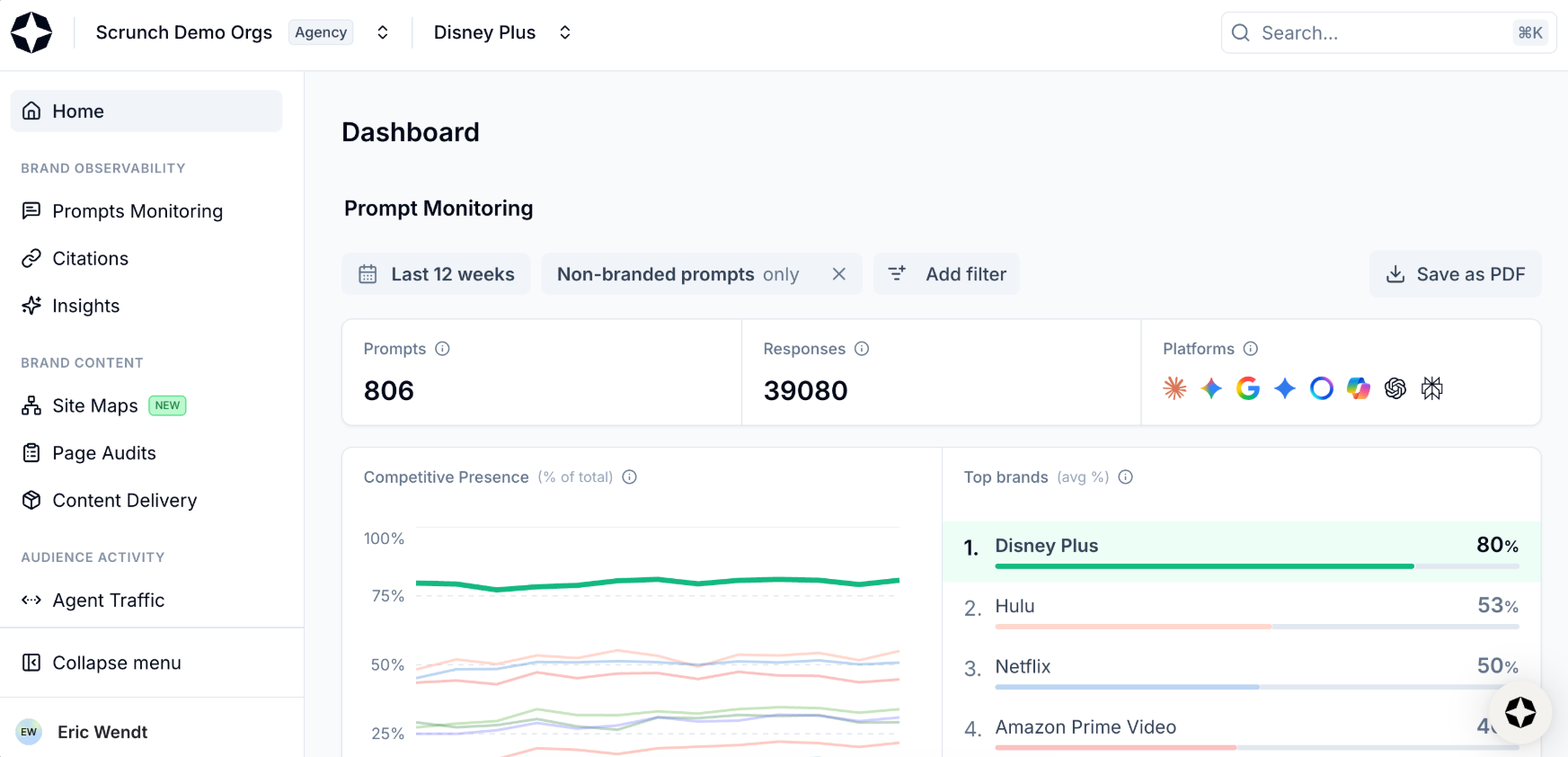
Scrunch AI’s Enterprise plan supports 9 LLMs, with Meta AI and Grok on the list. Its Core plan is scoped to 1 brand workspace and 4 LLMs (ChatGPT, Perplexity, MS Copilot, and Google AI Overviews).
Standout features
- AXP on Enterprise: Enterprise includes AXP, the Agent Experience Platform, which serves AI-optimized page versions to AI bots. The Core plan doesn’t include it.
- Bot traffic on Core: Core tracks AI agent and bot traffic to your site, with multi-domain tracking available on Enterprise.
- AI Search Trends: Shows trending AI search topics and approximate prompt volume. Core includes 3 topics, and Enterprise lets you set a custom number.
The Core plan with one brand workspace in one country maps cleanly onto a single-brand in-house team. An agency with a client book would need a workspace per client, which on this structure points to Enterprise and a sales conversation.
With 1 persona on Core, you track answers for one buyer profile, so a brand selling to both practitioners and executives would see only part of its prompt space. For benchmarking, Core’s 5 competitors cover a focused category but not a crowded one, so count the rivals a client expects to see before you choose a plan. On an agency roster, Scrunch AI fits your largest single-brand client.
Best for: Single-brand in-house teams in one market that want site audits and AI visibility benchmarks in one plan, with Enterprise as the route if the brand expands abroad.
Pros
- Bot traffic on the entry plan: Core tracks AI agent and bot traffic to your site, so you can see which AI crawlers reach the brand alongside how AI answers describe it.
- Audits and seats included: Core bundles 5 site audits a month and 5 user licenses.
Cons
- One market on Core: Core covers 4 LLMs in 1 country, with 1 persona and 1 language for one brand, and tracks 5 competitors.
- No integrations on Core: Core has no MCP or Query API access, and Data Studio needs Enterprise. SAML and OIDC SSO are Enterprise-only as well, while Google Single-Sign-On comes with both plans.
Pricing
Core is $250 per month, billed monthly, for 125 unique prompts in 1 brand workspace. Core starts with a 7-day free trial. Enterprise requires a demo call.
8. Ziptie
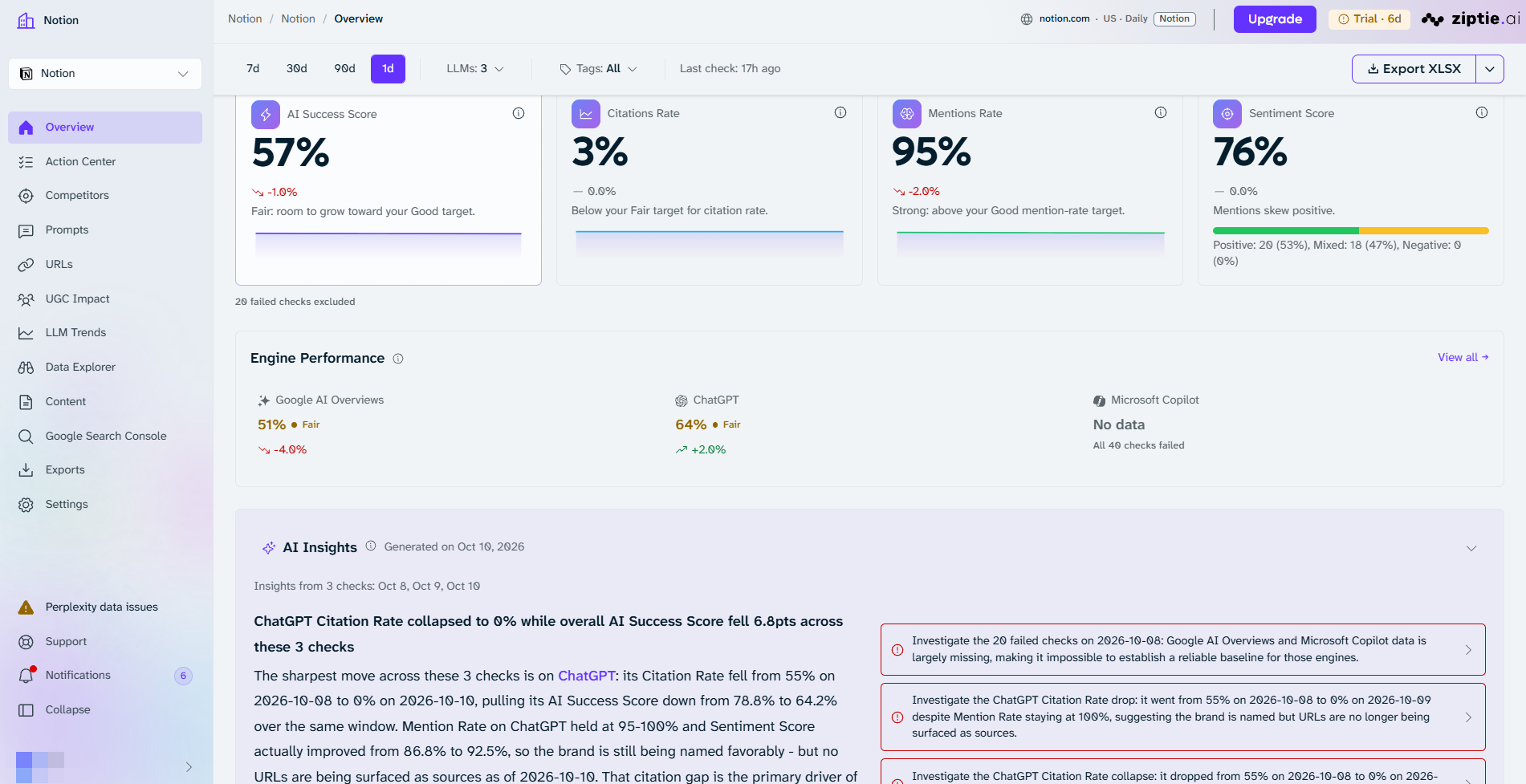
Ziptie has no fixed tiers: you build a plan from prompt count and refresh frequency plus engine coverage, with unlimited teammates and projects on any plan. That makes it the one usage-based build in this comparison.
Standout features
- UGC Impact Analysis: An add-on that shows which third-party platforms AI engines actually cite, ranked by citation share and volume.
- API and MCP add-on: API and MCP access costs $10 per month, with rate limits of 60 requests a minute per token and 50,000 a day per workspace.
- Organic results alongside AI answers: Google AI Overviews and Bing AI Overview checks also capture each engine’s top-10 organic results, so you can compare classic rankings with AI answers.
When prompt volume differs a lot between clients, a fixed tier makes the smallest account carry the unused prompts of its plan, while a built plan lets you size each one to what it actually needs.
You can also tune refresh frequency: a client you review monthly does not need the daily cadence a launch account does.
A built plan changes whenever a client’s prompt count or cadence changes, and the monthly bill then needs the same review your client budgets get. Rebuilding the plan at each renewal keeps that manageable.
The API and MCP add-on is priced low enough to include by default if any client dashboard pulls data automatically. Ask for the built price of your three largest clients up front, since the preset figures are starting points and your real mix sets the bill.
Best for: Agencies whose prompt volume varies by client and who want to size tracking per account instead of per tier.
Pros
- Exports without the API: Every plan includes native XLSX and CSV export options, and public share links, so client reports do not wait on the API add-on.
- Unlimited seats and projects: ZipTie never charges for seats, projects or competitors, so a new client only costs the prompts you track for them.
Cons
- Billing terms: Billing is in US dollars only, and paid subscriptions are not refunded.
- Three-engine trial: The 7-day trial runs on three engines, while four more – Google AI Mode, Perplexity, Bing’s AIO, and Gemini – unlock on a paid plan, so the trial is not a full test of the engine set you would pay for.
Pricing
Presets start from about $42.75 per month for Starter, $659.59 per month for Professional and $3,137.09 per month for Enterprise, each a starting point for a built plan rather than a flat tier.
When Promptwatch is still the right call
Switching has a cost, and in three situations it buys you little:
- You report on Claude and Grok, or Meta Llama and DeepSeek: Promptwatch’s model list includes Anthropic’s Claude and Meta Llama alongside DeepSeek and Grok, next to ChatGPT and the Google surfaces, and each plan tracks 4 models from it. SE Visible is doing to release Claude tracking soon. Below Enterprise, Peec AI sells Claude, Grok along with the DeepSeek and Meta Spark.
- Your workflow runs on MCP and API access: Promptwatch offers MCP and API access, so if your reporting pulls data into your own dashboards or an AI assistant, moving means rebuilding those connections first.
- One brand is your whole book: If a single brand with 50 prompts covers everything you track, the entry plan’s one-project ceiling never binds, and the case for moving gets weak.
If none of these holds, the pricing-model column in our comparison table is the fastest place to start.
Frequently asked questions about Promptwatch alternatives
Start with ChatGPT and add the engines your clients’ buyers use. SE Ranking’s traffic analysis found that ChatGPT sends most AI referral traffic, with Gemini and Claude growing fastest behind it, and ChatGPT referrals reached a new high in May 2026. Past those two, engine count is a tiebreaker. It shouldn’t decide your shortlist.
Prompt-based plans sell a fixed number of tracked prompts, so the monthly cost of a client is known up front. Credit-based plans sell a balance that each tracked answer draws down, so cost moves with engines and refresh frequency. Choose prompts when you budget per client, and credits when your research volume swings from month to month.
No completely free alternative exists, but SE Visible offers a 10-day free trial with support for 5 AI models. Profound and Ziptie have a 7-day free trial across 3 AI engines, and AthenaHQ has a free entry tier with starter credit. A free tier tells you whether a tool’s data looks right; it does not run client reporting, so judge each one on the paid plan you would actually buy.
AthenaHQ tracks Claude on Starter and Rankscale on all plans, while Otterly AI sells it as a paid add-on. Profound, Peec AI, and Scrunch AI list Claude on their Enterprise plans. SE Visible is going to support Claude tracking soon, and Ziptie does not track Claude yet. If Claude answers matter to your clients and you want them in the base plan, shortlist from the first two.
Run three checks before you cancel anything:
1. how your prompts map onto the new tool’s projects or workspaces
2. whether the engines you report on are included or sold as add-ons
3. how one reporting cycle compares when both tools run the same prompts in parallel
Choosing the right Promptwatch alternative
Pick by how a tool meters usage and how far one plan stretches across your clients, and let engine coverage break the ties:
- A multi-client agency: SE Visible. Pair it with SE Ranking to cover traditional search and show your clients a fuller picture of their performance.
- Many client projects with unlimited client seats: Peec AI’s agency plans.
- AI data read next to GA4 and Search Console: AthenaHQ.
- An enterprise buying through procurement: Profound.
- Engines well beyond the common set: Rankscale.
- A small prompt set with ChatGPT ads in view: Otterly AI.
- One brand in one market, with site audits: Scrunch AI.
- Prompt volume that swings by client: Ziptie.
Start a 10-day free trial of SE Visible and run your Promptwatch prompt set side by side before you commit.