8 Best Otterly AI Alternatives for 2026

If you started AI visibility tracking on Otterly AI, you probably started for a good reason: its $29-a-month entry tier is one of the few genuine on-ramps into the category, and it covers a first evaluation well.
That works well for a first evaluation, but it starts to strain on engine coverage and citation transparency first, reporting depth soon after, which is usually the point teams start comparing options.
This article reviews eight Otterly alternatives, with best-for use case, pricing-and-feature matrix, pros and cons, so you can evaluate close rivals and find the solution that will work for you.
Otterly AI alternatives at a glance
| Tool | Best for | Engines tracked | Countries | Agency/multi-seat support | Content creation | Starting price |
|---|---|---|---|---|---|---|
| SE Visible | High-level view of brand presence in AI answers with competitor benchmarking | 5 | 7 | ✓ 1, 3, 5 user seats | ✗ | $99/mo |
| Peec AI | Agencies managing multi-client reporting | 3 (up to 11) | 1, multi-country on higher tiers | ✓ Unlimited users | ✗ | $95/mo |
| Profound | Enterprise-scale engine coverage and multi-company accounts | 1 (up to 9) | Not disclosed | ✗ 1 seat (Starter) | ✓ Profound Agents | $99/mo |
| Semrush AI Toolkit | Teams already running Semrush | Not disclosed | 220+ | ✗ Paid add-on | ✗ | $99/mo |
| Scrunch AI | Brand sentiment and citation monitoring | 4 (up to 9) | 1, custom on Enterprise | ✓ 5 licenses (Core) | ✓ Basic generation | $250/mo |
| AthenaHQ | Tying AI visibility to revenue data | 5 (up to 10) | 1 (Starter) | ✓ Unlimited seats | ✓ Content optimization agent | $295/mo |
| Ahrefs Brand Radar | Backlink-integrated AI visibility | 6 (7 with custom prompts) | Not disclosed | ✗ Not seat-based | ✗ | $199/mo |
| Writesonic GEO | Combining tracking with content production | 3 (up to 10) | Custom (Enterprise) | ✗ 1 user (Starter) | ✓ AI Article Writer | $99/mo |
Why teams look for alternatives to Otterly AI
Otterly AI is an AI-visibility monitoring tool that tracks brand mentions in AI answers. It’s used by more than 40,000 marketing professionals and offers a 7-day free trial. For more details about the platform’s features, check out our full Otterly review.
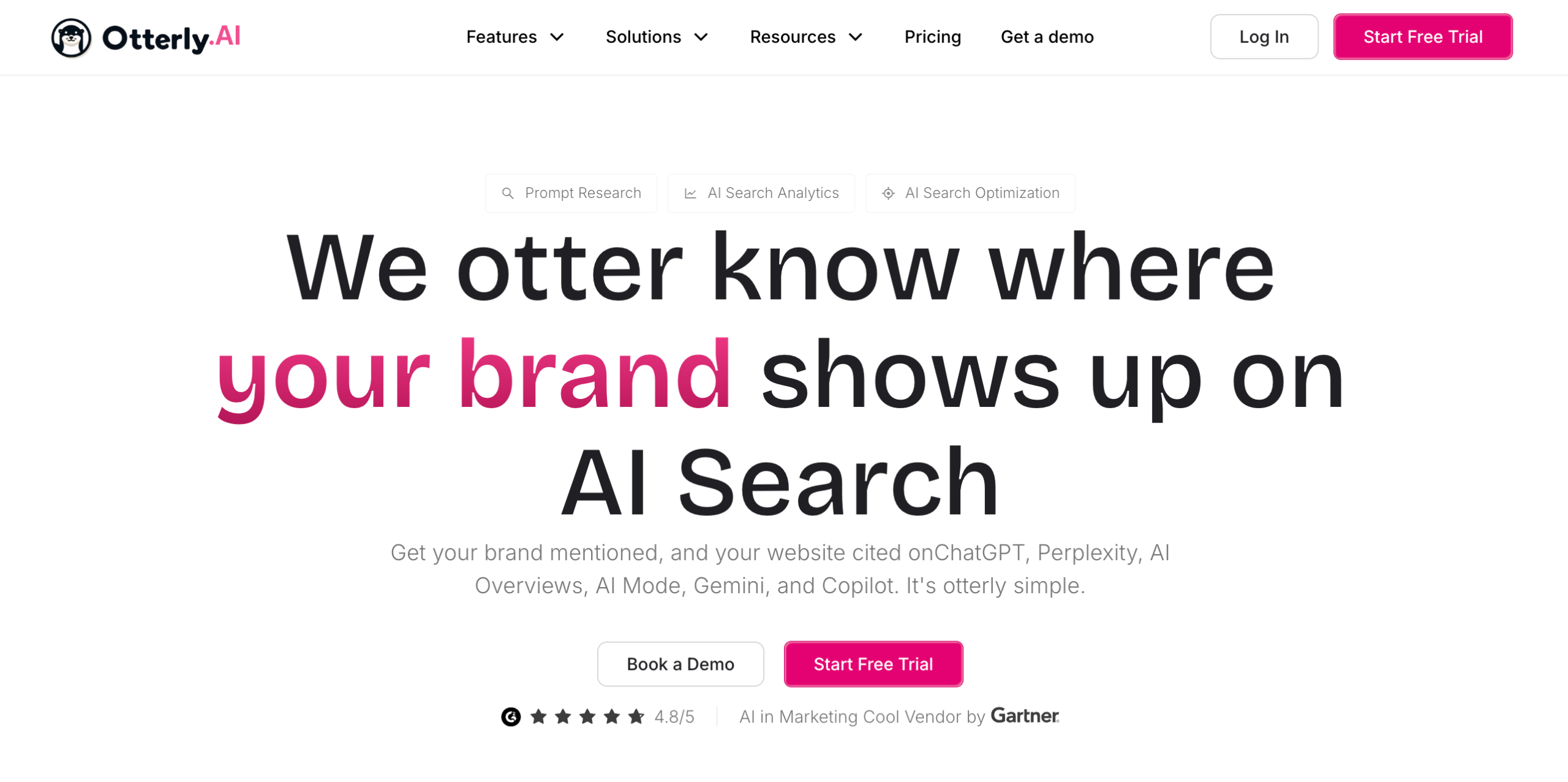
Teams look for alternatives to Otterly AI when they outgrow its entry tier. It holds a 4.7 out of 5 across 54 G2 reviews, none below four stars, and reviewers agree on what works: it sets up fast, and the dashboard shows prompt-level results clearly. The reasons teams start comparing options show up in those same reviews, clustered around scale:
- Engine coverage sits behind add-ons. Otterly’s base plans track four engines by default (ChatGPT, Google AI Overviews, Perplexity, and Microsoft Copilot), with Claude, Google AI Mode, and Gemini priced as separate paid add-ons on every tier.
- Citation transparency. As AI answers get harder to influence, teams want to see which sources an engine pulled from, not just whether their brand appeared. That source-level view is what turns a mention count into something a content team can act on.
- Reporting depth and historical data. The most common ask is more customizable reporting and more granular, historical trend data for long-term strategy, especially for enterprise-level monitoring. A few reviewers also note refresh lags when they track several domains at once.
- The jump from entry to scale is steep. Lite includes 15 tracked prompts a month at $29; the next tier, Standard, runs $189 for 100 prompts. One agency reviewer flagged exactly this: Lite runs short as the workload grows, and Standard is a stretch on a small-agency budget.
- From tracking to action. Some reviewers want more concrete recommendations at the price, rather than reporting they still have to interpret themselves.
Those limits bite harder because AI answers are noisy by nature. SparkToro’s 2026 research found that repeating an identical prompt returns the same brand list less than 1% of the time, and the same list in the same order only about 0.1% of the time. Reading that signal takes volume, enough prompts re-checked often enough to average out the noise, plus coverage of the engines your buyers actually use.
That instability is a core reason to evaluate other generative engine optimization tools.
1. SE Visible
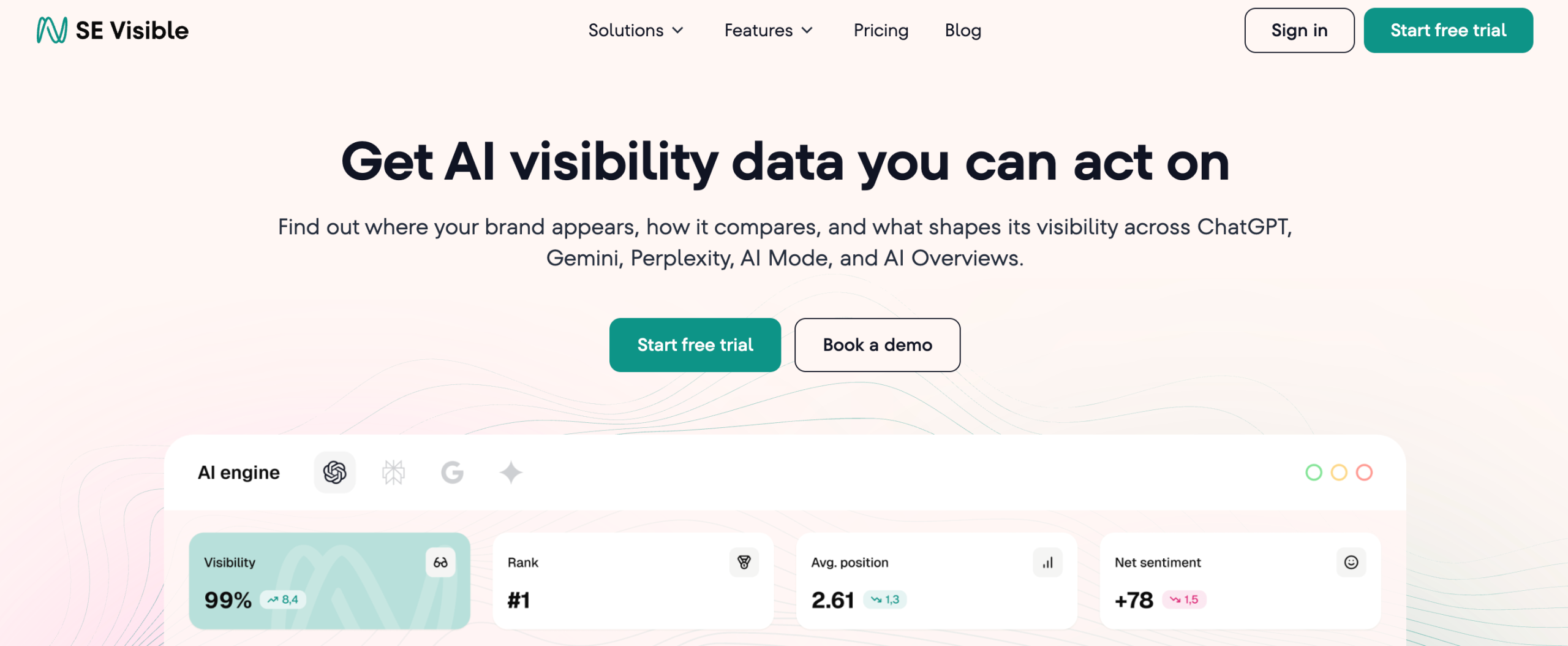
SE Visible by SE Ranking is an LLM visibility monitoring platform that tracks how your brand is mentioned, cited, and described across AI search engines. It re-runs the same prompts across five engines on a recurring schedule, so you’re reading a trend line instead of a single snapshot.
Standout features:
- Brand Visibility Dashboard: one screen showing where your brand appears across each tracked AI engine.
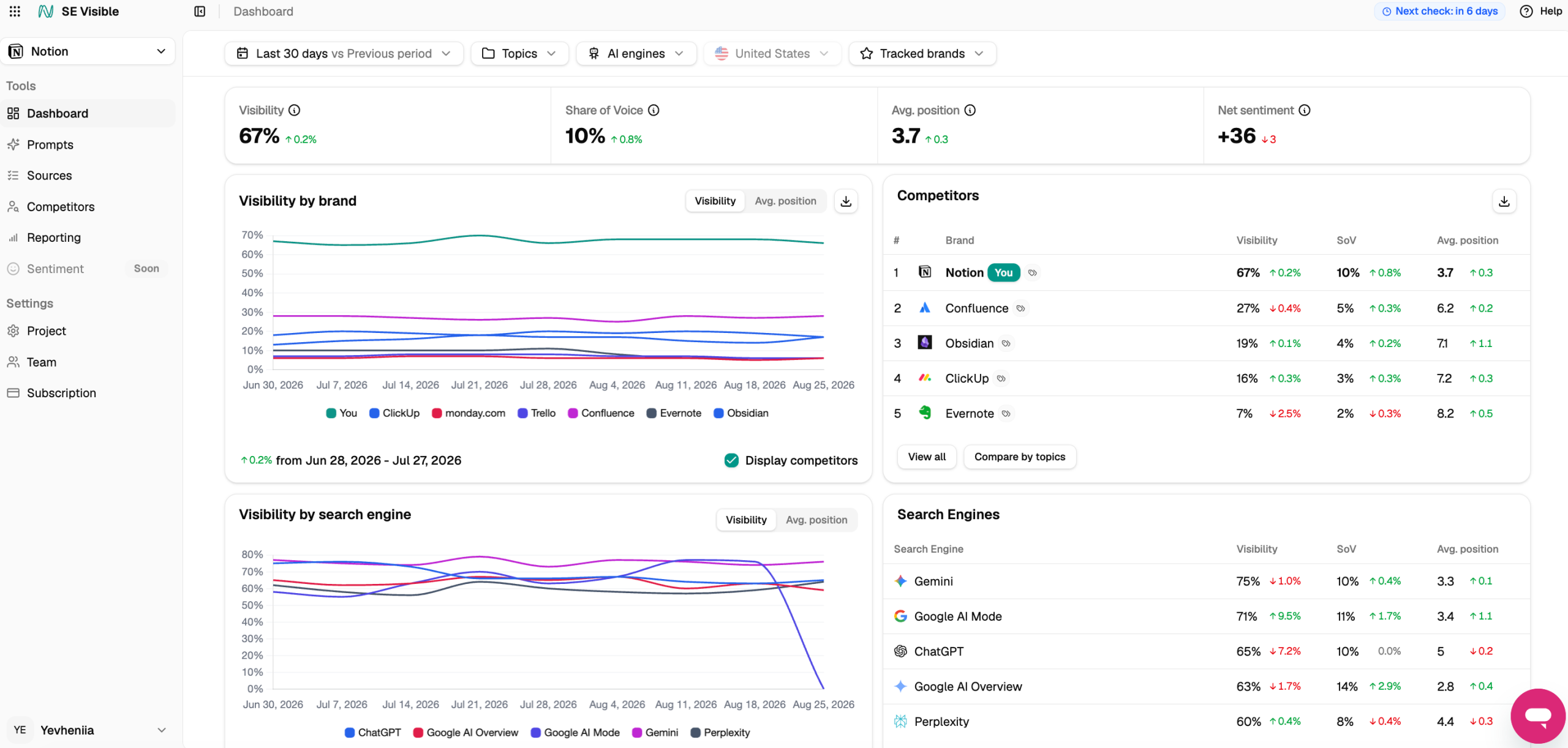
- Competitor Benchmarking: side-by-side share of voice against the competitors you track, with a gap view that flags prompts and topics where they’re cited and you aren’t.
- Multi-platform, multi-country, and multi-language coverage: ChatGPT, Gemini, Google AI Mode, Google AI Overviews, and Perplexity, across 7 countries and 5 languages.
- Sentiment analysis: an overall net-sentiment score with weekly shift tracking.
- Prompt and topic insights: prompt suggestions built into setup, or add your own.
- Source analysis: surfaces and ranks the domains AI engines cite from.
- Multi-brand management and collaboration: 3 to 10 client projects depending on plan, with multiple team seats.
Setup starts with a project: your brand, its aliases, and the competitors you want tracked alongside it. From there, the dashboard puts the headline numbers on one screen, from visibility score and average position to share of voice against named competitors and net sentiment. You can filter any of it by date, region, topic, engine, or competitor, and work from suggested prompts or add your own, grouped into topics so you’re reading coverage across a theme rather than one query at a time.
Best for: teams that need all major engines tracked, plus competitor benchmarking and multi-client projects under one account.
Pros
- Tracks 5 engines natively with no paid add-ons required.
- Daily refresh across every tracked prompt and engine, drawn from real browser responses rather than API or simulated answers.
- 1, 3, 5 team seats included in subscriptions.
- CSV export for sharing results with clients or leadership without a manual copy-paste step.
- API to pull SE Visible data into your own tools and dashboards.
- Google Data Studio connector to build client reports and mix in sources like GA4 or GSC.
Cons
- Does not yet track Microsoft Copilot and Claude.
- White-label delivery and scheduled reports are roadmap items, not yet shipped.
Pricing: Plans run from Basic at $99/mo (200 prompts and 3 projects) to Core at $189/mo (450 prompts and 5 projects) to Plus at $355/mo (1,000 prompts and 10 projects), with a 20% discount on annual billing. All five engines are tracked on every tier, so engine coverage isn’t gated behind the higher plans. SE Visible also offers a free 10-day trial, no credit card required.
2. Peec AI
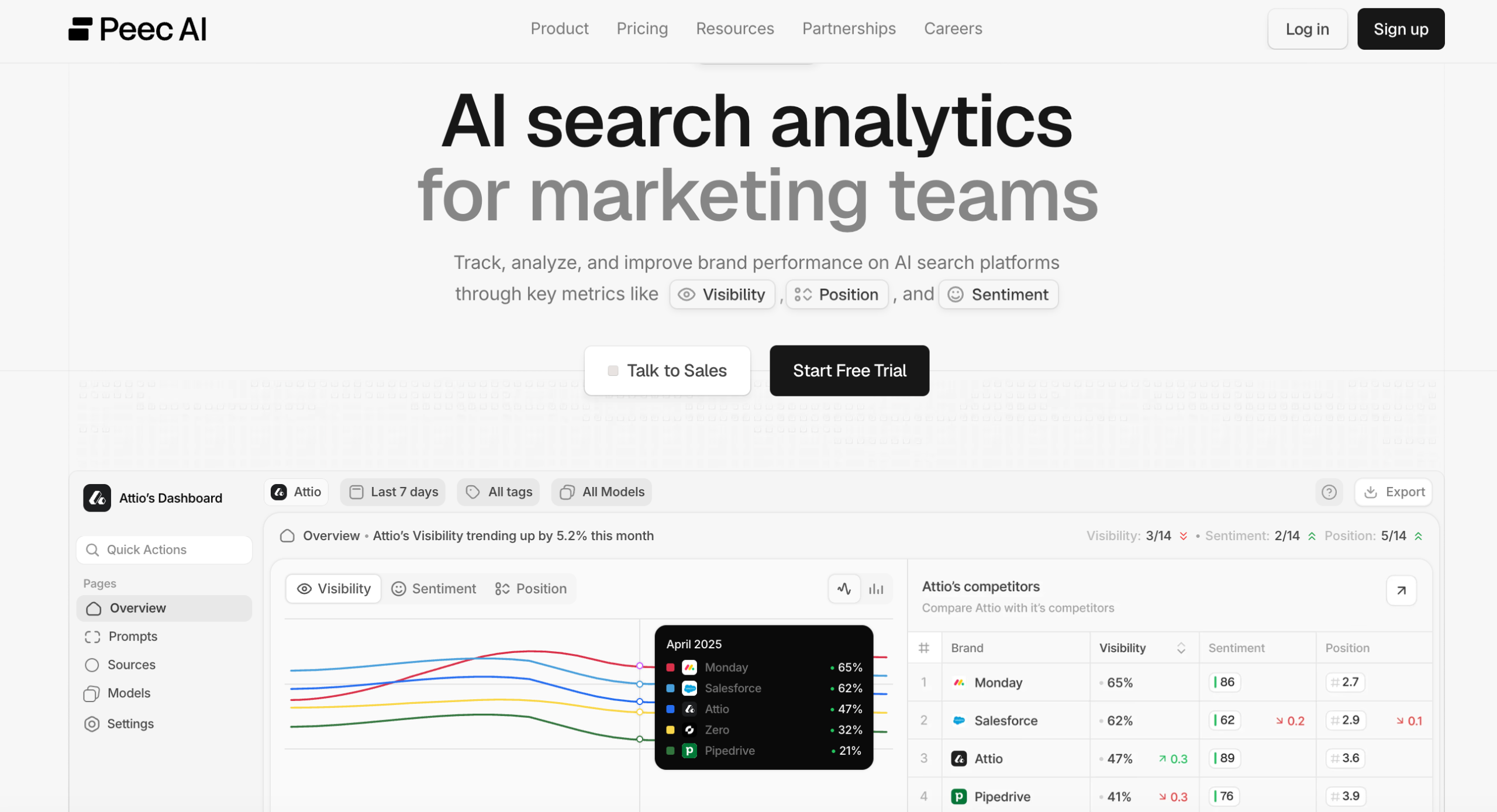
Peec AI is an AI search analytics platform that tracks how brands appear across ChatGPT, Perplexity, Gemini, Google AI Mode, and AI Overviews, scored on three metrics: visibility, position, and sentiment.
Standout features:
- Prompt Organization finds most relevant queries and organizes them with tags for persona or funnel stage and AI-suggested prompts backed by search volume.
- Brand Ranking monitors your position against key competitors across AI answers, scored on visibility, position, and sentiment.
- Source Identification spots the citations and URLs shaping your results, separating when your content is used to build an answer from when your URL is actually cited.
- Actionable Recommendations turns that into strategy insights for capturing high-impact opportunities, such as claiming a review-site profile or investing in digital PR.
Peec also connects to your stack through a public API, a native MCP integration for tools like Claude, and a Data Studio connector, with SSO on the top tier.
Best for: agencies running AI visibility for a roster of clients who want to size one plan around their whole book of business and pitch new accounts with live data.
Pros
- Unlimited users and client seats on every tier, so adding a teammate or a client viewer doesn’t raise the price.
- Every prompt is tracked daily from real AI responses, which gives clean trend data across dates, models, and regions.
- Pitch workspaces and white-label reporting are aimed at winning and keeping accounts, not just monitoring the ones you have.
Cons
- Model tracking is capped at a “choose 3” list of engines below the Enterprise tier, which may not suit agencies whose clients want a broader engine mix.
- Multi-country reporting requires stepping up from the entry tiers, an added cost for agencies whose clients operate in more than one market.
If you’re comparing tools against Peec AI specifically, our Peec AI alternatives guide covers that comparison in more depth.
Pricing: Peec’s Starter plan is $95 per month for 50 prompts. The Pro plan costs $245 per month for 150 prompts. The Advanced plan costs $495 per month for 350 prompts. All three plans allow you to choose 3 AI models to track and include unlimited user seats. Annual billing provides a 15% discount. Peec AI also provides a 7-day free trial.
3. Profound
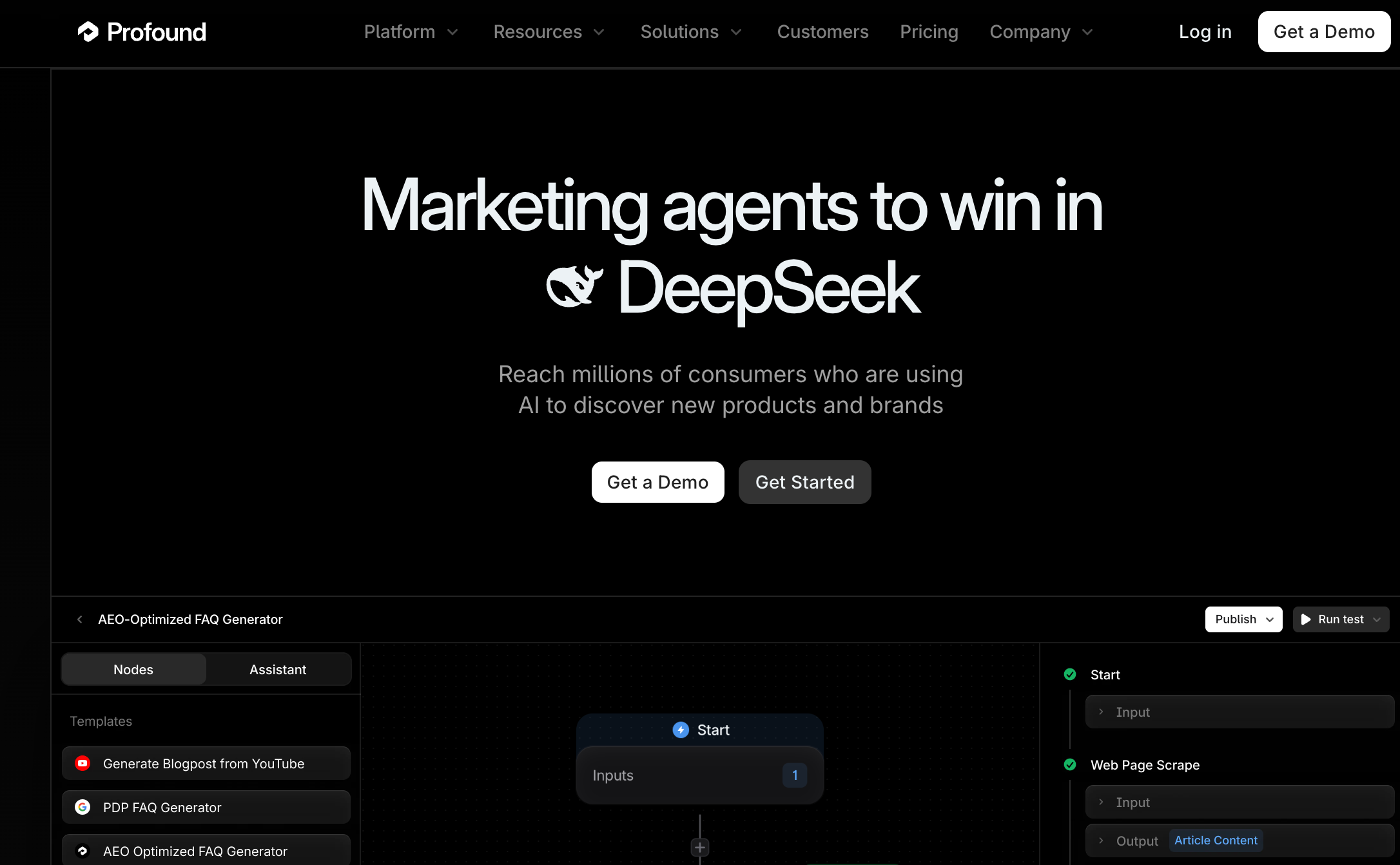
Profound is a full-stack AEO platform. Its scope reaches past monitoring into content creation and crawler-level analytics, and its agency track wraps all of that in tooling built for running many clients at once.
Standout features:
- Answer Engine Insights shows how AI engines describe and rank your brand across answers, with side-by-side competitor comparison.
- Prompt Volumes reveals what people actually ask AI at scale, so you can align strategy with real demand instead of guesswork.
- Agent Analytics tracks AI crawler activity at the CDN level across eight major hosting platforms (Akamai, AWS, Cloudflare, Fastly, GCP, Netlify, Vercel, and WordPress), on unlimited domains at every tier.
- Agents automate AEO content production, drafting and optimizing the pages meant to earn citations.
- Aim runs as a background agent that surfaces the highest-impact work for your brand each week.
For larger organizations, Profound adds SOC 2 compliance and SSO/SAML on its top tier.
Best for: a fit for organizations consolidating AI visibility tracking across several domains or business units rather than running a single site through the platform.
Pros
- Profound covers more than tracking. The same platform generates AEO content through Agents and measures how AI crawlers reach your site, so a team can act on a citation gap without switching tools.
- Agent Analytics is included on every tier, even Starter, tracking AI-crawler activity across unlimited domains and nine integrations
- Brand and agency plans run on the same platform, so a team can start self-serve and scale into multi-company or multi-client management without moving tools.
Cons
- Engine coverage is steeply gated. Starter tracks ChatGPT only, Growth adds Perplexity and Google AI Overviews for three, and the full nine engines come only with custom-priced Enterprise.
- Several things a mid-size team might expect are Enterprise-only: multi-region and multi-language tracking, API access, ChatGPT Shopping, and full Prompt Volumes search data.
If you’re comparing Profound against its own field of alternatives rather than Otterly’s, our Profound alternatives guide covers that ground in more depth.
Pricing: Starter tracks ChatGPT only (50 prompts, one seat, 100 Agent credits) and costs $99/mo; Growth covers three engines (ChatGPT, Perplexity, Google AI Overviews) with 100 prompts, three seats, 400 Agent credits at $399/mo. Both self-serve tiers include two months free on annual billing. Enterprise is custom-priced and unlocks the full nine engines, multi-company tracking, API access, SSO/SAML, SOC 2, ChatGPT Shopping, and full Prompt Volumes data.
4. Semrush AI Toolkit
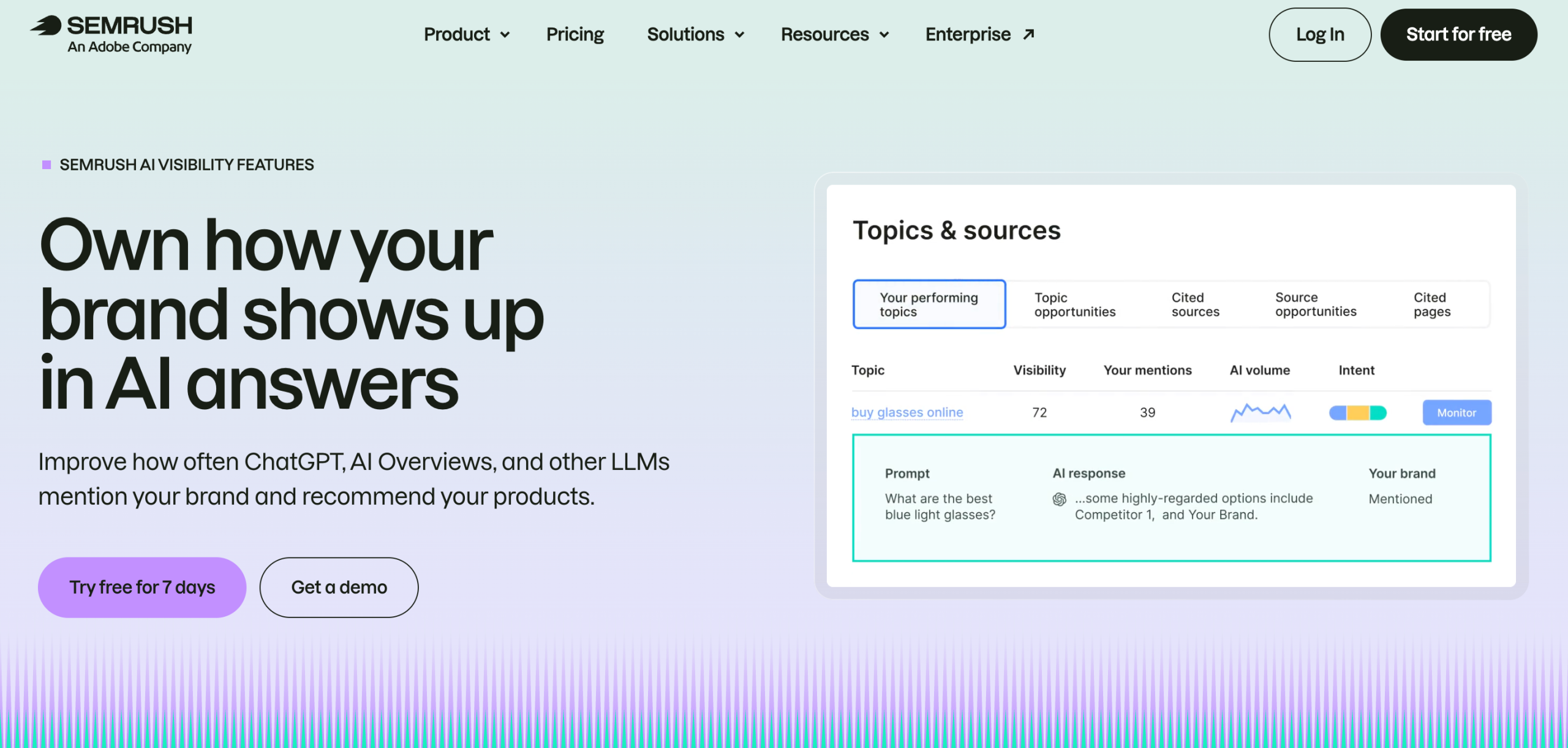
Semrush AI Toolkit is Semrush’s add-on module for tracking brand visibility across AI search engines, built for teams that already run Semrush for SEO and competitive research.
Standout features:
- Brand Performance: share-of-voice and sentiment tracking with AI-generated strategic recommendations, refreshed weekly, though tied to one domain on the base plan
- Prompt Tracking: daily tracking across 25 prompts on the Base plan, with coverage extending to 220+ countries and territories
- Prompt Research: topic-level AI search volume and difficulty data, drawing on up to 1,000 daily queries
- AI Search Site Audit: crawler-blocker checks folded into the same Site Audit workflow teams already use for technical SEO, covering up to 100 pages on the base plan
Best for: teams already running Semrush for SEO and competitive research who want AI-citation and sentiment data added to that same subscription.
Pros
- AI visibility data sits next to the SEO and competitive metrics a team already tracks in Semrush
- Prompt Tracking covers 220+ countries and territories on every plan, a wide geographic reach for a base-tier feature
- Weekly AI-generated recommendations come bundled into Brand Performance reporting at no extra cost
Cons
- Quite short free trial. 7 days might not be enough to explore everyithing the platform offers
- Brand Performance is scoped to one domain on the base plan; tracking a second domain or adding a teammate each starting at $45/mo, which adds up for agencies covering several client accounts
Pricing: The standalone AI Visibility Toolkit starts at $99/mo per domain, with no free trial. That base tier includes 300 daily AI Analysis queries and 25 tracked prompts, and caps site audit checks at 100 pages. Semrush also folds the toolkit into its bundled SEO and AI Search plans starting from $199/mo.
5. Scrunch AI
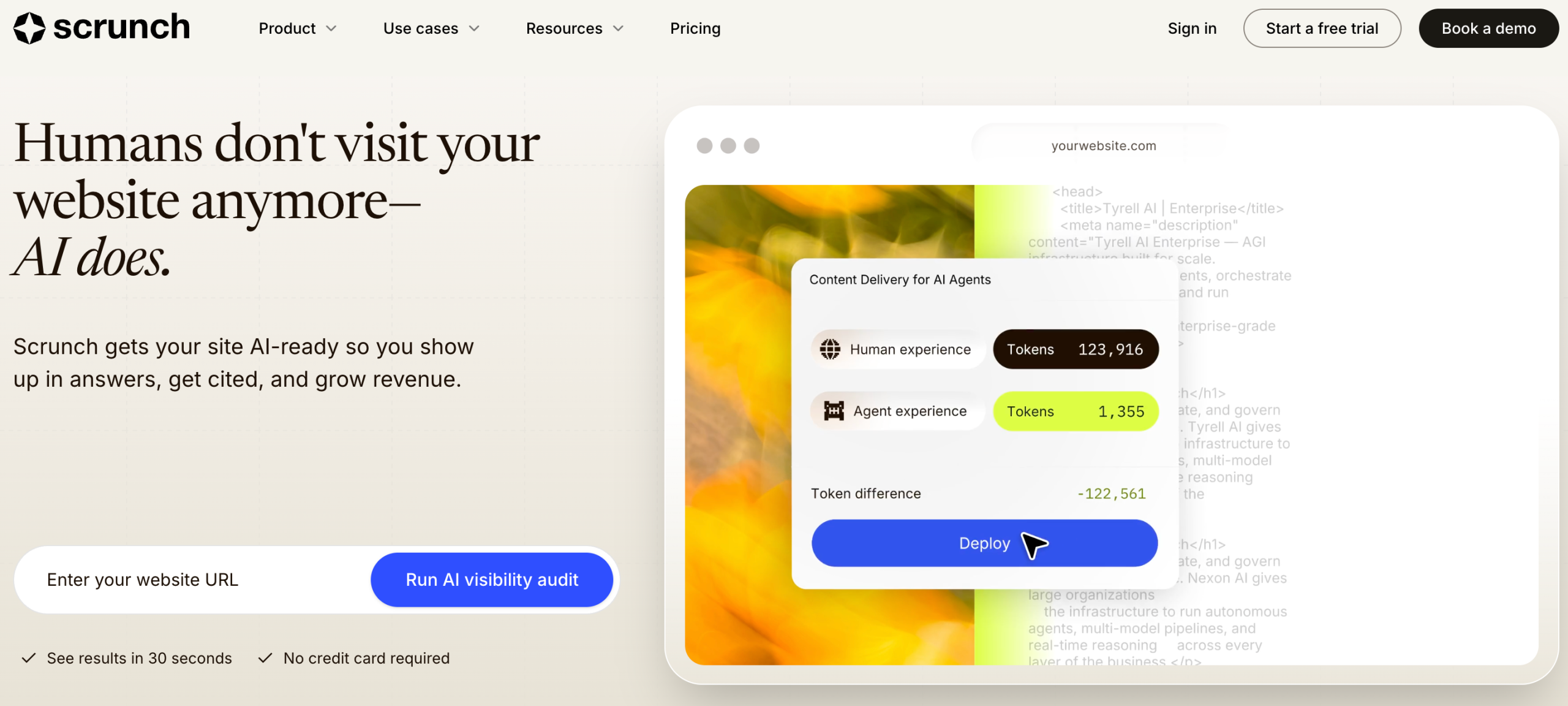
Scrunch AI is an AI visibility platform that has grown from monitoring into optimization. It tracks how your brand appears and gets cited across AI answers, then helps you act on the site itself through audits and page-level fixes. Its newer Agent Experience Platform (AXP) goes a step further, detecting AI crawlers at the edge and serving them content optimized for how they read a page, without changing what human visitors see.
Standout features:
- Monitoring & Citations tracks how your brand shows up across AI answers and ranks the sources shaping them.
- Insights turns that into recommendations, flagging competitive blind spots and content gaps.
- Site audits and Agent Traffic show how AI crawlers reach, read, and consume your site, with a site map of what to fix, and analyzed traffic from AI engines.
- AXP (Agent Experience Platform) detects AI agents at the edge and serves them AI-optimized content.
- Multiple engine coverage with ChatGPT, Perplexity, Google AI Overviews, and Microsoft Copilot on the Core plan, expanding to nine models (adding Claude, Gemini, Google AI Mode, Meta AI, and Grok) on Enterprise
Best for: teams that want to monitor AI visibility and act on the site itself, pairing citation and sentiment tracking with audits, page optimization, and serving AI-optimized content to agents through AXP.
Pros:
- Goes beyond monitoring. The same workspace audits your site, flags fixes, and generates optimization content, so tracking and acting live together.
- Sentiment and citation-trend reporting go beyond a simple mention count, tracking how brand perception moves across answers over time
- The seven-day free trial gives you a working sample of sentiment and citation reports before committing to $250/mo
Cons:
- The full nine engines, multi-country, API, Looker Studio, MCP, and AXP are all Enterprise-only and custom-priced
- Core caps out at five user licenses and Google SSO only, which can feel tight once an agency team grows past a handful of seats
Pricing: Scrunch AI’s Core plan is priced at $250/mo, covering 125 unique prompts and five site audits per month. It also includes five tracked competitors and a seven-day free trial. Enterprise pricing is custom and adds full engine and country coverage plus API and SSO access.
6. AthenaHQ
AthenaHQ is an AI visibility platform that ties AI citations to on-site revenue data, connecting brand mentions in AI answers to GA4 and Shopify analytics.
Standout features:
- Cross-platform tracking across 10+ engines, covering brand mentions, share of voice, citations, and sentiment in one view.
- Agentic copilot that answers questions like why a competitor outranks you on ChatGPT, drawing on your own prompt, citation, and competitor data rather than the open web.
- Content recommendations that map specific on-page and off-page fixes to the passages and sources AI models actually pull from in your category.
- GA4, Google Search Console, Shopify, and Webflow integrations connecting AI citations to on-site traffic and conversions
- Unlimited team seats with role-based access control on every paid tier
Best for: tying AI visibility to revenue data. Its GA4, Search Console, and Shopify integrations connect AI citations to traffic and conversions, with Shopify attributing revenue back to AI-search discovery, so AI search reads as a measurable channel rather than a mention count.
Pros:
- A genuinely free Essential plan with five engines tracked and no cost to start
- Direct GA4 and Shopify integration links AI citations to actual site traffic and revenue figures
- Unlimited seats on every paid plan, useful for teams that want visibility data shared broadly without per-seat costs
Cons:
- API access and extra credits sit outside the $295/mo Starter price as separate add-ons
- Multi-region and multi-language support are reserved for the custom Enterprise tier, so teams tracking multiple markets on Starter are limited to a single region until they upgrade
Pricing: Essential is free (300 credits, $25 credit value), Starter runs $295/mo for 3,600 credits with ten-model coverage, and Enterprise is custom-priced, with an additional 17 percent discount available on annual billing across paid tiers.
7. Ahrefs Brand Radar
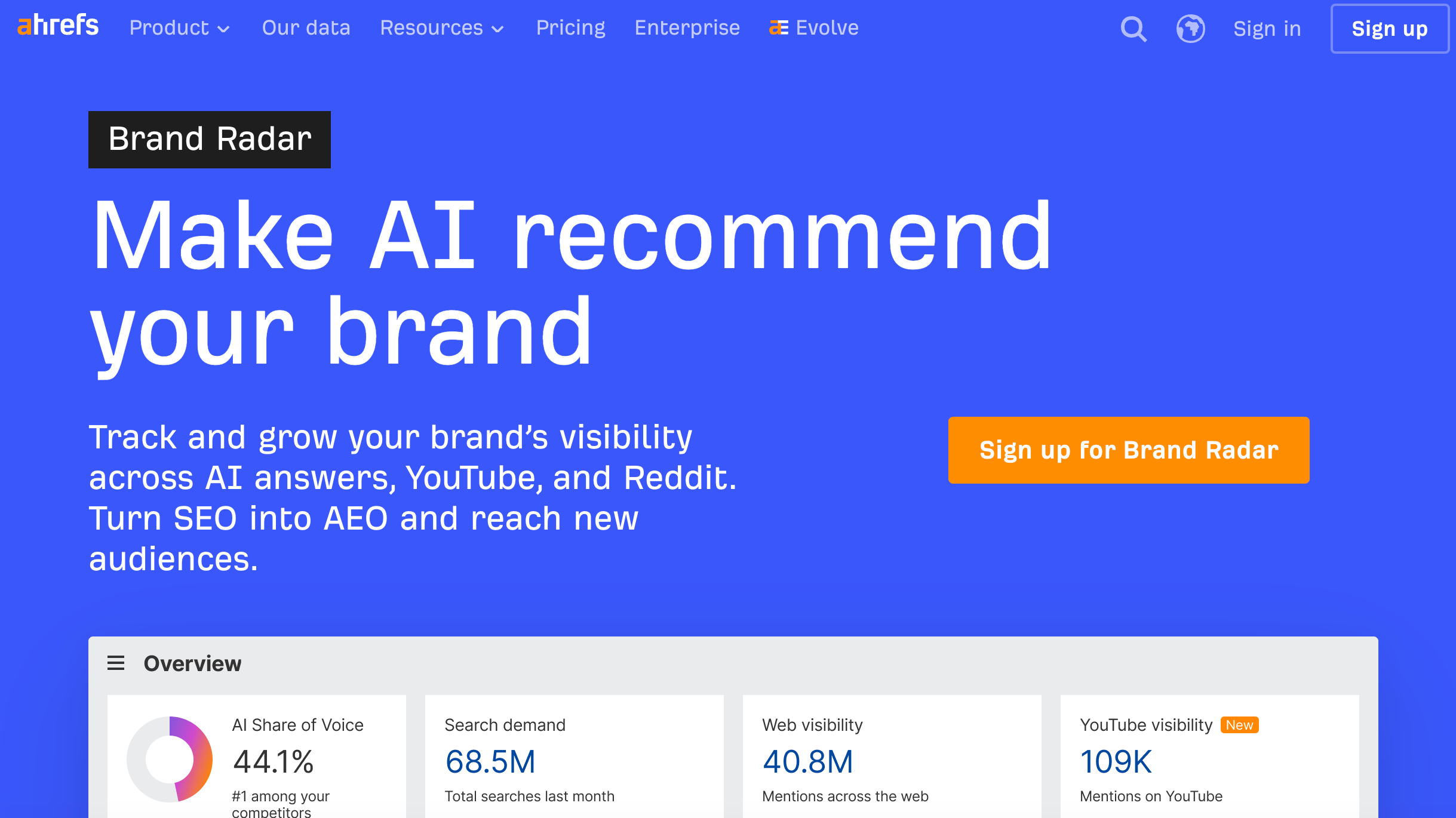
Ahrefs Brand Radar is the AI-visibility product inside Ahrefs’ SEO suite, built to show how a brand appears across AI answers and which sources feed them. What sets it apart is the data behind it: an index of 473M+ real, search-backed prompts, not synthetic ones, across six AI surfaces.
Standout features:
- Brand-vs-competitor benchmarking in the same interface as Ahrefs’ Site Explorer and Keywords Explorer data
- AI-citation source discovery, including YouTube, TikTok, and Reddit source tracking, currently free while in beta
- Custom prompt tracking layered on top of the 473M-prompt organic index, for questions the index doesn’t already cover
- Unlimited projects on the standalone product, for analyzing any domain’s AI visibility, not only your own
Best for: teams that already track backlinks and keywords in Ahrefs and want AI-citation data in the same account, without a second login.
Pros:
- The 473M+ prompt index already covers six AI engines (+Claude via Custom Prompts), so there’s no tracked-prompt list to build from zero
- Standalone Brand Radar only needs a free Ahrefs account to sign up and analyze any brand’s visibility
- AI-citation data lives in the same account as Ahrefs’ backlink and keyword tools, cutting down on tool-switching for teams already pulling that data
Cons:
- Pricing splits into a select-platforms tier and an all-platforms tier, with custom prompts as a further add-on, so the total takes more assembling than a single flat rate.
- The YouTube, TikTok, and Reddit source tracking is still in beta and free for now, so both its availability and its eventual price are unsettled.
Pricing: Standalone Brand Radar, for researching any brand’s AI visibility without an Ahrefs subscription, costs $199/mo per each selected platform, or $699/mo for full coverage across all seven engines. 5-10-20 AI prompts tracking is also inclides in Ahrefs’ standart plans (Lite at $129/mo, Standard at $249/mo, or Advanced at $449/mo).
8. Writesonic GEO
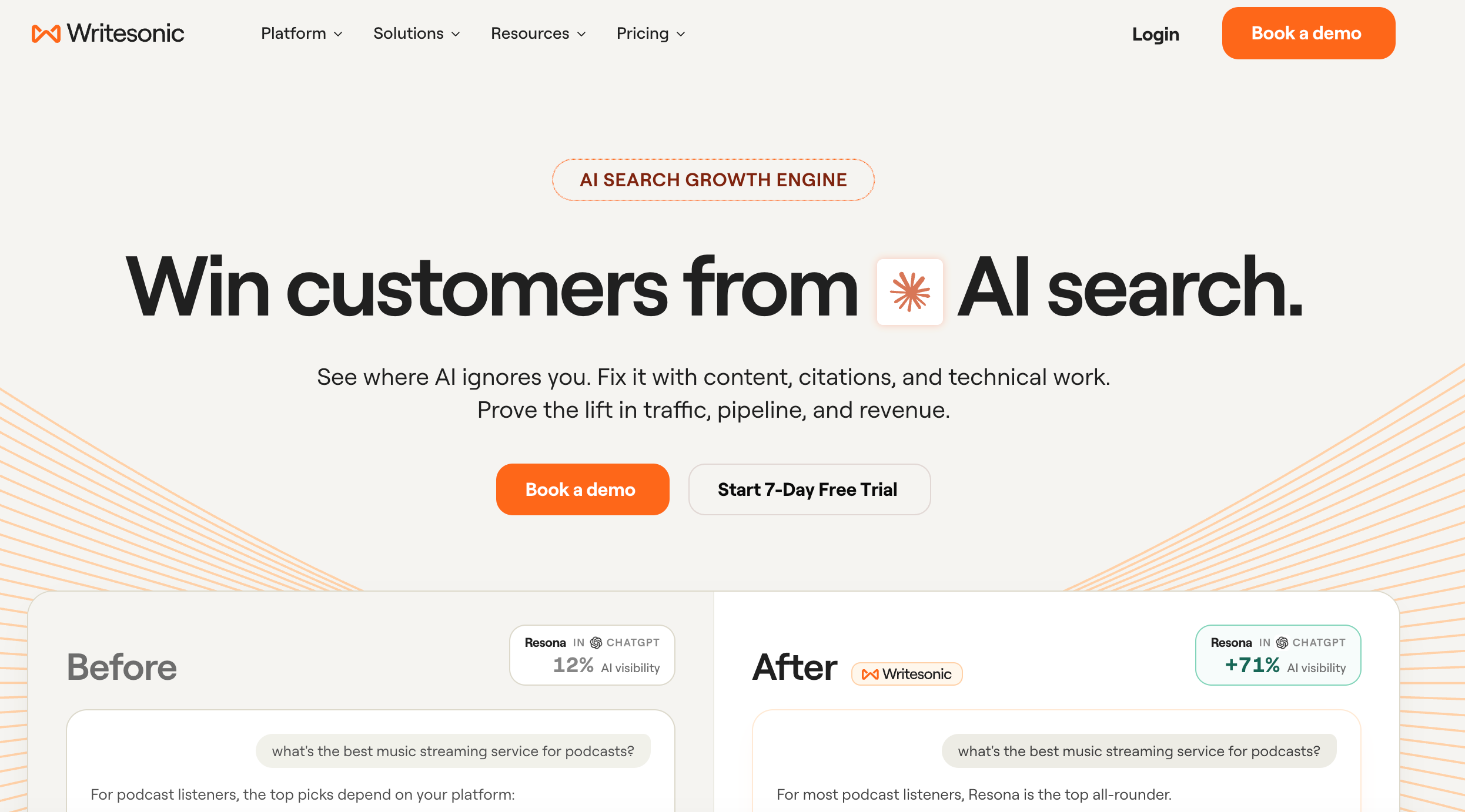
Writesonic is an AI search platform built to close the loop between spotting a visibility gap and fixing it. It tracks how your brand shows up across AI answers, runs the work to improve it, generating content, earning external citations, and clearing technical blockers.
Standout features:
- AI visibility tracking across AI answers, run daily, covering visibility, citations, and sentiment (sentiment from the Growth tier up).
- AI Article Writer that drafts content inside the same platform used for citation tracking, closing the gap between what’s tracked and what gets published
- Technical and crawler auditing that checks robots.txt, schema, and indexing, catches errors from GPTBot, ClaudeBot, and PerplexityBot, and auto-fixes in one click.
- Action Center that ranks the week’s highest-impact fixes across missing prompts, citation gaps, content, and technical issues.
Best for: combining tracking with content production, specifically for teams that already produce AI-search content at volume and don’t want tracking and writing split across two subscriptions.
Pros:
- Tracking and content creation live in one subscription, so a team can move from identifying a citation gap to publishing the page meant to close it without switching tools
- SEO and GEO run together, with AI-bot analytics, site audits, and content, a fit for teams treating AI search as an extension of SEO.
- Pricing is self-serve and transparent from Starter through Growth, with a 7-day free trial and no credit card.
Cons:
- Self-serve tiers track only three engines (ChatGPT, Gemini, Google AI Overviews); the full 10, including Perplexity and Claude, require custom-priced Enterprise.
- The agent execution the platform is built around is capped to trial runs below Enterprise (10 on Starter, 50 on Basic, 100 on Growth), and the full Action Center, GA4 and Looker integrations, multi-market tracking, and SSO are Enterprise-only.
- Sentiment analysis starts at Growth, so Starter and Basic track visibility and citations without it.
Pricing: Writesonic Brands plans price Starter at $99/mo, Basic at $249/mo, and Growth at $499/mo, with a custom-quoted Enterprise tier above that. A free trial is available without a credit card.
When Otterly AI is still the right call
Otterly AI’s $29/month Lite plan still makes sense for a narrower set of buyers than a scaling team.
- A single evaluation, before committing to a broader tool
- A very small team without multi-client reporting needs
- Budget-first testing to confirm AI visibility tracking is worth pursuing at all
For any of these, Lite’s daily tracking across ChatGPT, Google AI Overviews, Perplexity, and Microsoft Copilot in a single workspace covers the job today, without paying for multi-client reporting or broader engine coverage you don’t need yet.
Frequently asked questions about Otterly AI alternatives
- Is there a free alternative to Otterly AI?
Not entirely free, but close in places. Otterly AI itself runs on a 7-day free trial rather than a free-forever plan, and several of the tools compared here follow a similar trial-then-paid-tier model. AthenaHQ’s Essential tier stays free indefinitely rather than expiring, Semrush AI Toolkit requires payment from day one with no trial. SE Visible offers a free 10-day trial to check engine coverage against your own brand before committing to a plan. - Can you switch from Otterly AI without losing historical tracking data?
Not automatically. None of these platforms currently support Otterly import feature, so plan on rebuilding your historical baseline after switching; each one builds its own dataset from the day you connect it. Export your Otterly reports first, before you switch. - Which Otterly AI alternative covers the most AI engines?
SE Visible tracks five AI engines natively, including ChatGPT and Google AI Overviews, with no paid add-ons required. Among the eight tools compared here, Writesonic GEO’s Enterprise tier scales furthest, tracking all 10 platforms; Profound’s Enterprise tier tracks up to nine, at a comparable custom price point. - Do AI visibility tools replace traditional SEO tracking, or work alongside it?
They complement traditional SEO tracking rather than replace it. Rank tracking shows where you land in organic results. AI visibility tracking shows whether you’re cited in the answer instead. Most teams run both.
Choosing the right Otterly AI alternative
If your team needs a quarterly read on ChatGPT and Google AI Overviews, Otterly AI’s entry tier still covers that. The right pick depends on what you need once a single Otterly evaluation isn’t enough.
Acting on visibility, not just tracking it? Writesonic runs the fixes and proves the pipeline lift; Scrunch AI adds audits and content served to AI crawlers.
Running several clients from one account? Peec AI or Profound can work, but watch the limitations and price.
Need broad engine coverage and benchmarking without add-ons? SE Visible tracks five engines on every plan, with competitor benchmarking and source insights. Start with a free 10-day trial and see where your brand shows up across AI engines.