Otterly AI review: prompt monitoring, citations, and pricing in 2026

According to McKinsey & Company’s “New front door to the internet” (October 2025), roughly half of consumers already lean on AI-generated search, yet only 16% of brands track whether they actually show up in those answers. Most companies are making decisions about AI visibility with no instrument to read it.
Otterly AI is an AI search visibility platform built to close that gap.
It tracks brand mentions and citations across seven AI engines and also audits whether your own pages are crawlable and citable in the first place.
But if you’re reporting AI visibility for more than one client, the question isn’t really whether Otterly.ai works. It’s whether it works across several brands at a price you can rebill, before competitor tracking and per-engine add-ons reshape the invoice.
This Otterly AI review looks at how well it delivers on that: the prompt monitoring, the citation tracking, the GEO audit, and what the whole thing costs once you account for the engines you actually need.
Who Otterly AI is built for, and how it got here
Otterly.ai launched publicly in October 2024, founded by Thomas Peham, together with co-founders Josef Trauner and Klaus-M. Schremser, in Vienna, Austria. In his TechCrunch interview, Peham said that within about two months Otterly.ai had passed its first 1,000 users and stated the company would not seek outside funding, a stance GetLatka later corroborated. Otterly.ai remains fully self-funded today, which frees it from investor-set growth targets but also leaves no capital cushion if a pricing bet doesn’t land.
Since then, the team has grown to 17 people, and company-reported users have climbed from 1,000 at launch to more than 40,000 by August 2026. Gartner also named Otterly.ai a Cool Vendor in its 2025 Cool Vendors for AI in Marketing report.
Otterly.ai calls itself a content intelligence platform for AI search, and it aims at marketing pros broadly. But it can also suit agencies, in-house marketing teams, SEO teams, and enterprise teams.
Agencies are at the center: the product tracks competitors alongside your own brand by default and lets you manage multiple client brands under one account. What keeps it from being an everyone tool is the shape of its pricing. Prompt volume is capped per tier and several engines sit behind paid add-ons, so it fits focused, few-brand tracking far better than broad, high-volume monitoring.
How Otterly AI monitors prompts across AI engines
Prompt monitoring here means running the same prompt on a schedule across every major AI engine and logging what comes back each time, including the sources cited. Otterly builds that mechanism by interacting directly with each engine’s interface rather than pulling answers through an API. It currently tracks seven engines:
- ChatGPT
- Gemini
- Perplexity
- Microsoft Copilot
- Google AI Overviews
- Google AI Mode
- Claude
Four are included in main plans (ChatGPT, AI Overviews, Perplexity, MS Copilot), while others are available as add-ons. Compared with SE Visible by SE Ranking, users can track 5 engines in every plan (ChatGPT, AI Overviews, AI Mode, Gemini, and Perplexity).
For a wider look at tracking ChatGPT specifically, see our best ChatGPT rank tracking tools.
Otterly.ai runs the same prompts on a recurring schedule and reports what changes between runs: the phrasing of the answer, and which sources it cites.
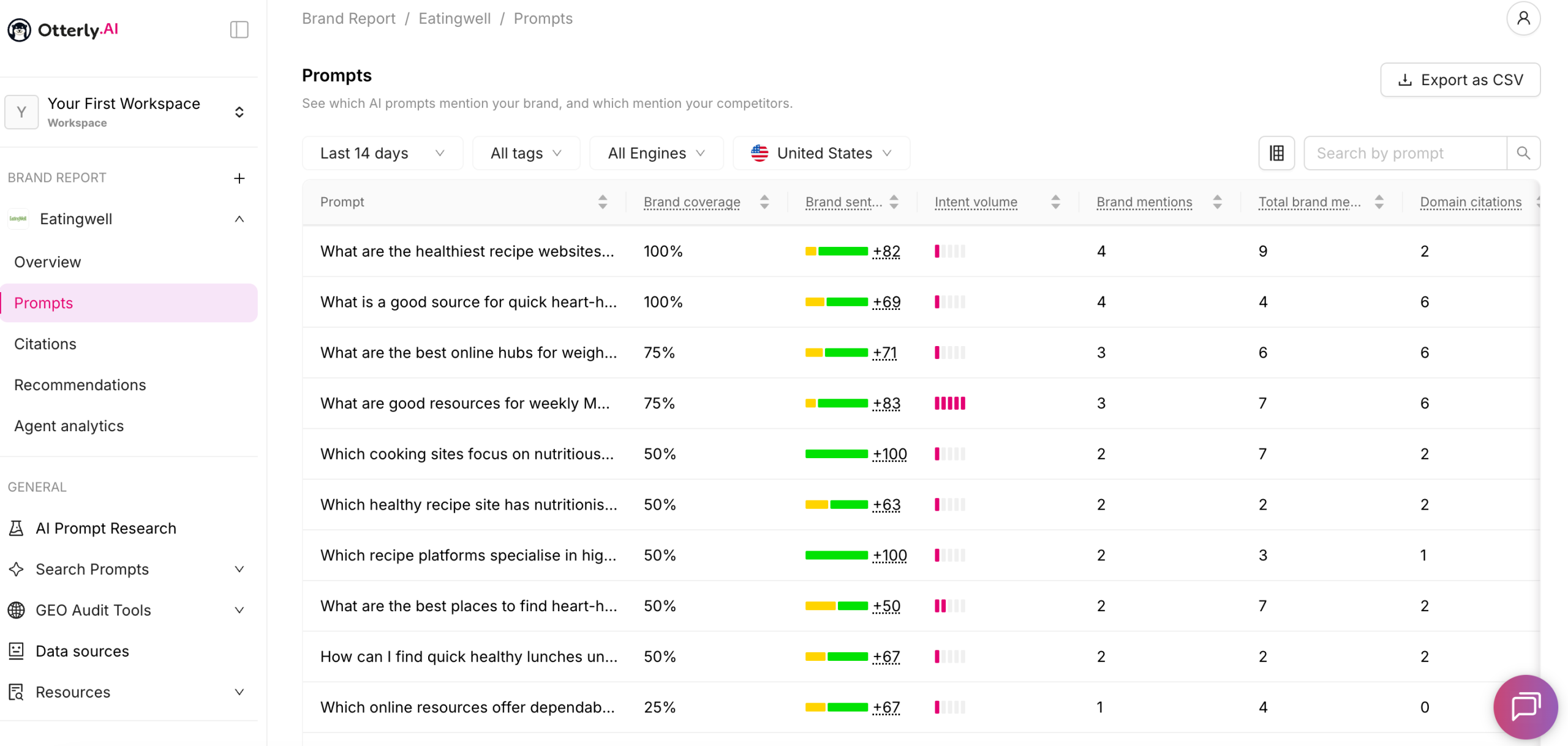
As AI engines start slotting sponsored results into their responses, Otterly captures those too: its ChatGPT Ads tracking logs ad placements in AI answers, so a single monitored prompt shows you both what the engine surfaced on its own and what someone paid to place there.
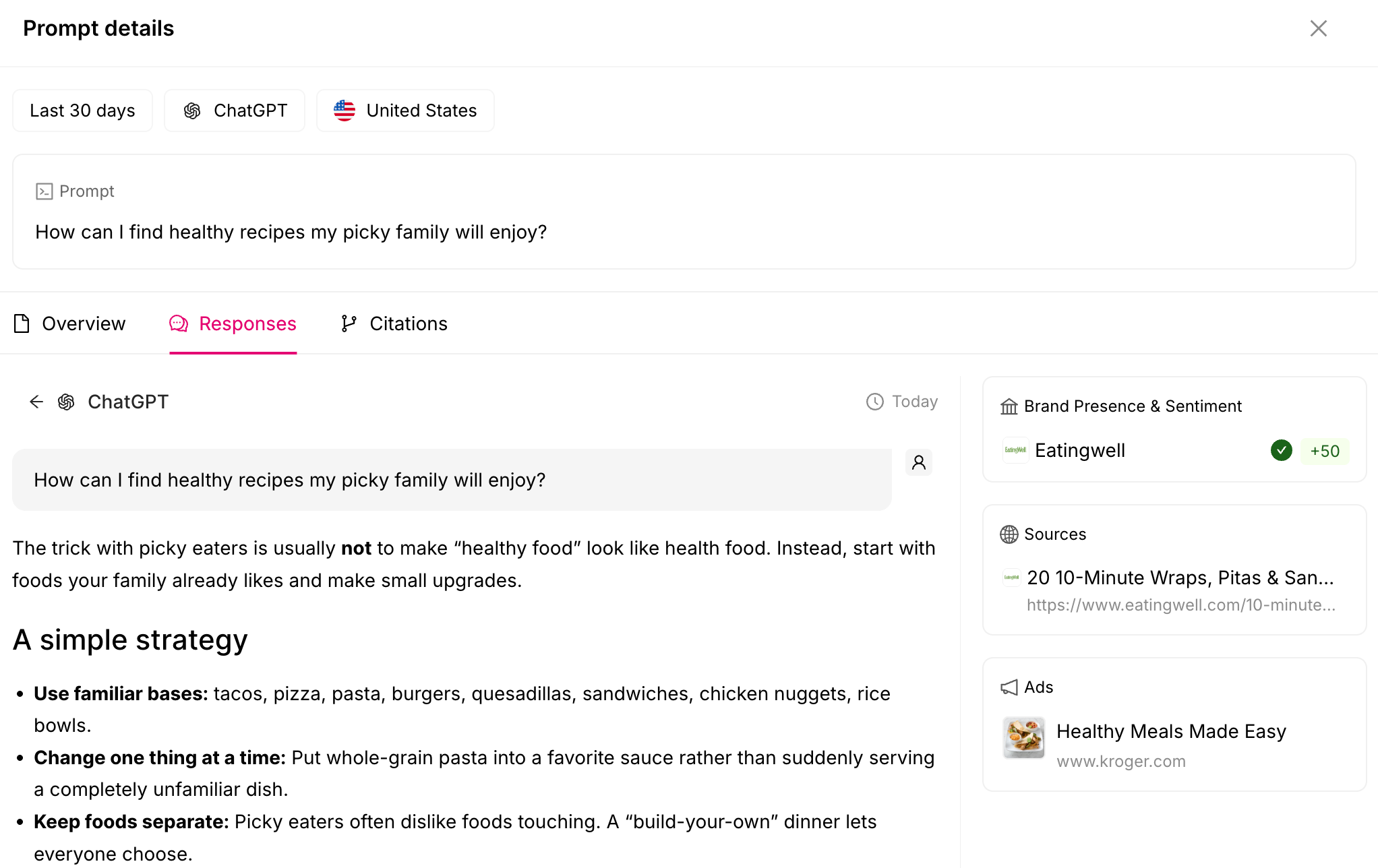
Apart from that, you can also research which questions people ask AI engines about your brand, product, or category. That’s what Otterly’s AI Prompt Research is for.
The module bundles a few capabilities worth separating out:
- Feed it a seed topic or a URL and it proposes prompt sets for you.
- Every prompt comes tagged by search intent and funnel stage, so you can sort for the questions that tend to end in a purchase rather than the ones that simply get asked most.
- A Query Fan-Out breakdown exposes the smaller follow-on queries an engine spins off internally from one parent prompt.
- It watches for drift, flagging when a model update or a shift in how buyers phrase things changes which prompts matter.
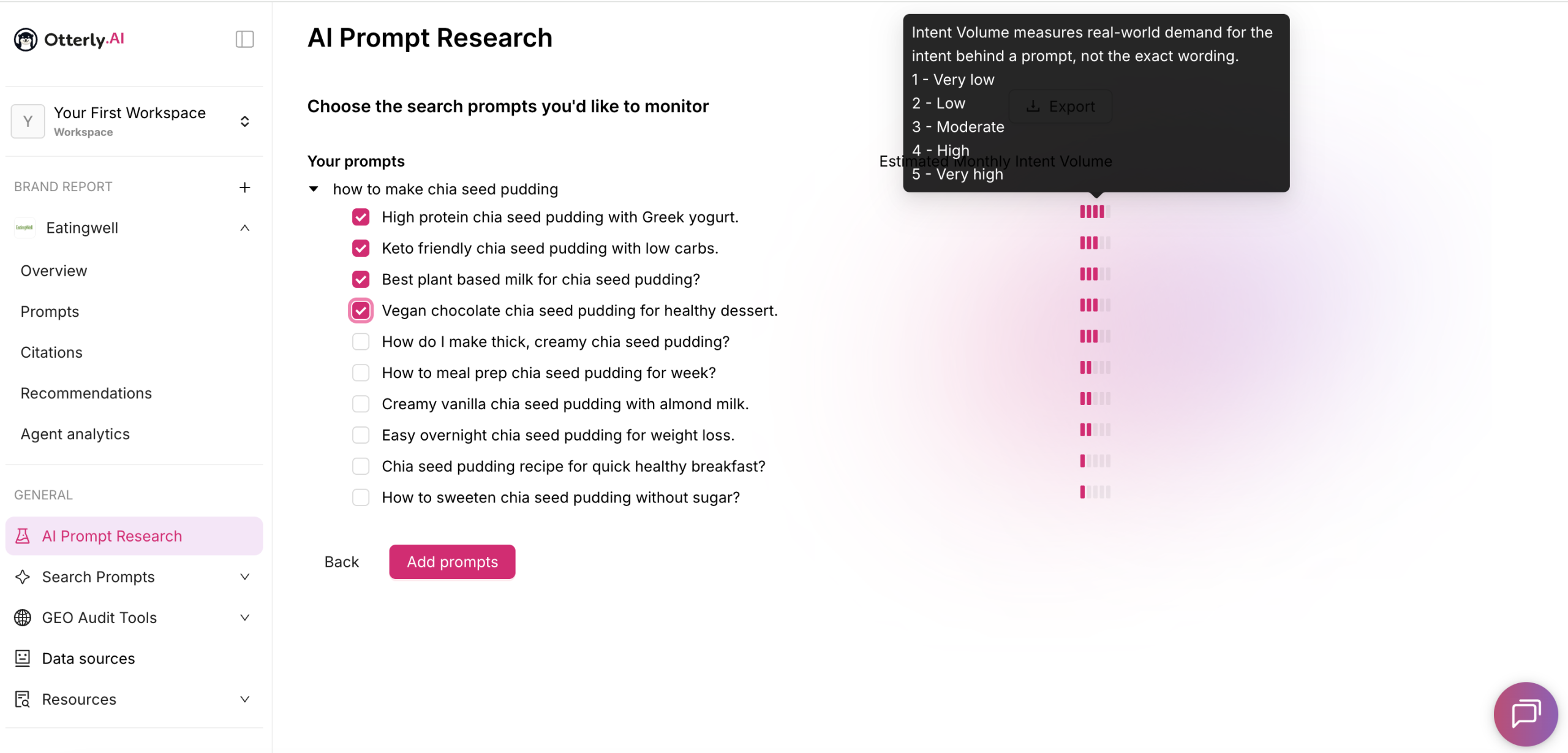
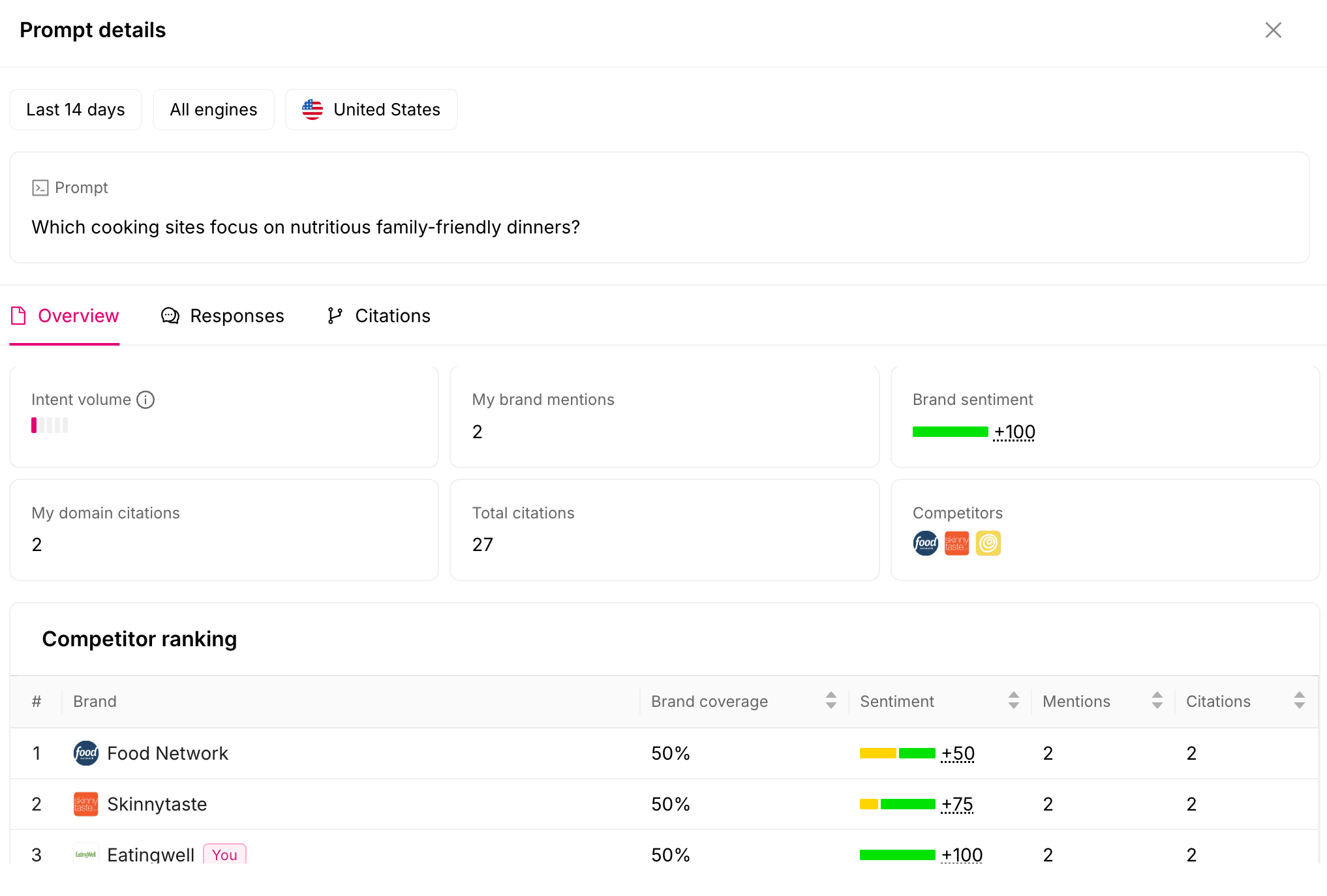
Competitor tracking comes bundled into the same workflow. Users can monitor their competitors alongside their own brands in terms of brand coverage, mentions, positions, and prompts.
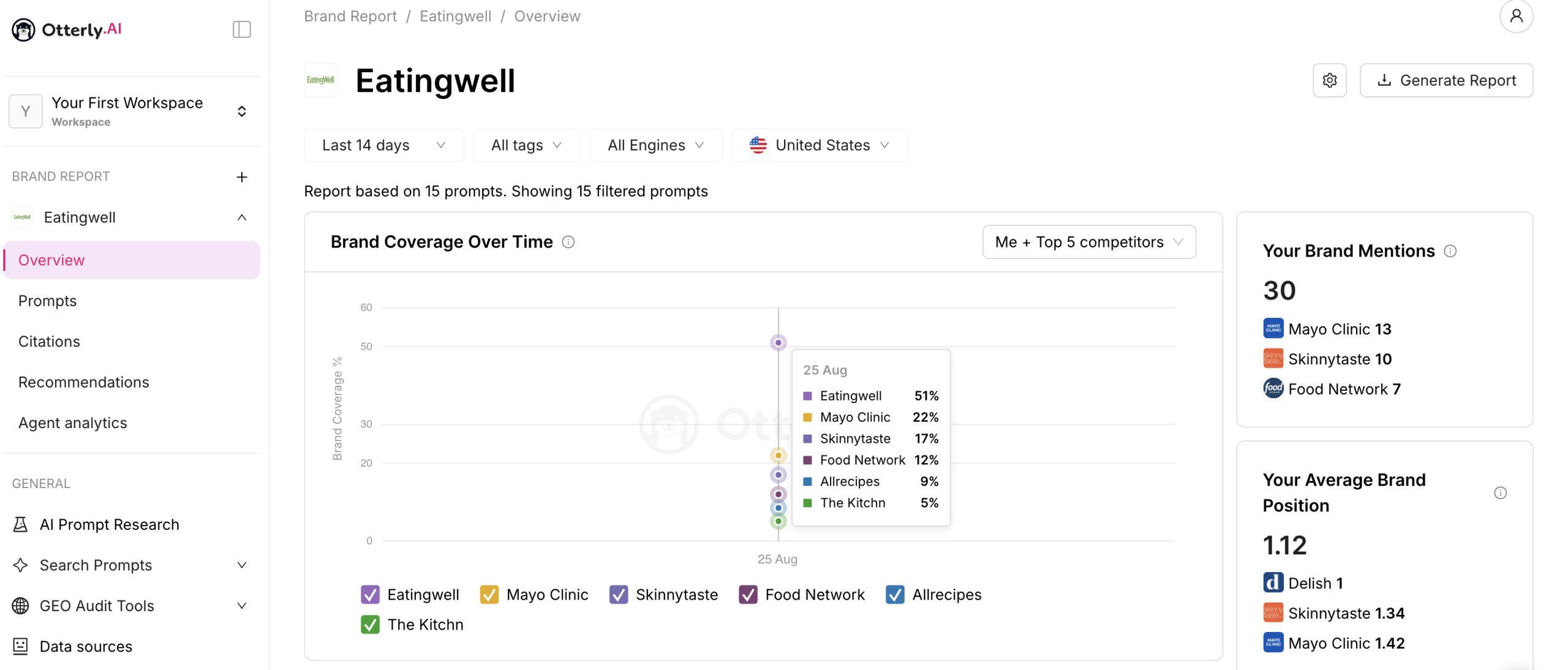
You can also see competitors per separate prompts and where they rank in AI responses.
SE Visible has an additional separate view for competitor benchmarking where you can analyze your visibility, share of voice, positions, and sentiments against tracker rivals.
How Otterly AI tracks citations and domain-level sourcing
This is where Otterly moves past counting mentions. Its AI Search Analytics module lists the specific domains and URLs each engine cited when answering about a tracked brand, and how often each one shows up, broken down engine by engine and prompt by prompt. Instead of a single number for how many times the brand was named, you get the actual sources behind the answer.
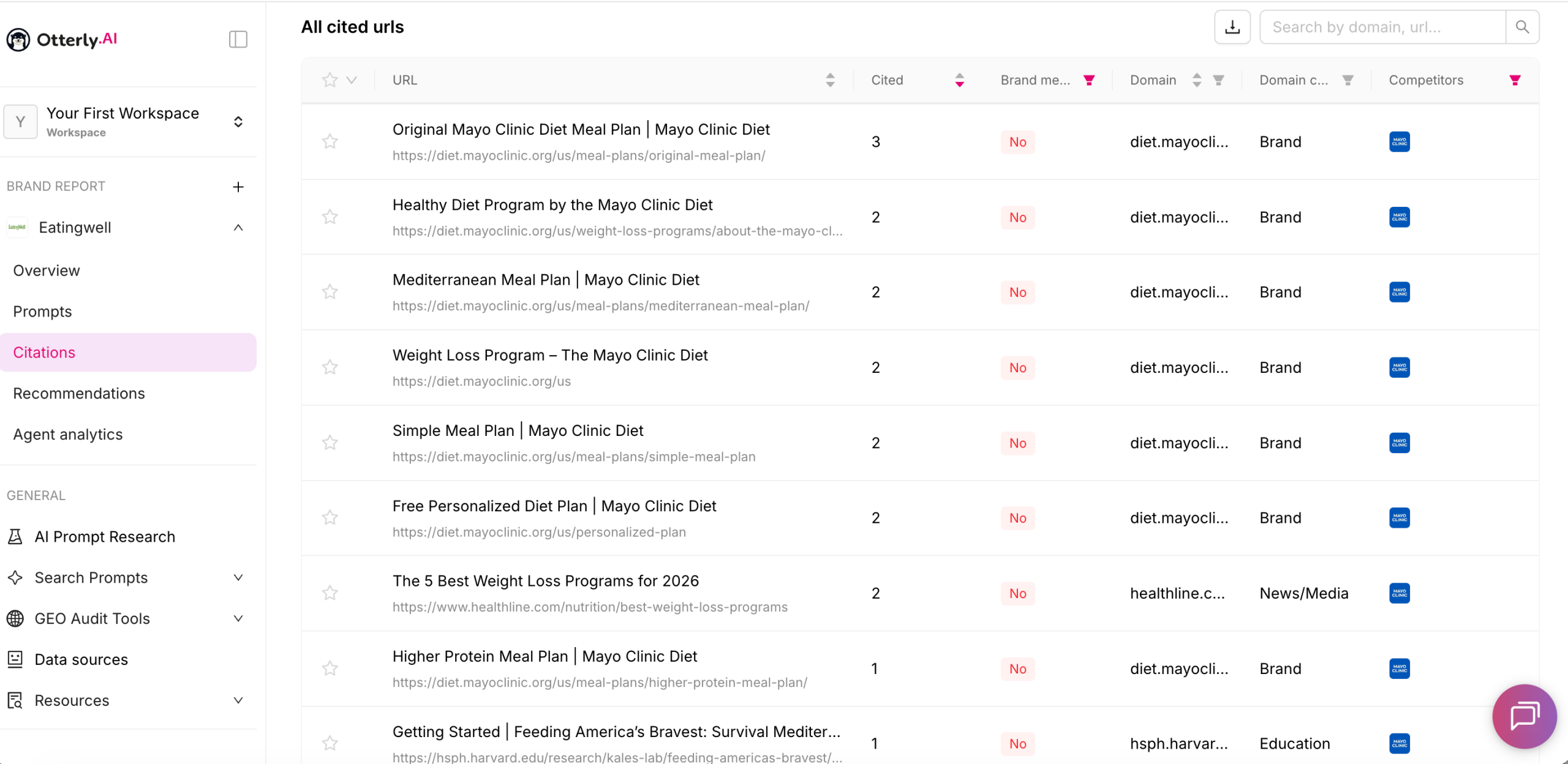
For an agency, that granularity is the point. It’s the difference between telling a client “you’re losing visibility” and showing them exactly why: whether a specific rival’s blog post is the thing getting cited for a given prompt, or whether the answer traces back to a third-party aggregator neither of you controls. One is a vague warning; the other is something you can act on.
Zoom out, and the same data answers a bigger question. Otterly’s Domain Citations view rolls every cited site into two things: a table of individual domains, each tagged with a category (News/Media, Government/NGO, Competitor, Blogs/Personal Sites, and the like), and a running count of how often it’s cited; and a distribution chart showing how those categories split across all the answers about your brand.
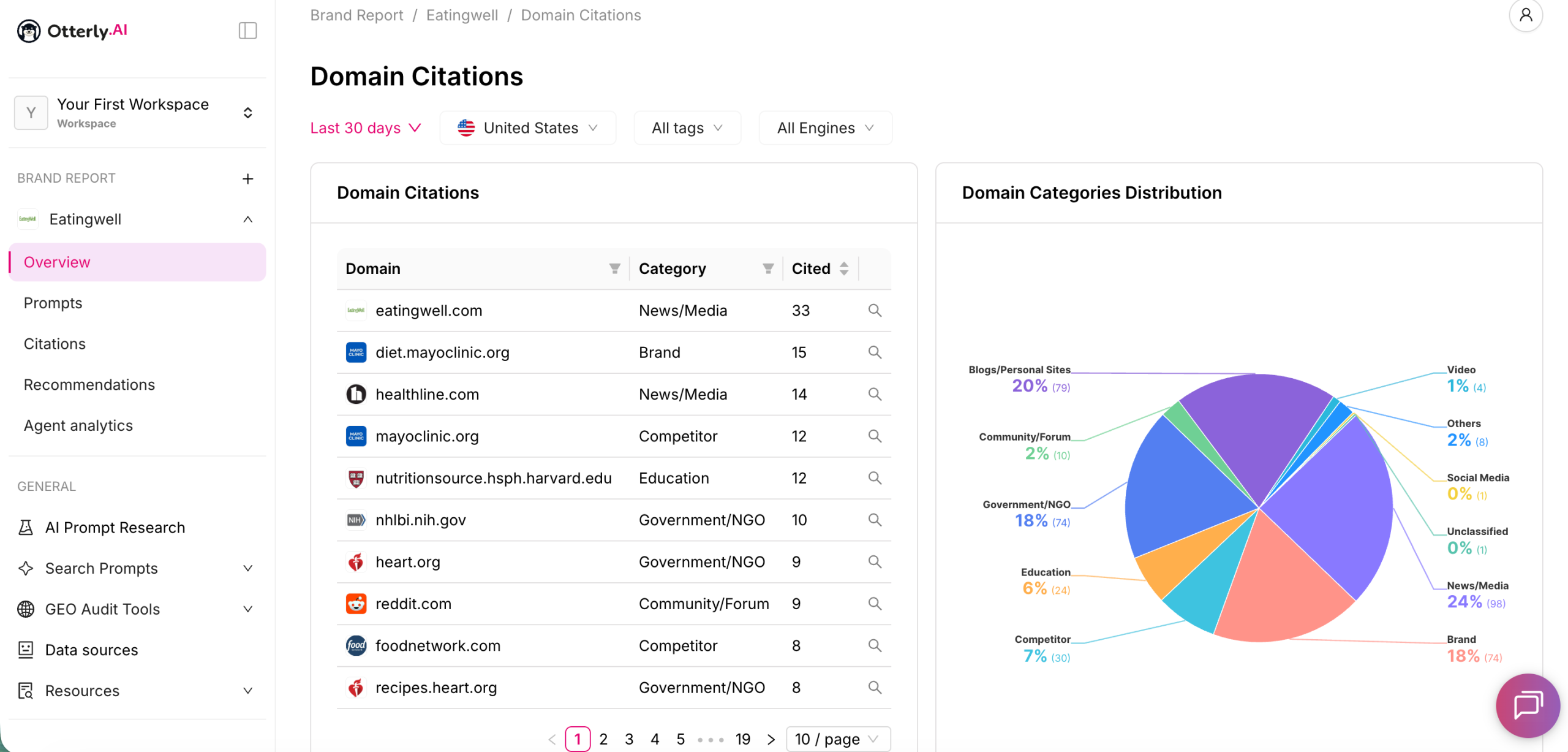
That move from individual URLs to source types is what makes it a strategy input rather than a scoreboard.
Seeing that answers in your category lean, say, a quarter on news and media, a fifth on independent blogs, and a large slice on government and institutional sites tells you where AI engines actually look when they answer questions in your market, and therefore where a brand has to show up to get pulled in.
A category dominated by News/Media is a PR and earned-media problem; one dominated by Community/Forum sources like Reddit is a completely different game. One caveat: the category labels are assigned by Otterly’s system and can’t be edited, so an oddly-sorted domain is worth eyeballing rather than taking at face value.
What Otterly AI’s GEO audit actually surfaces
The GEO audit is Otterly’s own diagnostic tool and it runs three checks:
- Crawlability Checker
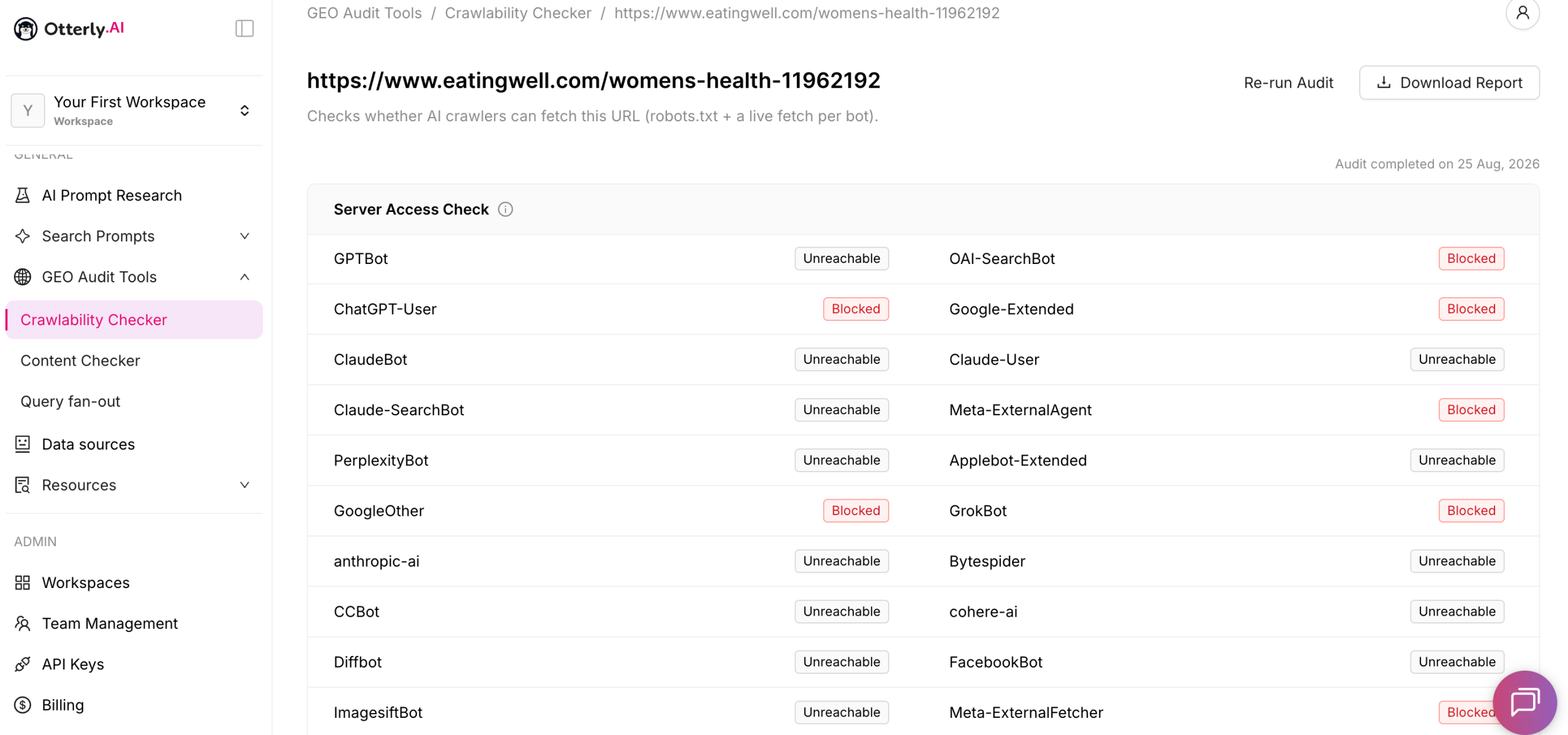
Before an engine can cite a page, its crawler has to be able to fetch it, and this is the check that confirms whether it can. Point it at a URL and Otterly runs it against roughly twenty named AI user-agents (GPTBot, ClaudeBot, PerplexityBot, Google-Extended, Bytespider, CCBot, and the rest). It reads what robots.txt allows, then attempts a live fetch as each bot.
Every agent comes back tagged blocked (disallowed in robots.txt) or unreachable (the live fetch didn’t land), and the whole report downloads.
Aleyda Solis, an independent SEO and AI-search consultant at Orainti, makes the same point about the category generally: “You need to allow AI crawlers to access your content. The rules you set might need to be different depending on your context”. The problem she’s describing is the same one the crawlability check is built to catch before a brand ever gets to citation counts.
- Content Checker
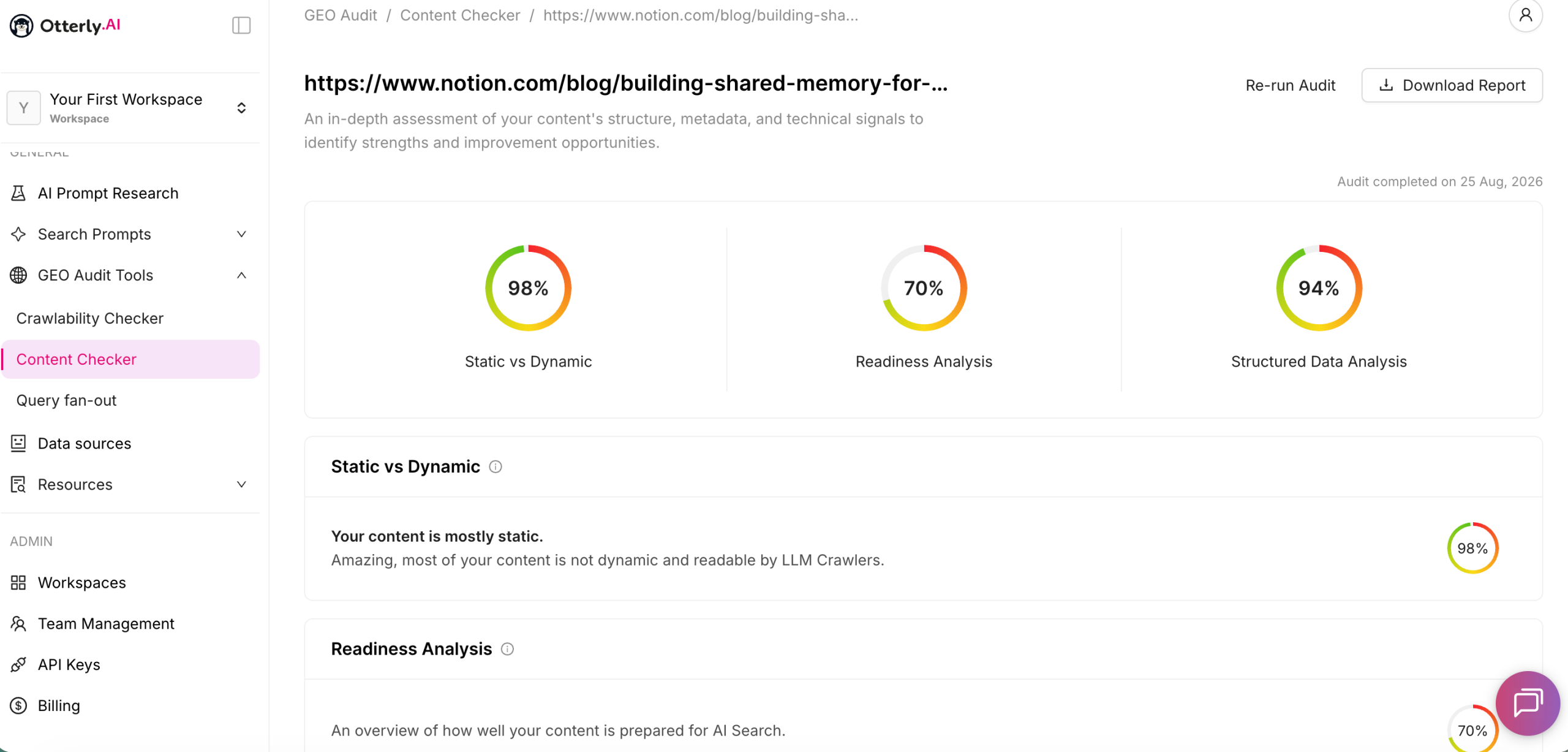
This tool shows three scores:
- Static vs Dynamic: how much of the page renders server-side and is readable by an LLM crawler, versus locked behind JavaScript
- Readiness Analysis: a broad read on how prepared the page is for AI search
- Structured Data Analysis: insights into how effectively your content is structured.
- Query fan-out
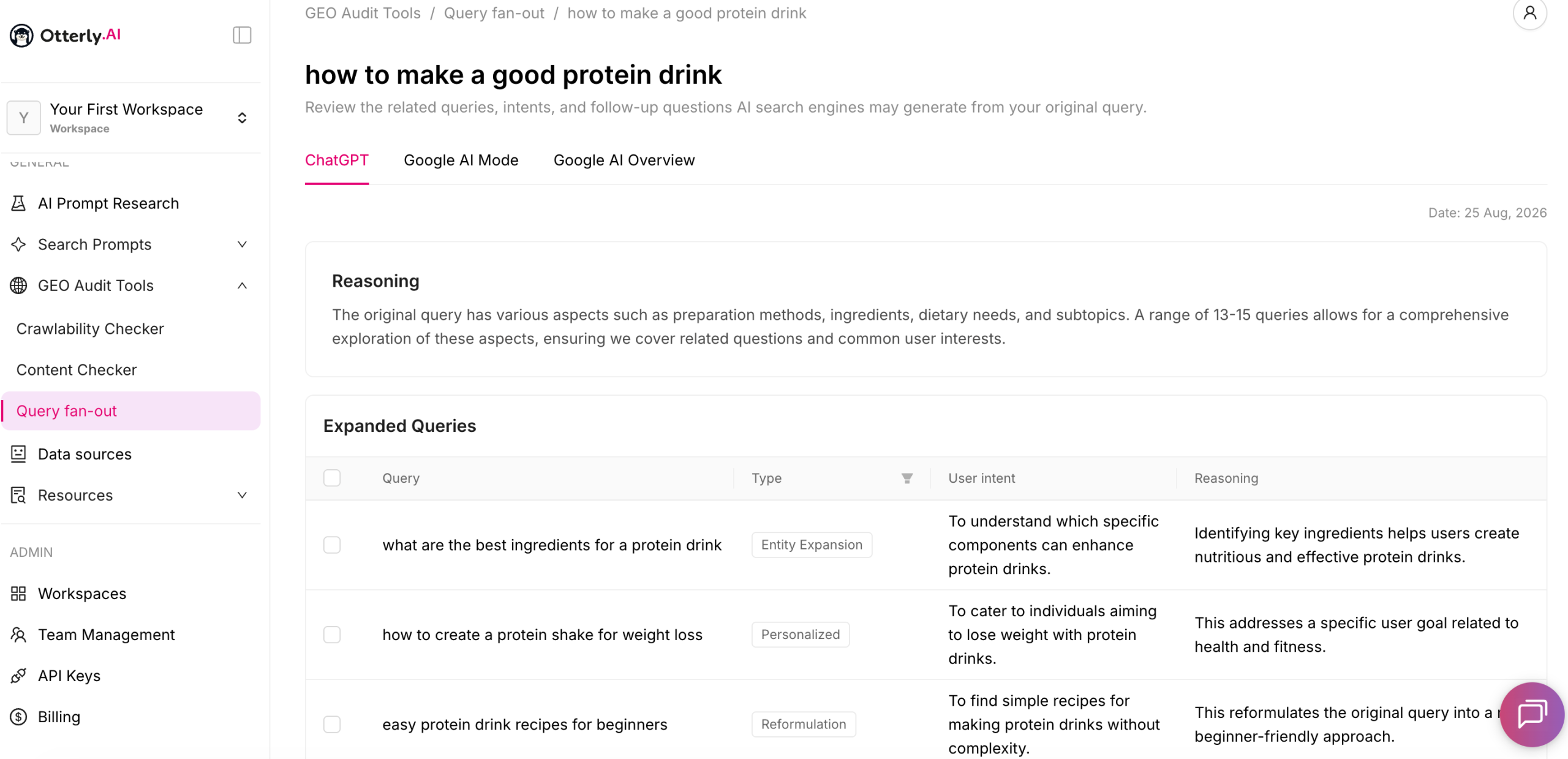
Enter a query and this shows how an engine is likely to explode it into follow-on questions, each tagged by type (Entity Expansion, Reformulation, Personalized) and by the user intent behind it, with separate results for ChatGPT, Google AI Mode, and Google AI Overview. For anyone planning content, it’s a map of the sub-questions a page has to answer to get surfaced, rather than the single phrase you started from.
The one thing none of the three can tell you is the thing you’d most want to know: how reliably a good score becomes an actual citation. Otterly AI hasn’t published an accuracy figure for its readiness scoring, and no independent source checked for this Otterly review has measured it either. So, the audit is best read as a well-built list of things to fix, not a forecast.
What is verifiable is that the tooling is maintained rather than frozen: Otterly has publicly rebuilt the GEO audit engine from scratch, a dated marker of ongoing work.
What Otterly AI’s Brand Visibility Index measures
If the citation and domain views show where AI answers pull from, the Brand Visibility Index tries to compress all of it into a single competitive picture. It’s a quadrant map: every brand you track is plotted on two axes: Brand Coverage (how often it appears in AI answers) across the bottom, and what Otterly calls Likelihood to Buy up the side, which drops the field into four zones: Leaders, Niche, Low Conversion, and Low Performance.
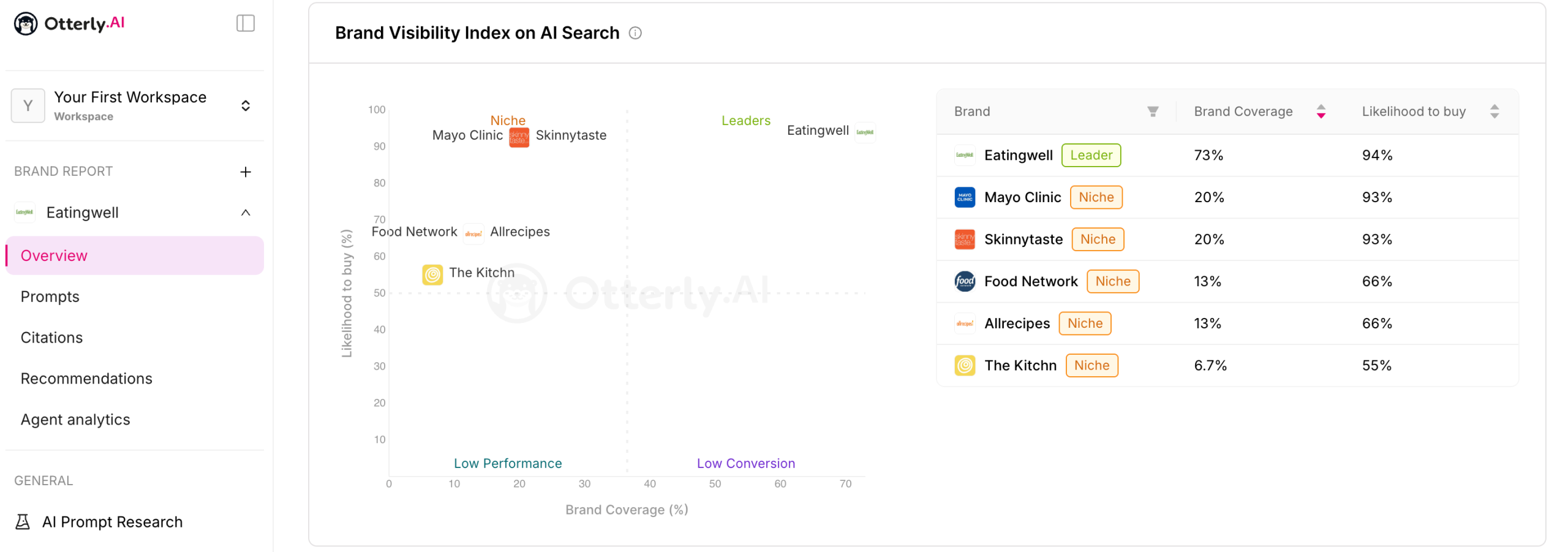
Against a real competitive set, it earns its place. In a food-and-nutrition report, Eatingwell lands in Leaders at 73% coverage. It shows up in most answers and ranks near the top when it does. Mayo Clinic sits in Niche. It scores just as high on quality (93 to Eatingwell’s 94) but surfaces in only 20% of answers, so it’s authoritative yet under-exposed.
The label to interrogate is “Likelihood to Buy.” Otterly’s own documentation is candid that the axis is calculated from a brand’s average position in AI answers. Ranking early in a generated answer is a fair proxy for prominence, but calling that purchase intent is an interpretive leap. Read it as “how prominently AI surfaces this brand,” not a conversion forecast.
What Otterly AI costs in 2026
Otterly.ai prices it’s three plans by prompt volume and audit limits. The four base engines (ChatGPT, Google AI Overviews, Perplexity, Microsoft Copilot) and unlimited team members are included in every plan.
- Lite: $29/month for 15 tracked prompts, and 1,000 GEO Audits a month.
- Standard: $189/month for 100 prompts, Agent Analytics, API and MCP access, and 5,000 GEO URL Audits a month.
- Premium: $489/month for 400 prompts, Agent Analytics, API and MCP access 10,000 GEO URL Audits a month.
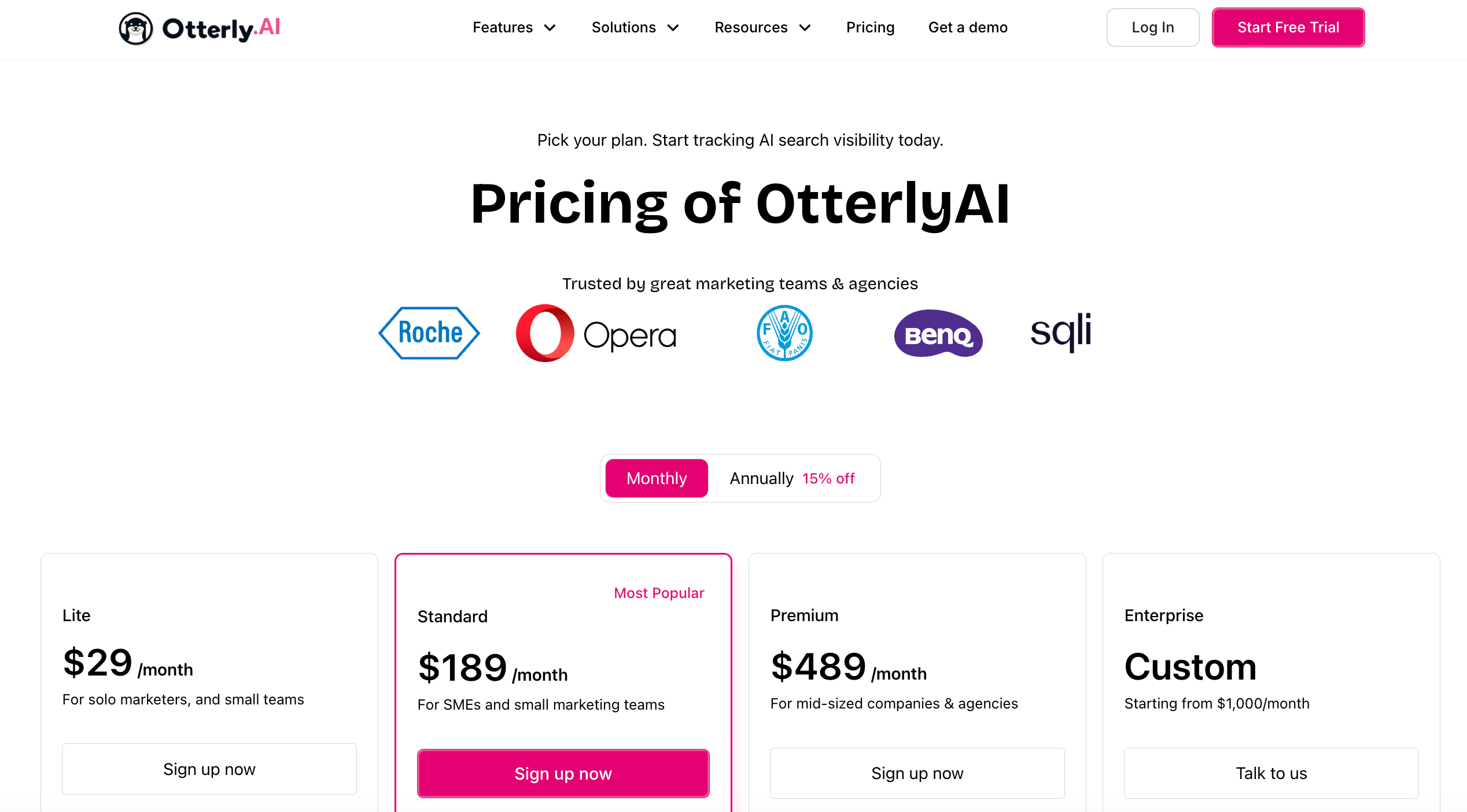
Enterprise sits outside that ladder: custom pricing starting at $1,000/month. Annual billing carries a 15% discount, and extra prompts are sold in 100-packs at $99/month.
What the engine add-ons cost
Upgrading tiers buys you more prompts, not more engines. All four base engines are the same on every plan, and the three optional ones are billed separately at each tier:
- Google AI Mode and Gemini: $9 / $59 / $149 a month on Lite / Standard / Premium
- Claude: $29 / $109 / $439 a month across the same three tiers
Claude costs three to four times what the other add-ons do at every tier. It’s just the most expensive engine to switch on.
So the sticker price is only the starting point. A Standard plan is $189 until you need Claude and Gemini, at which point it’s $357. And whether that math works comes down to which engines your brand actually needs to show up in, not how many the tool can track.
Who Otterly AI fits, and who should look elsewhere
The sweet spot is narrow but easy to describe: a handful of brands, tracked mostly within the four base engines, at a prompt volume that fits one tier. The further you get from that shape (more engines, more prompts, more brands) the faster the add-ons stack up. Where your account falls decides which list below is yours.
Good fit if:
- You’re tracking a handful of brands (your own plus a few competitors) and can live within the per-tier prompt caps of 15, 100, or 400.
- ChatGPT, Google AI Overviews, Perplexity, and Microsoft Copilot cover your priority engines, and paying separately for Claude, Gemini, or Google AI Mode isn’t a dealbreaker.
- Third-party sentiment carries weight in your decision: Otterly AI reviews on G2 average 4.7 out of 5 across 54 ratings, with Ease of Use at 9.3, Ease of Setup at 9.2, Quality of Support at 9.5, and Product Direction at 9.7
Look elsewhere if:
- Accurate sentiment tagging is central to your reporting: the same G2 reviewers who rate the tool highly overall single out its sentiment classifier as oversensitive, with one describing it tagging a plainly neutral mention as negative, so it’s the metric you’d have to hand-check before it reaches a client.
- Your prompt volume or engine mix would push you into paying for more than one per-engine add-on every month.
If you want a side-by-side view of Otterly against the wider field before committing, see how it stacks up among AEO platforms.
For agencies: managing brands under one roof
This is where Otterly is most at home.
Multiple client brands live in separate workspaces under a single login, with competitor tracking running alongside each brand’s own data. This is a practical setup an agency needs to report across several accounts without juggling logins.
The purpose-built layer is Otterly’s Agency Partner program, which you apply for after subscribing to Standard or Premium.
It bumps the prompt caps where agencies feel them most (150 on Standard, 500 on Premium, up from 100 and 400), and unbundles the things that make client work practical to run: unlimited client workspaces, one consolidated invoice across all of them, and white-labeled Data Studio reports that go out under the agency’s own name rather than Otterly’s. There’s also a “pitch workspace” for running a prospect’s audit before they’ve signed.
Otterly AI alternatives
Otterly isn’t the only way to measure AI-search visibility. There are several alternatives worth consideting:
- SE Visible collects real answers through a browser rather than an API, refreshes daily, and reports brand mentions, share of voice, average position, sentiment, and the domains and URLs, sorted by source type, from media to blogs to forums. Every tier tracks all five supported engines (ChatGPT, Gemini, Perplexity, AI Mode, and AI Overviews) with no per-engine add-ons, and prompt volume stretches further.
- Profound is the option teams reach for at the enterprise end. It’s built around agent-level data, conversation logs, and deeper citation reporting across more AI engines than Otterly covers.
- Peec AI is the closest peer to Otterly for agencies and mid-market teams, and the most direct answer to Otterly’s add-on model. It lets you choose your engines from a shared pool instead of paying per-engine fees on top of a base plan, and it bundles unlimited seats.
For a full side-by-side breakdown of Otterly.ai against other AI-visibility trackers, see Otterly AI alternatives.
FAQ
What is Otterly AI?
Otterly.ai is an AI-search visibility platform that tracks how a brand appears (or doesn’t) across AI-generated answers on ChatGPT, Gemini, Perplexity, Microsoft Copilot, Google AI Overviews, and Google AI Mode. It runs the same prompts on a recurring schedule, logs which sources each engine cites, and audits whether a brand’s own pages are crawlable and citable in the first place.
How much does Otterly AI cost?
Self-serve plans run $29–$489 a month across three tiers (Lite, Standard, Premium), priced by prompt volume. Four engines (ChatGPT, Google AI Overviews, Perplexity, and Microsoft Copilot) are included by default; adding Claude, Gemini, or Google AI Mode costs $9–$439 a month per engine, depending on tier. Enterprise pricing starts at $1,000/month.
Does Otterly track Claude and Gemini?
Yes, but not by default. Claude, Gemini, and Google AI Mode are paid add-ons on every self-serve tier, priced separately from the base plan. Claude costs the most to add, at $29 to $439 a month depending on tier.
Otterly AI review: final verdict
Two things stand out at the end of this Otterly AI review. First, Otterly AI does the core job well: it measures AI visibility with a direct, first-person method rather than inferring through an API, its citation and domain-sourcing views turn raw mentions into something you can act on, and it keeps shipping rather than coasting.
For a team tracking a handful of brands within the four base engines, it’s an easy recommendation. The reservations are about scope and cost: prompt caps and per-engine add-ons push the real price well past the sticker once you need Claude, Gemini, or broad multi-brand coverage.
So the question is whether your account sits inside Otterly’s sweet spot or at the expensive edges of it. If it’s the latter, SE Visible is built for that shape with multi-brand reporting, several engines in play, every one included at each tier. A 10-day free trial, no credit card required, is enough to tell which side of the line you’re on.