Peec AI review: what it tracks, what it costs, who it fits in 2026

If you’re evaluating Peec AI, you’ve already accepted the premise: AI engines are describing your brand to buyers, and you need to see what they’re saying. The real question is whether this specific tool is worth it.
This review breaks down what Peec AI tracks, what it costs today, and the kind of team that gets real value from it.
What is Peec AI, and can you trust it yet?
Peec AI is an AI-search analytics platform aimed at marketing teams. It runs prompts against the major AI engines, ChatGPT, Perplexity, and Gemini among them, then reports how often a brand shows up in the answers and how it’s described. Prompts rerun every 24 hours, so you’re watching a trend line rather than a one-off snapshot.
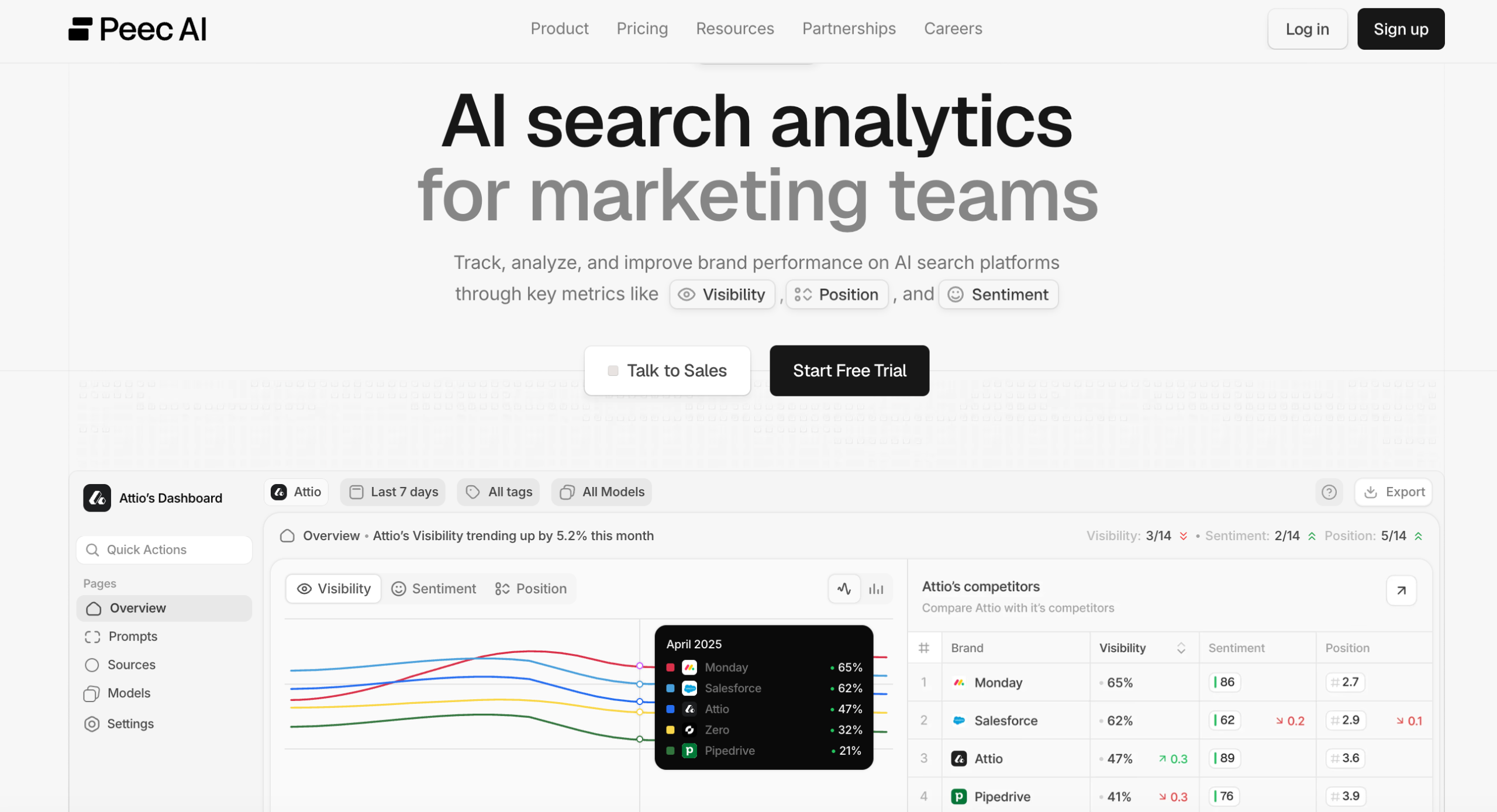
Whether it’s worth paying for comes down to two questions: does the tool do what it claims, and do the people using it trust it?
On G2, Peec AI currently holds a 4.8/5 rating across 18 reviews, with most of those at a full 5.0. That’s a thin sample, but the distribution skews heavily positive. Its Capterra profile tells a thinner story: zero reviews so far.
The praise clusters on two things:
- An interface that makes AI visibility legible instead of a black box.
- The MCP integration that pushes the data into other tools rather than stranding it in a dashboard.
One founder called the MCP the reason he chose Peec, and a growth manager credited the prompt tracking with surfacing LLM competitors he didn’t know he had.
The criticism is where a buyer learns more. Some flagged gaps that line up with the tool’s scope:
- Onboarding that suggested 50 heavily overlapping prompts and needed manual cleanup.
- A missing page-level AEO readiness check that some rivals include.
- Full model access gated behind higher tiers, which one enterprise user called a subscription wall.
At the same time, some recognizable SEO and GEO practitioners like Lily Ray (VP SEO Strategy, Amsive), Crystal Carter (Head of SEO Communications, Wix), and Ethan Smith (CEO, Graphite) are willing to attach their names to the platform.
None of this proves Peec AI will work for your brand. It clears the first bar, though: a real, checkable following and criticism specific enough to be believable. Whether it’s the right tool comes down to what it actually measures, which is where we go next.
How does Peec AI track AI search visibility?
Peec AI works backward from prompts. You give it a brand and domain, and it suggests or lets you write the prompts a buyer might type into an AI assistant, grouped by topic, then runs them against the AI engines on a schedule and records how each answer treats your brand.
The platform has four headline metrics that you might see almost in every report:
- Visibility: the share of tracked answers that mention the brand at all
- Share of Voice: the brand’s slice of all brand mentions, against the competitors tracked in the same prompts
- Position: the brand’s average rank when it does appear
- Sentiment: a 0 to 100 score for how favorably the answer framed the brand
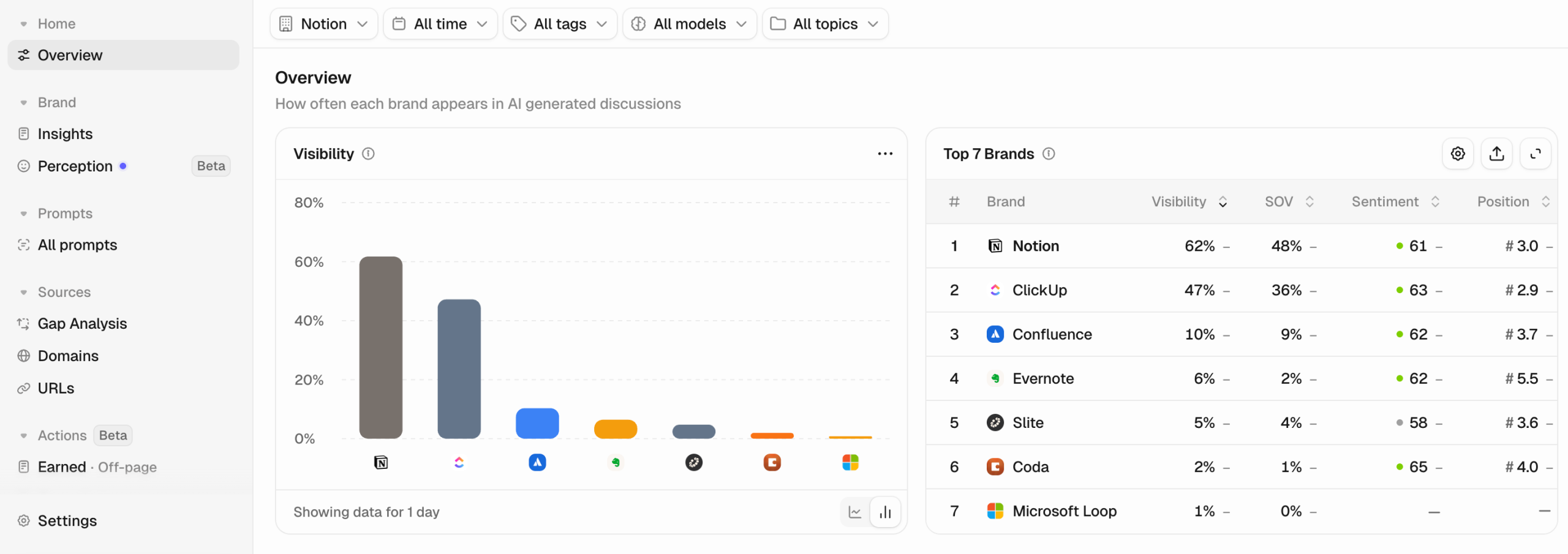
Peec runs the same prompts against up to six engines in its self-served plans, but you can only choose three to track. It expands to 11 platforms in the Enterprise plan. Peec currently supports:
- ChatGPT
- Perplexity
- Gemini
- Microsoft Copilot
- Google AI Mode
- Google AI Overviews
Claude Sonnet 4, GPT 5 Search, Deepseek, Qwen, Mistral are available through API.
The three-model default is worth weighing against how you’d use it: watching the full engine set means either buying a fourth model as an add-on or moving up to Enterprise. It’s the axis where SE Visible works differently, tracking 5 major AI engines on every plan rather than metering them by tier.
How does Peec AI track prompts?
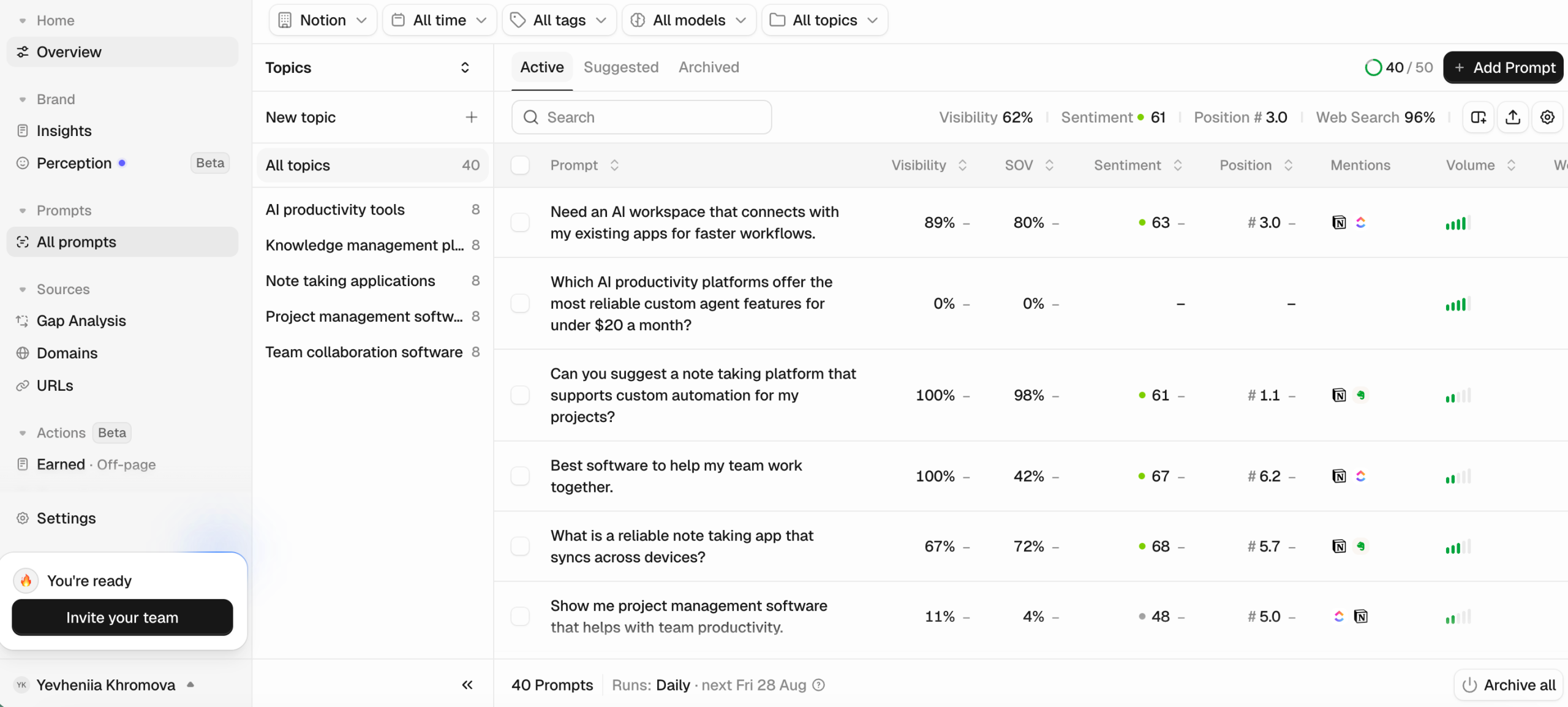
Peec AI groups prompts by topic, and a prompt list carries visibility, share of voice, sentiment, position, mention count, etc., for each.
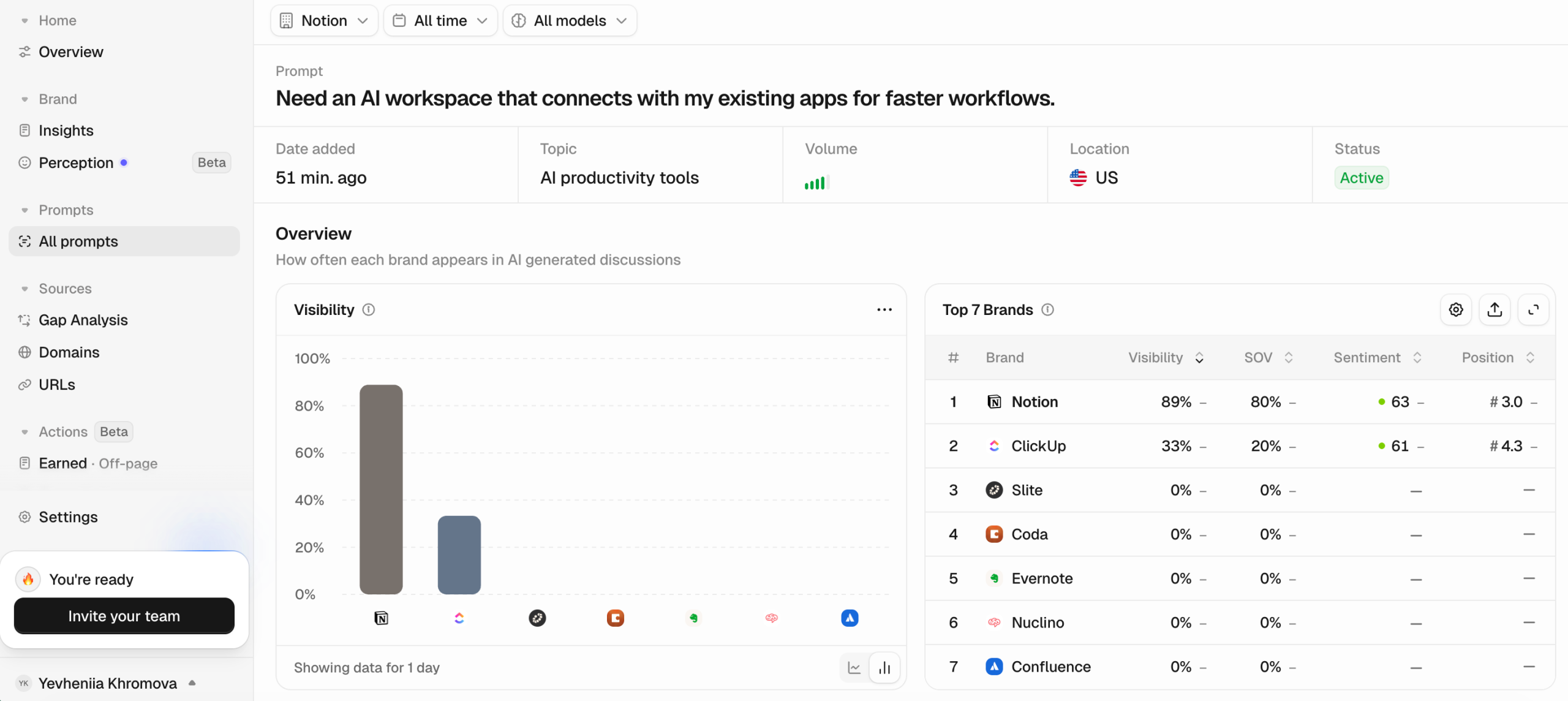
Open a single prompt, and it expands into its own report: the topic and search volume it belongs to, the model and location it’s tracked on, and a leaderboard of which brands show up for that exact query. That’s the level most buying decisions turn on, because a brand can look healthy in aggregate and still be invisible on the three or four prompts that feed its pipeline.
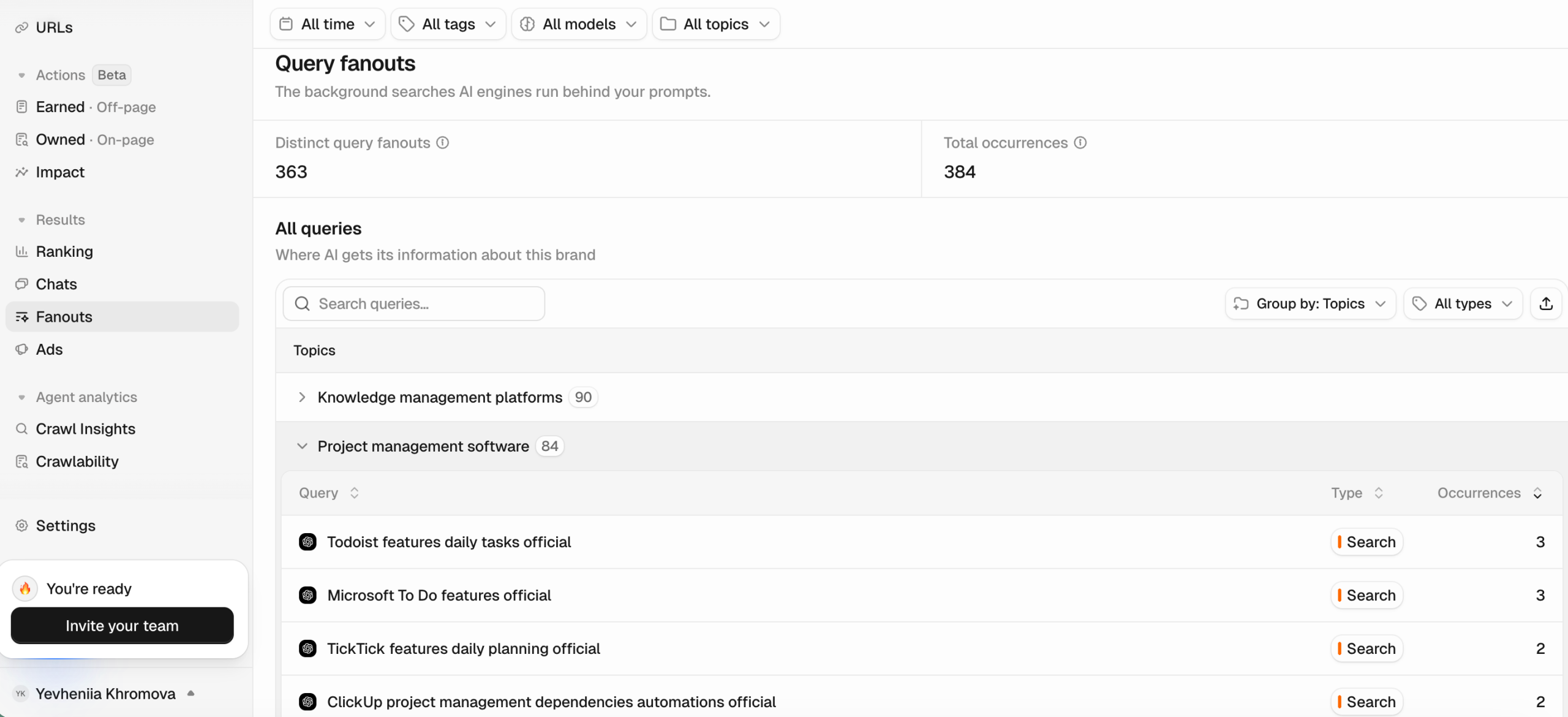
Peec’s Fanouts view exposes underlying searches that AI systems use to generate answers. It groups the fan-out queries by topic and counts how often each fires.
How does Peec AI benchmark competitors?
Benchmarking isn’t a side view in Peec; it’s the frame everything else sits in. It starts with a competitor set you define: you add the brands you want to be measured against, and from then on your numbers are read relative to them. That’s what turns a visibility score into a standing rather than a figure floating on its own.
The core view is a leaderboard that ranks your brand and its tracked rivals side by side on all four metrics at once, so a brand that shows up often but sits mid-answer reads differently from one that shows up rarely but wins its slot when it does.
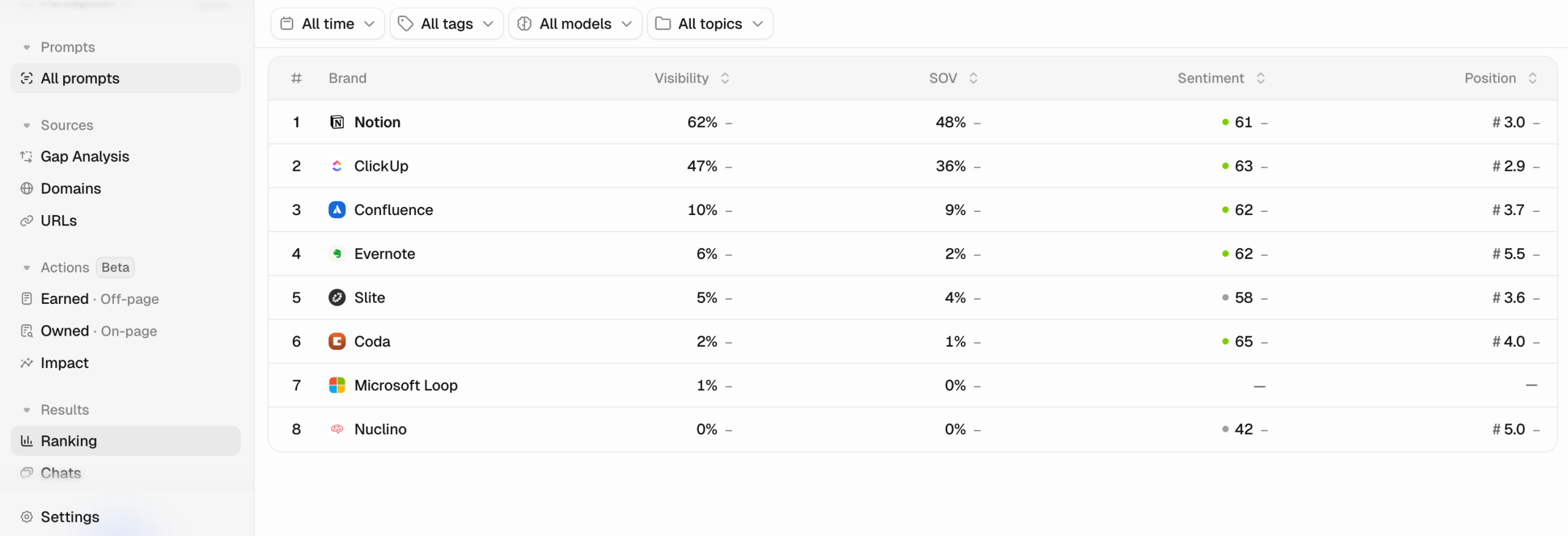
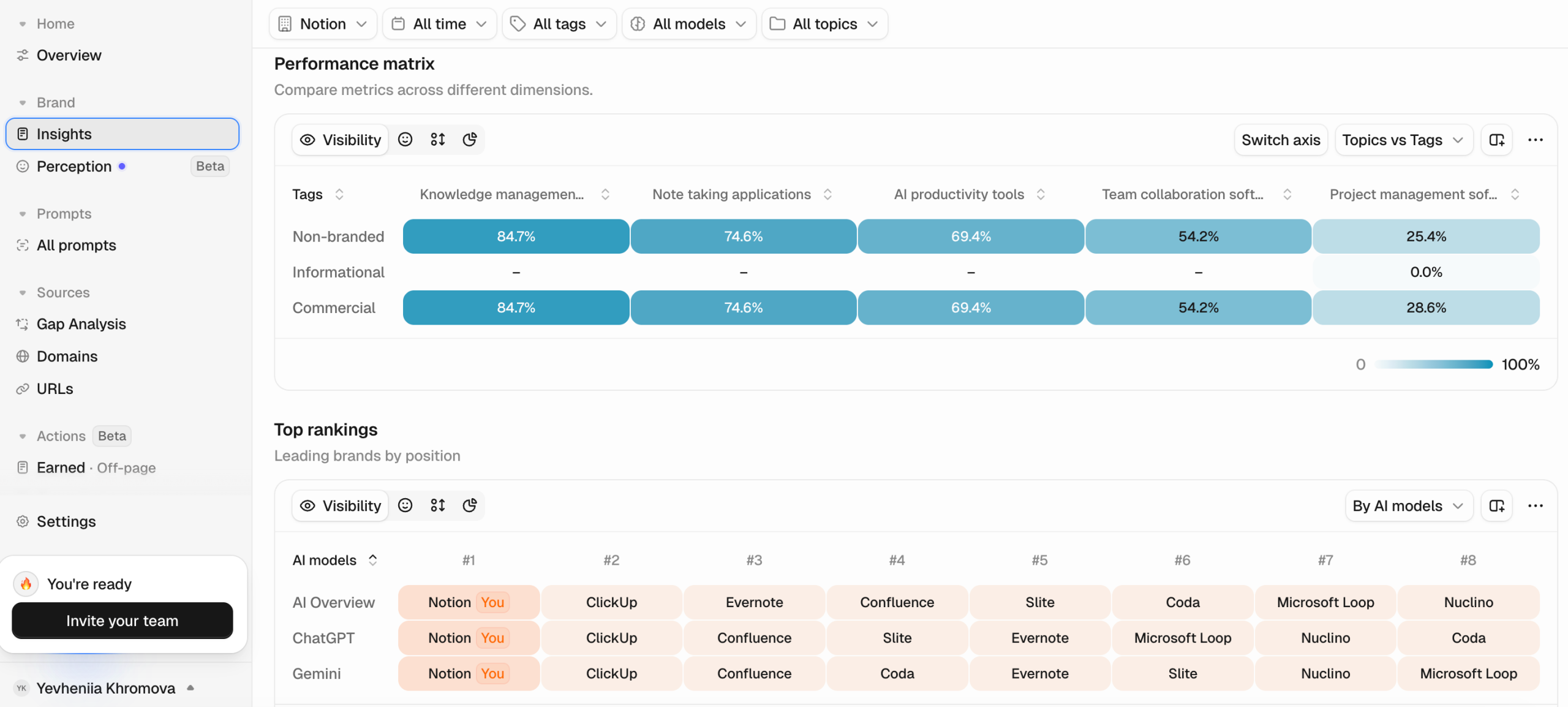
A rival that trails you on one model may lead on another. The model-level board is where you find which engine a competitor is beating you on, which is the part you’d actually act on.
SE Visible, on the other hand, offers a separate view for competitos. It approaches benchmarking the same way, from a competitor set you manage, with side-by-side comparison and per-engine filters that show where a rival leads on one model and trails on another. But a separate view gives you all this information in one tab, not sprinkled across the platform.
How does Peec AI track sources and citations?
Peec records the domains and URLs each answer draws from, and splits a source that informed the response from one the answer explicitly named. You can read that at domain, host, or URL level, each with a frequency count and a trend line, so a site that quietly feeds a lot of answers surfaces even when it’s never named outright.
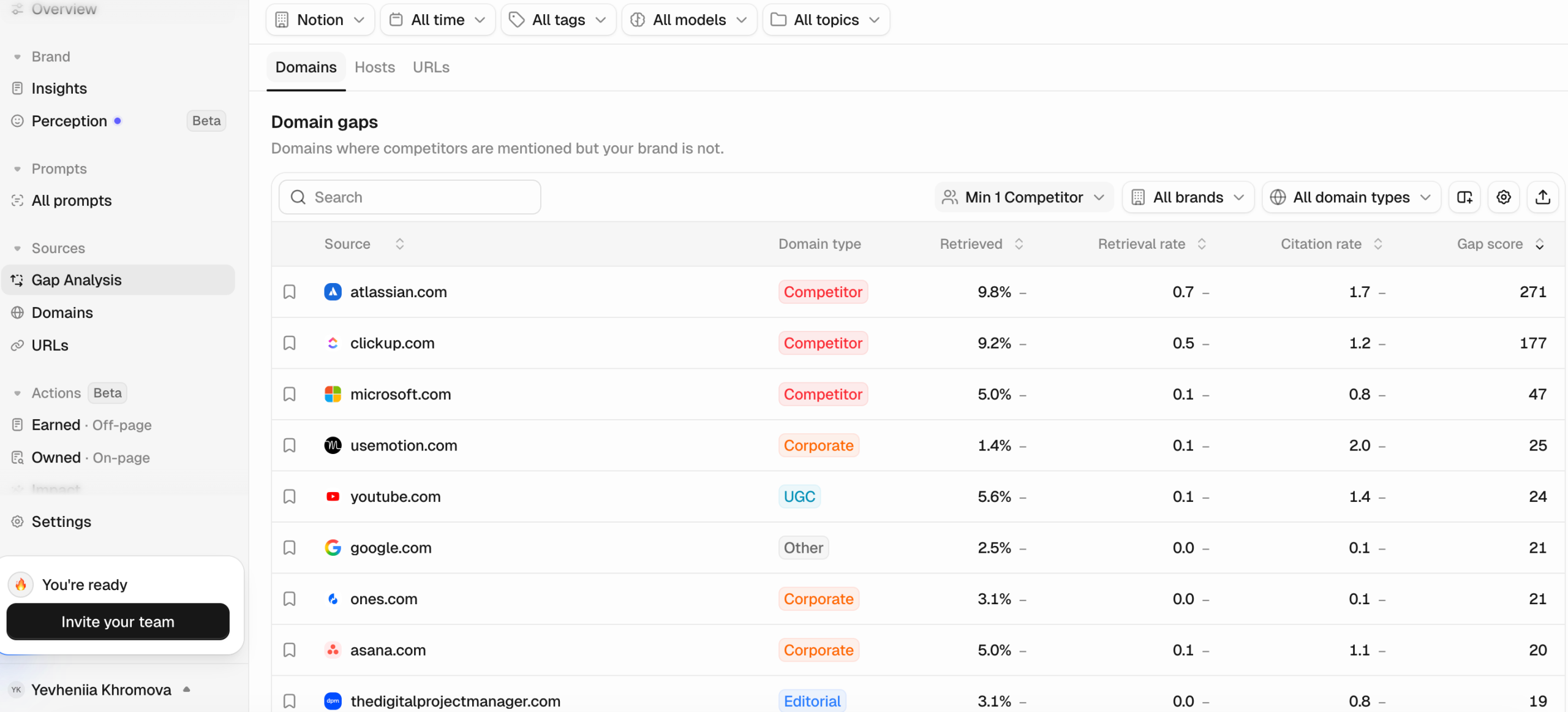
The sharpest cut here is Gap Analysis. It ranks the domains feeding AI answers, listing the ones that get pulled in when rivals come up but not when your brand does. Each domain carries a retrieval rate, a citation rate, and a gap score, and is tagged by type: a competitor’s own site, a corporate page, an editorial publication, or a UGC platform. This means, you can tell at a glance whether a gap is someone’s homepage or a third-party site you could realistically earn a place on.
SE Visible tracks the citation side of this as well, surfacing which sources get cited in answers about a brand, the type of source (editorial, community, and so on), and each source’s share of citations. You can also filter the sources thart have backlinks to your brand’s website (dofollow/nofollow).
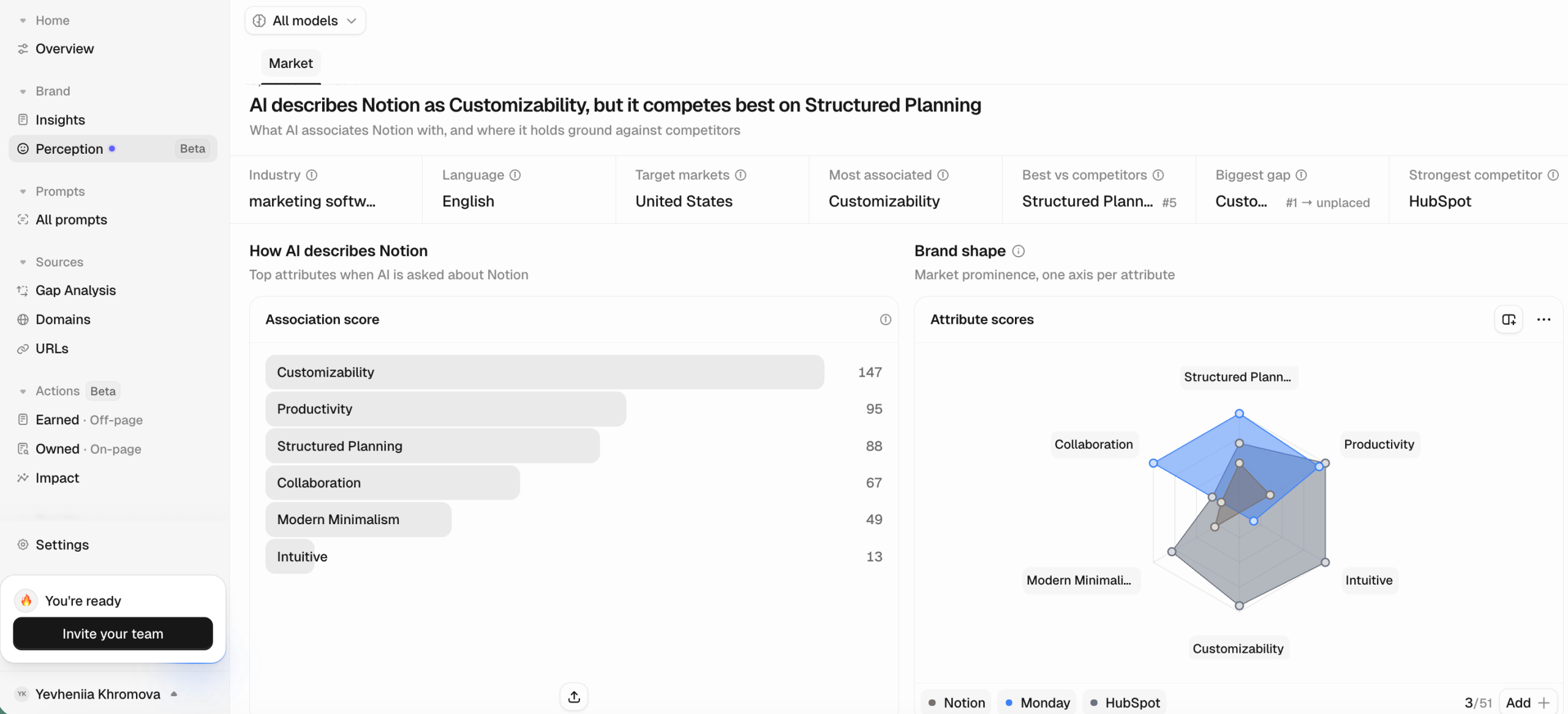
How does Peec AI track brand perception?
Peec’s Perception view looks past whether a brand appears and at what the engines associate it with, scoring the attributes that come up most when AI is asked about the brand, whether that’s ease of use, security, or price, and how strongly each one sticks.
It then plots the brand against competitors as a shape across those attribute axes, so you can see not just your own profile but where a rival owns an attribute you don’t.
How does Peec AI check LLM crawlability?
Visibility tracking assumes the AI engines can read your site in the first place, and Crawlability checks that assumption. It reads your robots.txt and reports, crawler by crawler, whether each AI bot is allowed, partially allowed, or blocked, separating the ones you’ve named explicitly from those covered by a global rule. It spans the training and search crawlers behind the major engines, such as GPTBot, Google-Extended, and Anthropic’s crawler, and compares your policies against competitors, with a URL tester for checking individual pages.
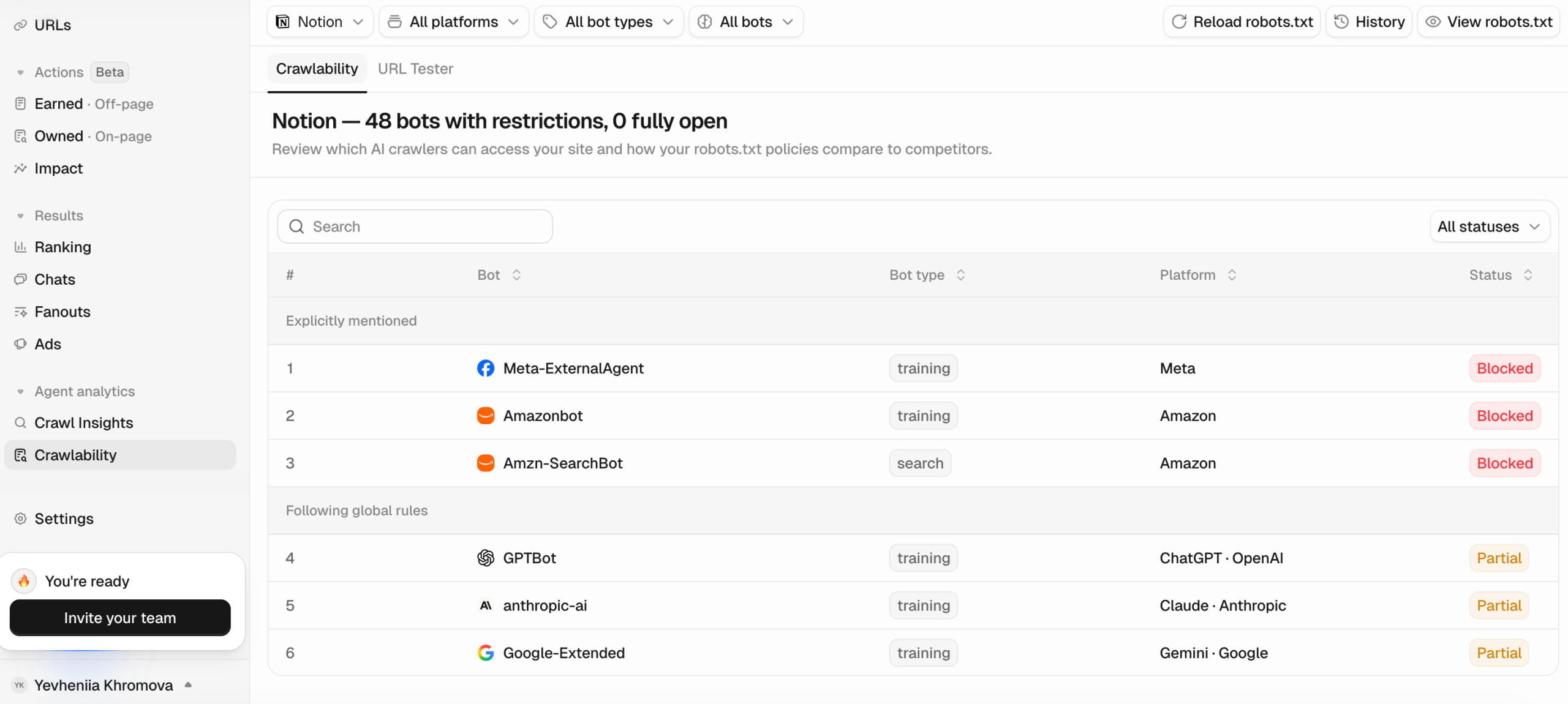
A blocked or partially blocked crawler is a concrete, fixable reason a brand might be missing from AI answers, and surfacing it is diagnosis, not just measurement. The fix still happens in your own robots.txt rather than inside Peec, but the tool tells you exactly where to look.
What’s new in Peec AI?
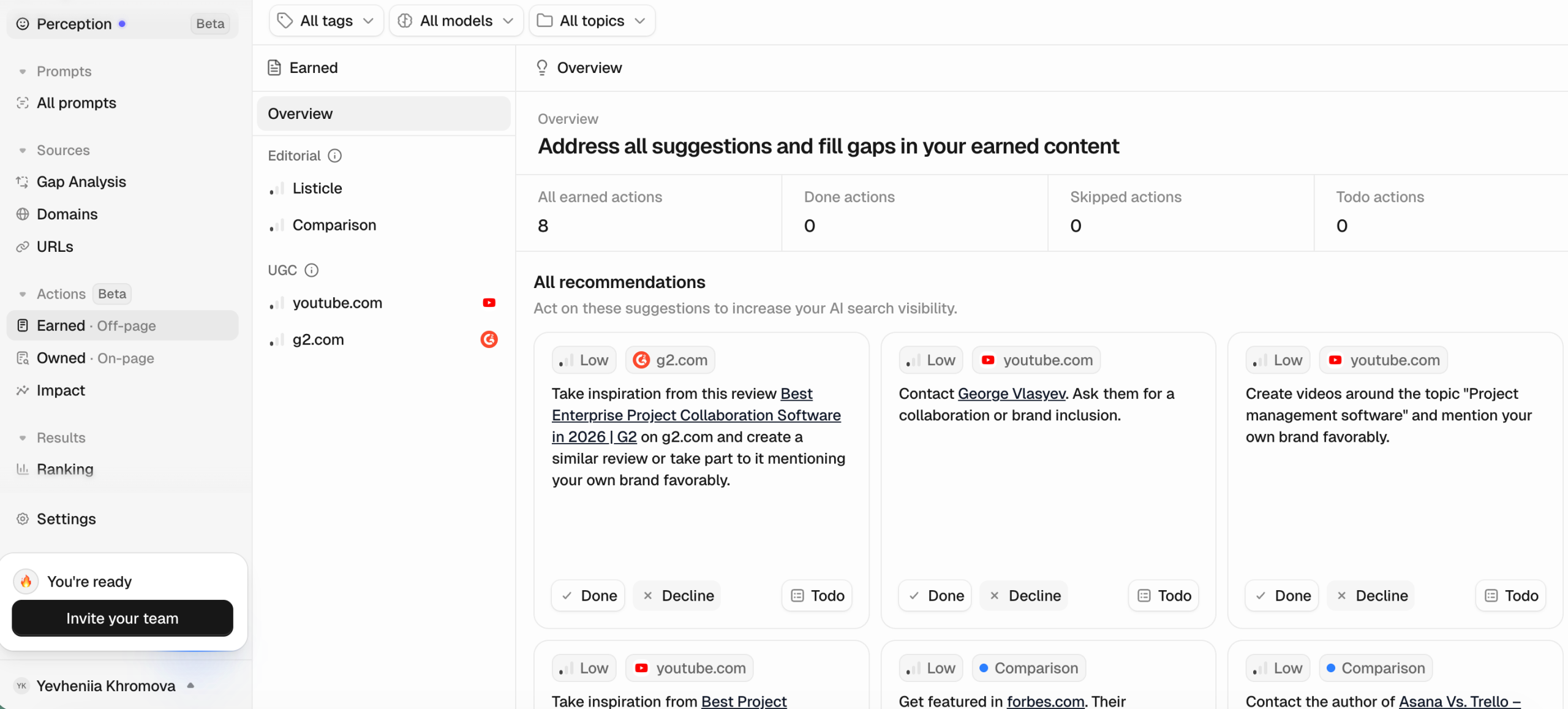
MCP and Actions are two additions to Peec AI: direct connections into other tools through Peec MCP, and a feature that ranks citation gaps into recommendations.
Peec MCP connects Peec AI’s visibility data out to other tools through MCP and a REST API. Named integrations include:
- Claude
- Cursor
- n8n
- any tool that supports MCP
A Data Studio connector handles reporting separately, through the same live page.
For a team already pulling AI-search data into a client dashboard or an agent workflow, that closes a real gap: instead of exporting a CSV and rebuilding the view somewhere else, the data can be queried where the work already happens.
Actions is the second addition. It takes the citation gaps Peec AI tracks and turns them into a ranked list of what to do next. You get recommendations:
- For third-party websites that influence how AI describes your brand.
- For improving content on your own website.
And you can also evaluate how your visibility shifted after implementing those recommendations.
Peec AI pros: what it does well
Peec’s strongest sides are a clean UI and a short learning curve. Its dashboard surfaces where a brand stands the moment you log in, without extra clicks to compare against competitors.
Support access follows the same pattern. Users like direct Slack access to the founding team even on lower tiers, rather than gating that kind of contact behind a ticket queue reserved for top-tier accounts.
It pulls these across the engines that matter right now, including ChatGPT, Perplexity, Gemini, Copilot, and Google’s AI Mode and AI Overviews. The dashboard visualizes movement over time, so you can read momentum at a glance.
The platform highlights the distinction between a passing brand mention and an actual citation. Peec separates the two and gives you a timestamped feed of recent AI conversations that included your brand, with context for each one.
For agencies, the structural details do the heavy lifting. The multi-project setup and Data Studio integration suit teams tracking several brands, and unlimited users with no per-seat cost means the whole team gets access without the pricing tax.
Peec AI cons: where it comes up short
A few limits worth mentioning:
- Cost scales with breadth. Engines beyond the core set, plus deeper GEO analysis and geographic expansion, sit behind add-ons or higher tiers, so a growing team’s bill climbs quickly.
- Peec doesn’t advertise SOC 2 compliance, and API access and SSO are Enterprise-only, and G2 reviewers have asked for more integrations, including Google Analytics.
- No built-in content generations, although the data for it is there.
- The 7-day free trial may not be long enough to see meaningful AI visibility trends before you commit, SE Visible‘s runs 10 days, which buys a little more room to watch the numbers move before deciding.
How much does Peec AI cost, and why the number keeps moving?
$80 a month is Peec AI’s current Starter-tier price, billed annually; billed monthly, it’s $95.
Here’s the full breakdown of Peec AI’s current brand plans, annual price first, with the monthly-billed price in parentheses:
- Starter: $80/mo ($95/mo monthly), 50 prompts, 3 tracked AI models, 1 project
- Pro: $205/mo ($245/mo monthly), 150 prompts, 2 projects
- Advanced: $420/mo ($495/mo monthly), 350 prompts, 5 projects, multi-country tracking, Looker Studio reporting
- Enterprise: custom pricing, unlimited projects, full model access, API and SSO
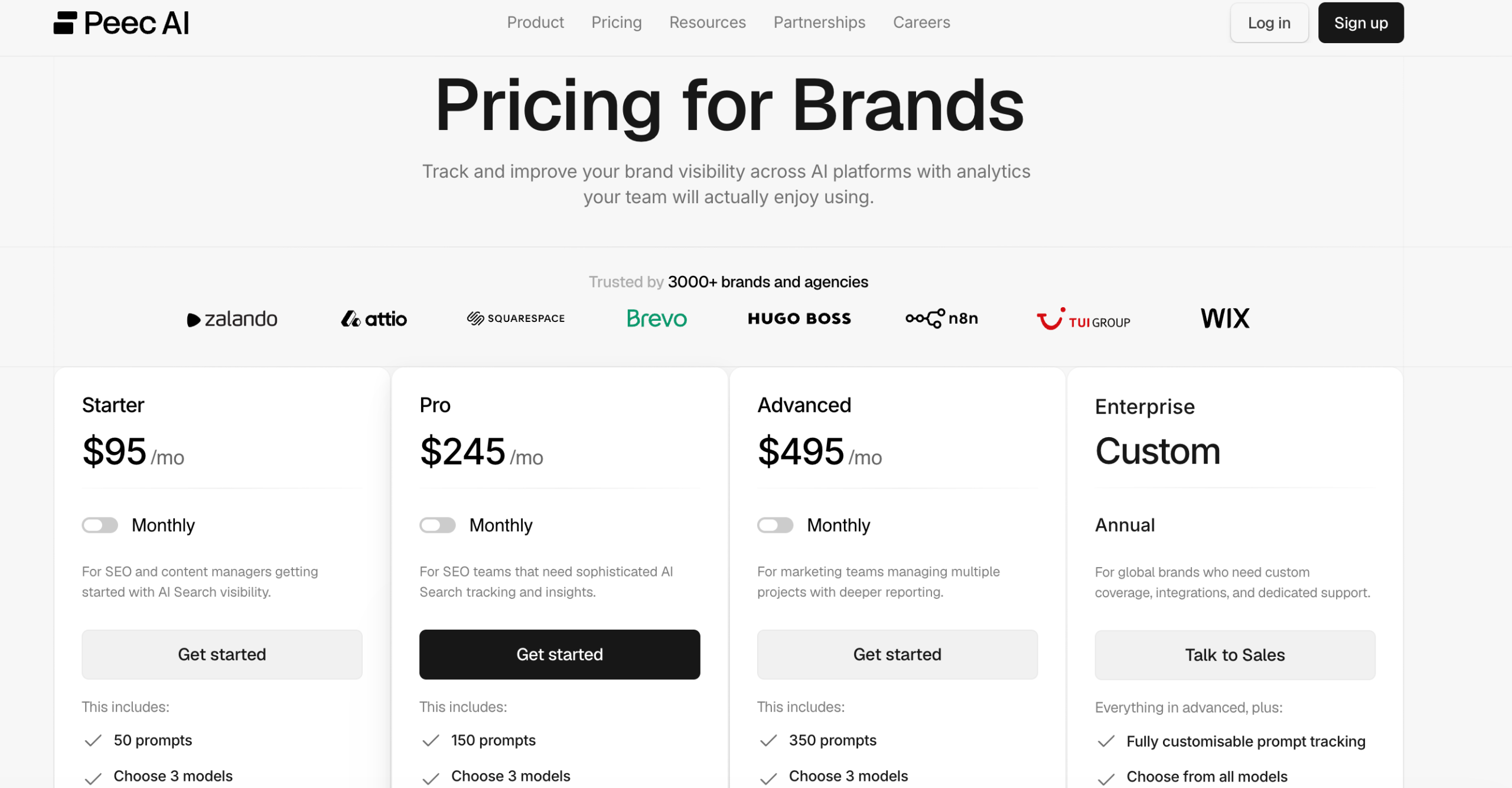
The monthly-to-annual discount runs about 15 to 16 percent across the three published self-serve tiers, a tight, consistent range.
Each self-serve tier tracks 3 AI models by default.
Agency pricing starts from $245/mo and grows to $1,195/mo.
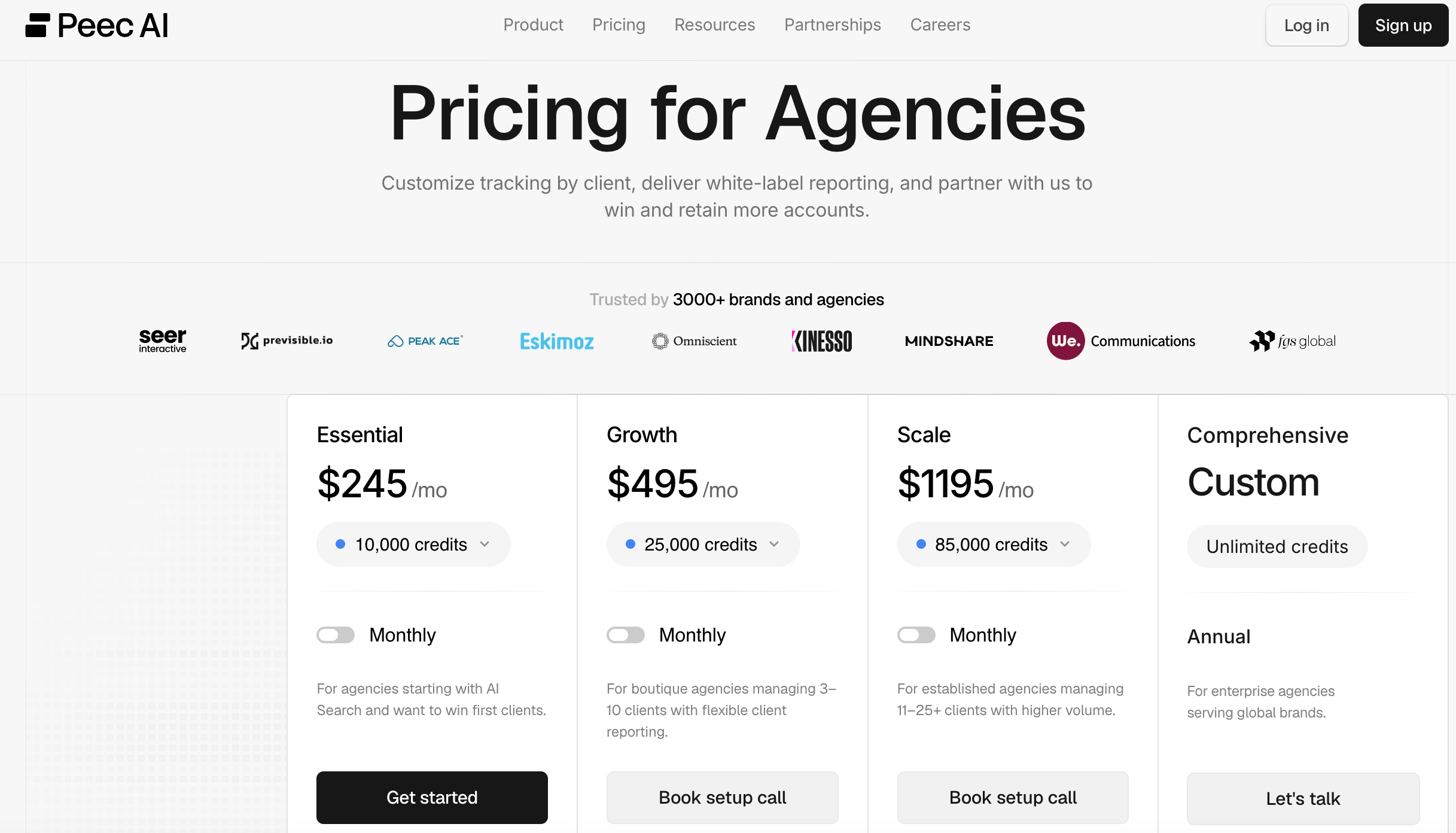
Pricing has shifted more than once over the past year, so treat the figures above as current at the time of publishing rather than fixed.
Who is Peec AI for?
If you already have measurable AI-search or referral visibility to track, Peec AI delivers the most value from day one. If you’re starting from zero AI-search visibility, you get a mostly empty dashboard for the first several weeks, because there’s nothing yet for the tool to measure.
Peec AI suits teams whose central question is how visible their brand is inside AI search:
- SEO and content strategists who want to see how often their brands and content earn mentions or citations inside ChatGPT, Perplexity, Gemini, and who want to know their share of voice against the field.
- Brand and growth marketers who want to know how AI models frame a brand’s sentiment against competitors.
- Marketing agencies who need multi-model reporting, competitor benchmarking, integrations, and unlimited seats.
- Enterprises that already have content production handled and need a diagnostic layer that pinpoints where AI engines cite competitors in their place.
Peec is a measurement and diagnostic layer for AI search visibility, and its value compounds when there’s already a content or SEO operation underneath it to turn findings into action. That operation is the part you bring yourself.
If you’re still mapping out where AI-search tracking fits alongside your content and technical SEO work, the best AI SEO tools roundup covers where Peec AI’s visibility-only focus sits relative to broader platforms.
Exploring Peec AI Alternatives?
If Peec AI’s single-purpose scope, or its shifting pricing, rules it out for your team, you don’t need to rebuild that shortlist from scratch. Our full breakdown of Peec AI alternatives already compares it against other AI-visibility trackers on tracking depth and pricing.
If you’re comparing the category more broadly rather than looking for a one-to-one swap, the best AI visibility tools compared covers a wider set of platforms than that alternatives roundup alone.
For a capability-based look at one of those options: SE Visible by SE Ranking.
It tracks the same major AI engines, including ChatGPT and Google’s AI Overviews, and adds a net-sentiment score alongside visibility and competitor data on one dashboard. That pairing matters because a shift in sentiment shows up next to the same visibility numbers instead of living in a separate report you have to cross-reference by hand.
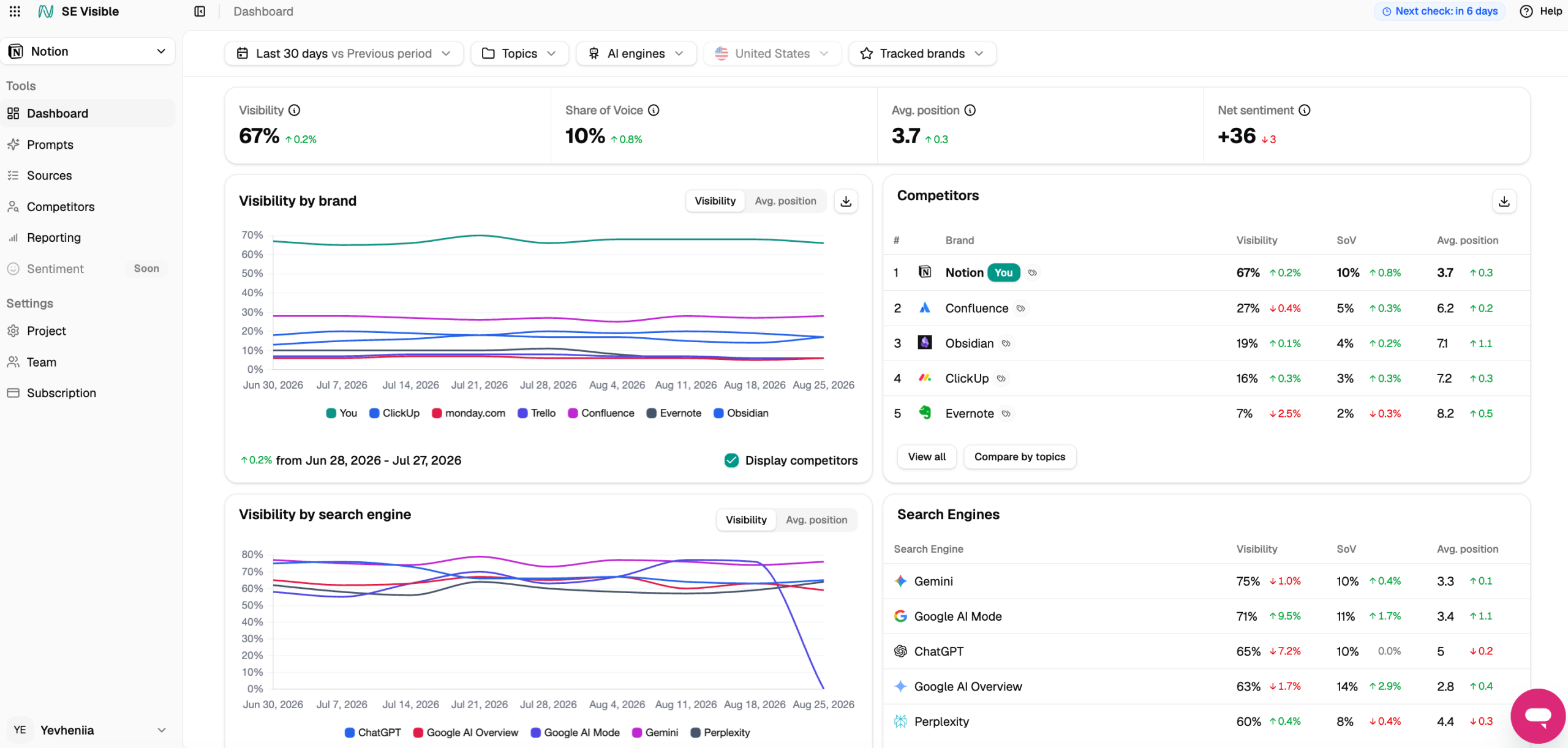
Like Peec AI, SE Visible is built for monitoring rather than execution: it shows what’s happening in AI-generated answers, but deciding what to fix from that data is still on you. SE Visible also sits inside the broader SE Ranking suite, which tracks traditional search rankings, analyzes competitors and offers solutions for content creation.
FAQ
Is Peec AI legit?
Yes. Peec AI is a real, venture-funded company that has raised roughly $29 million across three funding rounds, from pre-seed through Series A, according to Sifted and TechFundingNews. Its G2 profile shows a 4.8/5 rating across 18 reviews as of August 2026, with most of those rated a full 5 stars.
How much does Peec AI cost per month?
Peec AI’s self-serve plans currently run $80/mo for Starter, $205/mo for Pro, and $420/mo for Advanced, if billed annually (monthly billing costs more). Each tier tracks 3 AI models by default; a fourth model is a paid add-on. Enterprise pricing is custom. Agency plans start at $205/mo annually.
Does Peec AI offer a free trial?
Yes. Peec AI’s homepage highlights a free trial with no upfront payment required, and it runs 7 days.
Peec AI review: final verdict
Peec AI is a strong, focused choice for teams whose main question is how they show up in AI search.
It does the core monitoring job cleanly, with readable reporting, fast setup, and unlimited seats that suit agencies and growing teams. For a content or SEO operation that already knows how to act on a signal, it’s a capable feedback layer on AI search presence. But tracking more than 3 AI systems comes with additional price.
If that’s a dealbreaker for you, SE Visible tracks all major AI engines in all plans and adds a net-sentiment score alongside competitor data on one dashboard. A 10-day free trial is available at visible.seranking.com if you want to compare it against Peec AI on your own brand.