Local AI Visibility Tracking: AI recommends locally. Measure locally.
Track prompts and mentions down to the state or city, then roll the results up by market or franchise group. AI visibility by location, for portfolios where one national score was never the answer.
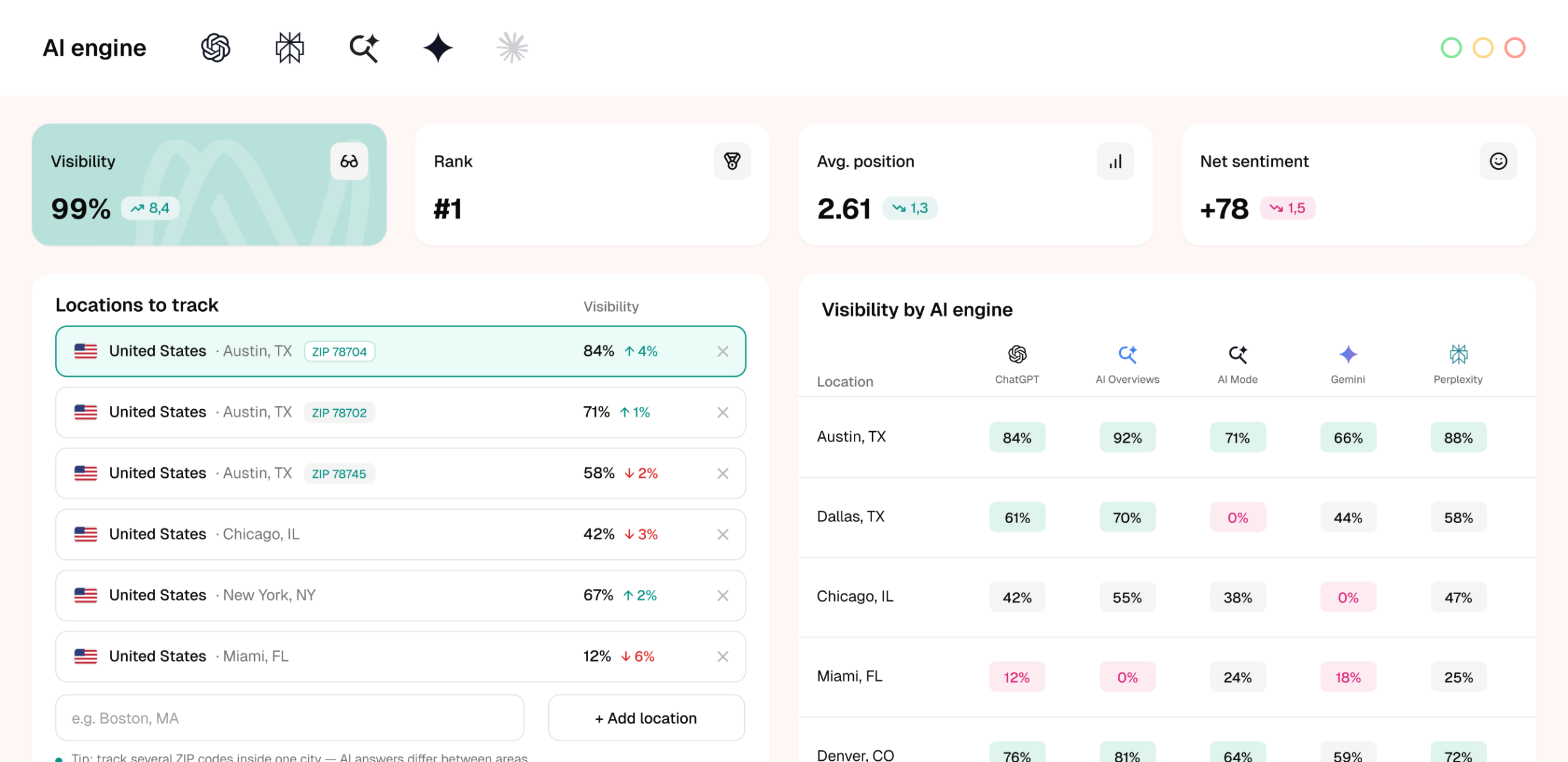
Local decisions need data that reaches the local level
A country-level average hides the answers your actual market hears. And the answer layer moves on its own schedule — a location can hold the local pack and still be missing from the AI answer printed above it.
Presence you can confirm, not infer
A national score tells you the brand is doing fine somewhere. It doesn't tell you whether one location is named when a customer nearby asks for a business like it — which is the question that location is judged on.
Know whether the gap includes you
SOCi's 2026 Local Visibility Index found ChatGPT recommended 1.2% of locations, against 35.9% for Google's local 3-pack. That gap is measurable one location at a time, which tells you whether you sit inside it or outside — and where to put the effort first.
A trend, not a one-off check
Checking a city by hand tells you where you stood on the day you checked. Running the same check on a schedule, across each engine, is what turns a snapshot into a direction you can act on
Read your local AI visibility one city, one engine, one prompt at a time
A single score can't tell you which city, which engine, or which prompt lost you the mention. These three cuts can.
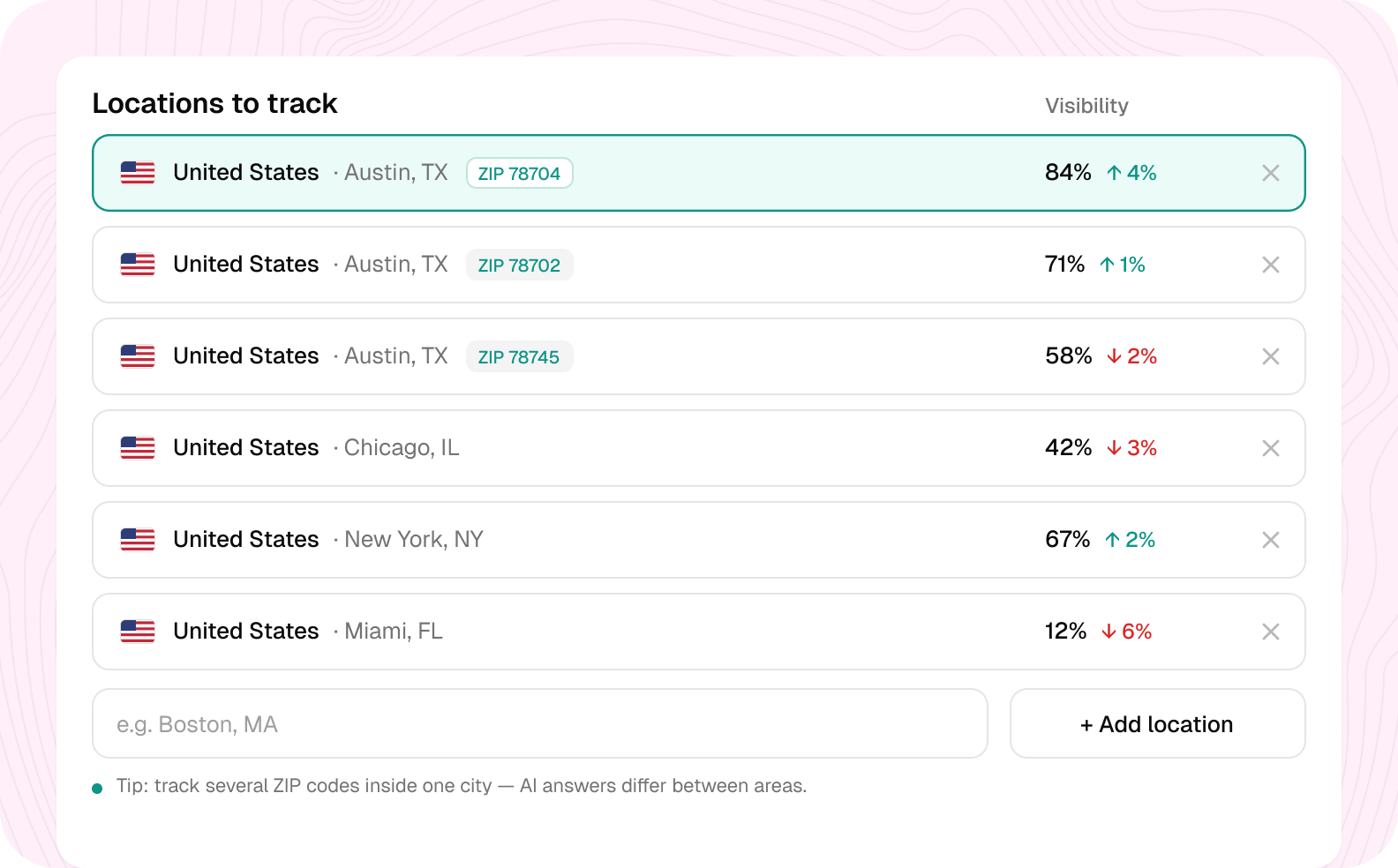
Visibility by city and region
Each city is tracked as its own read, so you can see whether a location is named in its own city without that read being diluted by how the brand does nationally.
A whole project can be set to one geography, or individual prompts can be pointed at different cities inside it — so one location and fifty of them each get a setup that matches how they actually operate.
Regions and cities each carry their own visibility score — down to state level where it's supported — which is what separates a location that never appears in an answer from one that appears only sometimes.
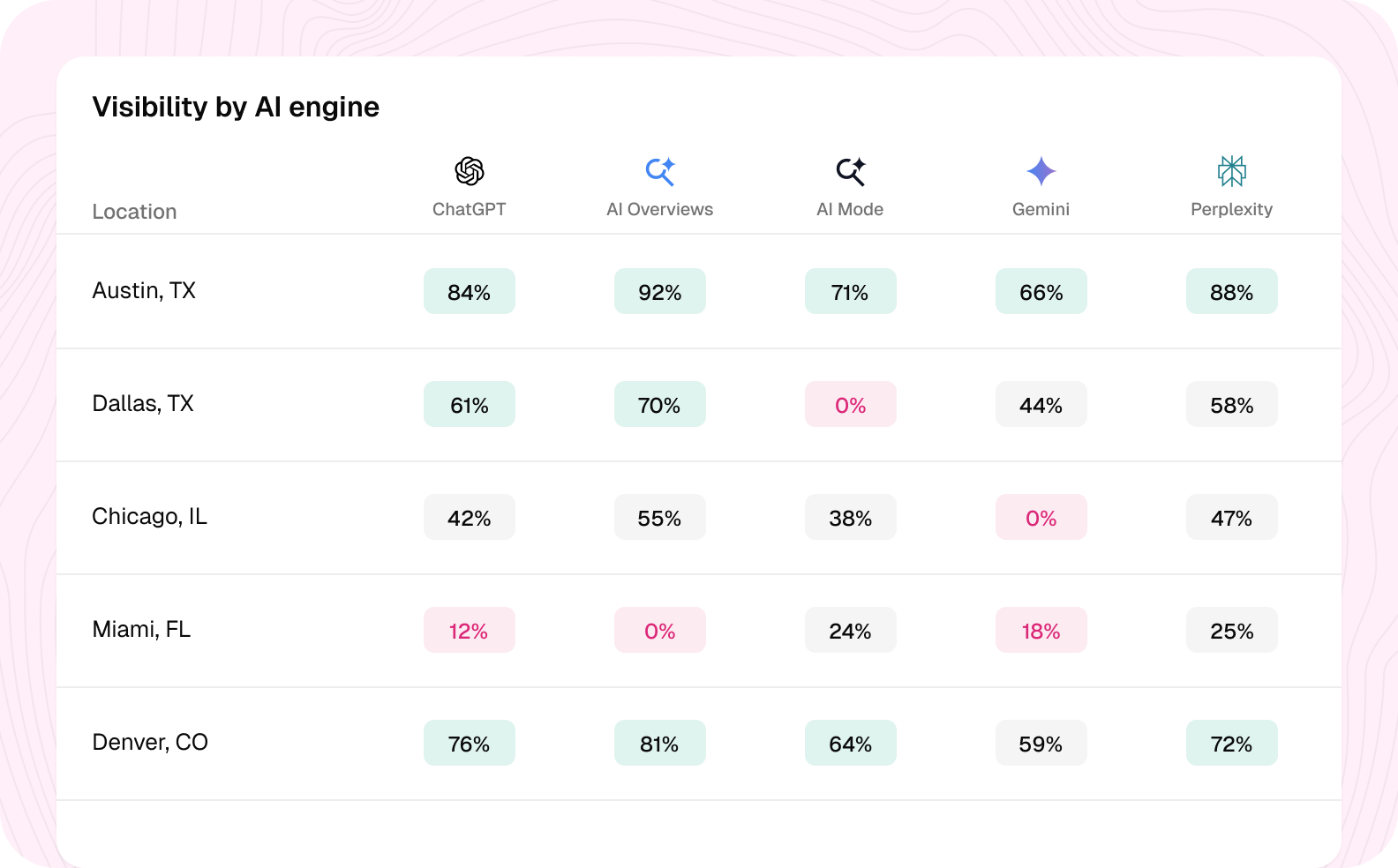
Visibility by platform
ChatGPT, Google AI Overviews, Gemini, and Perplexity are read separately rather than blended into one number, because a location can be named in one engine's answer and left out of another's for the same prompt in the same city.
Google AI Mode is read as its own engine rather than folded into Google AI Overviews, since the two build local answers differently.
Per-engine reads show which engine is leaving a location out, so the work goes to the engine where the gap actually is rather than across all of them.
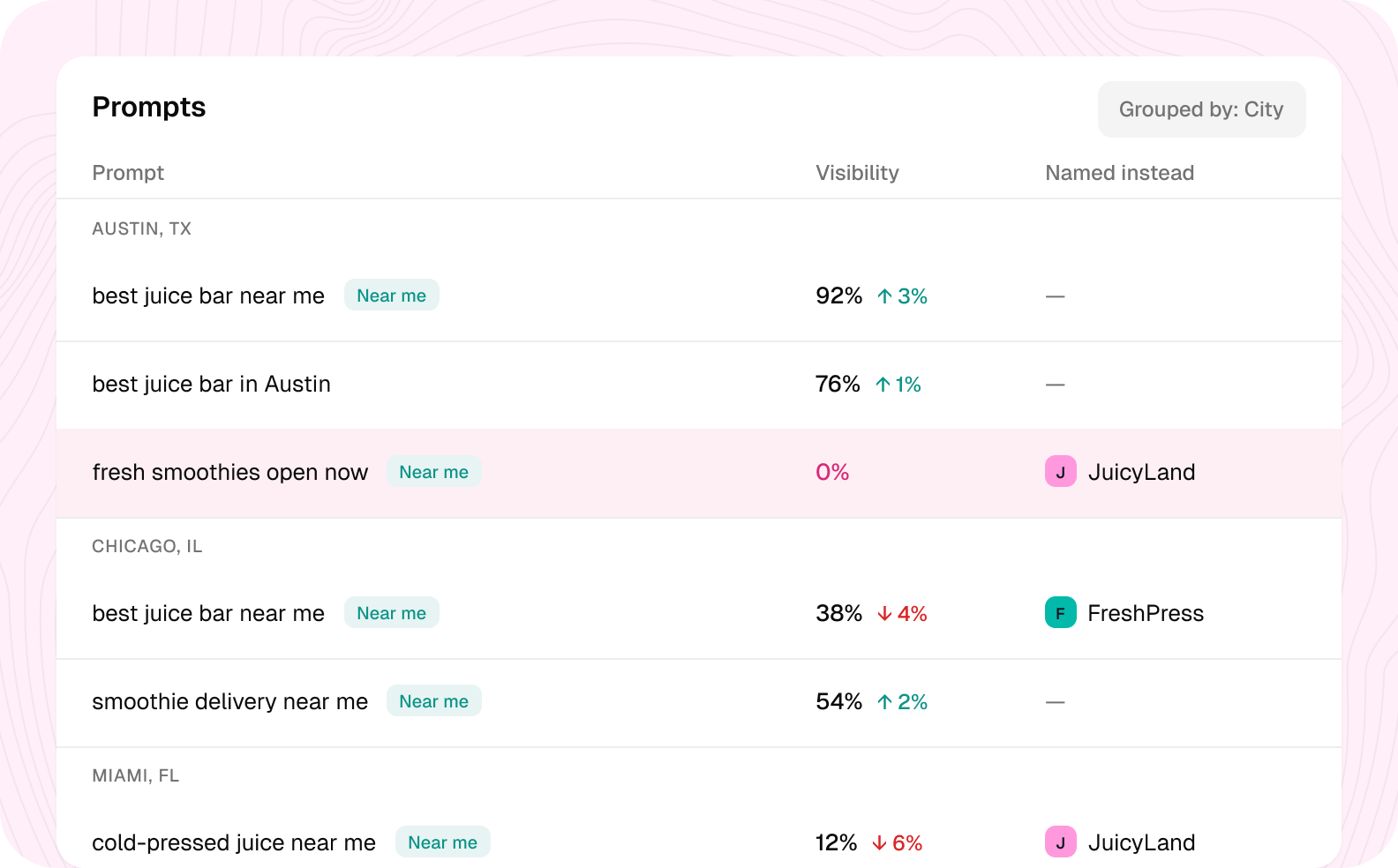
Visibility by prompt, including "near me" queries
Prompts are tracked one by one, so a "near me" query and the same query with a city name in it stay two separate reads instead of one blended local score.
Reading the answer text behind each prompt shows which competing business was named instead, and on what grounds — the part a position number never carries.
Grouping prompts by city means you report on what a local customer actually types, not on the national prompt set the account was briefed with.
Because the same cities are already tracked at location level in SE Ranking's rank tracking, a location's answer-layer visibility can be set next to its local search rankings — which is how you tell a location that slipped in the local pack from one that still ranks and simply isn't being cited.
See the answer people in your city are actually getting
Point it at your locations and see, city by city and engine by engine, where you're named and where another business is named instead.
Why marketing teams choosing us


Complete AI visibility tool with pricing that works for you
Choose the plan that fits your needs or explore SE Visible with a 10-day free trial
What is local AI visibility?
Local AI visibility is whether a business is named in the answers AI assistants generate for prompts about its area — and how it is described when it is named. It is measured per location: the same brand can be recommended consistently in one city and absent two towns away, because the assistants weigh local sources differently in each. It covers the mentions, citations, and sentiment in answers that carry local intent — including “near me” prompts and category queries with a city name in them. It is a separate read from local search rankings, which is why a location can rank in the local pack and still not appear in the answer printed above it
This carries the full category definition, moved down from H2 level per the structure mapping. It answers the head term the LP is not targeting, which is also why the companion blog explainer should link here and be linked from here.
Why isn't a single national AI visibility score enough?
Because a national score is an average, and an average can’t tell you whether a specific location is in a specific answer. A brand with two hundred locations can sit at a respectable national figure while a third of its locations are never named in their own cities — the strong locations carry the weak ones, and nothing in the number says which is which. Local decisions get made against that number anyway, so budget goes to cities that were already fine. Reading each location on its own is what makes that visible.
How do you track AI visibility for different locations?
You define the cities you care about, and each one is tracked as its own set of prompts against the answer engines. Every location keeps its own visibility score and its own answer history, so you can see whether it was named in a given city, on a given engine, for a given prompt. Locations can then be grouped into regions, brands, or franchise groups, so the same underlying data answers both a single-city question and a group-level one.
Do AI assistants give different answers in different locations?
Yes, and the difference is large enough to change what you’d do about it. SOCi’s 2026 Local Visibility Index, which looked at more than 350,000 locations across 2,751 multi-location brands, found AI recommendation rates far below traditional local search visibility and highly uneven between brands and categories. The assistants draw on different local sources and weight them differently, so two cities in the same region can produce different recommendations for the same query. That is the practical reason a country-level read can’t stand in for a local one. [VERIFY at build]
How do I use a local AI visibility tool day to day?
Most teams start by mapping their location list to cities and attaching the prompts a local customer actually types — “near me” phrasing, plus category queries with a place name. From there the routine is comparison rather than monitoring: find the cities where a location isn’t named, look at which business was named instead and on what grounds, and take that into the local content and listings work. If you track more than a handful of locations, grouping them is what keeps that routine from becoming a spreadsheet exercise.
Is local AI visibility optimization different from local SEO?
They overlap, but they measure different layers. Local SEO works on the signals that decide local search results — your Google Business Profile, NAP consistency across directories, LocalBusiness schema, reviews, and local pages — and it is measured by where you land in the local pack, or 3-Pack. Local AI visibility measures the layer above that: whether an assistant names you in the answer it generates for a local prompt, and how it describes you. The two are related, because assistants often draw on the same local sources, but they move independently — a location can hold a strong 3-Pack position and still be missing from the AI answer printed above it. SE Visible measures the answer layer, and it does not audit or manage your Google Business Profile, NAP consistency, LocalBusiness schema, or local pack rankings — those are local SEO tasks, and SE Ranking’s local rank tracking is where the search-layer side of the comparison comes from.
Who is local AI visibility tracking built for?
It’s for anyone who needs to know whether a specific location shows up in AI answers for its own area — a single business tracking its own city, a chain or franchise covering many, or an agency doing it on behalf of clients. What they have in common is the unit: the question comes down to one location in one place, because that is what a customer’s prompt is about. What changes between them is how many of those they track and how the results need to be grouped — not what is being measured.
Stop guessing whether your locations are in the answer
A 30-minute call over the locations you care about: which of your cities we can read today, what the per-engine coverage is for them, and where the gaps are.