Searchable review (2026): features, verdict, and fit

Searchable is an AI-visibility platform that tracks how brands appear across AI search engines like ChatGPT, Perplexity, and Google AI Overviews, built for GEO and AEO reporting.
The company was founded in 2025 and opened paid accounts publicly in January 2026. So, it’s a young platform, just like the category it operates in. AI-visibility and answer-engine tracking have only existed as a distinct product segment for a few years, and new entrants keep showing up as more marketing and SEO teams realize their presence in AI-generated answers needs its own measurement layer, separate from traditional rank tracking. Searchable has grown alongside that shift, picking up adoption quickly enough that it’s now a recognizable name among AI-visibility tools.
A platform this new hasn’t had years of iteration to smooth out every rough edge, and parts of its feature set are still filling in around the core tracking product.
What does Searchable’s AI visibility tracking cover?
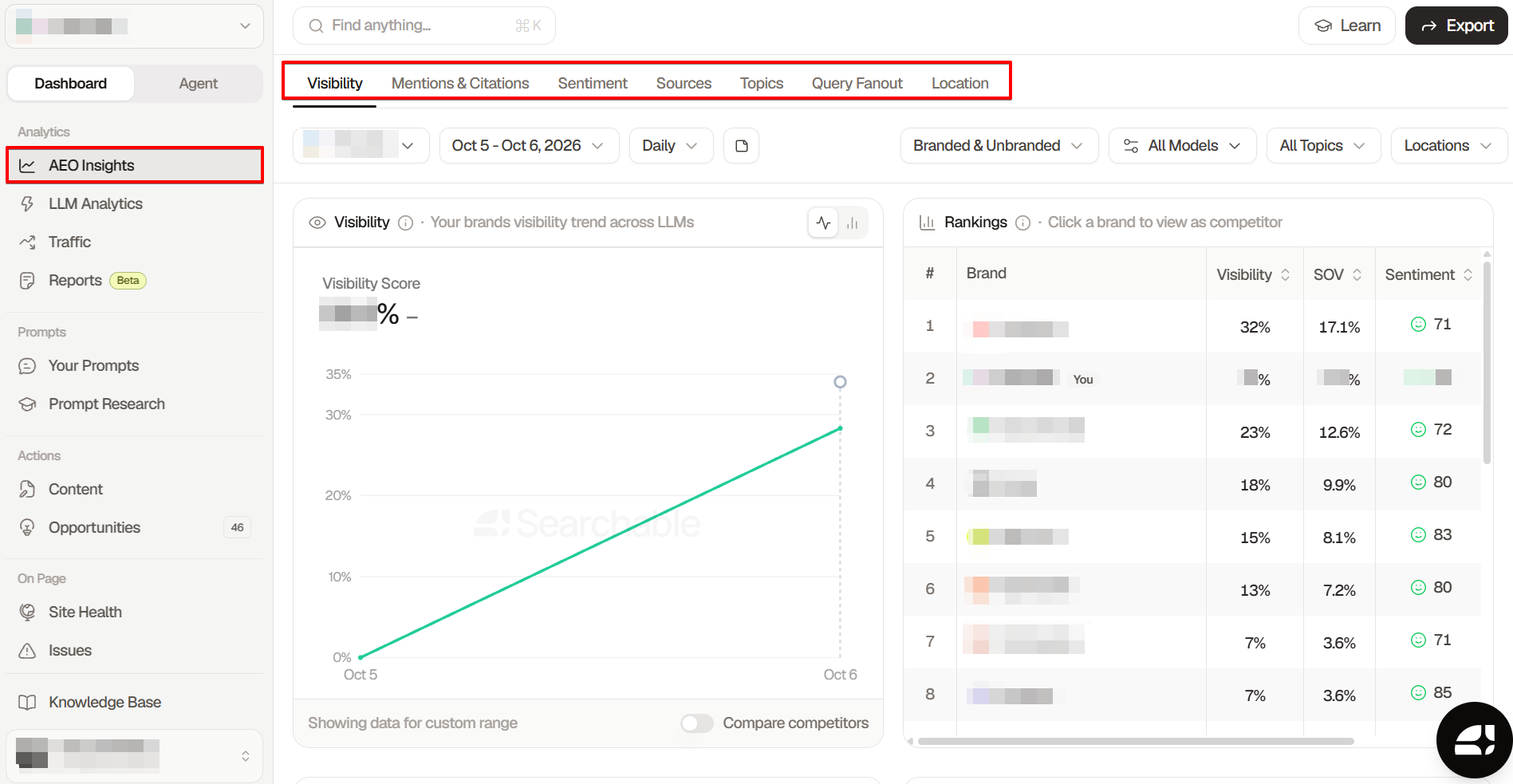
AEO Insights is Searchable’s analytics dashboard for AI search. It tracks how often your brand appears in AI answers and which competitors AI recommends more frequently. It also digs into the reasons behind those results: which websites AI pulls its information from, whether it talks about your brand positively or negatively, and which subjects, questions, and markets bring you the most visibility.
Searchable tracks nine AI platforms through its AEO Insights analytics layer, but only three come with every plan. The rest cost extra.
- Included in every plan: ChatGPT, Google AI Overviews, Perplexity
- Paid add-on on every plan: Gemini, Claude, Google AI Mode, Microsoft Copilot, Grok, DeepSeek (Claude and Grok also come in cheaper “Lite” versions)
This is where AI visibility platforms differ most. SE Visible by SE Ranking, for instance, includes Gemini and Google AI Mode on every plan alongside ChatGPT, and AI Overviews. And it also plans to expand coverage to Claude and Copilot.
So, keep in mind that every view in AEO Insights reports only on the ones you pay for, and Searchable’s base plan covers just three. So if your audience leans on Gemini or AI Mode, you’ll need add-ons, and “nine engines” starts to feel like a stretch.
Inside AEO Insights, seven views cover the actual measurement work:
- Visibility: rankings, a visibility score, share of voice, sentiment, and average position across AI platforms
- Mentions & citations: a full log of AI responses to your prompts, showing where your brand is mentioned, where it’s cited, and where it’s missing, along with trend charts and a buyer-stage funnel
- Sentiment: brand perception against competitors, the evidence AI models cite, and how accurately they describe your brand facts across models
- Sources: top cited domains, content types, and source URLs
- Topics: topic-level rankings, AI platform-by-platform performance, and topic gaps worth targeting
- Query fanout: the follow-up queries AI platforms generate when they answer prompts in your category
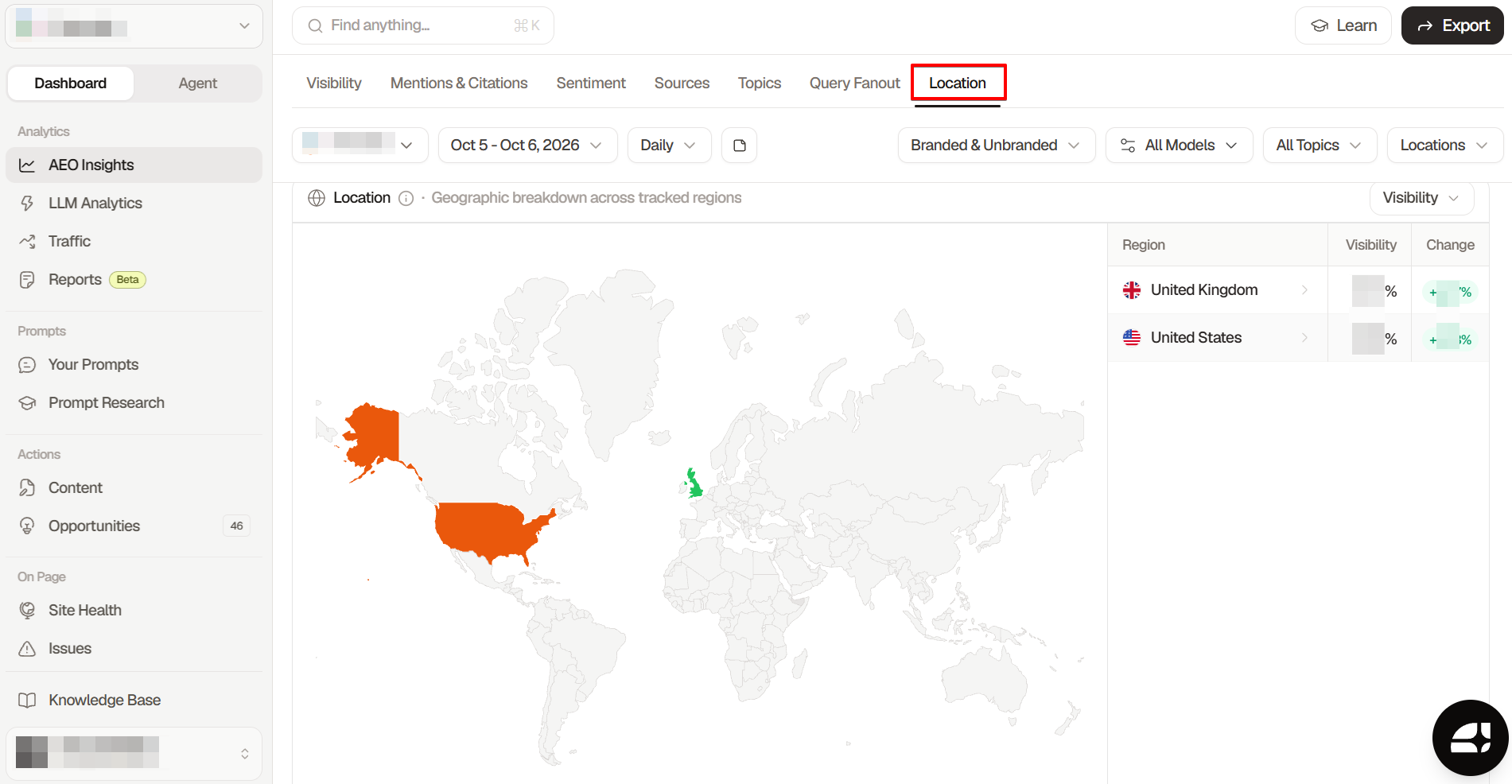
- Location: geographic visibility, share of voice, sentiment, and country trends
With the Location view, you can break your visibility down by country and region, and you aren’t limited to one market on any plan. That’s a real plus if you’re tracking an international brand.
One Trustpilot reviewer summed up why that depth is useful in practice: “It turns AI search visibility into real action. You can see where you show up in AI answers, why you’re there or not, and exactly what to do next,” wrote Andrew A. in a five-star review.
For comparison, SE Visible by SE Ranking takes a more granular approach to location: it covers 42 countries, and you can narrow tracking down to a single city or region inside its brand visibility dashboard.
What does Searchable’s LLM analytics feature track?
Searchable’s LLM analytics feature tracks AI-referral traffic to your own site: which AI bots crawl it, which AI engines send you visitors, and which pages those visitors land on.
Put simply, LLM analytics looks at AI activity on your own website. It counts the people who arrive from AI engines and the bots that crawl your pages, then breaks that down by platform, landing page, and device so you can follow the trends over time.
That’s a different question than tracking whether your brand gets mentioned somewhere in an AI answer. LLM analytics measures what happens after the mention, on your own domain.
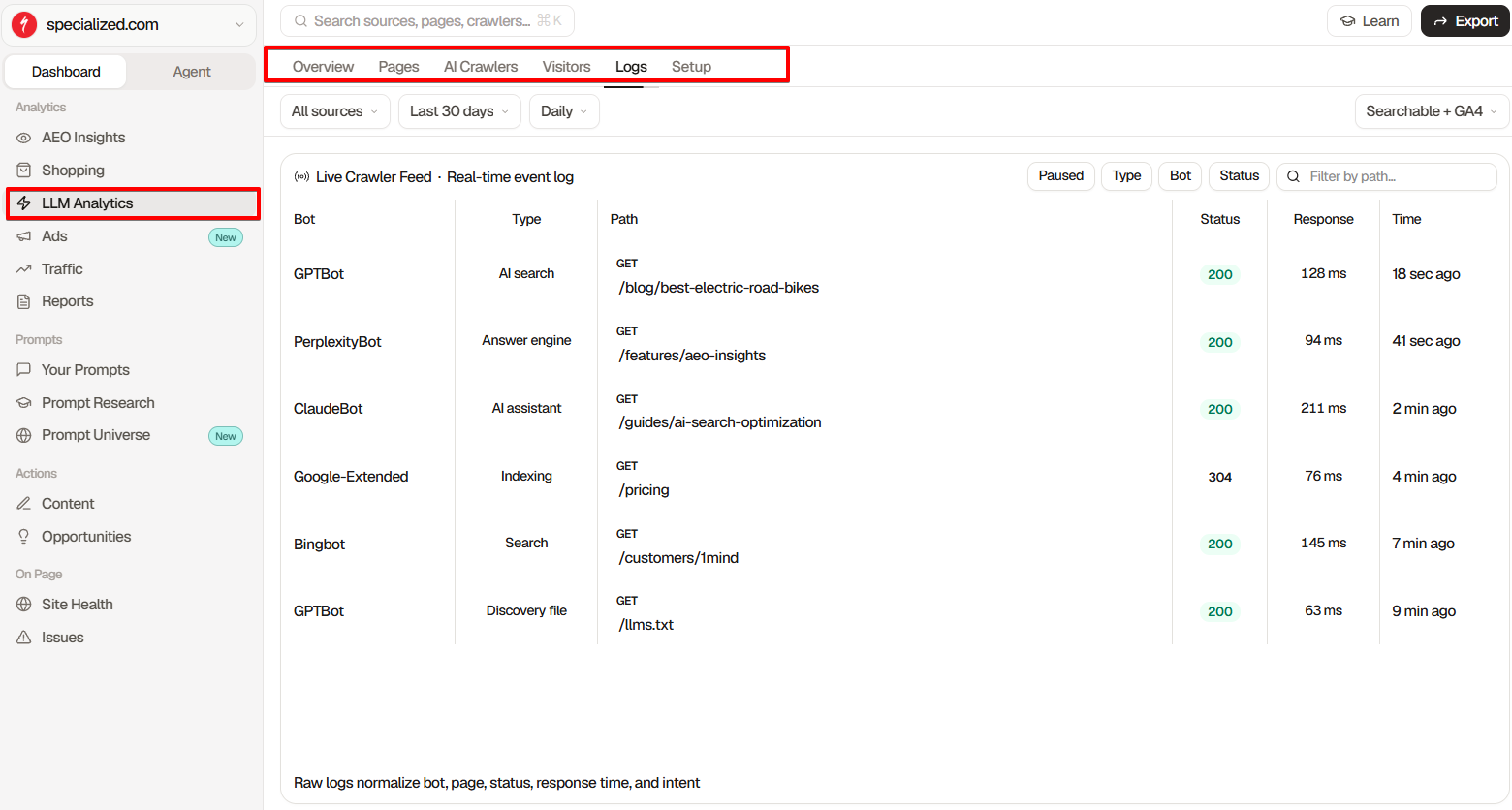
The dashboard is split into six tabs: Overview, Pages, AI Crawlers, Visitors, Logs, and Setup. Overview gives you the headline numbers: AI-referred visitors, and their share of your traffic. Pages and AI Crawlers let you drill into individual URLs and crawl numbers, and Setup is where you connect your hosting platform or CDN.
The Visitors tab shows how much of your human traffic comes from AI engines. It combines Searchable’s own tracking with GA4 to count total human visitors, then shows how many of them came from AI platforms and which one sent the most. It also pulls search impressions from Google Search Console and Bing and shows average engagement time. Below that, you’ll find the pages getting the most human traffic and a breakdown of AI referral sessions.
The Logs tab is the most hands-on view. It’s a live feed of every AI bot request as it happens, showing which bot hit your site (GPTBot, ClaudeBot, PerplexityBot, and others), what kind of visit it was, which page it requested, the server’s status code, how long the response took, and when it happened. You can pause the feed or filter it by bot, visit type, status, or URL path. That makes it easy to catch problems quickly, like an AI crawler getting errors on key pages.
That crawl-to-referral field carries more weight than it looks. It’s the difference between confirming a bot visited your site and confirming that visit turned into a real referral, which is the distinction that decides whether fighting for AI crawler access is worth the engineering time.
For client or exec reporting, this gives you concrete numbers: AI-referred sessions and their share of your traffic. Revenue and conversions aren’t part of this dashboard, so you’d still pull those from GA4.
How does Searchable handle prompt research and AI-intent tracking?
Searchable’s prompt research, part of its Prompt Intelligence feature, suggests buyer-intent prompts for your category, grouped by topic, with a volume and difficulty indicator for each one.
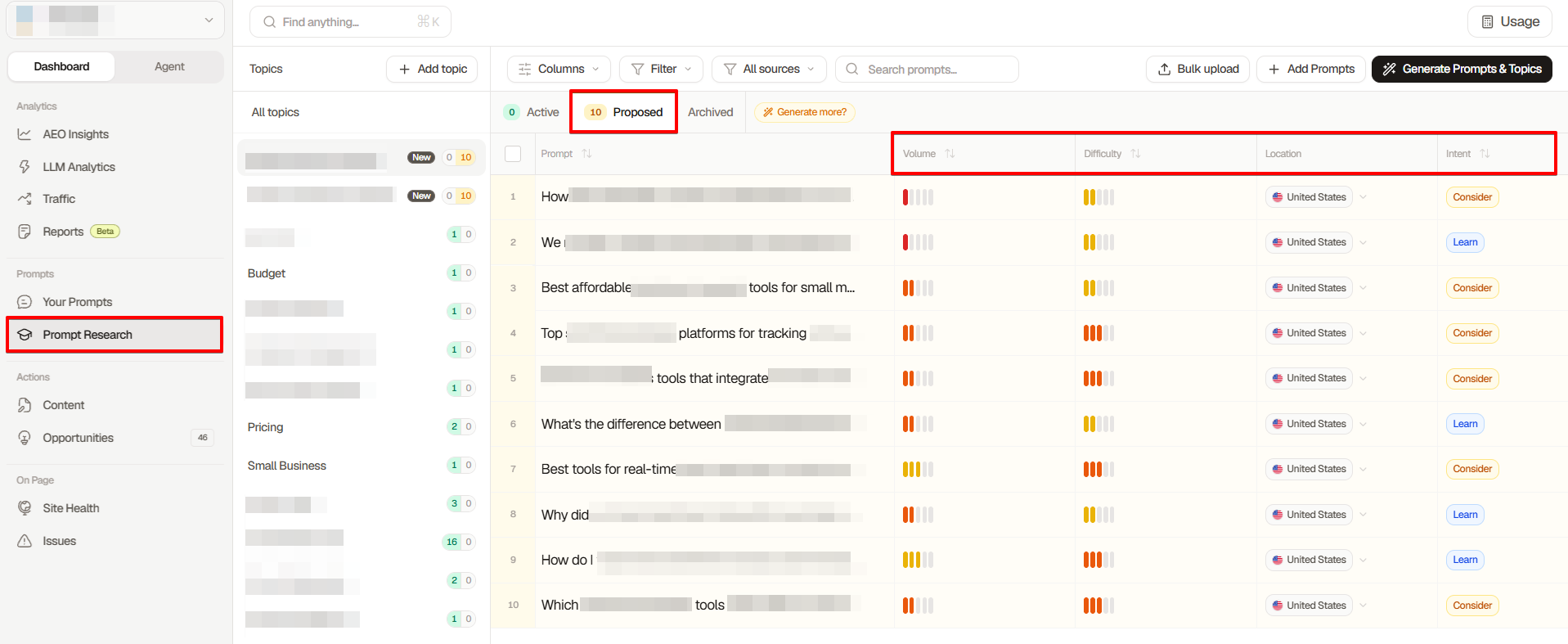
Instead of tracking a fixed set of keywords, the feature works from prompt volume: the actual phrasing someone types into ChatGPT or Perplexity while deciding between vendors. That’s a different starting point than a rank tracker, which still ties back to a keyword list you defined months ago.
To build that list, Searchable looks at your knowledge base, your competitors, and wider market signals. You go through the suggestions, keep the ones that fit, and turn them into tracked prompts. Each suggestion is tied to a country, so you can research prompts market by market.
That matters because people talk to AI tools differently than they search Google. Questions are longer and more specific, and the same need can be phrased dozens of ways. A prompt list built around your category gives you a better starting point than guessing which questions to track.
The harder part is knowing how much to trust the volume data. Volume and difficulty show up as indicators rather than exact figures, so it’s hard to tell how precise they are.
Aleyda Solís, an independent international SEO and GEO consultant at Orainti, raised this caution on Jan. 13, 2026, in a conversation with Humans of MarTech: individual prompts, she points out, “scatter across millions of variants,” which makes any single tracked phrase a narrow proxy for how people ask a question.
So, it’s better to treat Searchable’s suggestions and volume indicators as a direction, not an exact count. They’re a solid, topic-based starting point for content and messaging, but not a number to report.
How good is Searchable’s competitive benchmarking?
Searchable doesn’t have a standalone competitive benchmarking module. Instead, competitor comparison runs through AEO Insights, covered above, and shows up in six of its seven views:
- Visibility ranks your brand against competitors on visibility score, share of voice, sentiment, and average position.
- Mentions & Citations shows detailed position distribution across rivals and prompts where your brand wasn’t mentioned.
- Sentiment offers head-to-head framing against one competitor at a time.
- Sources tracks competitor source gaps: domains and URLs where AI platforms cite competitors while your brand is missing or underrepresented.
- Topics covers topic-level rankings, opportunity gaps, and competitive positioning.
- Query Fanout ranks the brands and products that appear in the follow-up searches AI platforms run when answering your prompts. Your brand sits in that ranking alongside competitors.
SE Visible organizes this differently. Its competitor view puts your brand and tracked competitors side by side in one place, and you can compare across all engines or filter to one and see visibility, Share of Voiсe, average position, and net sentiment with progress over time.
The Sources and Sentiment views go deepest. That matters more than a plain visibility score. Knowing you’re invisible for a prompt is one read. Knowing which competitor’s page an AI platform cited instead of yours is a more specific one, and it’s the detail a client report can actually use.
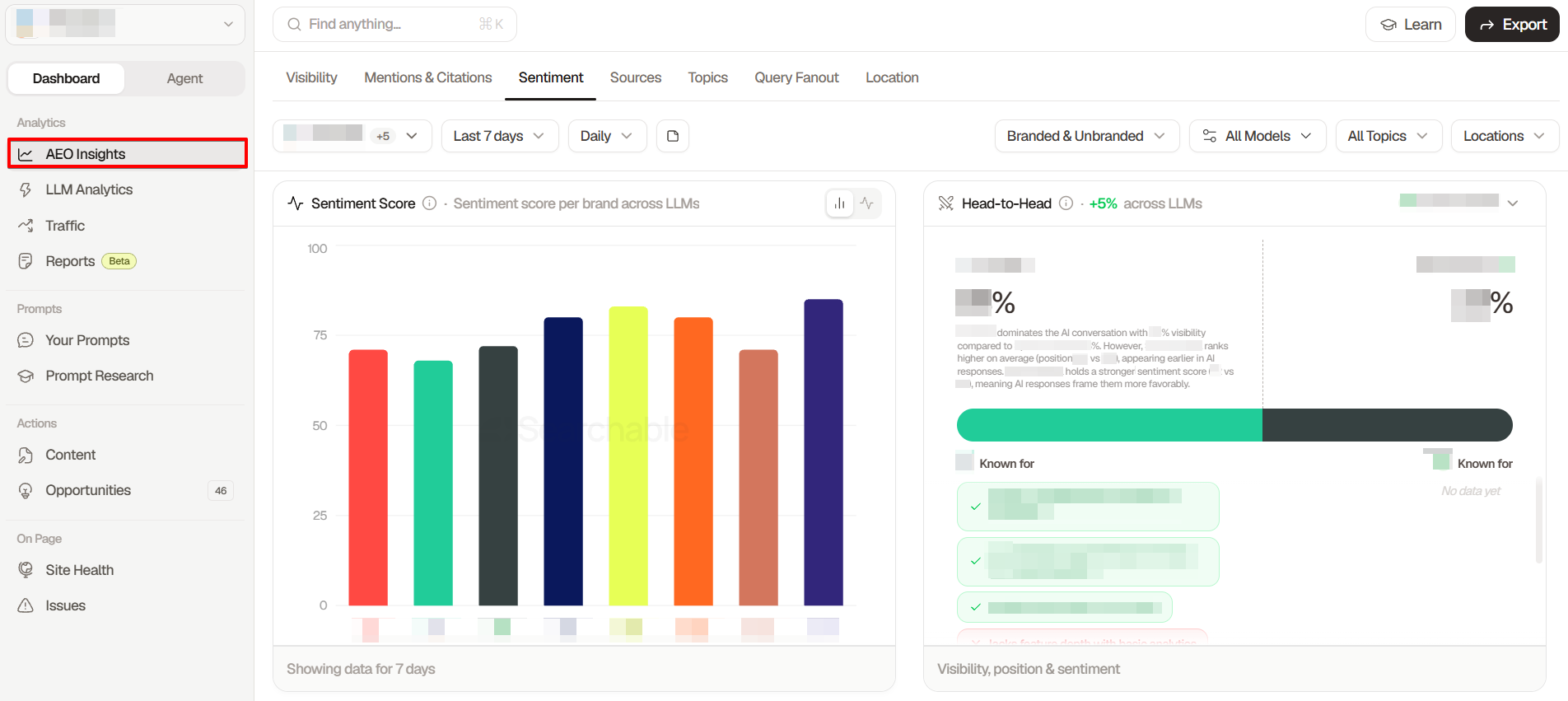
The trade-off is that competitor data isn’t gathered in one place. To get the full competitive picture, you have to click through six separate tabs and piece the story together yourself, which slows things down when you need a quick head-to-head read or a single view for a client report.
How do Searchable’s content studio and technical audits hold up?
Searchable bundles a content studio and a technical-audit analysis into every plan. Both tools scale by tier. The Pro tier includes 20 articles per month and 200 page audits per month. Enterprise raises that to 200 articles and 3,000 audits per month.
The content studio is a writing agent that drafts long-form articles as well as shorter formats like LinkedIn posts. Each draft gets an AI Readiness score out of 100, with issues flagged as high or medium severity. Drafts export to Markdown, HTML and other text formats, or directly to WordPress and Webflow.
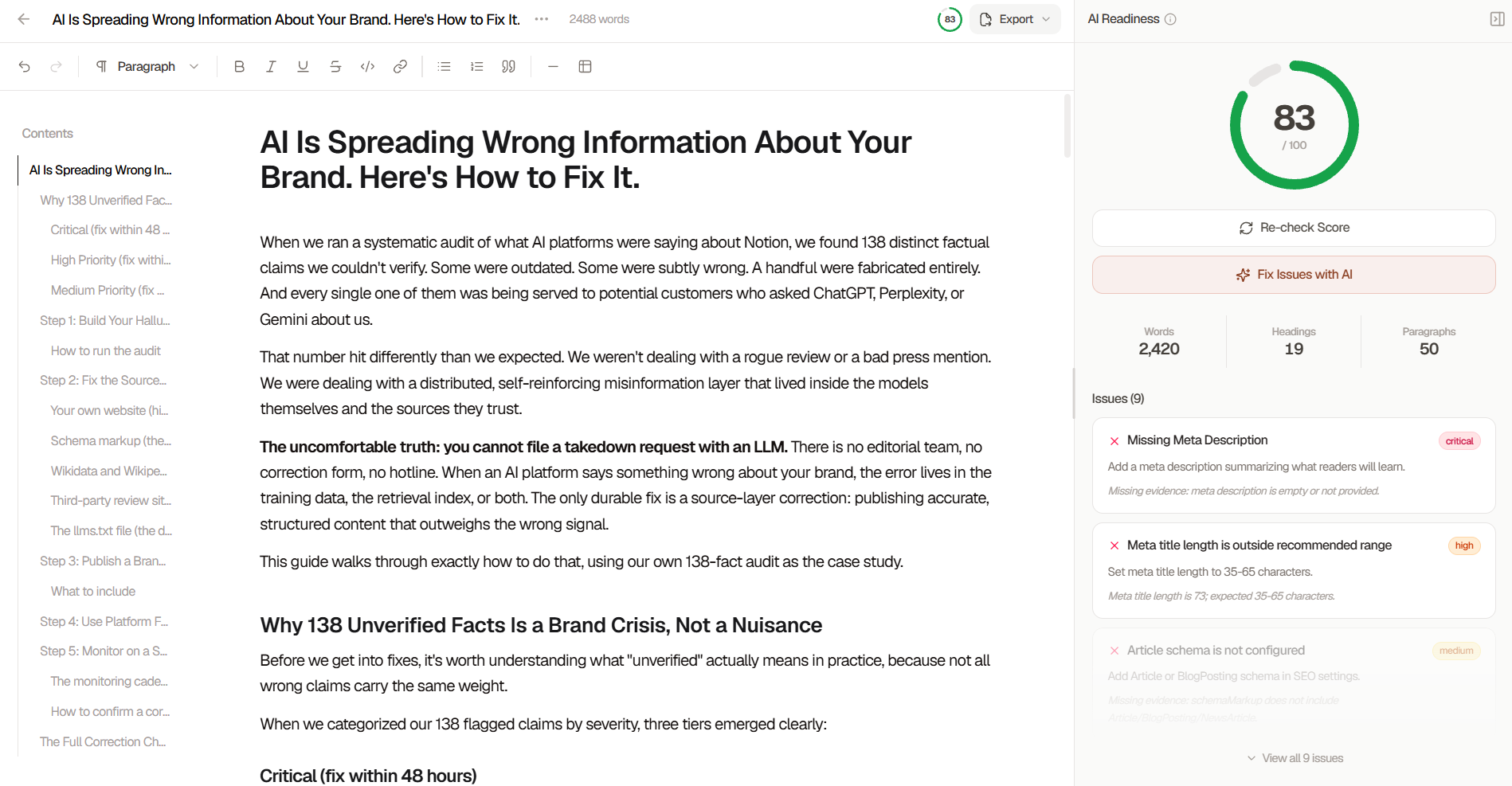
The audit tool runs on a separate scale, split across two tabs:
- Site Health lists every page on the site with its issue count, separate Technical and AEO scores, and when it was last audited. It also shows an overall site score framed against percentile bands like the top 1% or top 10% of sites.
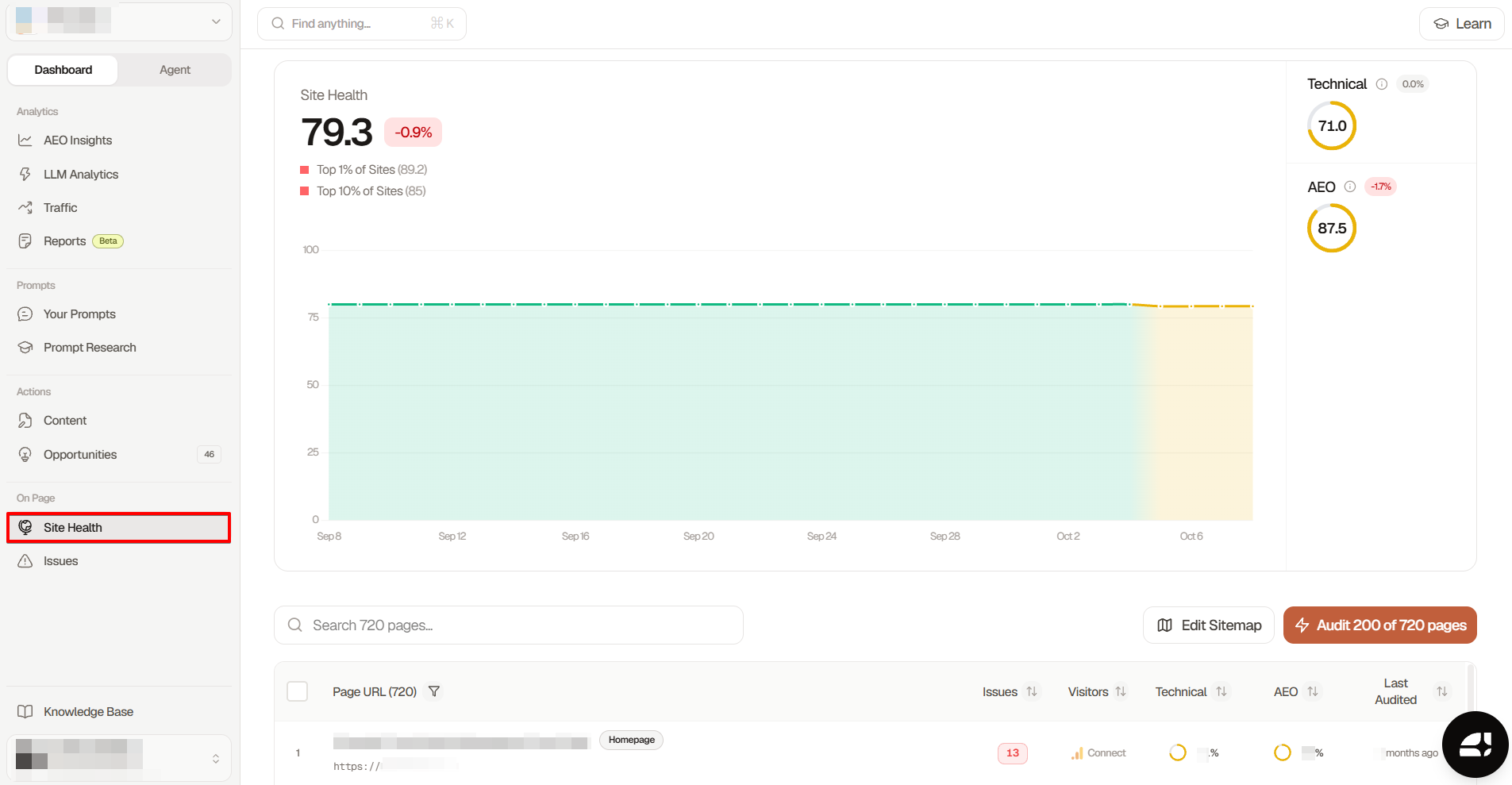
- Issues groups everything the audit finds into Technical, Content and AEO, and ranks it on four severity levels: critical, high, medium and low.
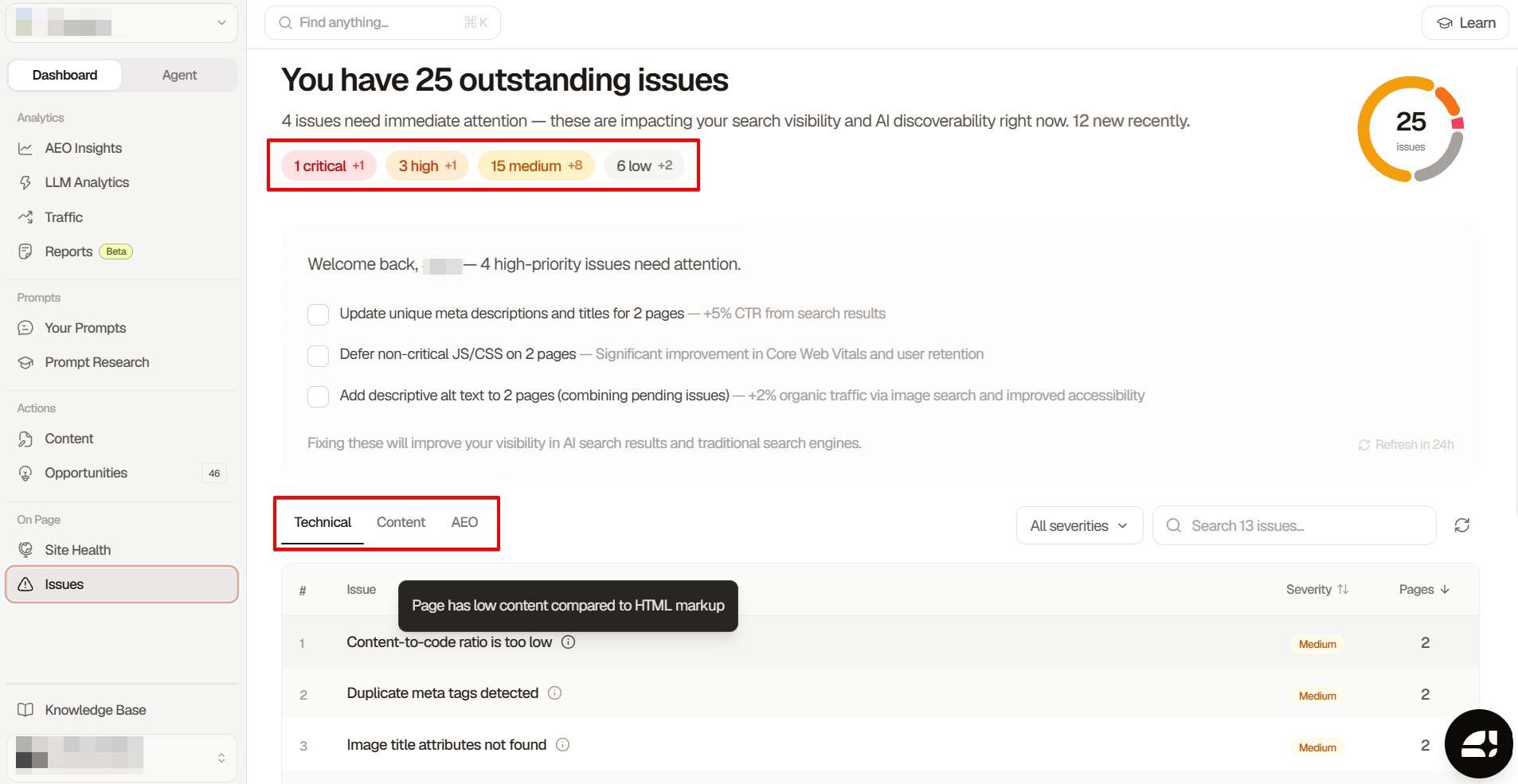
Some of the issues it flags:
- a robots.txt file blocking AI crawlers such as GPTBot
- missing or invalid FAQ structured data
- page load times slower than the recommended 2.5-second LCP
Independent reviews concentrate on the content editor, and the pattern there isn’t flattering. Melissa, a Trustpilot reviewer, wrote: “This thing is a hot mess. The content editor breaks EVERY TIME you put in the EEAT info, and it hallucinates a schema instead of using it.“
What does Searchable’s analytics and stack integrations cover?
Searchable connects to your existing analytics and content tools, and feeds site-health data into AI coding assistants, and the reviewers who mention these connections rate them well.
On the analytics side, Searchable connects to GA4, Google Search Console, and Bing Webmaster Tools to track the traffic AI platforms send to your site, so AI referrals sit next to its own AI-visibility numbers instead of living in a separate dashboard.
On the content side, Searchable exports directly to WordPress, Shopify, and Webflow, closing the loop between what the content studio produces and where that content gets published.
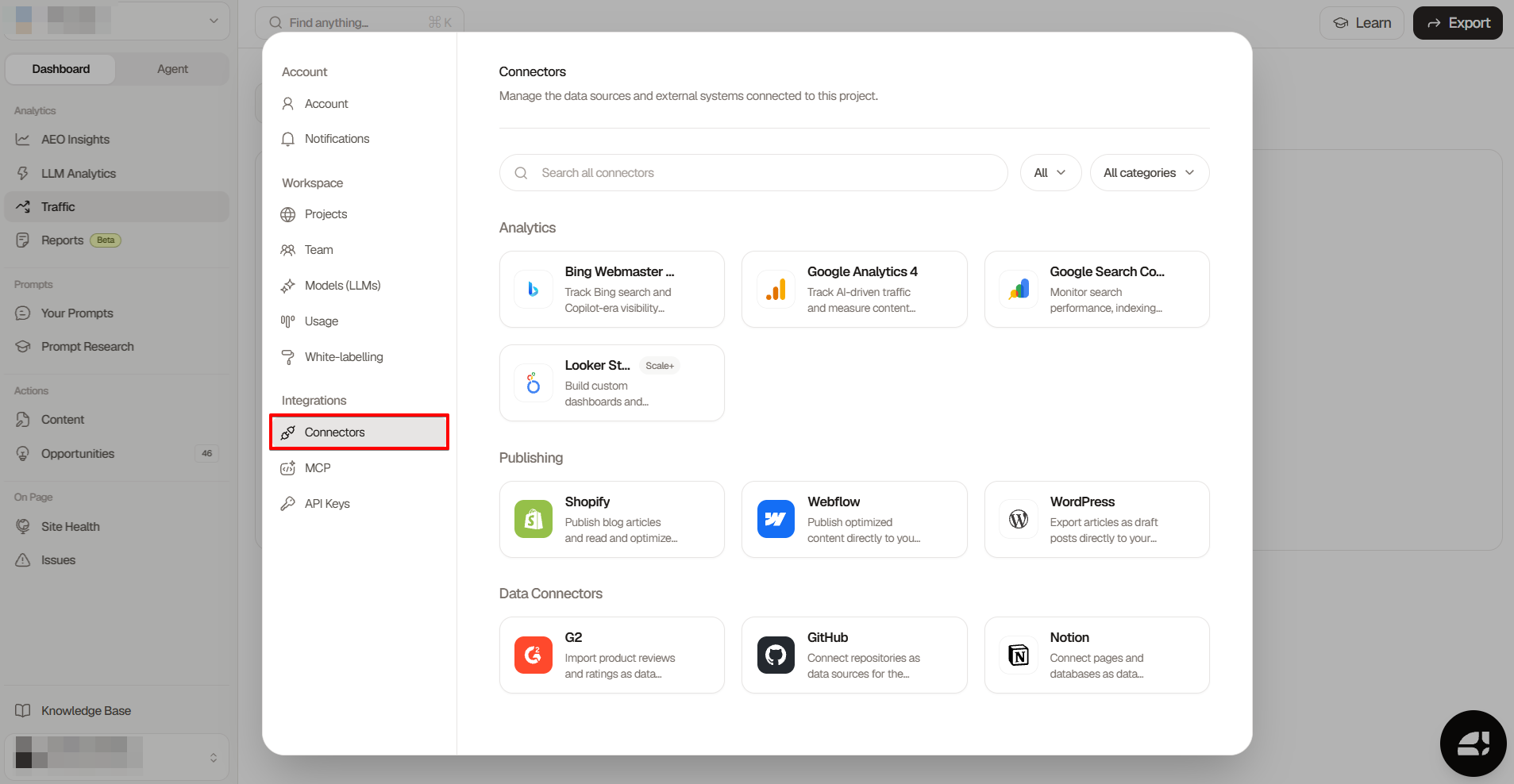
For technical teams, an MCP connection pushes site-audit findings directly into coding assistants such as Cursor and Claude Code, instead of requiring someone to copy issues out of a dashboard by hand.
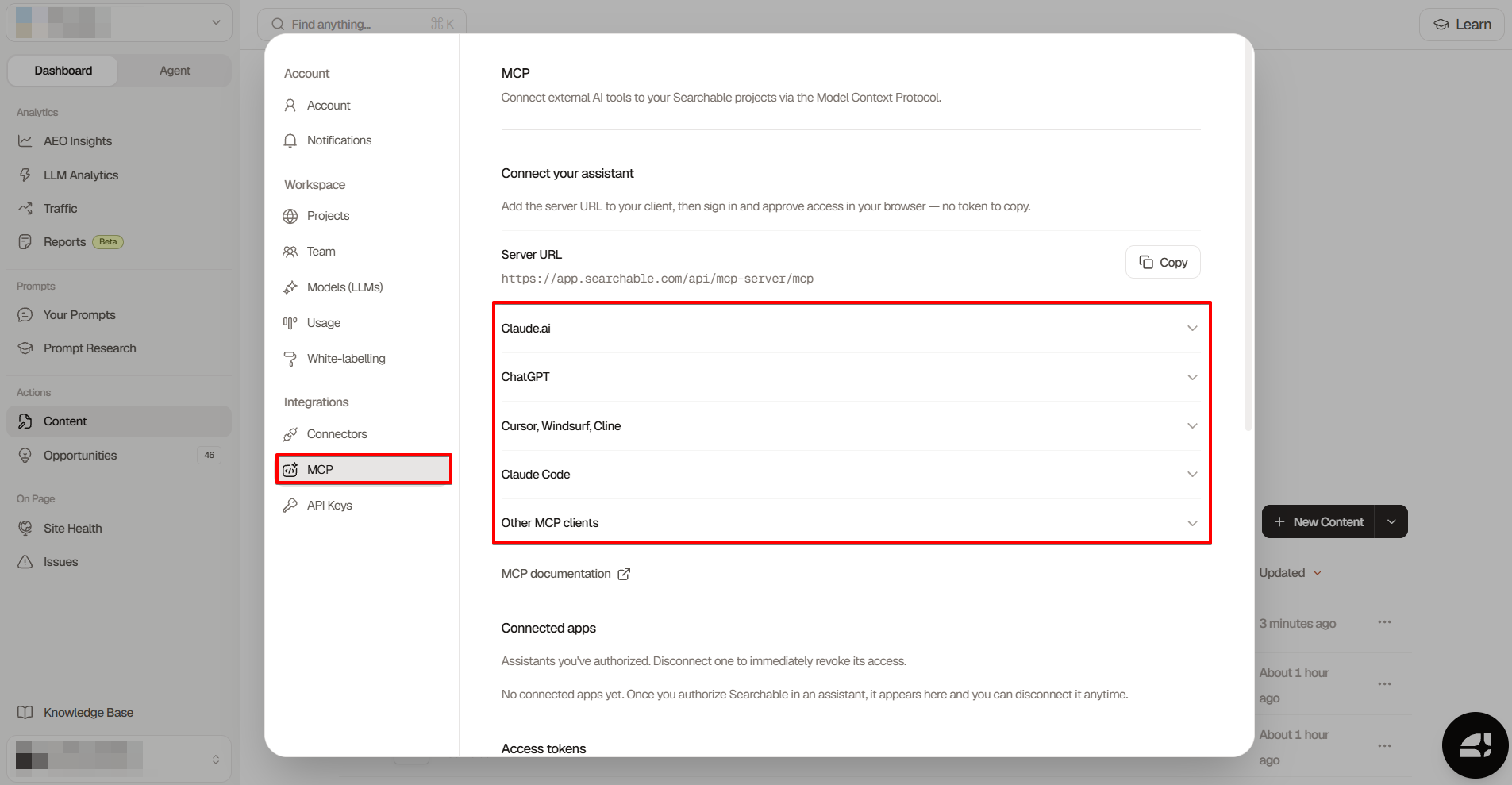
Integrations scale by plan. Scale and above subscriptions add Data Studio for reporting. The Custom tier unlocks Salesforce attribution, HubSpot sync, Slack alerts, Zapier, and bespoke API builds, so CRM-level revenue tracking requires a sales conversation.
Reviewers who mention the integrations rate them well. One says the GA4, Search Console and WordPress connections “make it easy to move from insight to action very quickly” (Trustpilot). An agency SEO lead called the MCP and Looker Studio launches “wonderful news” (G2).
What does Searchable’s AI shopping feature track?
Searchable’s AI shopping feature tracks how your products appear in AI-generated shopping results, from product share down to the exact prompts that trigger a recommendation.
That’s a narrower, more commercial question than general brand-mention tracking. This feature isolates whether AI recommends your specific product, and which competing products show up in the same result.
Specifically, it tracks:
- Product share and visibility in AI shopping results
- Top competitor brands appearing in AI product carousels
- Retailer share within those results
- Specific AI-recommended products, each listed with title, price, rating, merchant, category, platform, and how often it appears
- Which of your tracked shopping-intent prompts trigger product results, which AI models return them, and the top recommended brand for each prompt
Together, this shows which retailer AI points buyers to and what buying-stage language it links to your category, without running shopping queries by hand. AI shopping data is included on every plan, but Gemini and Google AI Mode are paid add-ons, so check which platforms your plan covers. It’s built for ecommerce teams and the agencies that report to them; if you don’t sell products, you can skip it.
How much does Searchable cost?
Searchable has separate plans for brands and agencies. Brand plans run from $125 to $999 a month, and agency plans from $250 to $999, with custom pricing available through sales on both. Plans bill monthly by default, and switching to annual billing in your account settings saves 20% on any plan.
The Brand tiers are the following:
- Pro, $125/month: 100 tracked prompts, 20 articles a month, 200 page audits a month, 1 project.
- Scale, $400/month: 500 tracked prompts, 80 articles a month, 1,000 audits a month, 10 projects. Scale is also where Data Studio integration and white-label reports switch on.
- Enterprise, $999/month: 1,250 tracked prompts, 200 articles a month, 3,000 audits a month, unlimited projects.
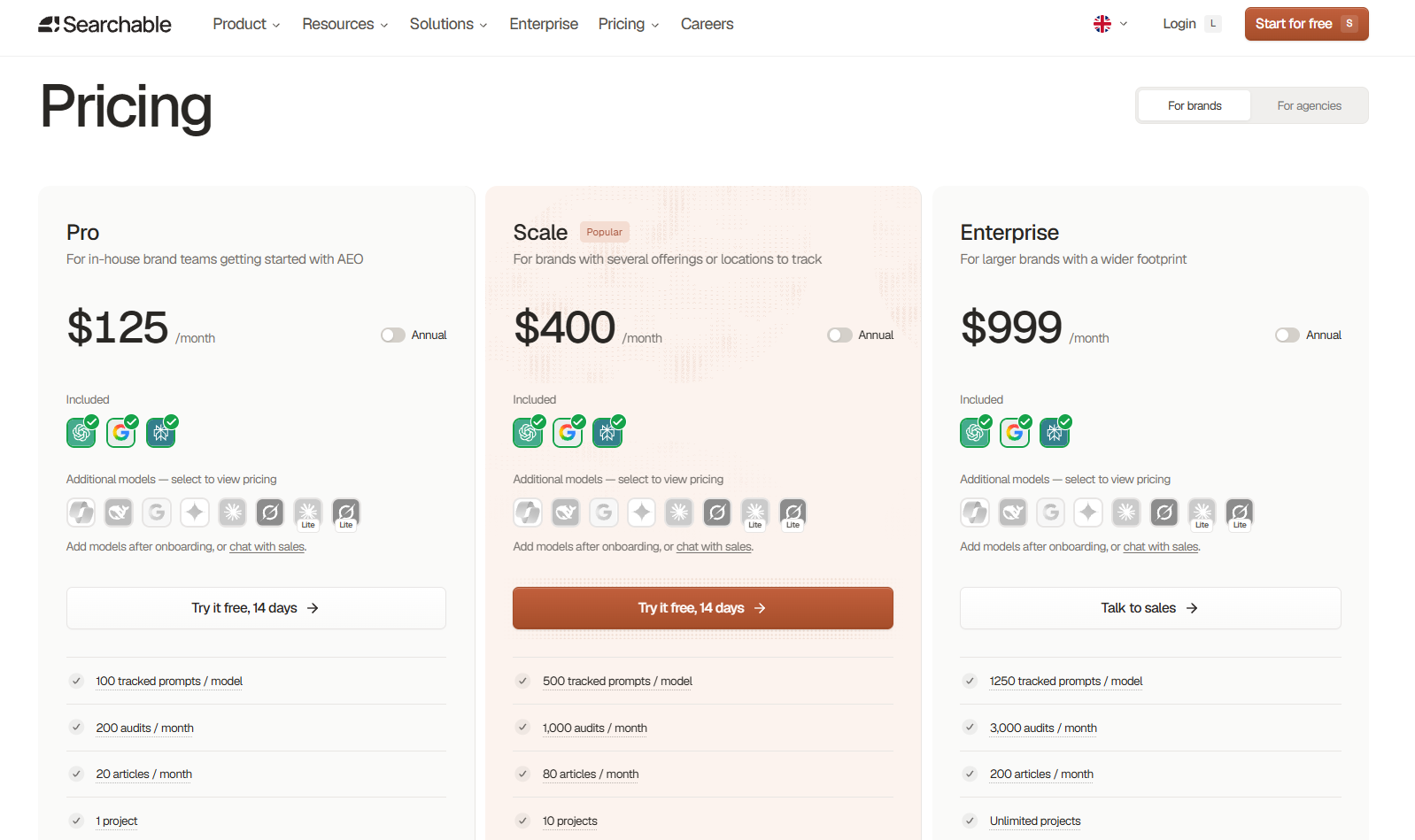
A Custom plan sits above Enterprise with no published price, and Pro and Scale both come with a 14-day self-serve free trial.
The Agency tiers:
- Launch: $250/month
- Growth: $400/month
- Enterprise Agencies: $999/month
Engines are where the price can climb. Every plan includes ChatGPT, Google AI Overviews and Perplexity. Everything else is a paid add-on, on every plan, including Gemini, Google AI Mode, Claude, Microsoft Copilot, Grok and DeepSeek.
The add-on cost scales with your tier and depends on which engine you pick. For example, if you’re adding Gemini, the monthly price went from $125 to $175 on Pro, from $400 to $650 on Scale and from $999 to $1,624 on Enterprise. A brand that wants to track ChatGPT, Gemini and Claude on Scale should budget well above the $400 headline price.
SE Visible takes a different approach. Every plan includes all supported AI engines plus multi-country and multi-language coverage, so the price you see is the price you pay for engine coverage.
Who is Searchable a good fit for?
As our Searchable review shows, this platform suits teams that want to act on their AI visibility data in the same tool, not just monitor it. Most of its value comes from what you can do after spotting a gap, so how well it fits depends on which of those workflows your team will actually use.
Content teams get the most from the Content Studio. It drafts articles and shorter formats like social media posts, scores each draft for AI readiness and exports straight to WordPress or Webflow. A team publishing regularly to win AI citations can plan, write and ship from one place.
Technical SEO and development teams benefit from the site audit. It separates technical and AEO issues per page and flags problems. Each issue can be sent to coding assistants such as Cursor or Claude Code. Teams that want to see how AI bots crawl their site can also connect server logs from hosts like Vercel or Cloudflare.
Agencies get Data Studio and room to track prospects as well as clients.
Ecommerce brands get a shopping view showing which products and retailers AI recommends.
So, if you only need a dashboard of brand mentions, much of what you’d pay for here would go unused.
How does Searchable compare to other AI-visibility tools?
SE Visible by SE Ranking is a direct Searchable alternative worth evaluating side by side: similar core AI-visibility tracking, with more AI engines included on every plan.
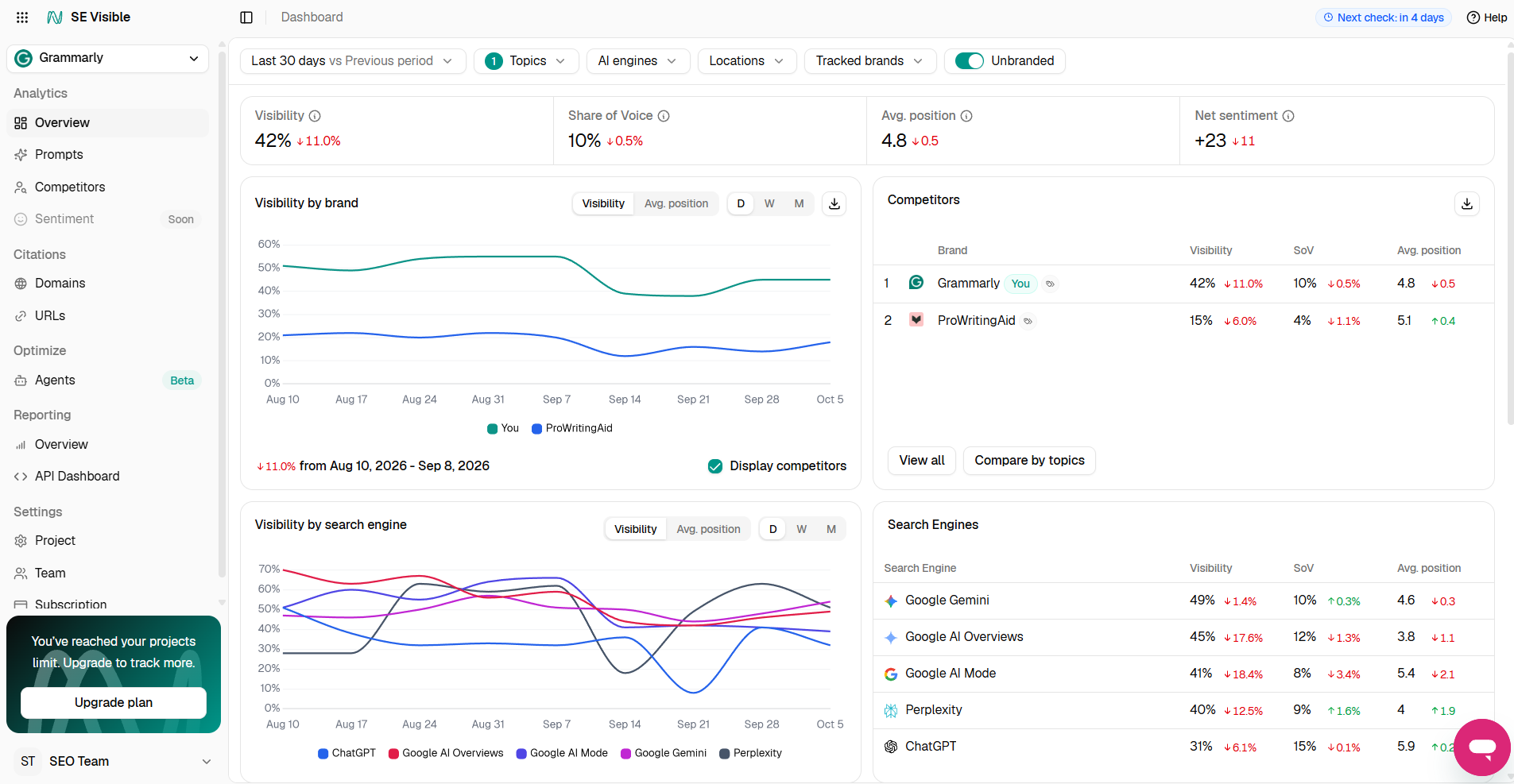
Both tools cover the same core ground. Each tracks how often AI answers mention your brand, your share of voice against named competitors, and which sources AI platforms cite. Where they differ is how competitor data is organized. SE Visible has a dedicated Competitor Benchmarking tab that puts the comparison in one view. In Searchable, competitor metrics are spread across its AEO Insights tool.
Another difference is engine coverage. SE Visible includes: ChatGPT, Gemini, Google AI Mode, and Google AI Overviews on every plan. Searchable includes three (ChatGPT, AI Overviews and Perplexity) and charges extra for the rest.
That difference carries into data volume. Searchable’s prompt allowances apply per engine, while each SE Visible prompt runs across all five engines. At ten projects, SE Visible’s Plus plan analyzes about 150,000 AI answers a month. Searchable’s Scale plan analyzes about 45,000 across its three included engines. If your reports depend on a broad sample of answers, that gap shapes how much you can say with confidence.
For agencies, the gap shows in price. Five client projects cost $189 a month on SE Visible’s Core plan against $250 on Searchable’s Launch plan for agencies. Ten projects cost $355 on Plus against $400 on Searchable’s Growth agency plan.
Searchable has the edge if you need more than five engines and are willing to pay for add-ons such as Claude, Copilot or Grok. It offers content and audit tools that SE Visible doesn’t, those live in SE Ranking’s platform built by the same team. With both platforms you get traditional search, AI visibility, technical audits, content tools covered.
For a wider field than just these two, our roundup of the best AI visibility tools covers the category with the same feature-by-feature lens.
Frequently asked questions
Searchable is a good fit for teams that want to create content, fix technical issues, and track AI visibility in one tool. It’s less suited to teams that only need visibility tracking, because you’d pay for features you won’t use.
Every plan includes ChatGPT, Google AI Overviews and Perplexity. Gemini, Google AI Mode, Claude, Microsoft Copilot, Grok and DeepSeek are available as paid add-ons, and the price depends on which ones you add.
Brand plans start at $125 a month and agency plans at $250 a month, with custom pricing for larger teams. Annual billing saves 20%. Base plans include three AI engines, and the others are paid add-ons that can raise the monthly price noticeably.
SE Visible by SE Ranking is a close alternative. It includes more AI engines on every plan, provides competitor data, tracks prompts, sources, and sentiment. Other tools often compared with Searchable include Profound, Peec AI, and AthenaHQ. Compare engine coverage, prompt limits and add-on costs, not just the entry price.
Bottom line
It comes down to what you need most. If you want content creation, AEO page audits and AI visibility tracking in one place, and you’re happy to pay extra for engines like Gemini or Claude, Searchable is a strong pick. Just check the final price with your add-ons before you sign.
If your main job is building AI search visibility strategy and showing clients how they stack up against competitors, SE Visible by SE Ranking makes that easier. It has a dedicated competitor benchmarking view and includes more AI engines on every plan. Whichever you choose, double-check the numbers before they go into a client deck.