Profound vs Peec AI: a capability and fit comparison

If you’re shortlisting AI visibility platforms, Profound and Peec AI usually end up side by side. Both track how your brand shows up in AI answers, but they’re built for different buyers. Profound is an enterprise platform. It tracks up to nine AI engines and pairs that data with an AI assistant and agents that turn findings into content. Peec AI is the self-serve option. It starts at $95 a month, tracks three AI models of your choice, and makes client reporting easy. The right pick depends on how your team buys and what it does once the numbers come in.
This comparicon article goes feature by feature. Where both tools do the same job, we put them side by side. Where only one has a feature, we cover it on its own.
Profound and Peec AI at a glance
Both are young tools in a young category, and both move fast enough that agencies evaluating AI-visibility platforms now shortlist them together. Here is a quick Peec AI vs. Profound quick comparison:
| Feature | Profound | Peec AI |
|---|---|---|
| Pricing model | Free Trial, then custom Enterprise (after a demo). Agencies: Agency Growth $99/mo + $399 per client workspace | Self-serve: Starter $95, Pro $245, Advanced $495/mo. Custom Enterprise. Credit-based agency plans from $245/mo |
| Free trial | 7 days | 7 days |
| AI engines tracked | Up to 9 on Enterprise: ChatGPT, Perplexity, Google AI Mode, Gemini, Microsoft Copilot, DeepSeek, Claude, Google AI Overviews, Exa Search. | 3 of your choice on Starter, Pro and Advanced, from ChatGPT, Google AI Mode, Google AI Overviews, Microsoft Copilot, Gemini and Naver AI. Extra models $35–$165/mo. Up to 13 on Enterprise, adding Perplexity, Claude, Grok, DeepSeek, Mistral and others |
| Tracking frequency | Daily | Daily |
| Visibility, sentiment, competitors | Yes | Yes |
| Source and citation analysis | Yes | Yes |
| Prompt volume data | Yes | Yes |
| Ranked recommendations | Opportunities via Aim. Limited on Trial, unlimited on Enterprise | Actions ranked by impact, grouped into four goals |
| AI agents for content work | Profound Agents, Agent Template Marketplace, Profound Sheets | Peec Agent with pre-built and custom skills for reports and diagnostics |
| Brand knowledge base | Context Manager | Company and project context for Peec Agent |
| Fact-checking AI answers | Fact-check data feeds Aim | Yes, every plan (5–25 prompts, 5–50 facts) |
| Prompt intent tags | Informational, commercial, conversational, generative, with sub-intent breakdown (in Prompt Volumes) | Informational, commercial, transactional, plus branded/non-branded |
| Shopping analytics | Yes. ChatGPT Shopping, Enterprise only | Yes. Included in every plan. |
| AI bot and referral traffic | Agent Analytics, unlimited domains | Crawlability audit, AI referrals, crawl insights |
| API | Enterprise and Agency Enterprise only | Pro and up. Every agency plan |
| MCP | Yes | Yes. Every plan |
| Data exports | CSV and JSON on Enterprise | CSV on every plan |
| Data Studio connector | No | Yes. Advanced and up. Agency plans from Scale |
| Client reporting (agencies plans) | Pitch workspaces (10/mo) and client workspaces | View-only shareable dashboards, pitch projects |
| Seats | Unlimited on brand plans. 5 agency seats on Agency Growth | Unlimited users |
| SSO | Enterprise | Enterprise |
What Profound is built for
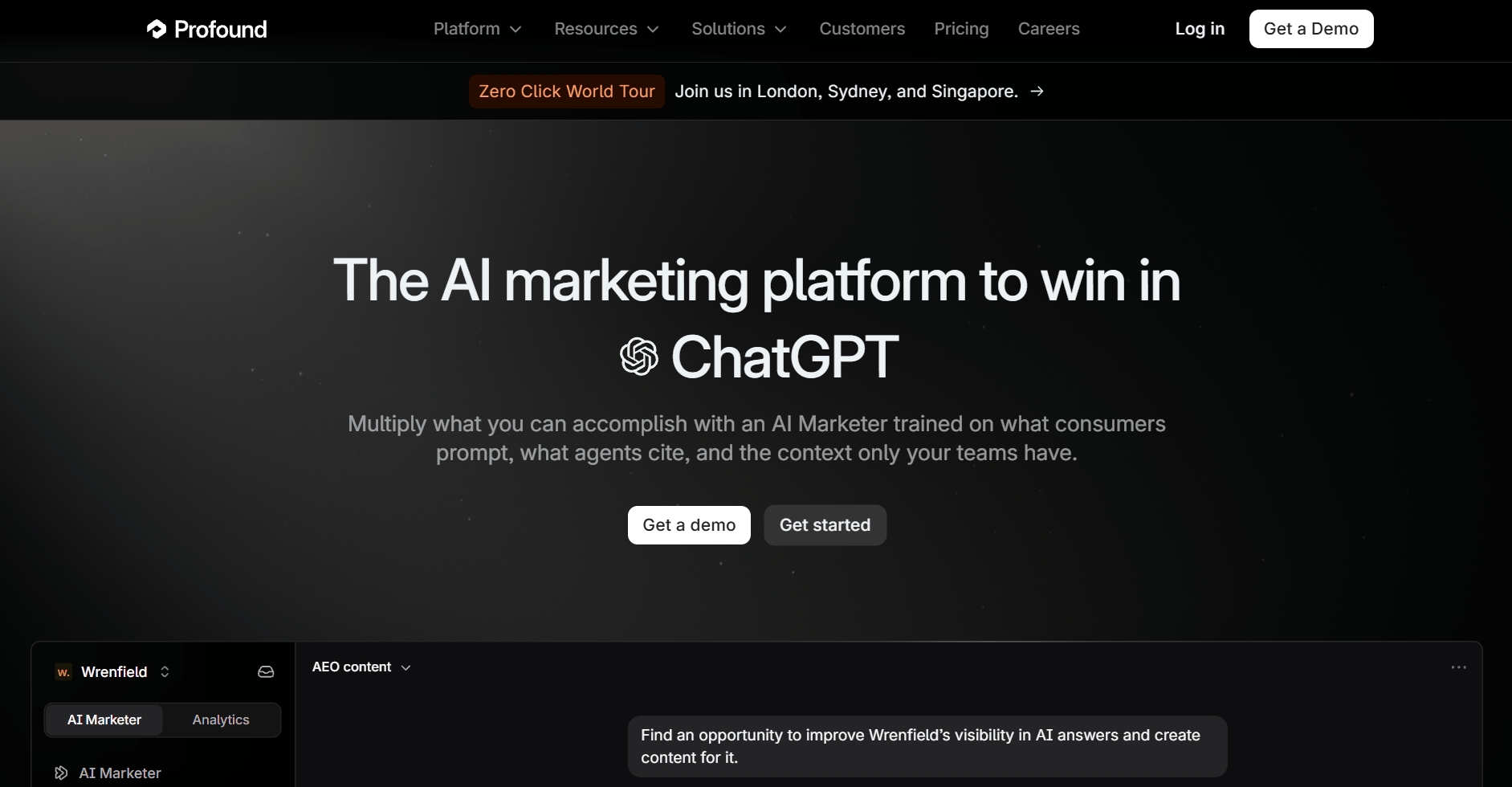
Profound is built around Answer Engine Insights, which tracks citations and sentiment day by day. That data feeds Aim, Profound’s AI marketer, which flags what’s worth acting on next. Two more layers sit on top: Context Manager, a knowledge base that keeps outputs on-brand, and Profound Agents, which handle content research, drafting and publishing.
If you want one system that both tracks AI visibility and does something about it, this is where Profound fits. Our full Profound review shows how the pieces connect.
What Peec AI is built for
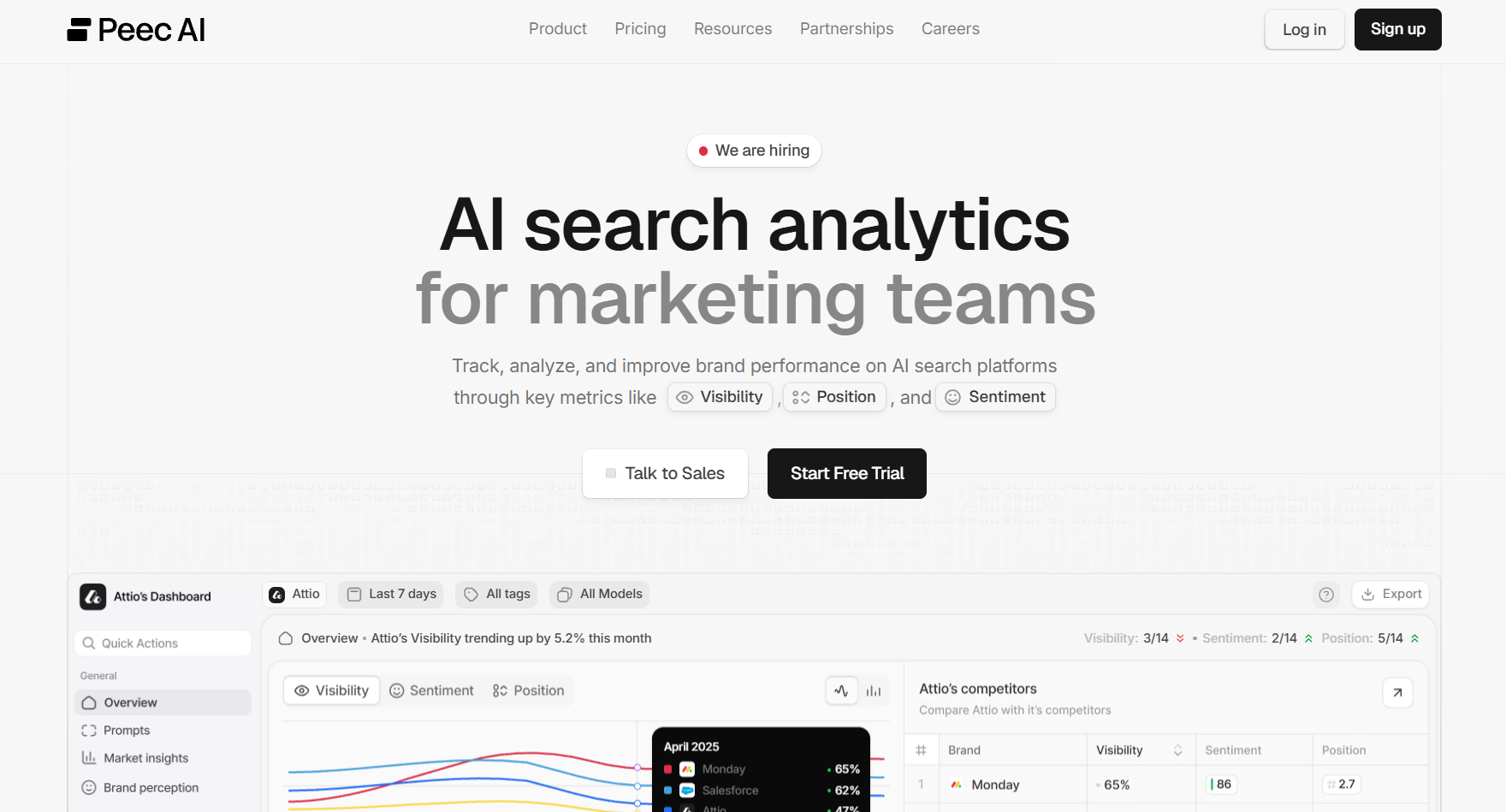
Peec AI starts with a visibility dashboard and an Actions list that ranks what to fix first. Sources, Fanouts, an Ads library, Agent analytics and Shopping round out the sidebar. You sign up without a sales call, and one analyst can run it day to day. Agencies get a view-only dashboard they can share with clients on every plan, which is a big reason account managers like it.
Our full Peec AI review covers both brand and agency setups.
AI engine and model coverage
Coverage is where the two tools split first. Profound’s Enterprise plan can track up to nine AI engines. Peec AI has you pick three models on every self-serve plan and saves its full list of up to 13 for Enterprise.
Profound’s engine coverage
Profound’s free Trial covers three engines: ChatGPT, Gemini and Google AI Overviews. It runs 50 prompts a day for seven days.
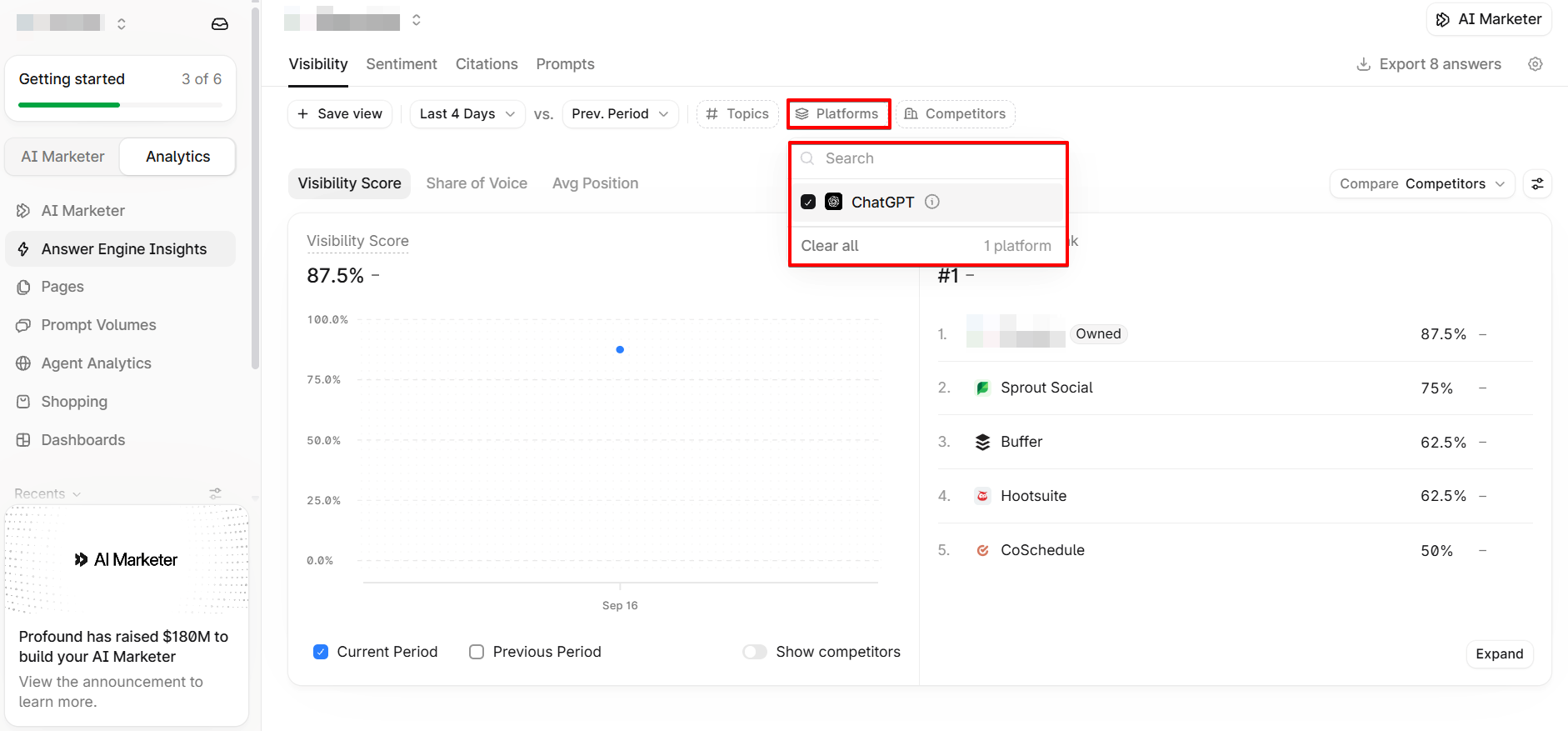
Enterprise (called Agency Enterprise on agency accounts) can track up to nine engines: ChatGPT, Perplexity, Google AI Mode, Gemini, Microsoft Copilot, DeepSeek, Claude, Google AI Overviews and Exa Search. How many you actually get depends on the package you agree with Profound.
The self-serve agency plan, Agency Growth, tracks three engines in each client workspace: ChatGPT, Perplexity and Google AI Overviews.
Peec AI’s engine coverage
Peec AI’s plans, from Starter through Advanced, work the same way: you choose three models to track, daily, no matter which tier you’re on. Higher tiers unlock more prompts and more projects.
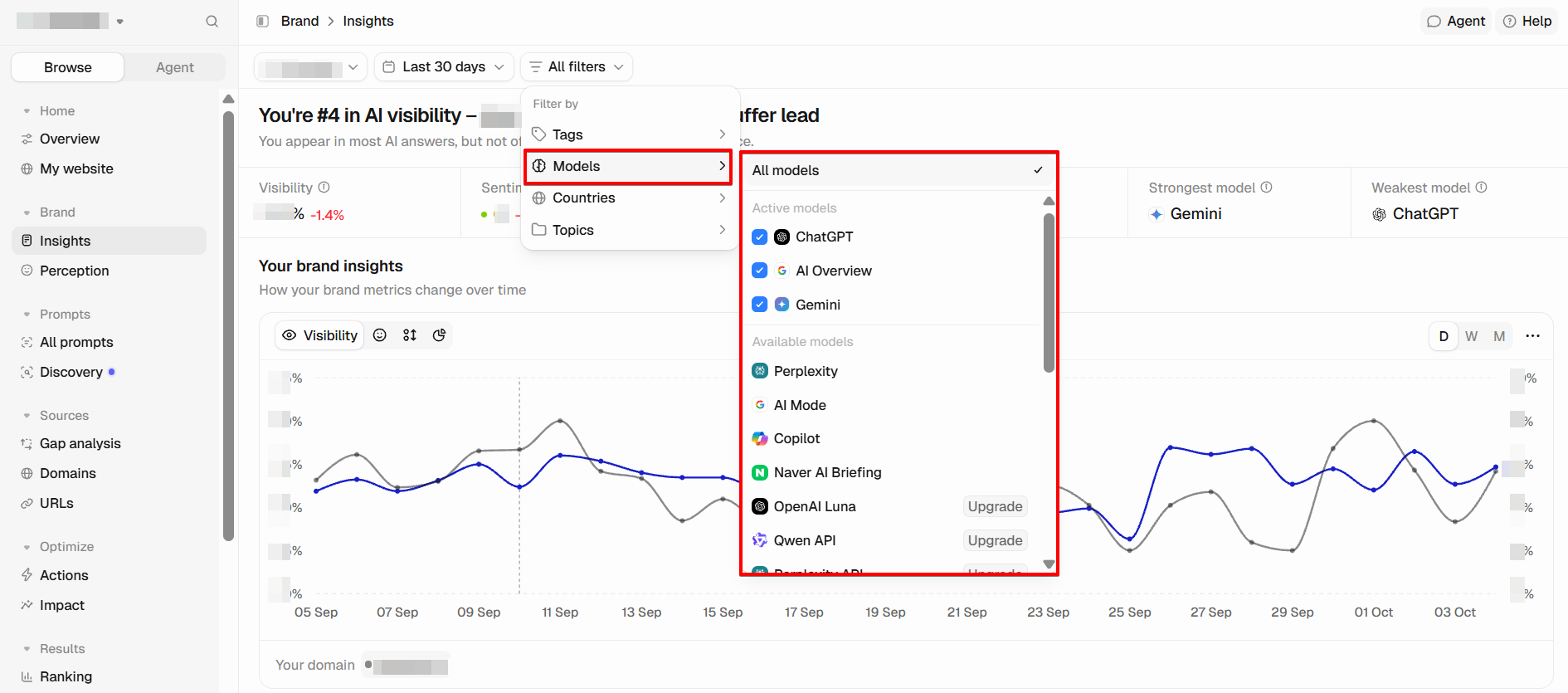
The three-model cap stays the same until Enterprise, which removes it entirely and tracks up to 13 LLM models, including Claude Sonnet 4 and Grok alongside the more common engines.
If three models feel limiting on a self-serve tier, Peec AI sells a single extra model as an add-on instead: $35 a month on Starter, $85 on Pro and $165 on Advanced (less on annual billing), rather than forcing a full-tier upgrade.
For a team weighing coverage on its own, the practical question is whether three fixed models cover your actual prompt set, or whether you need the flexibility to pick engines by name from the start.
If coverage is the deciding factor: SE Visible by SE Ranking tracks ChatGPT, Gemini, Perplexity, Google AI Mode and Google AI Overviews on all plans, with no per-engine add-ons and no model tiering. Claude and Microsoft Copilot support are coming soon. That’s still fewer engines than Profound’s or Peec AI’s Enterprise ceilings. The difference is where the line sits: the five engines most buyers check are in all plans, including Basic, so choosing a lower tier doesn’t mean narrowing coverage.
Visibility and sentiment tracking
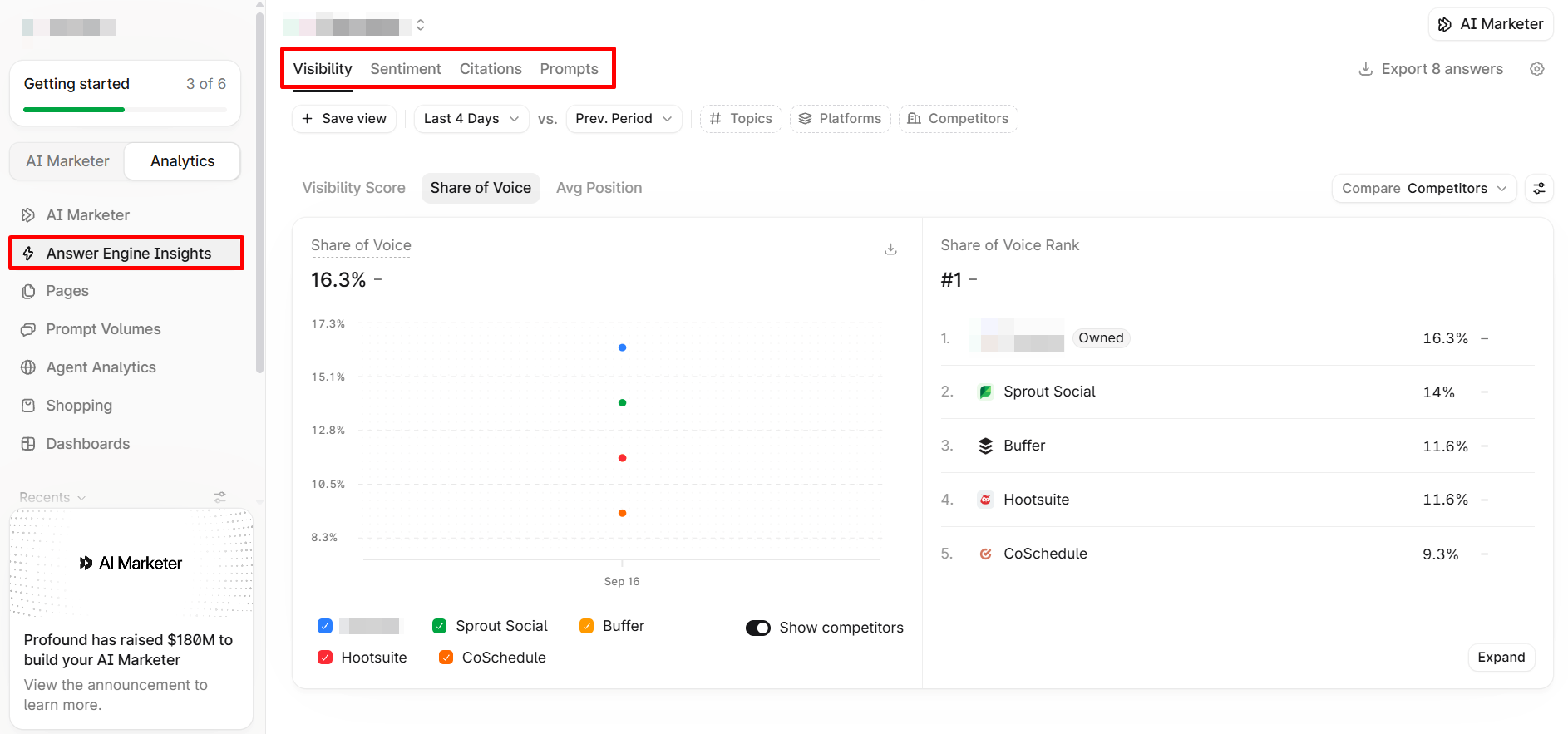
Both tools give you a real visibility and sentiment dashboard, not a raw count of citations. Profound puts everything in one daily, page-level view. Peec AI splits it into an overview plus a few dedicated sections. Pick the one that matches how your team reads the data.
Profound’s visibility and sentiment tracking
Profound bundles this work into Answer Engine Insights. It covers:
- Citation tracking, run daily: for seven days on the Trial and ongoing on Enterprise
- Prompt visibility data, grouped by topic and tag
- Sentiment analysis broken down by prompt, topic, and platform
- A competitive-presence view that tracks how often competitors surface alongside your brand in the same AI answers
Because tracking runs daily on Enterprise, you’re not stitching together a picture of your citation footprint from a series of one-off exports.
Peec AI’s visibility and sentiment tracking
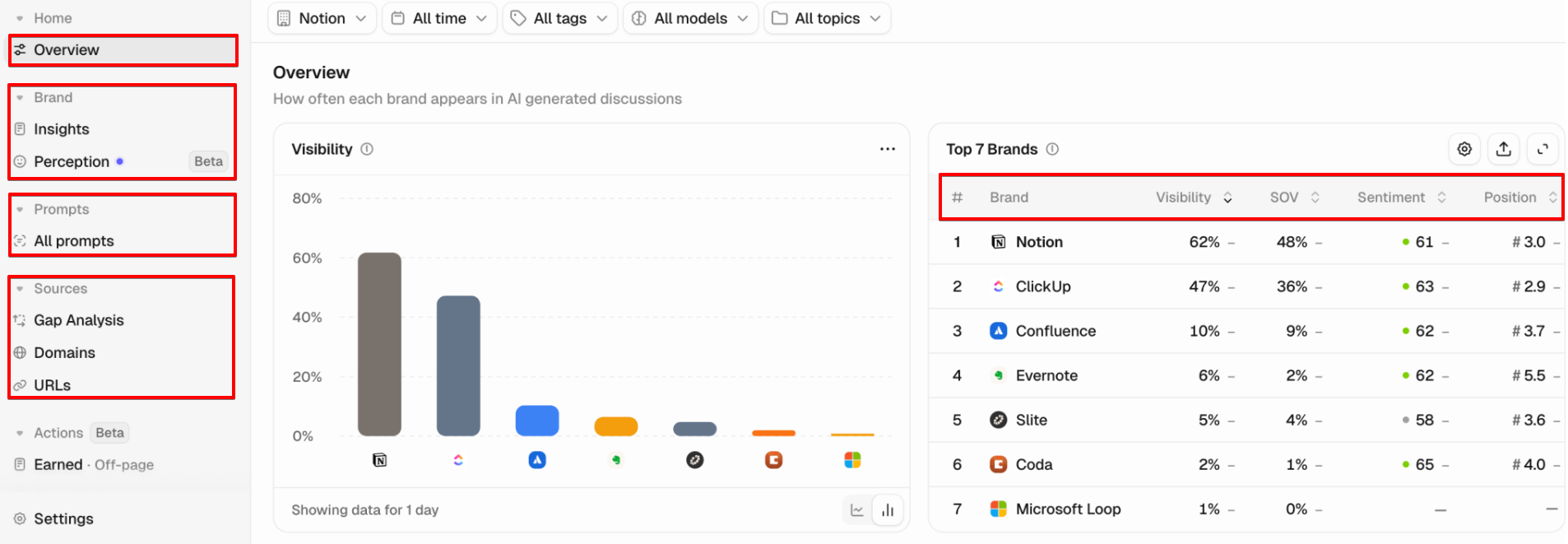
Peec AI keeps the core numbers on one Overview hub: visibility, position, sentiment, and share of voice in a single view – then breaks out the deeper work into dedicated sections:
- Brand: Insights and Perception
- Sources: gap analysis, domains, and URL-level data
- All Prompts: the whole list of tracking prompts with key metrics
Whichever structure fits how your team works, check where your own brand actually stands before you commit to either vendor’s read of it.
Recommendations and next-step guidance
Profound’s Opportunities feature and Peec AI’s Actions feature do the same job: turning tracking data into a ranked list of what to fix next. Both explain why each item matters, and both track whether finishing it helped. The difference is what happens after you accept one: Profound can hand the work to an AI agent, while Peec gives you a brief and a checklist to work through yourself.
Profound’s Opportunities feature
Opportunities is a capability of Aim, Profound’s AI Marketer, and it runs as a background agent rather than a dashboard you check. Each week Aim produces a ranked list of things worth acting on – a visibility gap, a sentiment decline on a key topic, rising prompt volume in a category you don’t cover, a competitive benchmark slipping, content your sitemap is missing – and each one comes with the data behind it and Aim’s reasoning.
It draws that from Answer Engine Insights plus prompt volumes, agent analytics, fact check and benchmarking data, and your own knowledge bases, sitemaps, and connected apps. Accept one and Aim turns it into a Project: a brief, concrete tasks, and a recommended Profound Agent to execute each one. Each Project then tracks its own visibility score, rank and citation share, so you can see whether the work moved the metric.
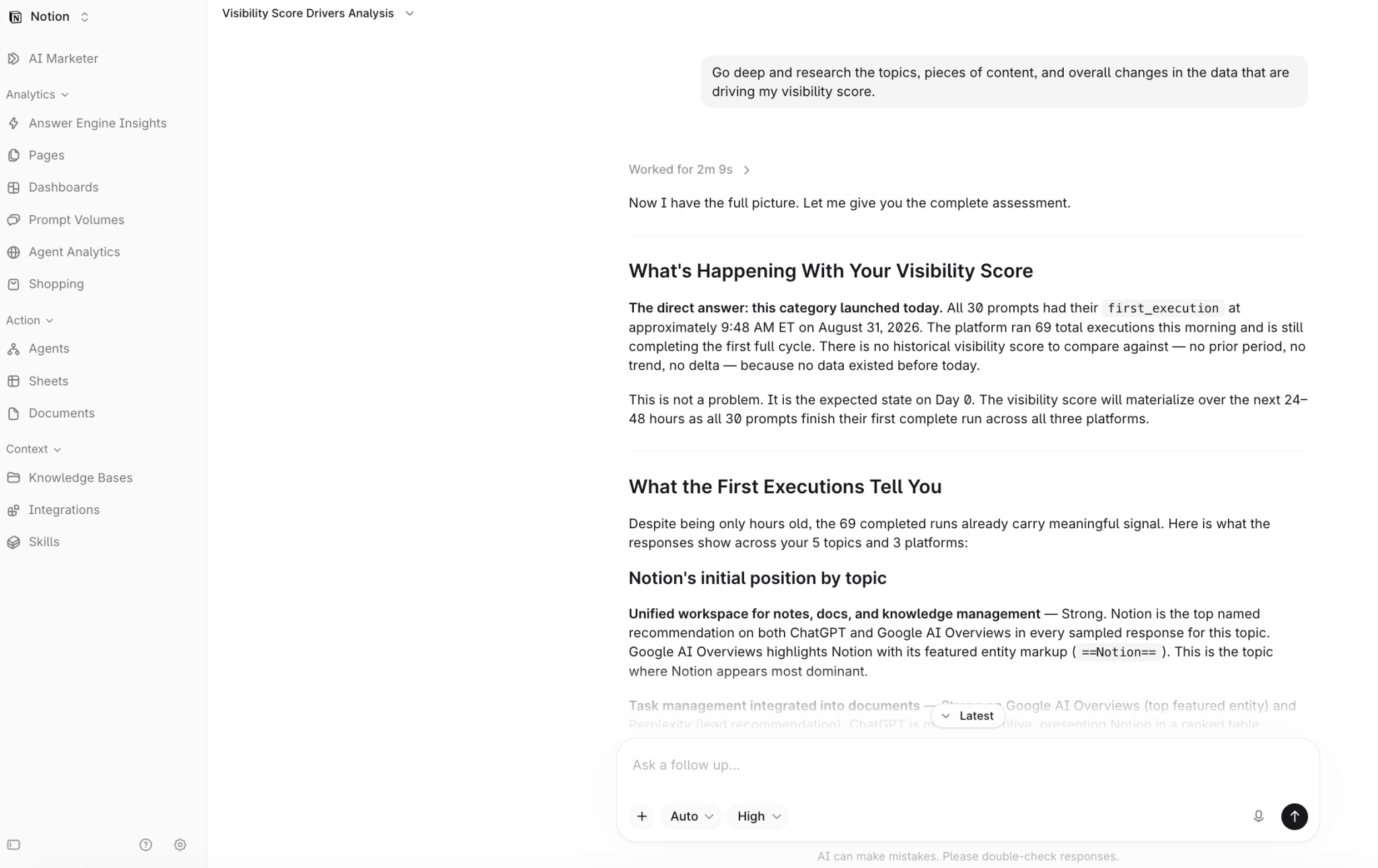
How many opportunities you get depends on the plan: a limited set on the Trial, unlimited on Enterprise, and four a week per client workspace on Agency Growth.
Peec AI’s Actions feature
Peec AI’s Actions page ranks suggestions by impact and groups them into four goals:
- Fix how AI reads your site: technical fixes like adding the schema type that matches the page
- Improve your own pages: content briefs for new articles on your own site and optimization tips for existing pages
- Get mentioned elsewhere: placements on the third-party editorial and reference sites AI already cites
- Fix wrong claims AI makes about your brand
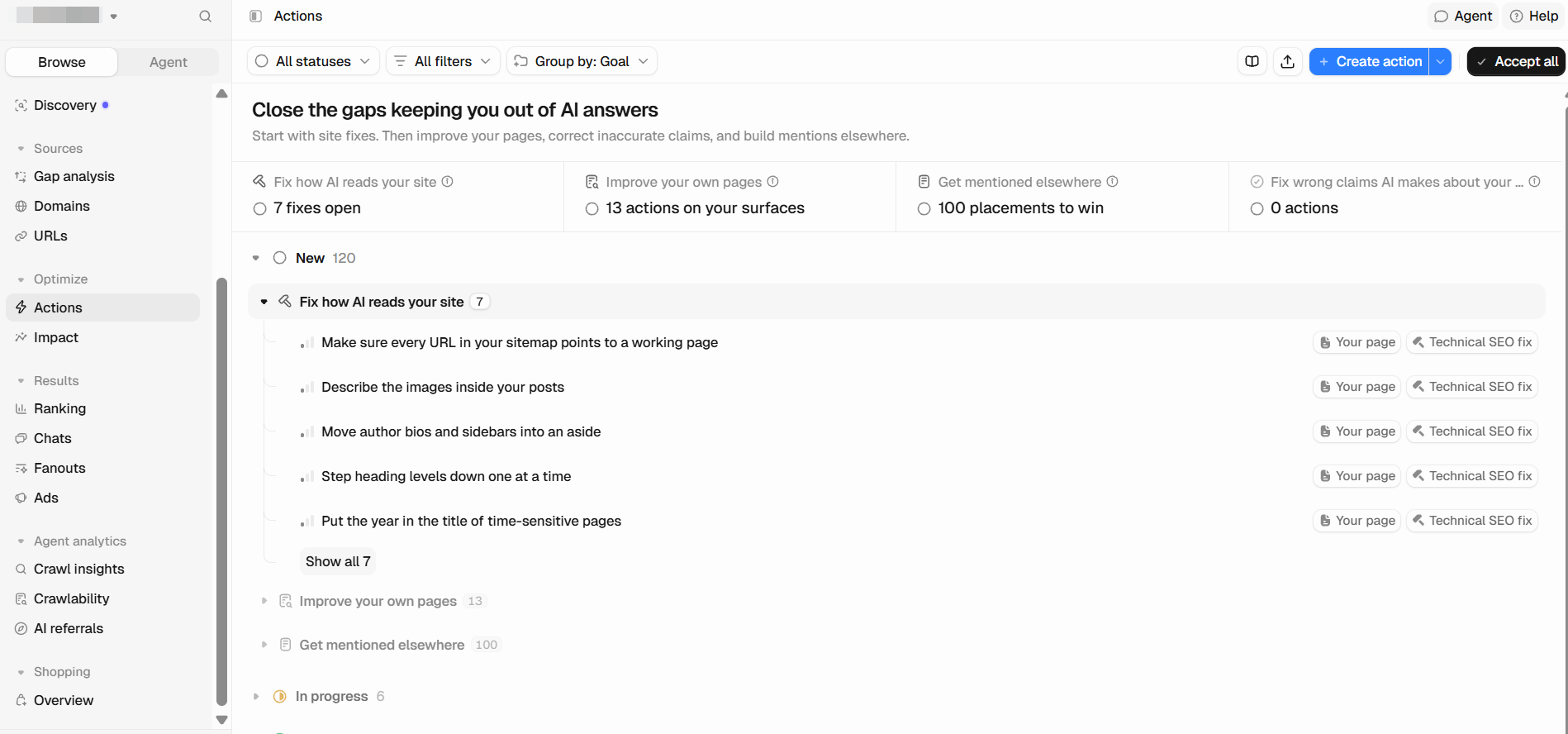
Each action opens into a full case: why it matters; which pages are affected; lists of pages for the insertions; a suggested brief; and a step-by-step checklist, etc. A separate Impact view shows whether your visibility moved after you finished the work.
In practice, it looks like a reasonable starting point for a team new to AI-visibility monitoring: the suggestions need little interpretation before you can act on them.
Neither feature replaces judgment. Profound’s Opportunities list and Peec AI’s Actions list both point to where to look. Deciding what’s worth doing about it is still the analyst’s job.
Including agents is where many of AI visibility platforms are heading. SE Visible is no exception. It recently introduced Agents, currently in beta, showing opportunities tied to a specific prompt with a visibility gap. For example, it can show sites to earn a third-party mention where competitors are cited and you aren’t, and comes with supporting context and a priority level. Agents suggest, and the decision stays with you. Scheduled audits and alerts triggered by events like a drop in mentions are planned, but not live yet.
Shopping analytics for retail and e-commerce
Both platforms have built dedicated, SKU-level shopping analytics. The difference is reach: Profound covers ChatGPT Shopping and reserves it for Enterprise, while Peec AI includes shopping on every plan.
Profound’s shopping analytics
Profound Shopping tracks how products surface inside ChatGPT Shopping results. It reports a Shopping Mode Rate (how often a query triggers the shopping interface instead of a plain text answer) alongside visibility scores, ranking positions, and category coverage gaps. SKU-level analysis drills into individual products with their related citations and keywords, and a merchant layer shows whether checkout traffic lands with third-party retailers or your own store.
Beyond placement, it audits how AI describes what you sell: which attributes get attached to a product (“best budget shoes”), whether those descriptions are accurate, which product images appear, and how the resulting framing shapes shopper sentiment.
Coverage is ChatGPT Shopping only, and the capability is gated to Enterprise.
Peec AI’s shopping analytics
Peec AI runs shopping analytics as its own dedicated product, with its own feature page and its own tracked metrics. It covers:
- SKU-level visibility for individual products
- AI-cited price compared against your actual catalog price, to catch cases where an engine quotes a number that doesn’t match what you charge
- Appearance tracking per product (the number of chats a product turned up in)
- Catalog upload through Shopify, CSV, or a Google Merchant Center feed
Tracking every SKU is data-intensive, but Peec includes AI Shopping on every plan rather than reserving it for higher tiers.
That level of granularity earns its keep once a catalog is large enough for per-product patterns to matter: a cluster of items showing the wrong price, or a whole category missing from AI answers while a competitor’s isn’t. A five-product storefront doesn’t need this. An agency running a retail client with a few hundred SKUs across multiple categories does.
Where each tool goes beyond the basics
Some features on each side simply don’t have a counterpart on the other. What follows is a straight rundown of what each tool adds beyond the shared ground covered above, not a head-to-head matchup.
Profound’s additional features
Profound’s extras center on giving its AI Marketer assistant more to draw on and more ways to act on what it finds:
- Context Manager. Teams upload documents and other source material, including webpages, to build a reference set for how AI Marketer describes the brand, paired with Brand Kits that define tone and writing style. That same source of truth grounds Profound’s FactCheck feature and feeds retrieval for Agents.
- Profound Agents. Workflow automation for content research, drafting, and publishing.
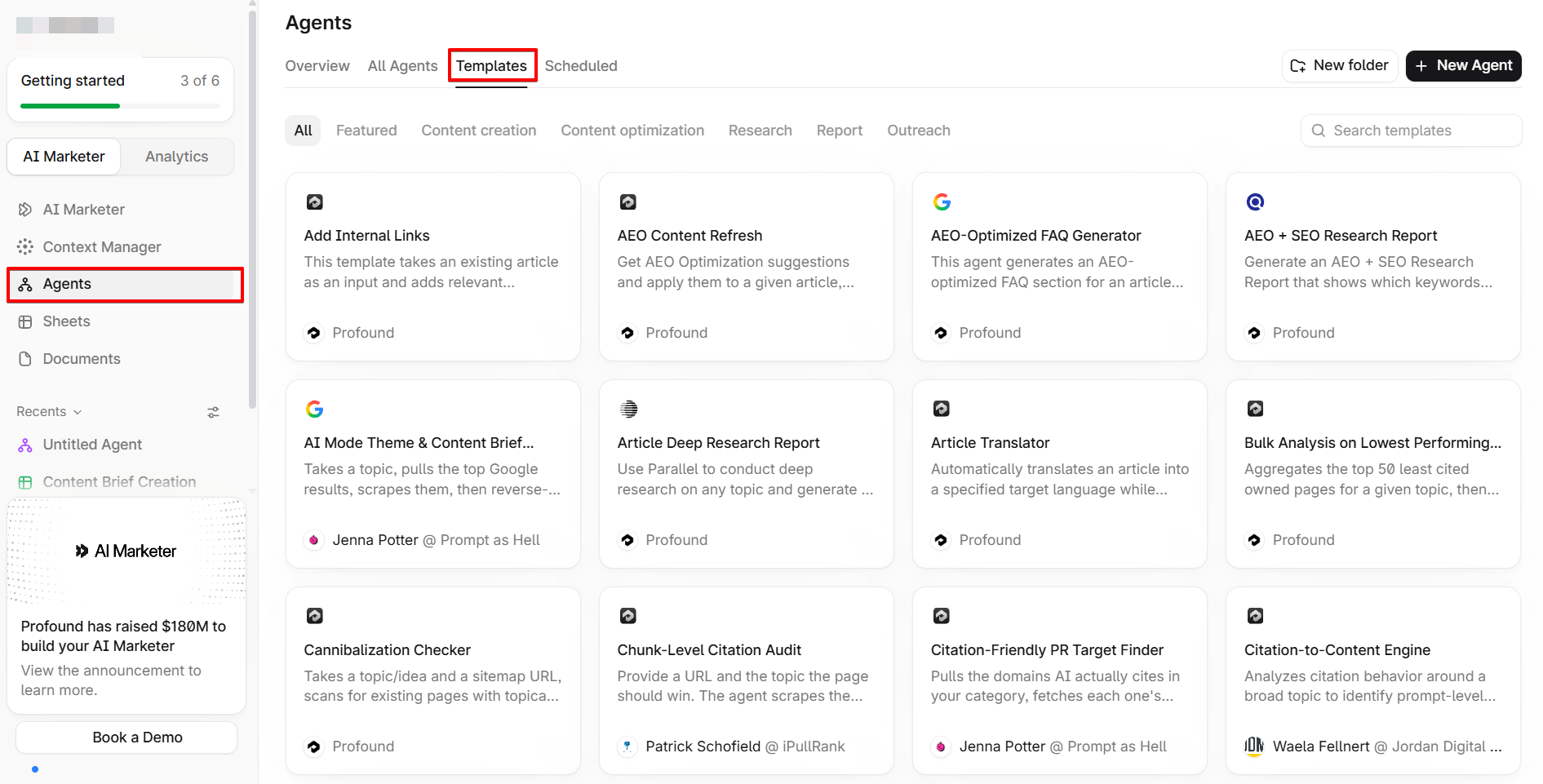
- Agent Template Marketplace. A library of ready-to-use agent templates from the Profound community, covering content creation, content optimization, research, reporting and outreach.
Peec AI’s additional features
Peec AI’s extras sit closer to the prompt level than the dashboard level. Every tracked prompt is classified as informational, commercial or transactional, which helps a team focus on the prompts most likely to influence a purchase decision. Profound classifies intent too, but inside Prompt Volumes, its research dataset of real user prompts, rather than on the prompts you track.
Fact-checking checks what AI answers say about a brand against facts the brand sets as its own reference, and shows the pages behind each claim. It’s useful in categories like health or finance, where an inaccurate AI answer carries real risk.
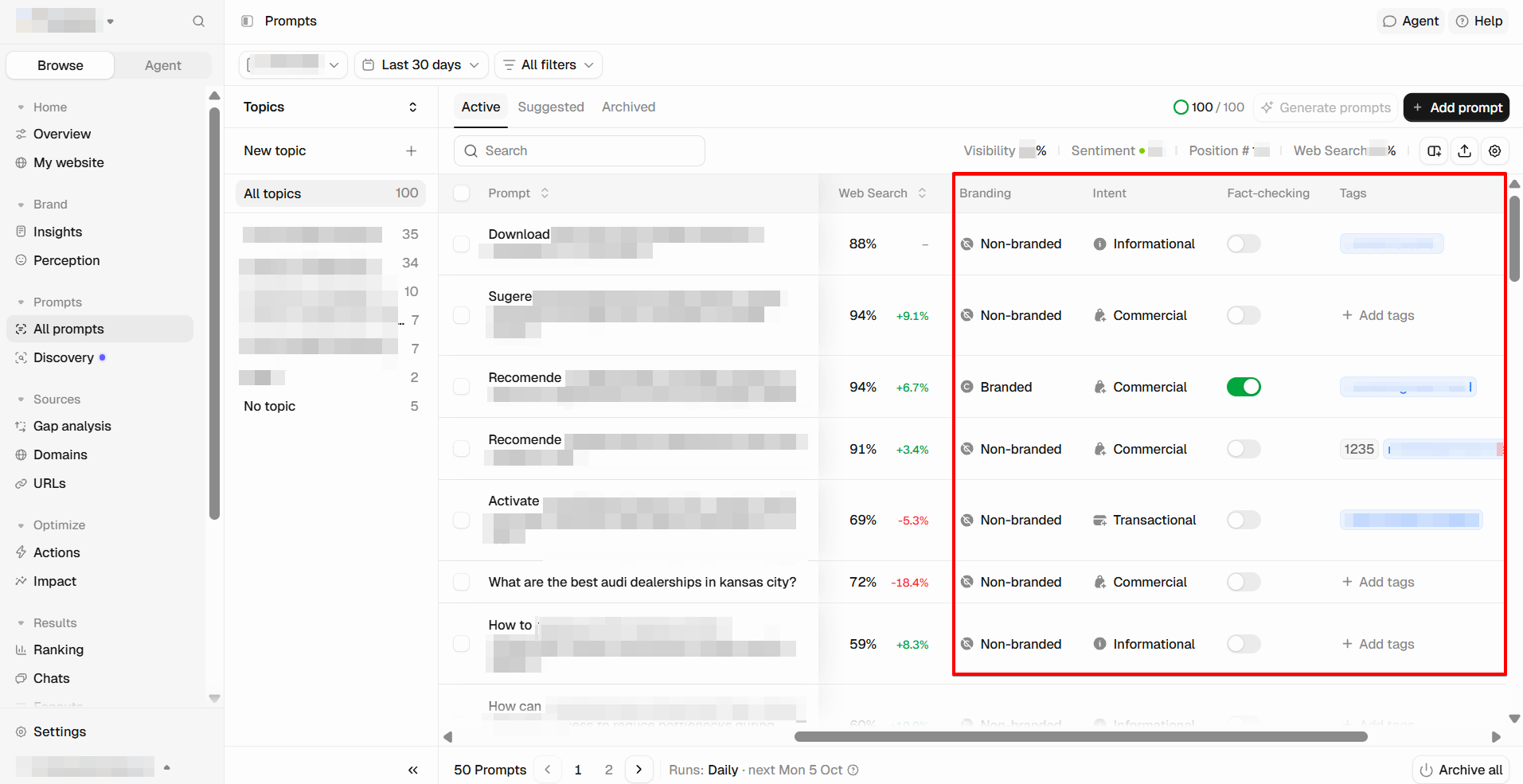
The difference is access. Peec includes fact-checking on every plan, and the tier sets how many prompts you can check and how many facts you can keep active: 5 prompts and 5 facts on Starter, up to 25 and 50 on Advanced. Profound has a similar feature, FactCheck, but only on Enterprise.
Agency fit
Both platforms have thought about agencies. Peec AI and Profound each run a dedicated agency plan built for tracking multiple client brands side by side, so an agency isn’t stretching a single-brand product across a roster of clients.
Profound for agencies
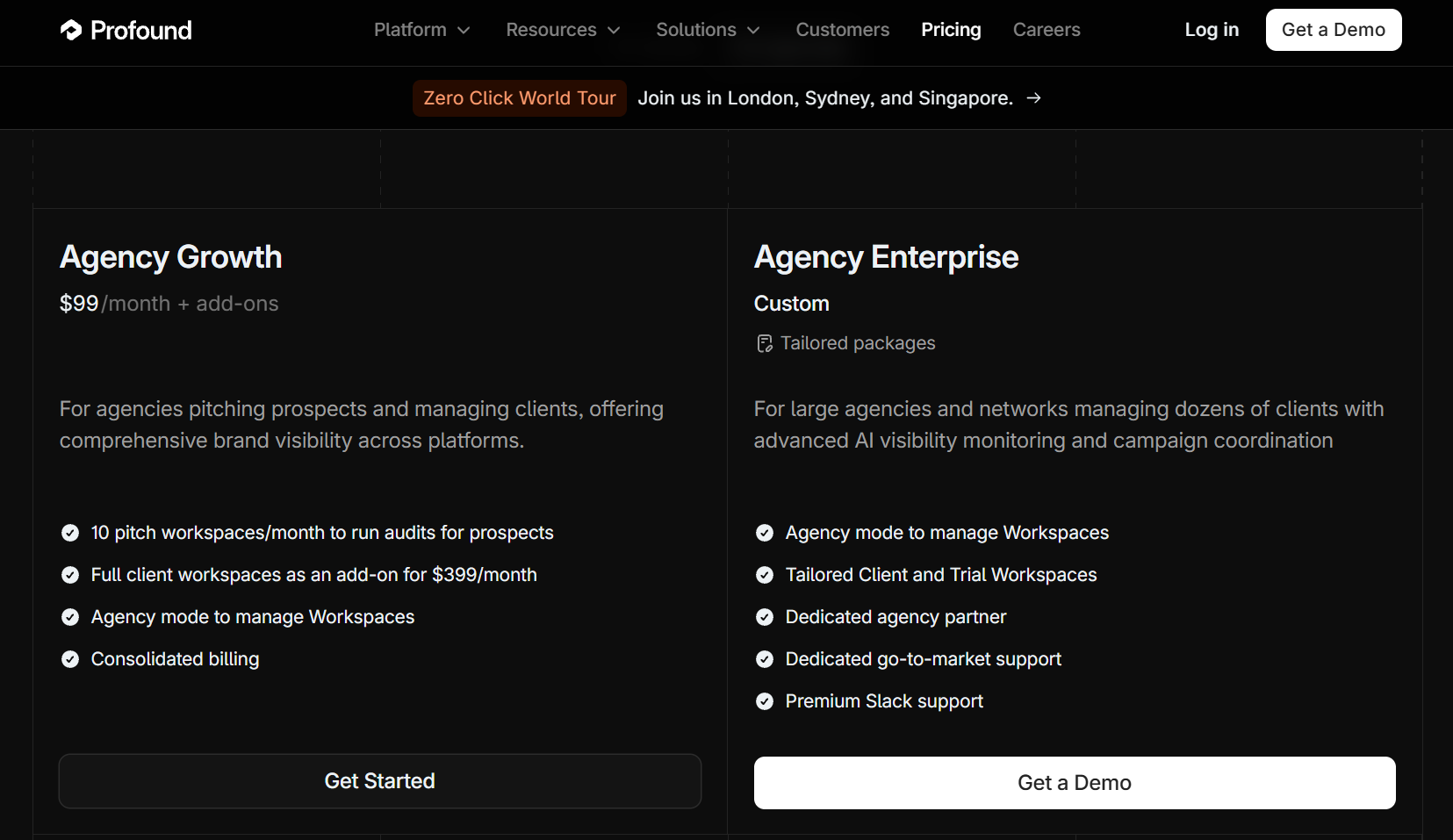
Profound’s current path for agencies runs through two options: the Agency Growth subscription, or the custom Agency Enterprise plan. Agency Growth costs $99 a month for the agency setup: 10 pitch workspaces a month for prospect audits, five agency seats and consolidated billing. Each paying client then needs a full client workspace at $399 a month, which includes 100 daily prompts, 400 Agent credits and four Opportunities a week.
The first choice covers three named engines:
- ChatGPT
- Perplexity
- Google AI Overviews
Beyond engine coverage, both plans track unlimited domains for AI-sourced traffic and attribution, integrate with Google Analytics, and keep all-time history.
Agency Growth exports to CSV and JSON, though only from client workspaces, not pitch workspaces, and has no API access – that’s reserved for Agency Enterprise.
Peec AI for agencies
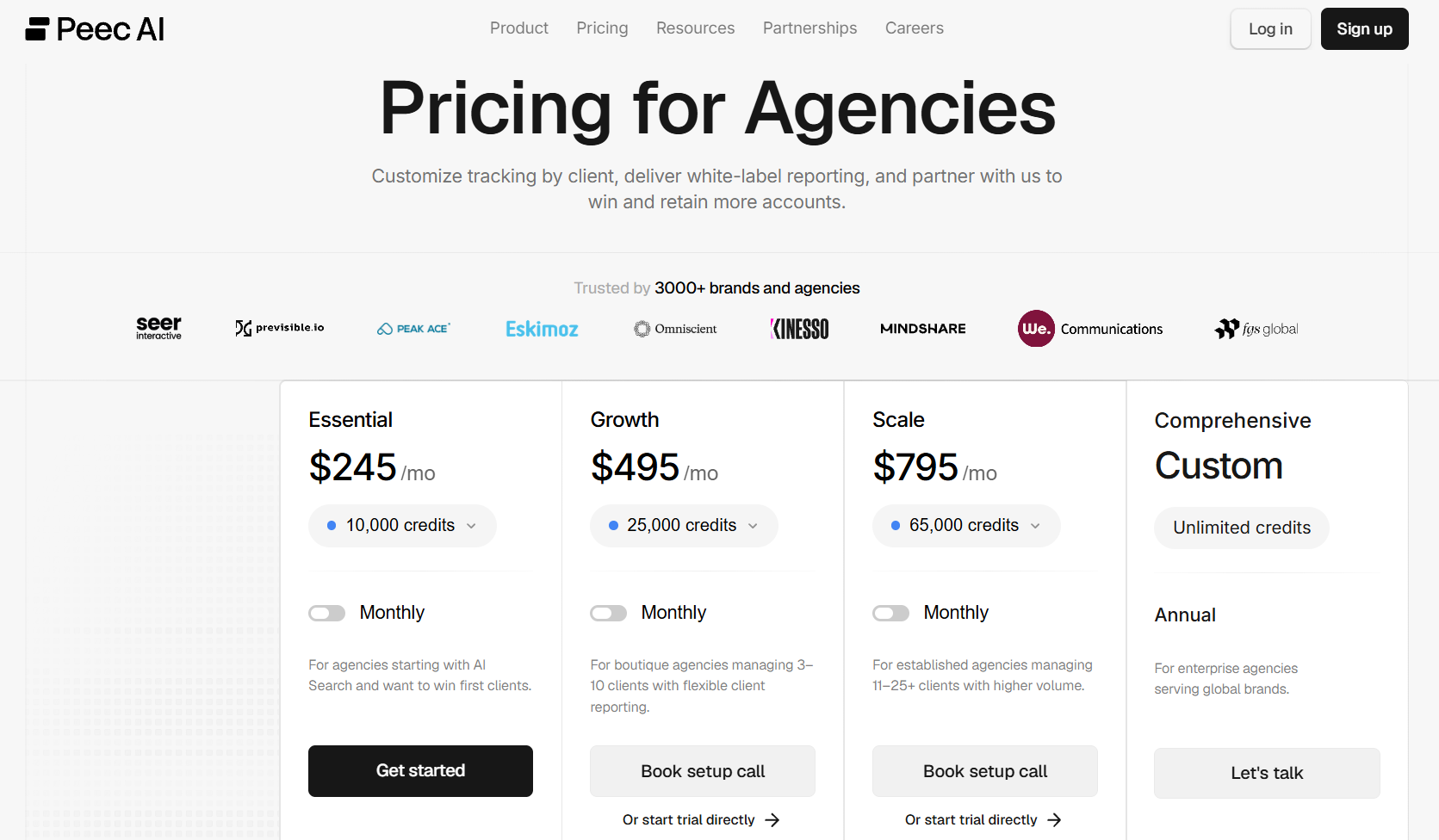
Peec AI’s agency pack starts at $245/month on the Essential tier, sized for agencies running three client accounts. Every agency tier ships a shareable, view-only client dashboard; Data Studio connector gets added starting at the Scale tier, $795/month.
Team users and client users are unlimited across all plans – seats for your own staff to work on client projects, and seats for clients to log in and view their own data, neither of which eats into what you’re paying for.
API and MCP access come with all plans too, so an agency running its own reporting stack isn’t pushed to a higher tier to reach the data. Free pitch projects let you run audits for prospects before they sign, then convert straight into a paid client project.
Pricing runs on a credit system rather than a flat per-seat fee. One prompt tracked on one model for one day equals one credit, and every project needs a minimum of 900 credits. Credits pool across a client roster and can be reallocated between projects, which adds flexibility, but sizing a plan for a specific client roster takes more arithmetic than reading the sticker price.
For agencies whose client reporting already lives in Data Studio, that data access is the line worth checking. Profound keeps its API on Agency Enterprise, and Peec AI adds its Data Studio connector from the Scale tier. SE Visible includes API access on all plans and a Data Studio connector, so visibility data can feed the dashboards you already maintain. SE Visible doesn’t yet have dedicated agency reporting inside the platform. For now, the API and connector are how agencies report on it.
Pricing and plans
Peec AI publishes three self-serve monthly tiers plus a custom Enterprise plan. Profound publishes one plan price, Agency Growth at $99/month, plus add-ons.
Profound pricing
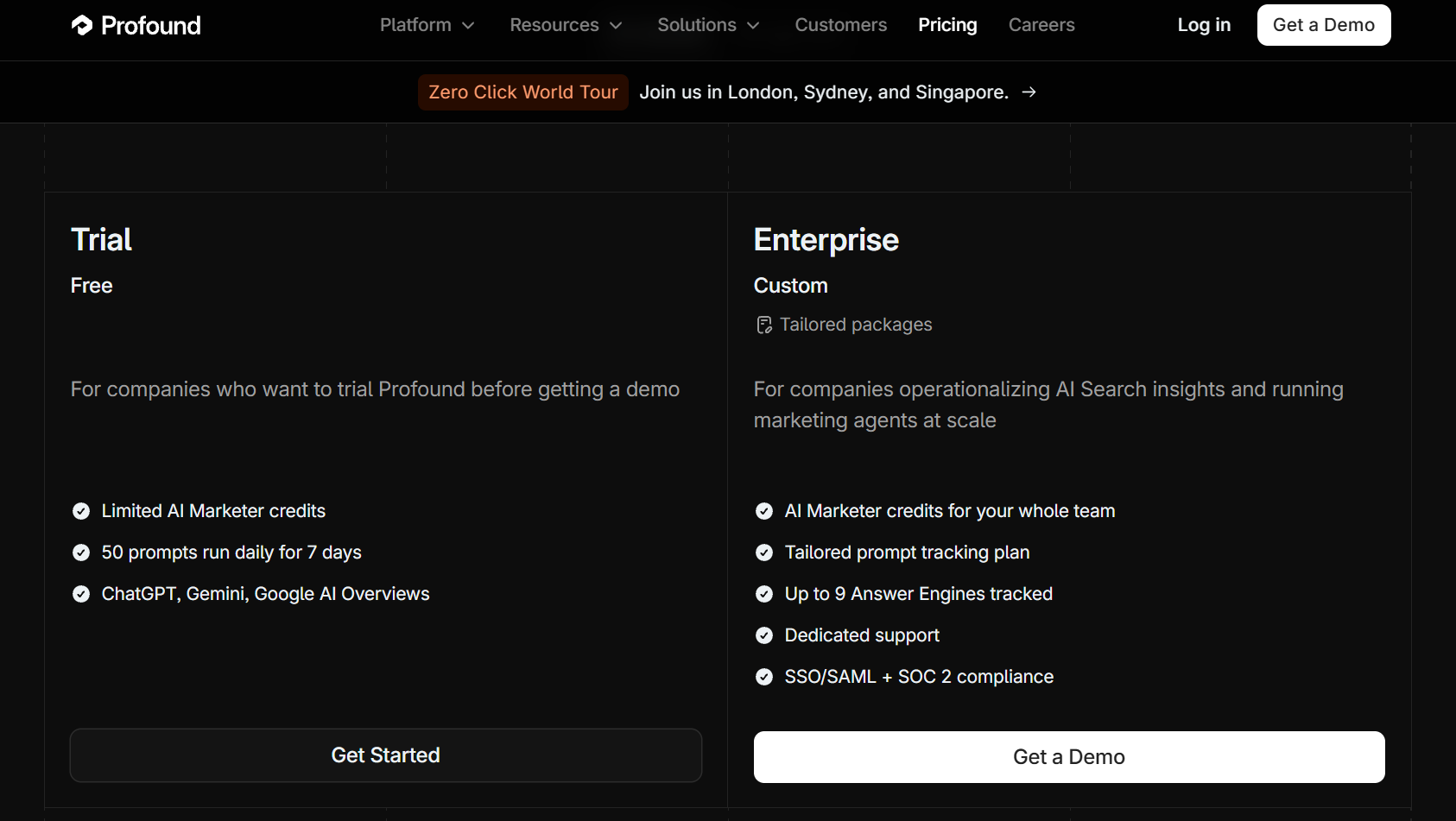
Profound’s live pricing page carries two cards for Brands: a free Trial and a custom Enterprise tier. The Trial runs 50 preset prompts a day for seven days on ChatGPT, Gemini and Google AI Overviews. It’s limited to one language and one region, with no history, API access or exports included. Enterprise pricing isn’t listed; it’s quoted after a demo call and sized to a team’s prompt-tracking plan. Moving from Trial to Enterprise adds:
- Full API access
- CSV and JSON export
- All-time historical tracking
There’s no self-serve tier between the two. If you outgrow the Trial, the next step is a sales conversation instead of a self-serve upgrade.
Peec AI pricing
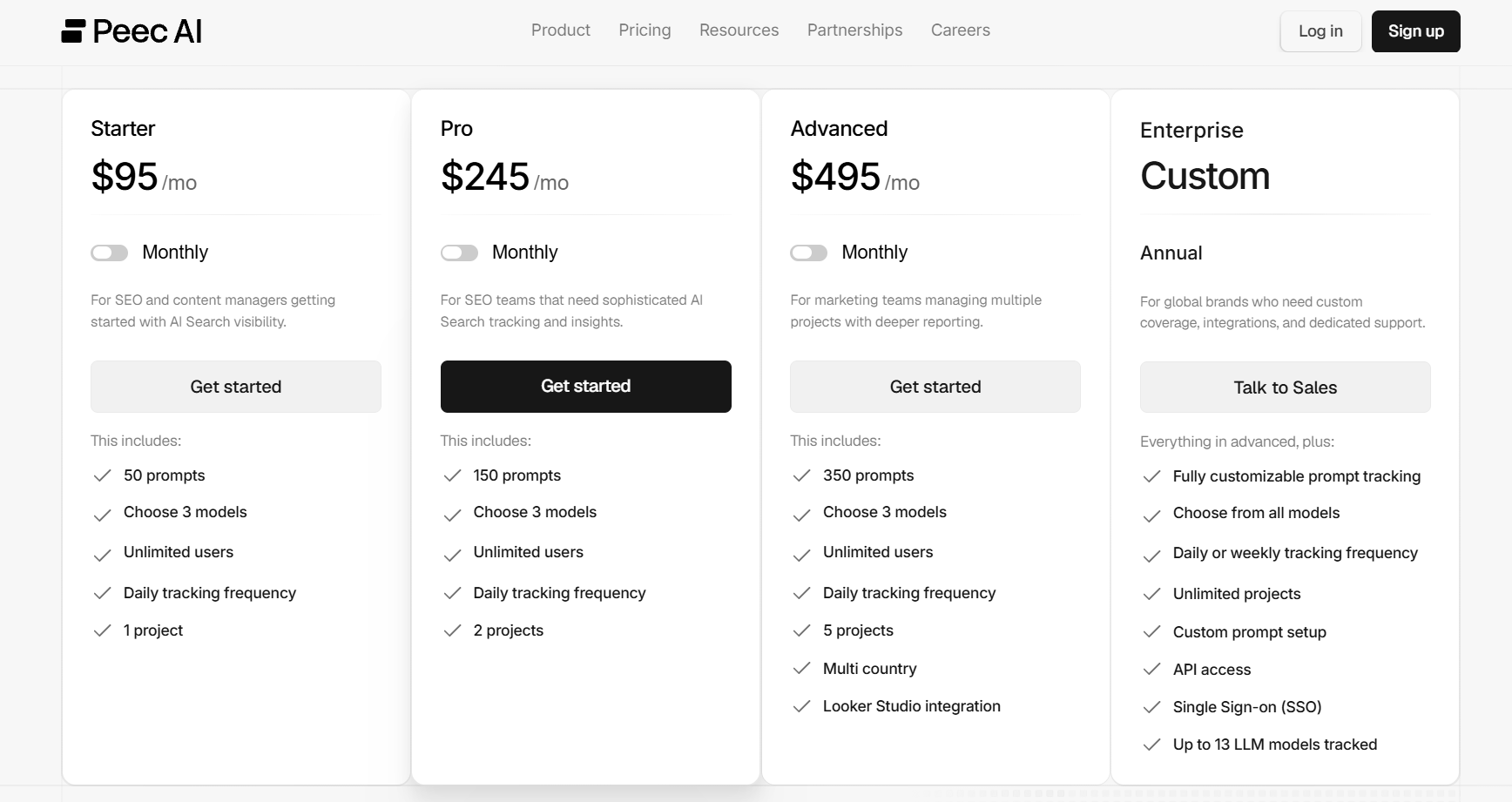
Peec AI publishes three self-serve tiers, plus a custom Enterprise tier above them:
- Starter: $95/month, 50 prompts/month, 1 project
- Pro: $245/month, 150 prompts/month, 2 projects
- Advanced: $495/month, 350 prompts/month, 5 projects
All three self-serve tiers include unlimited users and cap model tracking at 3 chosen AI engines; Enterprise raises that ceiling to as many as 13.
Annual billing brings a flat 15% discount across all three self-serve tiers, but that discount doesn’t change feature access.
Where each tool falls short
Both Profound and Peec AI carry real, documented gaps worth knowing before you commit to either one.
Profound’s biggest limitations
Profound’s own pricing page draws three hard lines for anyone evaluating a paid plan, and none of them are hidden in fine print.
- The only self-serve paid tier is Agency Growth, at $99/month plus add-ons. For brands rather than agencies, Profound’s main pricing page shows just two cards – Trial and Enterprise – and every path beyond the Trial runs through a demo or sales conversation.
- The free Trial lasts seven days: 50 prompts, tracked on ChatGPT, Gemini and Google AI Overviews. Scaling past that requires booking a sales call, the same conversation Enterprise pricing runs through.
- Trial accounts get no API access and no data export; historical tracking is also Enterprise-only, so anything you want to keep past the trial window needs an upgrade.
Peec AI’s biggest limitations
Peec AI’s pricing has three limitations of its own, most of them tied to how usage scales with tier.
- All three self-serve tiers, Starter through Advanced, cap model tracking at 3 AI models. The full set, up to 13 models, is reserved for Enterprise, so tracking a model outside your chosen three means either an add-on fee or an upgrade.
- Starter is thin for teams. It includes one project, no API access and no Data Studio connector, so teams reporting to stakeholders will likely need Advanced at $495 a month.
- The credit system for agencies is genuinely difficult to estimate ahead of time: one prompt times one model times one day equals one credit, with a 900-credit minimum per project. Forecasting a monthly prompt set means doing that math up front, before signing a contract.
None of these limits are hidden. They just don’t surface until you read the pricing page and FAQ in full.
Choosing between Profound and Peec AI
Pick Profound if you want deep analytics and AI agents that act on them, and you’re fine going through a sales process. Pick Peec AI if you want to start today on a published price and run monitoring yourself.
Where Profound fits best
Profound fits teams that have outgrown basic citation tracking and want one platform for answer-engine analytics and content workflows. The Enterprise tier tracks all nine of Profound’s named engines, a meaningfully wider set than a three-model cap, which matters once your brand needs visibility beyond the two or three most popular assistants.
Context Manager and Agents add real value here too: once your source-of-truth documents are uploaded, Agents can turn a flagged opportunity into a draft brief without pulling in a separate content tool.
What that fit costs you is speed of access. There’s no published self-serve price for brands, and every path past the seven-day trial runs through a demo, so you need budget approval and a sales cycle before ongoing tracking starts.
Where Peec AI fits best
Peec AI fits teams that want to start tracking today rather than after a sales call. Self-serve pricing starts at $95 a month and scales predictably through the Pro and Advanced tiers before reaching a custom Enterprise plan, so budget planning doesn’t require a quote first. Every tier below Enterprise caps you at three tracked models, so a leaner team won’t see the same model breadth Profound’s Enterprise tier covers.
Peec’s strength is how much comes with the base plans. Every plan includes intent tags on tracked prompts, fact-checking and SKU-level shopping data. Profound reserves its shopping data for Enterprise. Agencies get published pricing and a client-ready dashboard without negotiating a contract. If you’re a lean team that wants numbers this month, that’s hard to beat.
Some teams sit between the two. And SE Visible is built for that case. A dedicated AI-visibility mandate, all five major engines, transparent pricing. Metrics open into the unedited answer them came from, collected through real browser sessions, with linked and unlinked mentions counted separately, so the numbers in a client or board report can be checked. Its recommendations layer is still in development but the data and insights is already there. And what’s important, it works well with SE Ranking’s SEO platform, so with both, you cover visibility across Google and AI results.
Frequently asked questions
Yes, if you want self-serve pricing and hands-on monitoring more than content agents. You’ll track fewer models per plan, three plus paid add-ons, but you get shopping analytics and fact-checking on every tier. See our Peec AI alternatives roundup for more options.
Profound is worth it if you need agents that turn findings into content, and your team can run a sales process to get there. Enterprise tracks up to nine engines, but brand pricing is quoted after a demo, and API access, FactCheck and historical data sit on that tier. Agencies can start self-serve on Agency Growth, though client workspaces track three engines. Our full Profound review breaks down where it holds up and where it doesn’t.
There’s no single best platform for AI visibility tracking. It depends on which engines you need covered and whether you want content-generation workflows bundled in. Self-serve pricing versus a custom enterprise deal matters too, depending on your buying process. Profound and Peec AI cover different parts of that need, and neither is the only option worth evaluating. Our best AI visibility tools roundup covers the wider field.
Profound and Peec AI answer the same question, what AI says about your brand, for different buyers. Whichever you choose, AI answers are only one of the two places your buyers now research. Google results are the other. If you want to see where your brand stands across AI engines before committing budget, SE Visible’s 10-day free trial shows visibility, share of voice and sentiment against your competitors. Pair it with SE Ranking for the organic side of the picture.