8 Searchable alternatives for tracking AI visibility in 2026

Most teams start comparing Searchable alternatives when the plan stops matching the work. Three engines are included and the rest cost extra, while white-label client reports wait on the next tier up.
Switching has its own risk, because imported answers get re-scored with the new tool’s methodology and the baseline your clients have seen can move.
This guide compares Searchable alternative, what each one covers, what they charges for the rest, and what their pros ancd cons are. Keep reading to find a platform that match your needs.
What to check before you switch from Searchable
- Count included engines, not advertised ones: Searchable’s Pro plan covers three engines (ChatGPT, Perplexity, AI Overviews) for $125 per month, and each of the others (Claude, Gemini, Google AI Mode, Copilot, Grok, DeepSeek) is a separate add-on with its own price. For example, Claude alone lifts the bill to $325 per month. Compare alternatives on the engines included in the plan you’d buy.
- Match the pricing unit to your client book: Searchable counts prompts, but some alternatives count credits, and with every engine switched on, a credit plan can cost more.
- Keep your API access when you switch: Searchable includes the API on every plan, so check that the alternative you choose includes it on the plan you’d buy, not only on a higher tier.
- Export your Searchable history before you cancel: Pro keeps only 12 months of data, so a year in, your oldest client data is already dropping off. Plan the export before you cancel.
Searchable alternatives at a glance
If you report on several client projects and want the same five engines in each, start with SE Visible by SE Ranking. If model breadth matters more, look at AthenaHQ and Rankscale; ZipTie fits teams that would rather pay per check than per tier
| Tool | Best for | AI engines (included vs add-on) | Pricing model | API / MCP access | Starting price |
|---|---|---|---|---|---|
| SE Visible by SE Ranking | Teams that need all major engines on every project, with the source answer behind metrics | 4 included (ChatGPT / Gemini / Google AI Mode / Google AI Overviews), no add-ons | Flat tiers by prompts and projects | API , CSV exports | $99/mo, billed monthly |
| Peec AI | PR and brand teams tracing recurring objections and ads in AI answers | 3 models of your choice per tier; up to 13 on Enterprise | Flat tiers by prompts and projects | API on all plans except Starter; MCP and CSV exports | $95/mo, billed monthly |
| Profound | Enterprise-scale engine coverage and multi-company accounts | Up to 9 on Enterprise; Trial: ChatGPT / Gemini / AI Overviews | Custom Enterprise packages | API on Enterprise; none on Trial | Not disclosed (contact sales) |
| Otterly AI | Teams that want page-level GEO audits and AI crawler logs next to prompt tracking | 4 included; Claude / Google AI Mode / Gemini as paid add-ons | Flat tiers plus engine add-ons | API and MCP quotas per plan | $29/mo, billed monthly |
| Scrunch | Teams that want prompts sorted by buyer-journey stage, with sentiment from the entry plan | 4 on Core; 9 on Enterprise | Flat Core tier; custom Enterprise | Query API and MCP on Enterprise | $250/mo, billed monthly |
| AthenaHQ | Single-market brand teams that want 11 models with GA4 and Search Console data alongside | 11 on Starter | Credits (one credit per AI response) | API as a paid add-on, price on request | $295/mo (3,600 credits), billed monthly |
| Rankscale | Teams tracking AI shopping cards and ads, or checking prompts more often than daily | 10 on Pro | Credits, 0.25–2 per engine per prompt (Claude costs 2) | REST API from Pro+ ($229/mo); MCP | From $17/mo (Essentials, billed yearly); Pro $99/mo billed monthly |
| ZipTie | Agencies with uneven prompt volume across clients that would rather pay per check | 7, priced per prompt per engine | Usage-based, $0.01 per prompt per engine | API and MCP add-on, $10/mo | From $42.75/mo (calculator estimate) |
Why teams look for alternatives to Searchable
Searchable is an AI visibility platform that shows how your share of voice compares with competitors in AI-generated responses. It also runs technical site audits that flag schema markup and crawlability problems.
For more details on what this platform is capable of, check out our Searchable review.
Teams usually leave Searchable because of plan limits, not because of the product. The plan they bought for monitoring starts limiting what they can report: only three engines are included, Pro keeps just 12 months of history, and white-label client reports need a higher tier. The tool itself reviews well (4.8/5 on G2), so switching is about what the plan includes, not about quality.
The plan ladder, as of October 2026:
- Pro costs $125 per month, billed monthly.
- Scale costs $400/mo.
- Enterprise is listed at $999.
- Custom has no published price and goes through sales.
The pain points that push teams to look elsewhere trace back to that ladder:
- Three engines included: Every plan includes three AI engines, and the others (Gemini and Claude among them) are paid add-ons.
- One project on Pro: Pro covers 1 project and 100 tracked prompts per model, so a second client means a second subscription or a move up the ladder.
- Reporting starts on Scale: Data Studio and white-label reports are not included on Pro; both start on Scale.
- Lite answers carry no sources: The Claude and Grok (Lite models) responses come without web citations or sources, which leaves little to act on for digital PR.
- Learning curve: Manthan D., a small-business CTO, wrote on G2: “It feels overly technical, so the learning curve is quite steep.“
1. SE Visible
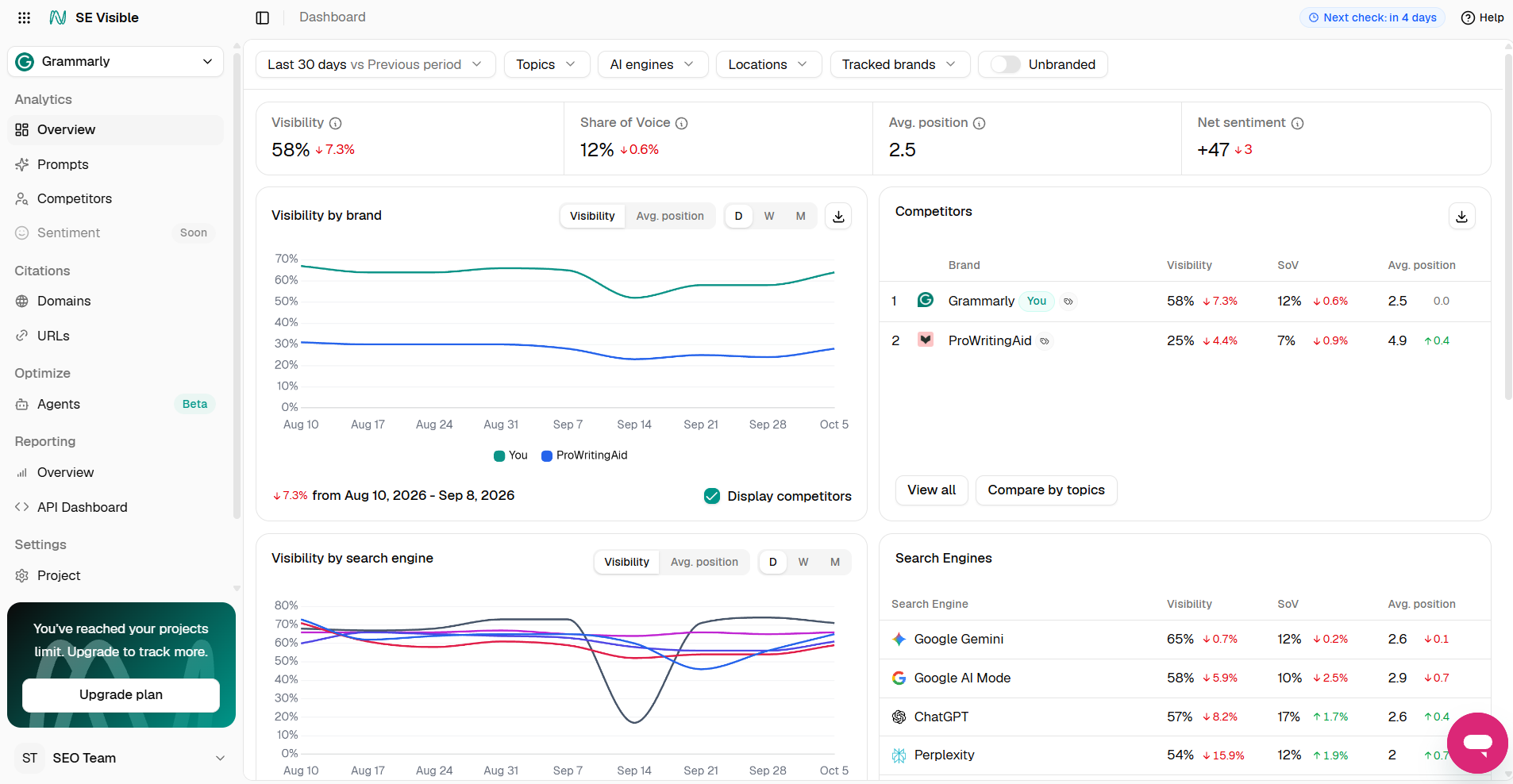
SE Visible is a standalone AI visibility platform that monitors four engines (ChatGPT / Gemini / Google AI Mode / Google AI Overviews). It collects responses through a real browser session in the graphical interface, the same surface a person uses.
Standout features:
- Daily refresh: Metrics refresh with daily tracking, so shifts show up as they happen instead of weeks later.
- Competitor gap view: It lists the prompts and topics where competitors are cited and you are not.
- Net sentiment score: Sentiment is tracked as the share of positive mentions minus the share of negative ones, separate from the visibility score.
- Per-engine source tracking: You can track how frequently each source is cited by each AI engine, which you can turn into a digital PR and outreach list.
- Client dashboards and API: The Data Studio connector builds self-refreshing client dashboards, and the API pulls metrics and prompt results along with cited sources.
For a multi-market client book, geography is the first thing to check: tracking is available in 42 countries, and SE Visible supports 9 languages.
Best for: Agencies and in-house teams reporting AI visibility across several client or brand projects on one engine set.
Pros:
- No engine add-ons: Plans track the same five engines with no engine add-ons and no model tiering, where Searchable includes three and sells the rest.
- Unlimited users: You can invite unlimited users, so account managers and client contacts share a project without a seat count.
- From a search company: SE Visible is built by SE Ranking, a team with years of experience tracking search that translated into a comprehensive SEO suite. Both platforms come from one vendor, so your Google and AI visibility reporting sits with a team that knows both.
Cons:
- Basic exports: CSV or XLSX export, and there is no PDF export yet.
- Topic-level sentiment pending: Sentiment breakdown by topic is on the roadmap, so topic-level sentiment reporting stays manual for now.
- Four engines as of now: SE Visible tracks ChatGPT, AI Overviews, AI Mode, and Gemini, if you need Claude or Copilot you’ll have to wait as they are on the roadmap now.
Pricing: Basic costs $99 per month, or $79 per month billed annually, with 200 prompts and 3 projects. Core costs $189 per month, or $151 per month billed annually, with 450 prompts and 5 projects. Plus costs $355 per month, or $284 per month billed annually, with 1,000 prompts and 10 projects.
Custom plans go through sales for a package beyond the standard tiers. The plans include a 10-day free trial, and no credit card is required.
2. Peec AI
Peec AI fits teams that need to know what AI answers say against a brand more than how many engines say it. On engine count, it doesn’t lift Searchable’s ceiling: Starter, Pro, and Advanced each track three models you choose, and going past three means Enterprise or buying them as paid add-ons.
Standout features:
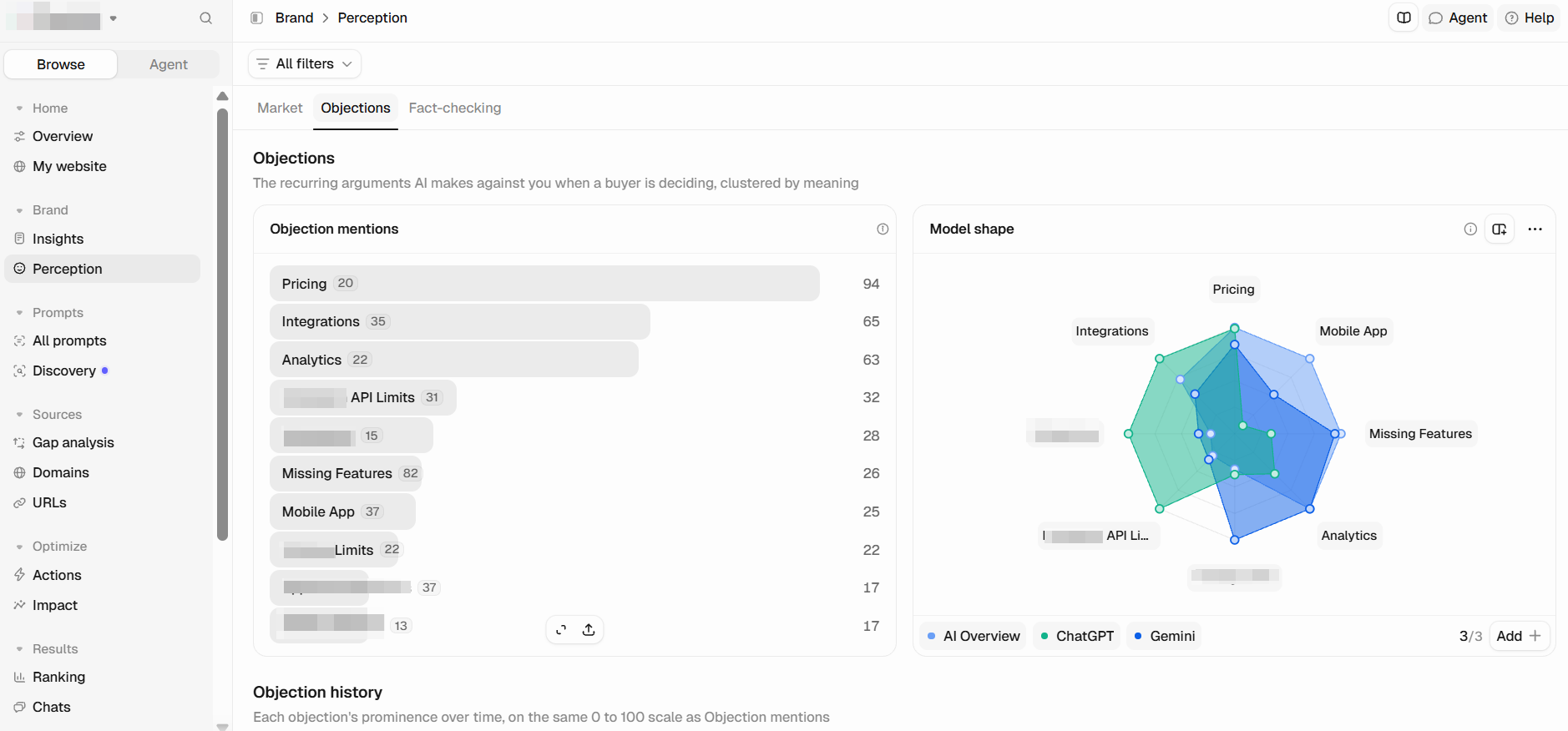
- Objections: Recurring arguments AI raises against your brand are grouped by meaning and traced to the pages behind them.
- Ads library: It shows which of your tracked prompts carry sponsored placements in ChatGPT answers and which advertisers appear, including those bidding on your brand.
- Crawlability audit: It checks which AI bots your robots.txt allows, partially allows or blocks, across 40+ bots.
- Source classification: You can see what kind of page feeds an answer, with each cited source tagged as competitor, editorial or UGC, for example.
- No country surcharge: Peec charges nothing extra per country or language, since pricing stays tied to prompts, but the plan caps how many countries you can track (one on Starter, three on Pro and Advanced).
Our Peec AI alternatives comparison covers the tools teams weigh against it.
Best for: Brand and PR teams that need to know which objections AI answers raise about a brand, and which pages feed them.
Pros:
- No seat pricing: The entry plan already allows unlimited users, so a bigger account team never forces an upgrade.
- Actions: These are opportunity-scored recommendations with next steps for both your website and content on third-party websites.
Cons:
- Ads page limited to ChatGPT: The Ads analysis covers ChatGPT only for now.
- Three models per plan: Starter, Pro, and Advanced each track only three models of your choice, and every extra model is a paid add-on.
- Data Studio from Advanced: The Data Studio integration starts on Advanced at $495/mo, so client reporting on Starter and Pro means exporting data manually.
Pricing: Starter is $95 per month, billed monthly, with 50 prompts and 1 project. Pro is $245/mo, with 150 prompts and 2 projects. Advanced is $495/mo, with 350 prompts and 5 projects; it adds multi-country tracking and DataStudio integration. Enterprise is custom-priced. Annual billing takes 15% off.
3. Profound
Profound now sells one paid plan. In September 2026, it dropped its self-serve Starter and Growth tiers, so tracking beyond the free Trial means an Enterprise contract through sales, with up to nine answer engines. For a team leaving Searchable’s self-serve plans, that changes the buying process as much as the feature set.
Standout features:
- Nine engines: Profound lists capability for ChatGPT / Perplexity / Google AI Mode / Gemini / Microsoft Copilot / DeepSeek / Claude / Google AI Overviews / Exa Search.
- Dynamic Bot Rendering: It detects answer-engine agents and serves them a fully rendered version of the page, without changes to your CMS.
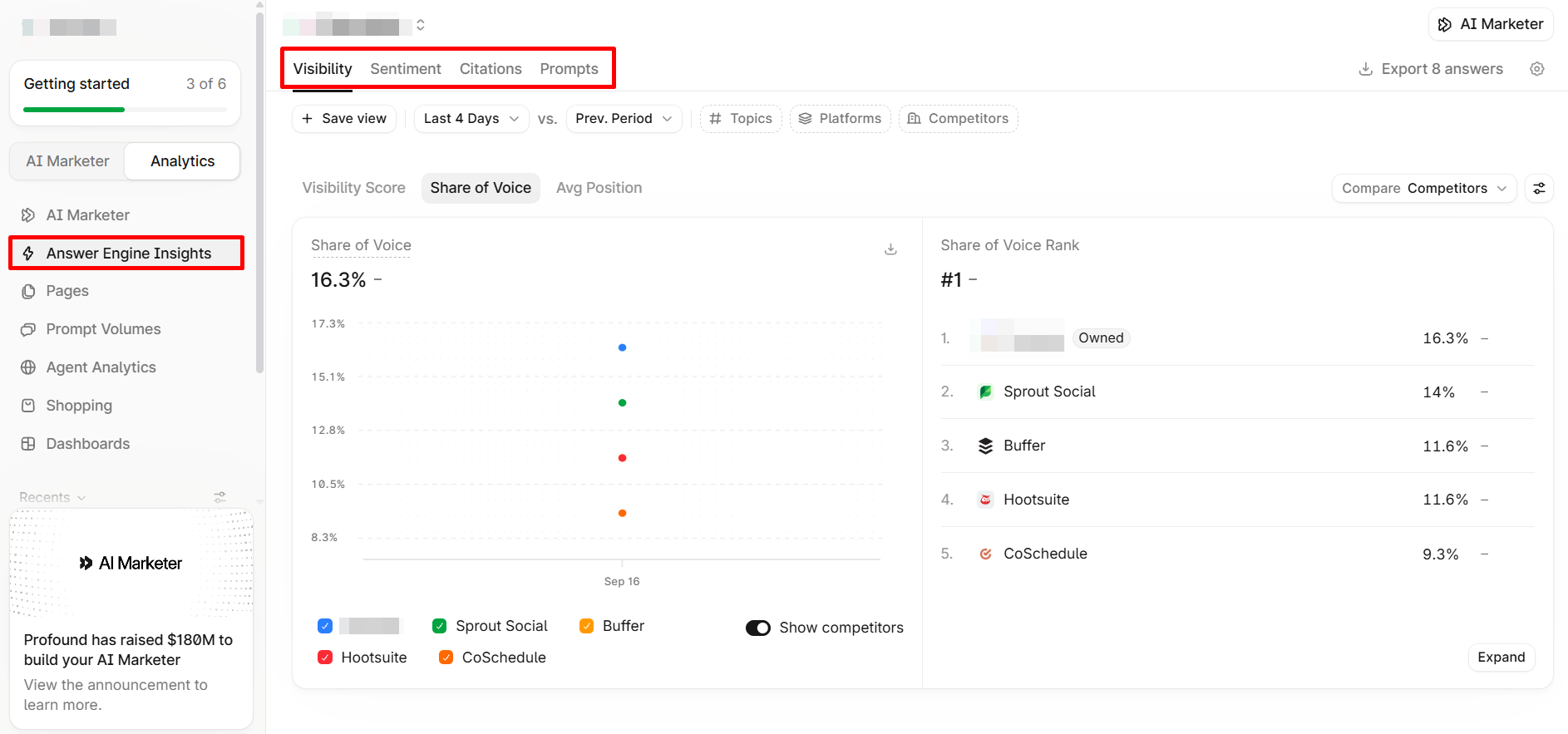
- AI Marketer: Profound’s built-in assistant, Aim, investigates changes in your visibility, sentiment and citation data, suggests next tasks, and runs Agents to draft and update content for you.
Bring your own prompt list to the demo and treat the call as a coverage audit: ask which of those engines your client segments actually use before paying for all of them. Our Profound alternatives piece compares the other options in more depth.
Best for: Bigger teams that need enterprise-scale engine coverage and multi-company accounts.
Pros:
- Guidance from agents: Sara M., VP of Content & Generative Search, said in a G2 review: “Profound’s agents are extremely helpful for brands who are unsure what to do after reviewing the data that Profound provides.“
- All-time history on Enterprise: Enterprise keeps all-time history and adds CSV and JSON exports plus API access, so client reporting can run outside the platform.
Cons:
- Single-market Trial: The Trial covers 1 language and 1 region, while Enterprise sets both as custom.
- Bot rendering on three CDNs only: Dynamic Bot Rendering works only for sites on CloudFront, Cloudflare or Vercel.
Pricing: Profound publishes no price: Enterprise is custom, sold as packages through sales. The free Trial runs 50 prompts daily for 7 days. It tracks three engines (ChatGPT / Gemini / Google AI Overviews).
4. Otterly AI
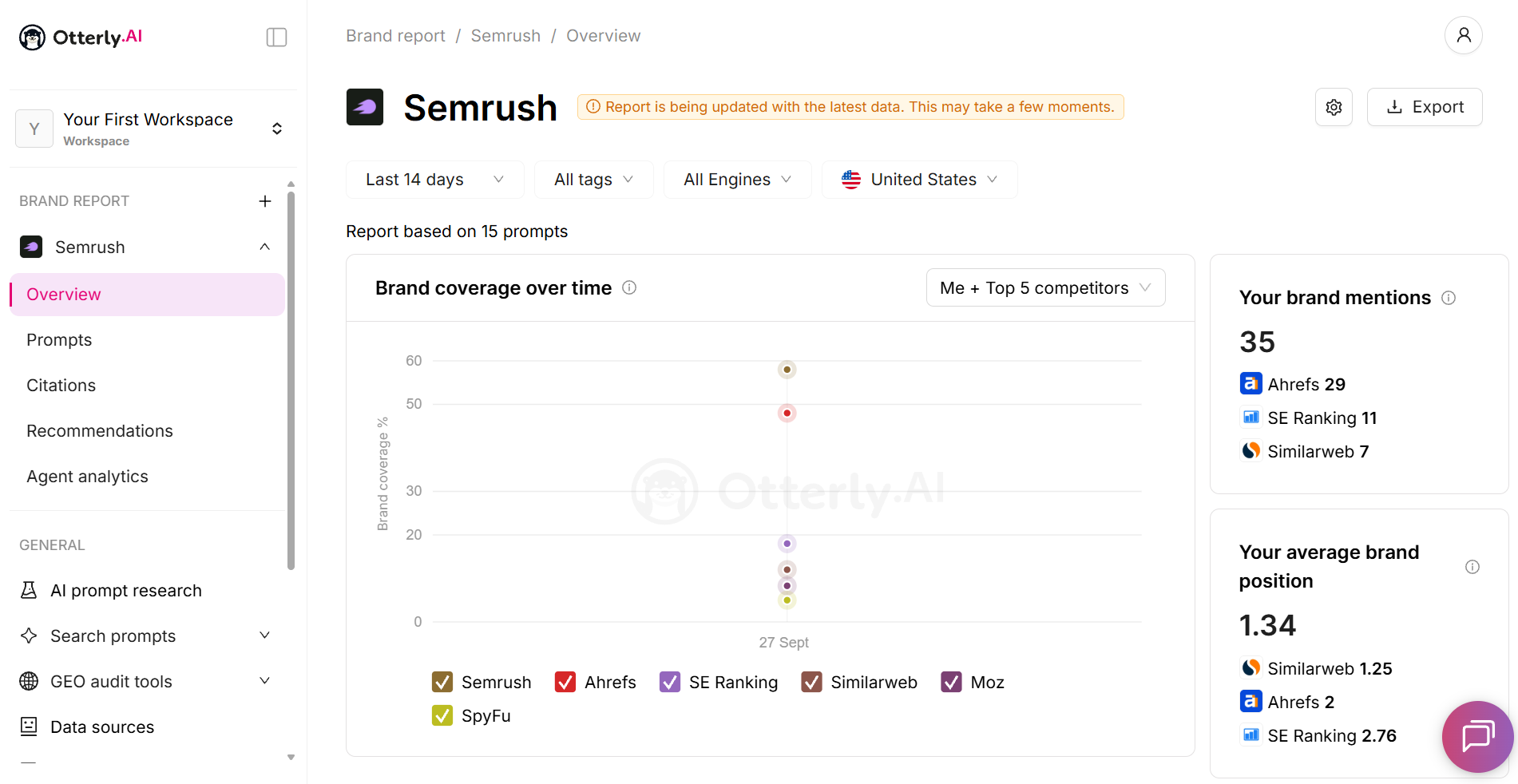
Otterly.AI pairs prompt tracking with GEO audits of your own pages, 5,000 URLs a month on Standard, and ChatGPT Ads tracking on every plan.
Standout features:
- Market coverage: Tracking has reached 50+ markets.
- Query Fan-Out: Enter a prompt in the GEO Audit and see the range of queries AI search engines may generate from it.
- Agent Analytics: It shows which AI agents and crawlers reach which pages of your site.
- Log ingestion: Agent Analytics takes server logs via file upload or Webhook, Cloudflare or a WordPress plugin.
- MCP server: You can query visibility data straight from AI assistants such as Claude or Cursor.
Add-on prices also rise with the plan, so check them on the tier you would actually buy. Our Otterly AI alternatives roundup goes deeper on the move away from it.
Best for: Teams that want to test a prompt set on a low entry tier before committing a client budget.
Pros:
- Quotas stated up front: You can size client reporting before building it, since Standard allows 2,000 API requests and 2,000 MCP requests a month.
- Low entry point: Lite is the lowest paid entry price on this list, which makes it a reasonable place to test prompts before a client commits.
Cons:
- Four engines by default: Plans track four engines by default, and Claude, Google AI Mode and Gemini cost extra.
- Lite limits: Lite includes 1 workspace and 3 recommendations per week.
- Ads reporting paused: ChatGPT Ads reporting was paused in September 2026 after OpenAI changed how ChatGPT displays ads.
Pricing: Lite costs $29 per month, billed monthly, with 15 search prompts. On the annual basic, Lite is $25 per month, billed annually. Standard costs $189/mo, with 100 search prompts. Premium, pitched at mid-sized companies and agencies, runs $489/mo for 400 search prompts. Enterprise is custom-priced from 1,000 search prompts.
On Standard, the Claude add-on costs $109 per month. The Google AI Mode add-on costs $59 per month on Standard. A 7-day free trial is available.
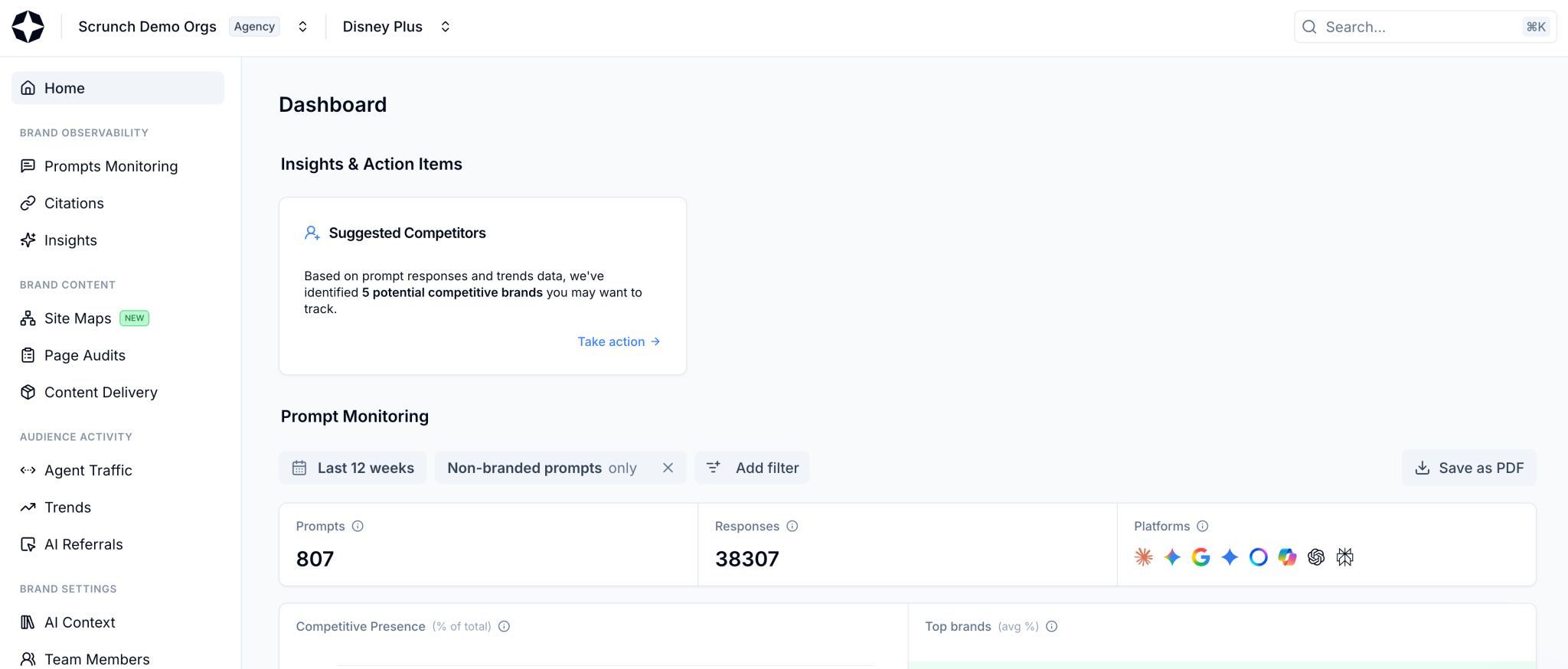
5. Scrunch
Scrunch Core covers a single country and four LLMs. The Query API and MCP access you would build client reporting on sit on Enterprise, so price Scrunch at the Enterprise quote.
Standout features:
- Nine LLMs on Enterprise: Enterprise adds five that Core lacks (Claude / Gemini / Meta AI / Google AI Mode / Grok), for 9 LLMs in total.
- AI bot traffic: You can analyze AI agent and bot traffic alongside answer tracking.
- Funnel stages: It sorts your tracked prompts by stage of the buyer journey, so you can see where in the funnel AI answers mention you.
Scrunch pitches Core at teams evaluating the product and proving impact before scaling, and the limits match that. The seat cap on Core matters too: an account team bigger than the included licenses either rotates access or moves up.
Best for: Single-market brand teams that want sentiment and recommendations from the entry plan and a clear path to more models later.
Pros:
- Sentiment and recommendations on Core: Both come with the entry plan, so you can read tone and next steps before paying for Enterprise.
- Control over tracking: Sarah S., a founder and search-first strategist, wrote in a G2 review: “The control it gives us over how we’re tracking our clients’ AI visibility is second-to-none.“
Cons:
- Setup takes work: Users report that configuring prompts, personas and the CDN connection for agent features takes real effort, especially without technical help.
- No Data Studio on Core: Data Studio access is not included on Core.
Pricing: Core costs $250 per month, billed monthly. It includes 125 prompts and 5,000 responses per month, plus 5 user licenses. Core tracks 5 competitors. A 7-day free trial is available on Core plan. Enterprise is custom-priced for teams that need expanded model coverage, more features and dedicated support.
6. AthenaHQ
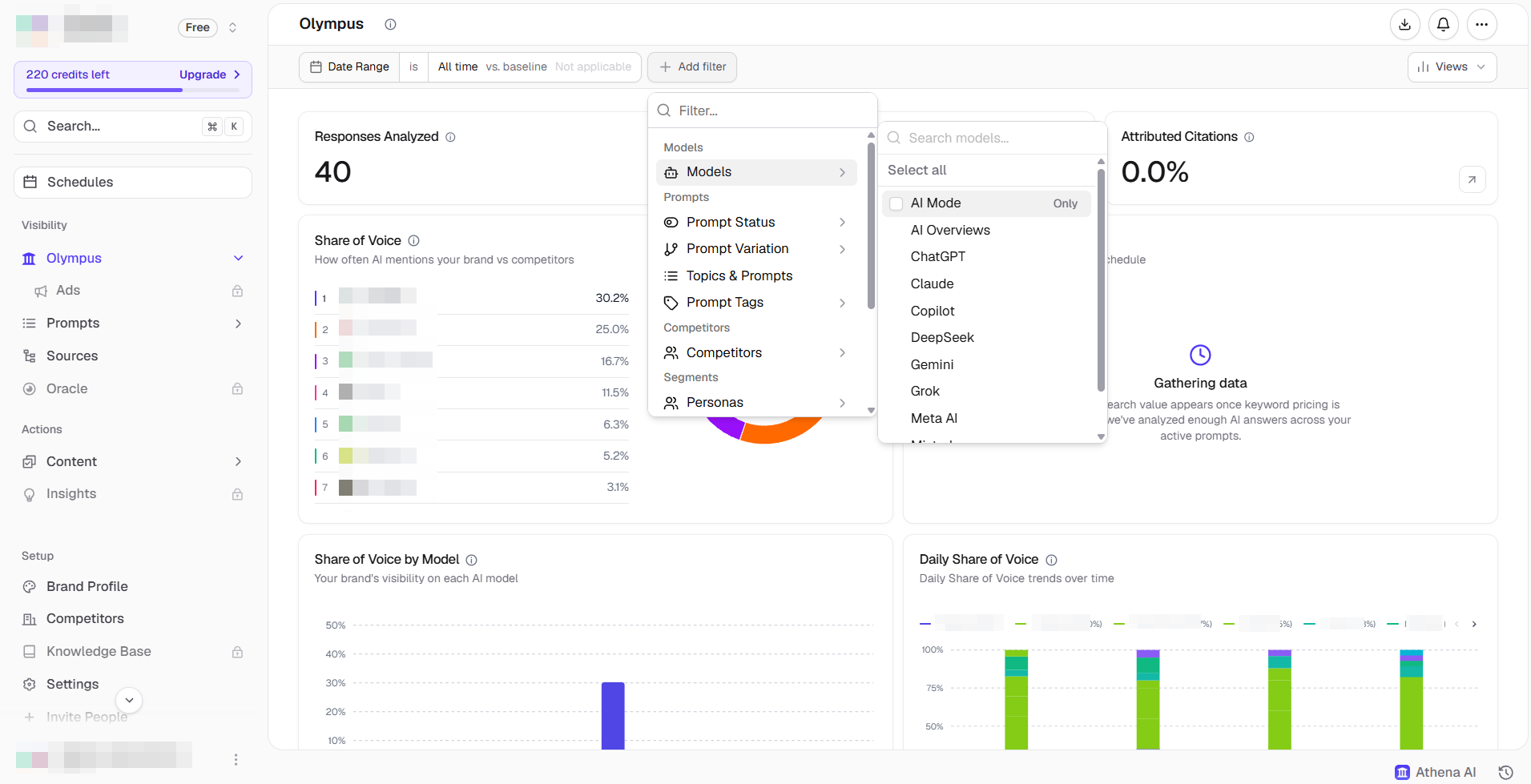
AthenaHQ puts 11 models on its Starter plan, one of the widest default set in this list, and meters responses against a monthly credit allowance.
Standout features:
- Eleven models on Starter: The set runs from ChatGPT and Perplexity to DeepSeek and Mistral.
- Store and CMS integrations: Shopify and Webflow sites connect directly.
- Traffic data: GA4 and Google Search Console integrations connect AI visibility with site traffic.
- Crawler control: A smart robots.txt and llms.txt manage AI crawler access dynamically.
- Content work: The platform includes a content optimization agent alongside tracking.
Credits decide how far those models go. With 1 credit per AI response, running one prompt across all 11 models costs 11 credits, so 3,600 credits cover about 327 prompt runs a month, or roughly 11 prompts a day. That is enough for a focused brand program in one market and thin for an agency book, which is also where the single-region Starter limit bites.
Best for: Brand teams in one market that want the widest default model set and GA4 context next to AI visibility.
Pros:
- Knowledge Base on Enterprise: It adds claim review and Oracle discrepancy detection, so you can check AI answers against what the brand has on record.
- Helps with primary focus: Alex N., Head of Digital Product at a mid-market company, reviewed it on G2: “AthenaHQ is an awesome tool that has shown us exactly where we need to focus our GEO efforts and what content we should publish.“
Cons:
- Single region on Starter: Starter supports a single language and region; multiple languages and regions are Enterprise-only.
- SSO on Enterprise: SAML SSO is an Enterprise feature.
- Unpublished add-on prices: API access and extra credits are add-ons billed on top of Starter, priced on request.
Pricing: Starter costs $295 per month, billed monthly. It includes 3,600 credits per month, and each credit buys one AI response. The annual toggle takes 17% off. Enterprise is custom-priced with custom credits. A free entry plan with 300 credits sits below Starter.
7. Rankscale
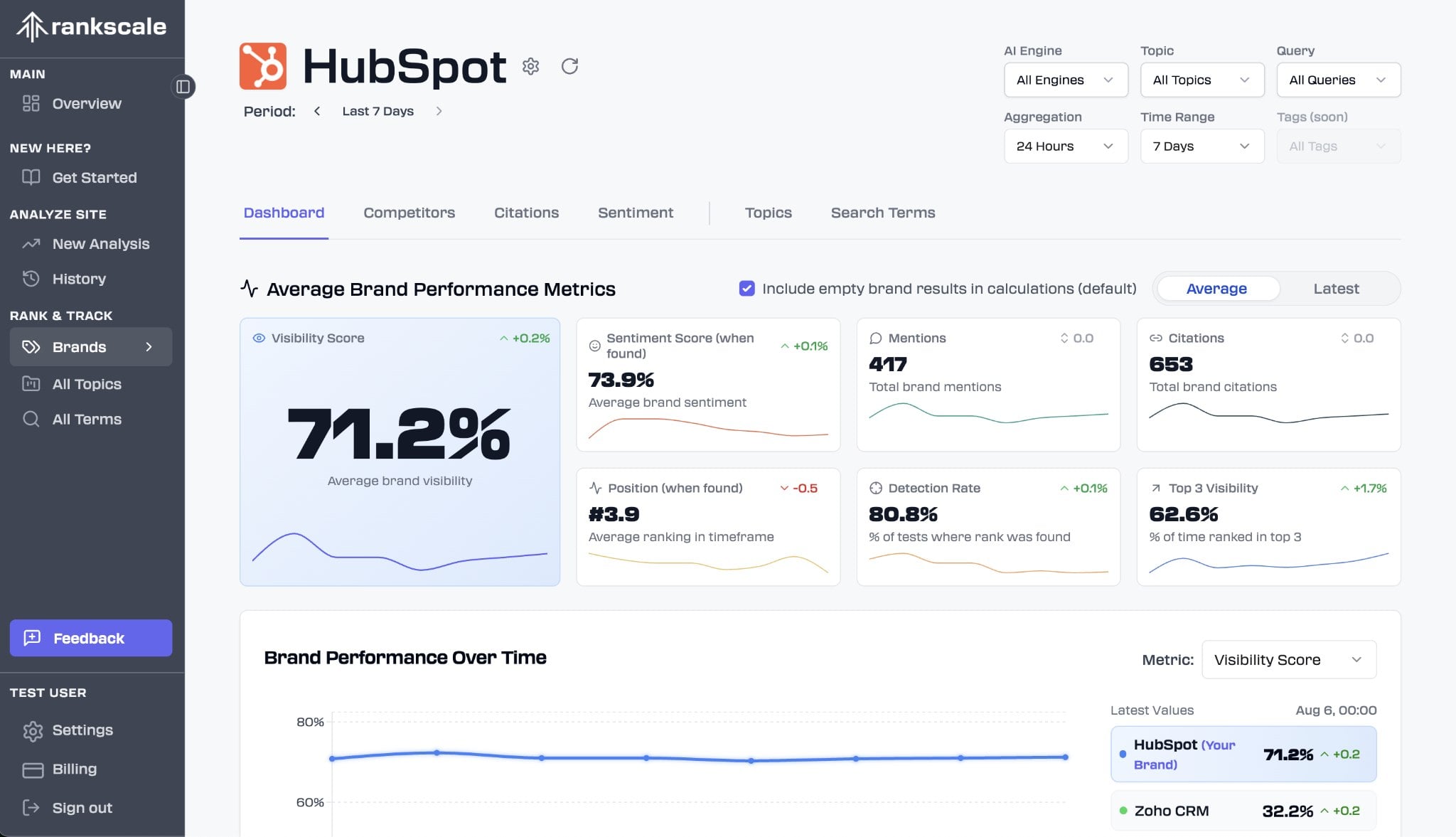
Rankscale meters monitoring in credits, typically 0.25 per engine per prompt, so the engines you switch on decide how many prompts a plan covers.
Standout features:
- Region coverage: Pro already includes all regions, so a new market needs no plan change.
- Ten engines on Pro: The entry plan covers ChatGPT / Perplexity / Google AI Mode / Google AI Overviews / Gemini / DeepSeek / Mistral / Claude / Muse Spark / Microsoft Copilot.
- Shopping analysis: It breaks down shopping cards by provider and item on three surfaces (ChatGPT / Google AI Mode / Bing Copilot Shopping).
- Ad analytics: Sponsored ads in ChatGPT / Google AI Mode / Copilot are measured for share of voice and advertiser leaderboards.
- Query Fanout Insights: Added to Brand Details in September 2026, it ranks the internal searches AI engines run for your prompts.
At the typical rate, 1,200 Pro credits are the 4,800-answer cap; with all ten engines switched on, each prompt run costs 2.5 credits, so the plan covers 480 prompt runs a month, and cutting to four engines lifts that to 1,200.
Best for: Agencies that want wide engine coverage on the entry tier and are willing to manage prompt volume against a credit budget.
Pros:
- Bi-hourly option: Tracking frequency runs from bi-hourly to monthly, so fast-moving prompts can be checked more often than daily.
- Published prices: You can budget Enterprise without a sales call, because its price is listed with the other tiers.
Cons:
- White-label links from Growth: White-labeled dashboard links, which remove Rankscale branding, start on Growth.
- Clunky bulk editing: Editing prompts in bulk takes a lot of double-checking, and the list of keyword and engine combinations gets cluttered.
Pricing: Pro costs $99 per month, billed monthly, with 1,200 credits. Pro tracks up to 4,800 answers, with 10 brand dashboards and 50 page audits. Pro+ is $229, and Growth costs $385/mo, with 5,500 credits. Enterprise costs $780/mo, with 12,000 credits. The yearly toggle saves 15%. A 7-day free trial covers Pro.
8. ZipTie
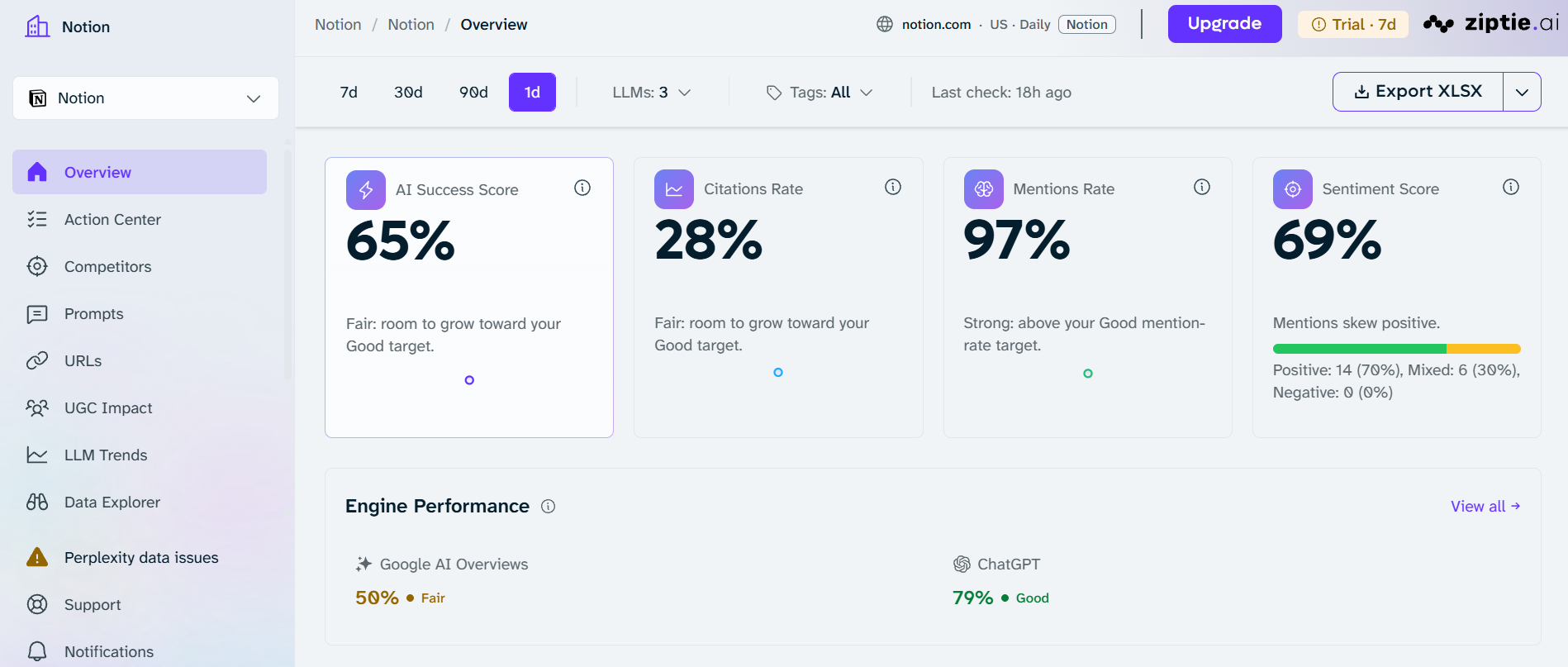
ZipTie bills for the prompts you monitor and the engines you run them on, and its named presets estimate a monthly total from those two choices.
Standout features:
- Seven engines: Paid plans track ChatGPT / Perplexity / Gemini / Google AI Overviews / Google AI Mode / Microsoft Copilot / Bing AI Overview.
- Frequency options: Prompts can run on a daily, weekly or monthly schedule; a weekly prompt costs a seventh of a daily one.
- Organic results too: It tracks Google and Bing Top-10 organic results alongside their AI engines.
- UGC Impact Analysis: This paid add-on reads every Reddit thread and YouTube video the engines cite for your prompts, shows how they portray your brand, and ranks every other cited platform by citations and trend.
The per-check math is the whole comparison. 100 prompts on all 7 engines, run daily, is 21,000 checks a month; at $0.0087 per check that comes to about $182.70 per month before term discounts, which sits between the Searchable’s Pro and Scale plans.
The same math cuts the other way for small accounts: a client tracked weekly costs a seventh as much, so a long tail of low-priority clients stays cheap.
Best for: Agencies with uneven prompt volume across clients that would rather pay for checks than for a tier sized to the biggest client.
Pros:
- Usage-based pricing: Teammates and projects are unlimited, so a new client adds only the prompts you track for it.
Cons:
- No white-label reports: Only the PDF snapshot and CSV/Excel row data exports.
- No refunds: ZipTie does not issue refunds for the unused time.
- API and MCP cost extra: Public API and MCP access are a paid add-on rather than part of the base plan, and they stay off for the whole trial.
Pricing: The Starter preset starts from $42.75 per month, as a calculator estimate. Professional starts from $659.59 per month. Enterprise starts from $3,137.09 per month.
The rate card is $0.01 per prompt per engine, or $0.0087 per check on all 7 engines. API and MCP access costs $10 per month extra. Content generation adds $20 per month per context.
Longer terms save more. Seats and projects are never billed, and neither are competitors. The 7-day trial includes 25 daily prompts monitoring on ChatGPT and Google AI Overviews plus Microsoft Copilot, with no card required.
What to export before you leave Searchable
Searchable Pro keeps historical data for 12 months, while Scale and above keep it unlimited, so run the switch in this order.
- Export first: Pull the answer history out before canceling, and if you took the annual discount of 20%, schedule the export well ahead of the renewal date.
- Overlap for one reporting cycle: Run the same prompt set in both tools for one cycle, since imported answers are analysed with the receiving tool’s methodology, and Searchable warns that calculated metrics may differ between platforms.
- Budget the overlap: An extra month of Pro, at $125/mo, is small next to a baseline dispute with a client.
- Re-baseline with clients: Date the switch in the client report and restate the baseline from that point, so a shift caused by the new tool’s methodology isn’t read as a change in visibility.
- Ask how answers are collected: Collection methods differ between tools (SE Visible, for example, collects responses through a real browser session, not through an API), so ask each vendor how its answers are gathered before you compare numbers from before and after the move.
When Searchable is still the right call
- You publish with its content generator every week: Searchable generates articles and other content as well as product descriptions engineered for AI citation. Scale includes 80 articles a month and 10 projects.
- You track many markets: Pro through Enterprise list unlimited countries and regions, so adding a market never changes the bill.
- You run an agency that wants its own platform: In September 2026, Searchable launched a white-label platform that puts your agency’s brand on everything from the login clients see to their reports and emails.
Frequently asked questions about Searchable alternatives
Yes: AthenaHQ’s free entry plan includes 300 credits. Most other tools here run trials instead. Profound, Scrunch, and ZipTie offer 7-day trials, while SE Visible’s trial runs 10 days.
Count projects before anything else: SE Visible’s Plus plan includes 10 projects, and users are unlimited, so adding a client does not add a seat. Peec AI’s Advanced plan covers 5 projects, so a larger client book pushes you toward Enterprise. Rankscale’s white-label links, along with 50 brand dashboards, start on Growth, which costs $385/mo.
Compare included engines before headline price, because add-ons change the bill: for example, on Otterly AI Standard, the Claude add-on alone costs $109 per month. Then check the pricing unit, since credits and per-check billing make volume depend on how many engines you switch on. Last, check history and export rights before signing. Read our guide on how to choose AI visibility platform to get a clear plan.
Choosing the right Searchable alternative
Start with the Searchable limit that made you look.
- If the limit is engines: SE Visible includes four engines on every plan, with no add-ons or model tiering. AthenaHQ and Rankscale cover more, 11 and 10 engines, but meter them in credits, so the extra engines come out of your prompt volume.
- If the limit is client volume: ZipTie bills per check with unlimited projects, which suits a client book where prompt counts vary a lot between accounts. SE Visible supports 3-5-10 projects.
- If the limit is reporting: Check the tier where Data Studio and the API start before comparing headline prices. Peec AI starts Data Studio on Advanced, while SE Visible has both API and Data Studio connector on each plan.
- If you want a low-cost test first: Otterly AI Lite is the lowest paid entry on this list.
Whichever you choose, plan for the switch itself. Run both tools on the same prompts for one reporting cycle and date the new baseline in client reports, so a change in methodology isn’t read as a change in visibility.
Start a 10-day free trial of SE Visible and run your current Searchable prompt set side by side before you cancel.