How to choose an AI visibility platform: a buyer’s guide

Finding out whether ChatGPT mentions your brand takes about five minutes. Choosing which tool should track it for you takes weeks. There are dozens of AI visibility platforms now, with new ones appearing almost every week, and their demos look nearly identical: every engine covered, sentiment tracking, a dashboard that seems to have done your job for you already. From the slides, you can’t tell which parts are real.
That’s what this guide is for. It covers the questions to ask any vendor, what a good answer sounds like, and how to check it against your own data during the trial, before you sign up for a year. If you’d rather start with a ranked list, here’s how the main AI visibility tools compare.
What should you check when choosing an AI visibility platform?
Check whether the data is complete, verifiable, and usable in your reporting before you compare features or price. These nine checks cover it:
- Confirm which AI engines and markets the platform covers.
- Ask how many prompts and runs support each score.
- Check that it benchmarks you against named competitors.
- Verify you can see the prompts and topics driving each score.
- Confirm it names the specific sources shaping your AI answers.
- Check that it scores sentiment and shows it next to your visibility score.
- Review seat, project, and export limits if you run multiple clients.
- Test if it’s built for your niche and company size.
- Weigh the real cost, add-ons included, against your budget.
Each point below gets its own section: what to ask, what a real answer looks like, and how to verify it yourself.
Which AI engines and markets does an AI Visibility platform cover?
Confirm which AI engines a platform tracks, and whether its market and language coverage matches where your buyers are, before you weigh any other factor.
ChatGPT and Perplexity don’t behave like Google’s AI Overviews or AI Mode: each pulls from a different mix of sources and refreshes on its own schedule, so a brand that’s strong in one engine can be nearly invisible in another. That gap matters more as adoption grows, because buyers aren’t consolidating onto a single LLM.
If your evaluation is narrower than a full platform, dedicated single-engine options exist. For ChatGPT alone, there are tools for tracking ChatGPT visibility specifically; for Google’s newer AI surface, there are options for monitoring visibility in Google’s AI Mode. The tradeoff is coverage. A single-engine provider can’t tell you how the same prompt performs when a buyer asks it in Perplexity or Gemini instead, and the answer often differs.
Check engine coverage per plan, not per platform. Some vendors let you pick three engines on an entry plan, or unlock the full set only on Enterprise, so the coverage in the demo isn’t always the coverage you buy.
SE Visible by SE Ranking is a standalone AI brand-visibility platform that tracks brand mentions and citations across AI engines. Current coverage:
- Engines: AI Overviews, Google AI Mode, ChatGPT, Gemini, and Perplexity. Claude and Microsoft Copilot support is coming soon
- Markets: 42 countries, with the option to narrow tracking to a city or region
- Languages: English, French, German, Dutch, and Spanish are currently available for the platform interface, and each project has its own prompt language
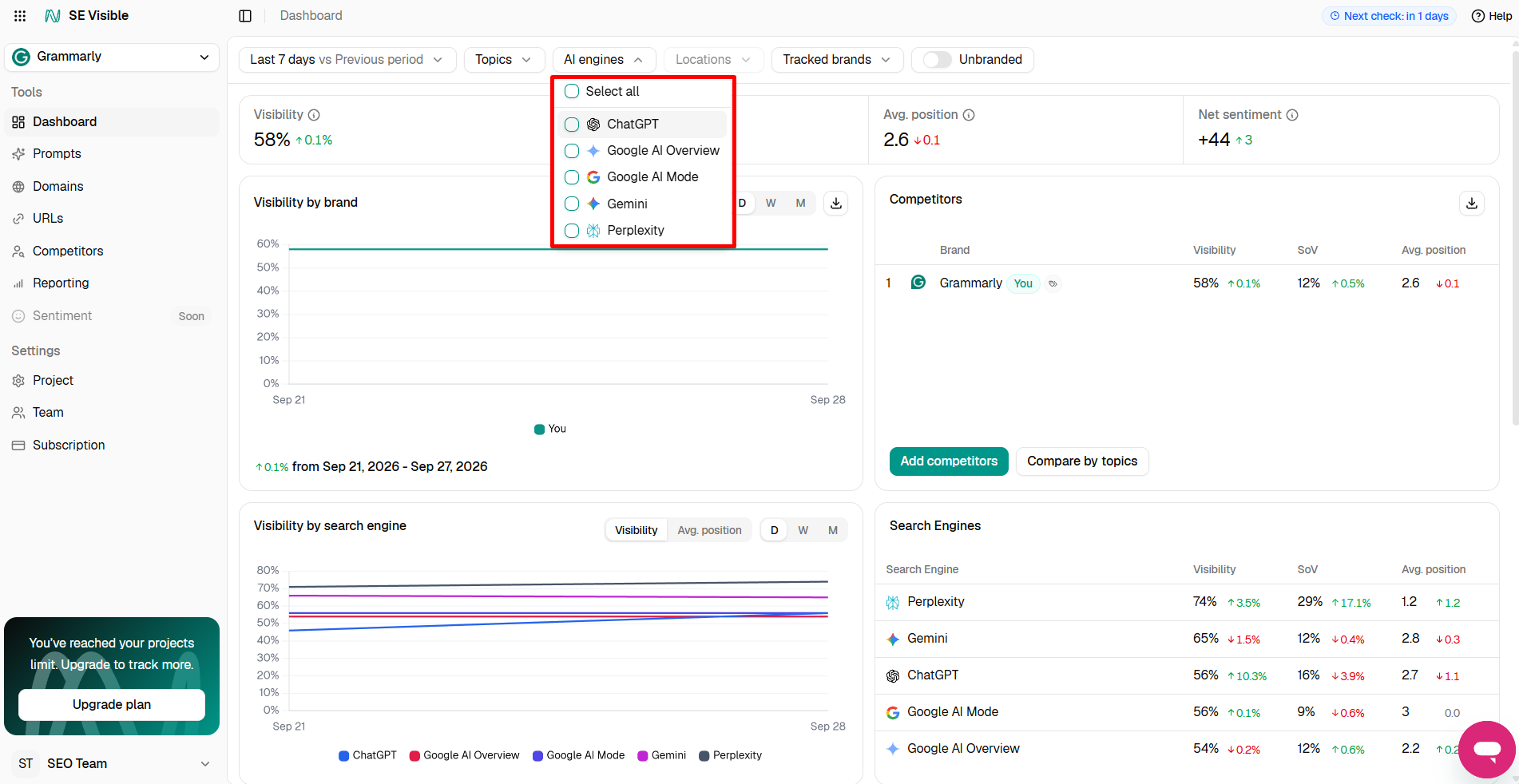
Data refreshes daily by default. You can switch a project to weekly if you want your prompt allowance to last longer.
Whichever LLM visibility tools you’re weighing, apply the same test: do its engines, markets, and languages match where your buyers search?
Can you trust the numbers it gives you?
Ask ChatGPT the same question twice and you can get two different brand lists. So a single visibility number on a dashboard is really an estimate, and how good it is depends on how many answers sit behind it.
In SE Ranking’s AI Mode research, we ran the same 10,000 keywords through AI Mode three times on the same day. Only 9.2% of cited URLs overlapped across the three runs. At the domain level, overlap rose to 14.7%: the engine kept returning to the same sites but picked different pages each time..
Rand Fishkin, co-founder of SparkToro, has described this same instability in plain terms:
“You will get completely different answers. And if you do that 10 times, you will get 10 incredibly unique different answers.”
Rule of thumb for a brand-level score is 150 to 200 prompts, each run at least three times per engine. That’s roughly 450 to 600 answers per engine, which gets the margin of error down to about ±5 percentage points. A tool that runs a small prompt set once and reports the result as a trend line is mostly showing you noise.
For reference, SE Visible runs every tracked prompt once a day on each engine you track, through a real browser session rather than an API, so each prompt builds up about 30 answers a month per engine. On the Basic plan (200 prompts across five engines), that’s around 30,000 answers a month behind your scores.
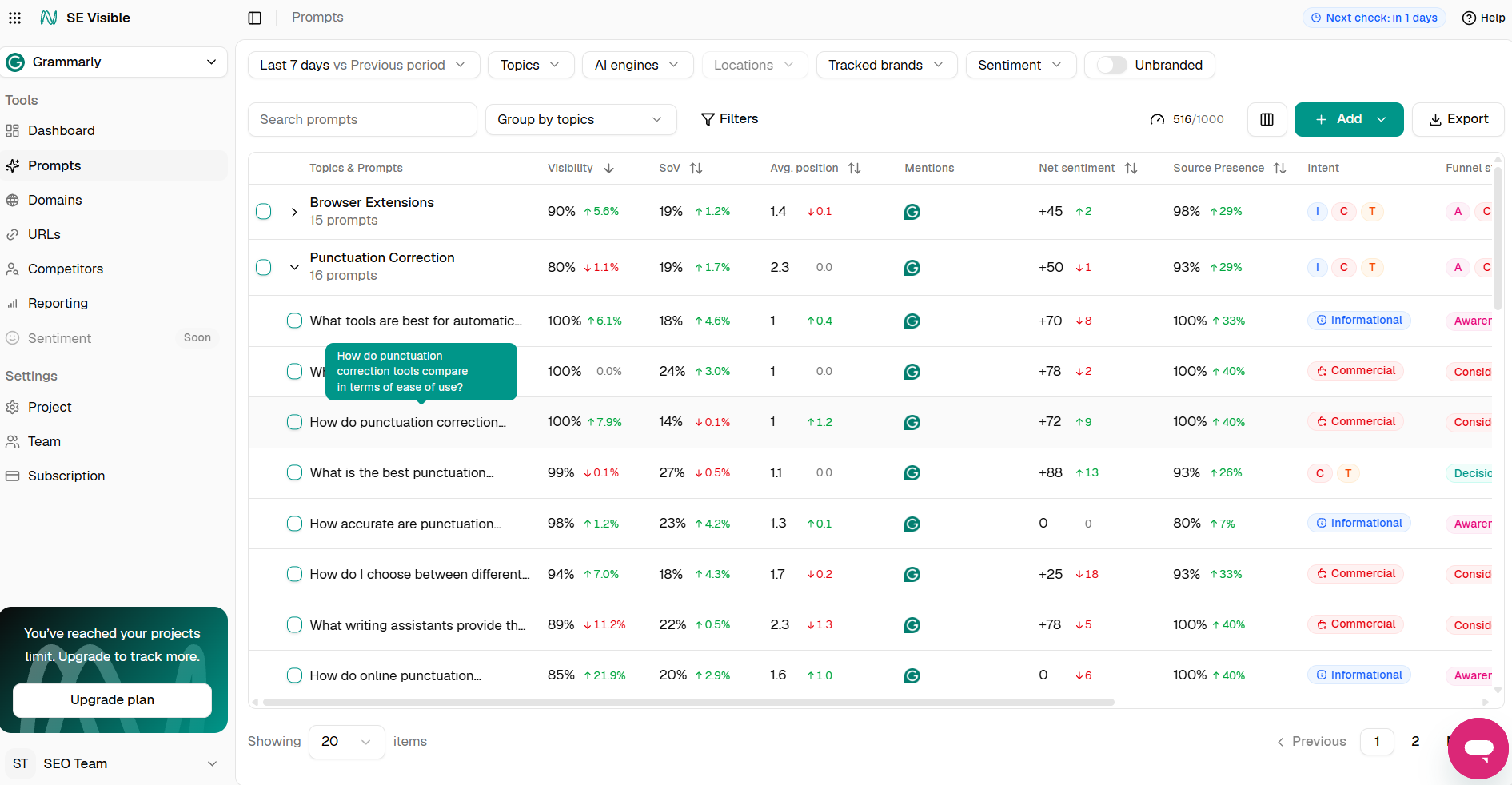
Ask in the demo: How many prompts feed each engine’s score, and how many times does each one run before a number shows up on the dashboard?
Does it show you where you stand against competitors?
A platform worth evaluating here answers two separate questions: whether your brand shows up in AI answers about your category, and whether it gets recommended when it does. Those are two different outcomes, and the distance between them is wider than most benchmarking checklists assume.
Being cited and being recommended aren’t the same thing. SEO consultant Lily Ray to look at AI Overviews for 100 “best [category] software” queries. Brands’ own self-promotional listicles were cited 323 times. In 224 of those cases (69%), Google cited the brand’s page but recommended someone else (Search Engine Land). In other words, your page can be inside the answer while a competitor gets the recommendation.
Competitor benchmarking is built to catch that gap. It shows where your brand is cited without being recommended, and where a competitor wins the recommendation on the same prompt. The reverse view matters just as much: the prompts and topics where competitors appear and you don’t, and which pages the engines pulled those answers from. That last one is an outreach list, the articles worth getting your brand added to.
SE Visible suggests direct competitors at setup and benchmarks share of voice topic by topic, based on the competitors you add to a project rather than an unlimited or automatically tracked field.
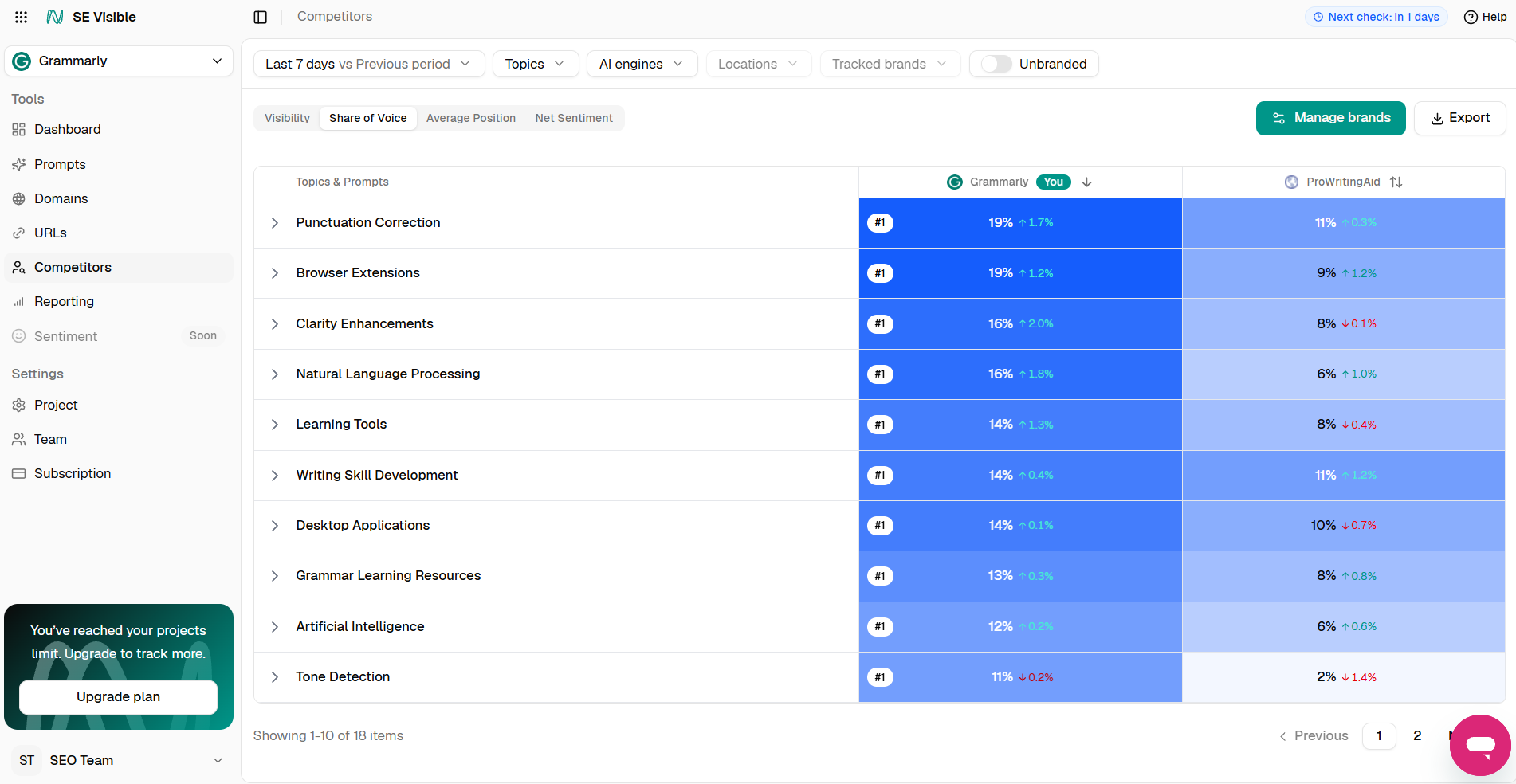
It also shows the list of competitor sources for better visibility understanding.
Use a free trial to run the comparison against the specific competitors you name, not a generic industry set, and check if it shows the sources behind each answer. Do that before you decide the comparison data is worth building a reporting habit around.
Can you see exactly what it’s measuring?
A visibility score only earns your trust when you can see the prompts and topics that produced it.
You should be able to go from the score into a topic, then into a single prompt, and read the actual AI answer, see which engine produced it, and see what it cited. That’s how you check the tool’s reading against your own.
What that transparency looks like in practice: a breakdown by individual prompt and by topic, showing which specific question produced which answer, on which engine.
In SE Visible, every prompt opens to the full list of answers collected for it. Each answer shows whether you were mentioned, your position, the sentiment, and whether your site was cited.
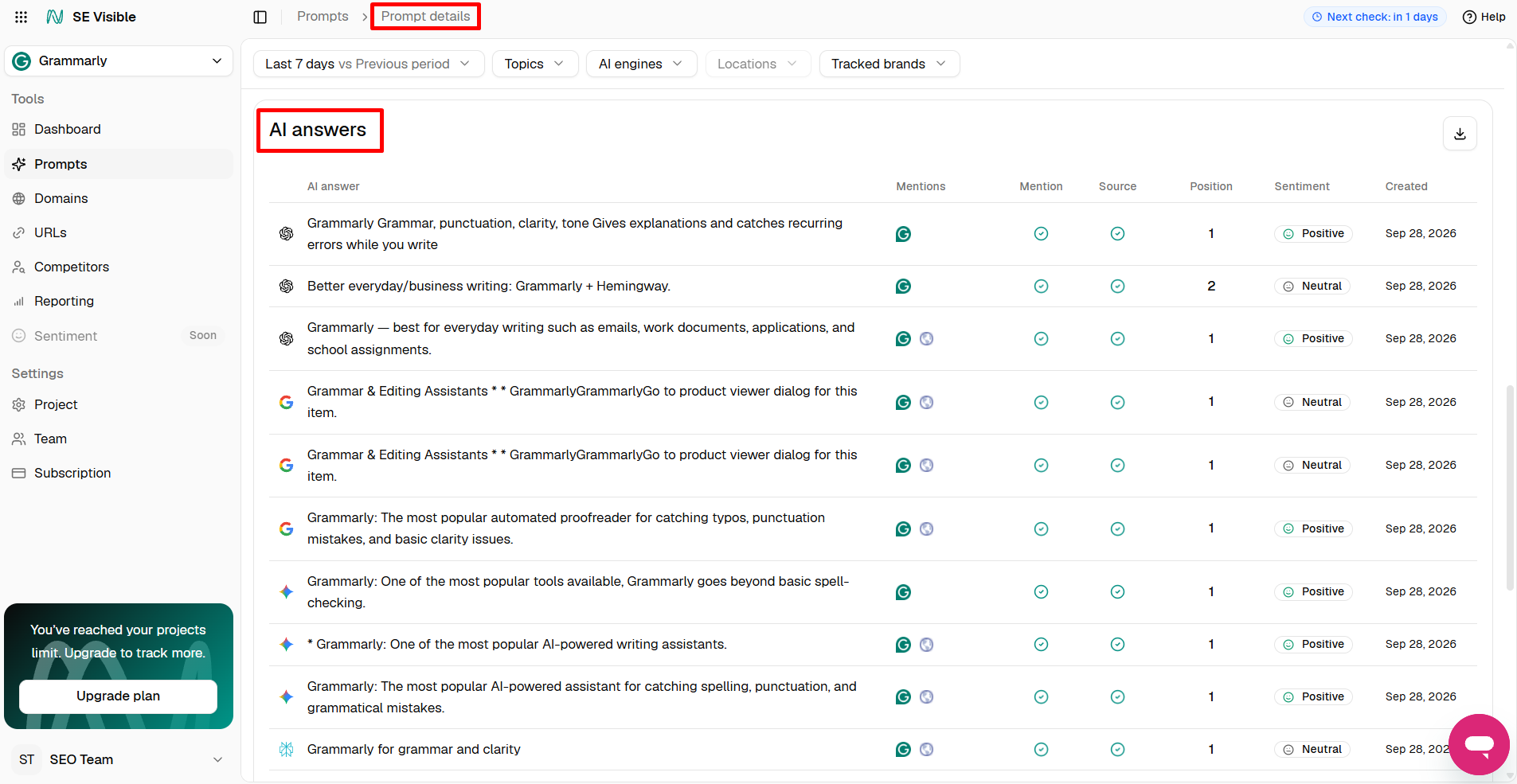
Try this during the trial: Pick 20 prompts you care about and run them yourself in ChatGPT and Perplexity. Then compare what you see with what the tool reports. If they don’t roughly match, you’ve learned more than any demo would tell you.
Does it show you what’s shaping your AI answers?
Most of what an AI engine says about you comes from someone else’s page, so the platform needs to show exactly what’s shaping that answer.
In our Civoryx experiment, external articles collected about 19,000 citations in non-branded answers over six months, while the brand’s own site collected fewer than 2,000. And 85.5% of non-branded answers that mentioned Civoryx also cited at least one of those external articles. When none was cited, the brand was named in just 0.29% of answers.
That changes what an AI visibility platform needs to report on. A tool that only counts brand mentions tells you that you were named. It rarely shows where the citation behind that mention actually lives. Look for a platform that tracks link-level citations and brand mentions together, so you see what’s being said about you and which pages are shaping it.
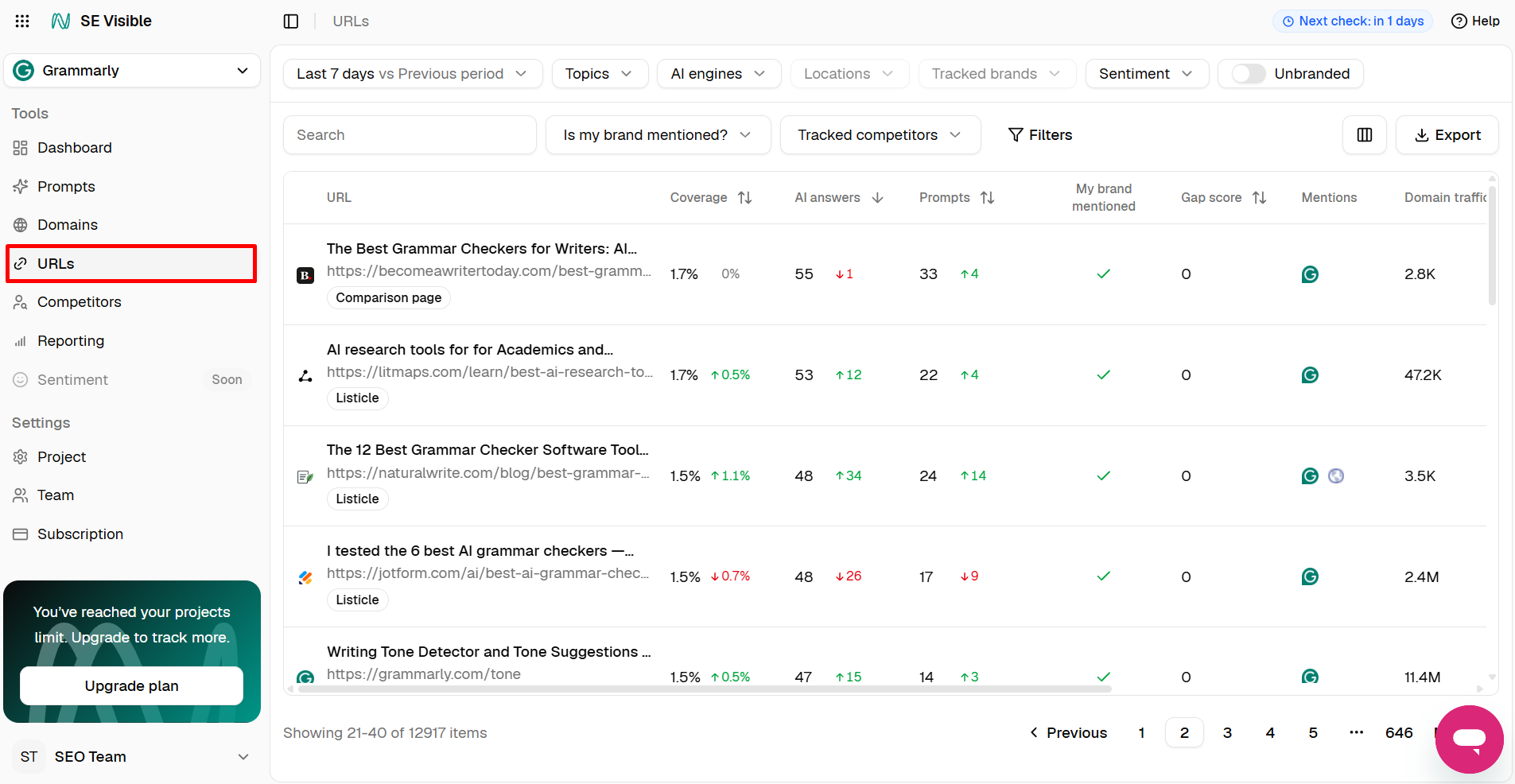
SE Visible’s URLs section lists every domain and URL cited across your tracked prompts. A Coverage column shows what share of answers cite each source, and you can see which competitors those sources mention. Say a G2 category page or a Reddit thread keeps showing up next to your competitors: that’s your outreach list. The tool won’t find contacts or run the PR for you, but it tells you where to start.
For a narrower view of this category, AEO tools built for citation tracking approach it from the answer-engine-optimization angle.
Pro tip: See whether the report names the domain and the exact URL behind each citation. Also pay attention to filtering options: can you filter sources that cite your competitors or can you filter sources by page type?
Does it catch how AI describes your brand?
Mention counts tell you AI is talking about your brand. They don’t tell you whether that’s a compliment or a warning sign.
That distinction matters more than it sounds. Two answers can both mention you. One recommends you, and the other says your support is slow to reply. A tool that only counts mentions scores them the same.
That’s why sentiment needs to sit next to visibility. More mentions with falling sentiment is a very different problem from more mentions with flat sentiment, and you’ll only spot it when both numbers are on the same screen.
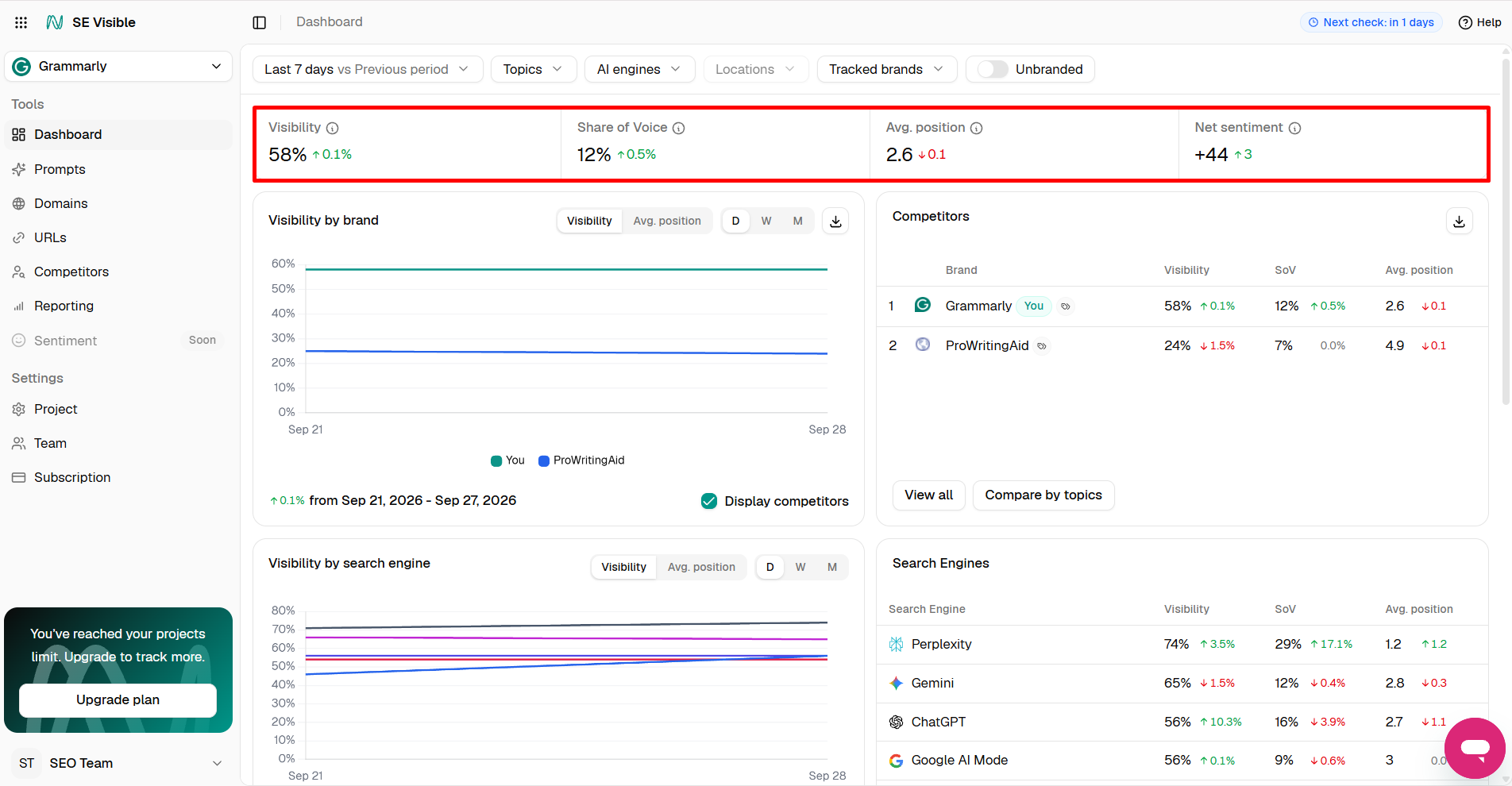
SE Visible scores Net Sentiment separately from the visibility score and shows it next to visibility, position, and share of voice, all from the same daily check.
Pro tip: In the demo, ask whether sentiment is a scored metric or just a label attached to mentions – then ask to see it on the same screen as the visibility score.
Do you need to manage multiple clients?
If you’re running AI visibility across a client book, seat and project limits determine whether a platform scales with your team more than the price tag does.
That distinction is easy to miss on a quick pricing-page skim. Some LLM visibility tools cap seats per plan tier and charge extra per added user. Others leave seats open but cap the number of brands or projects you can run at once, so a fourth or fifth client account can push you into a higher tier even though headcount hasn’t changed. Before you commit, check:
- How many people can log in and pull data at the same time
- How many client brands or projects a given plan actually supports
- What format the platform exports data in, and whether that fits your existing client reporting
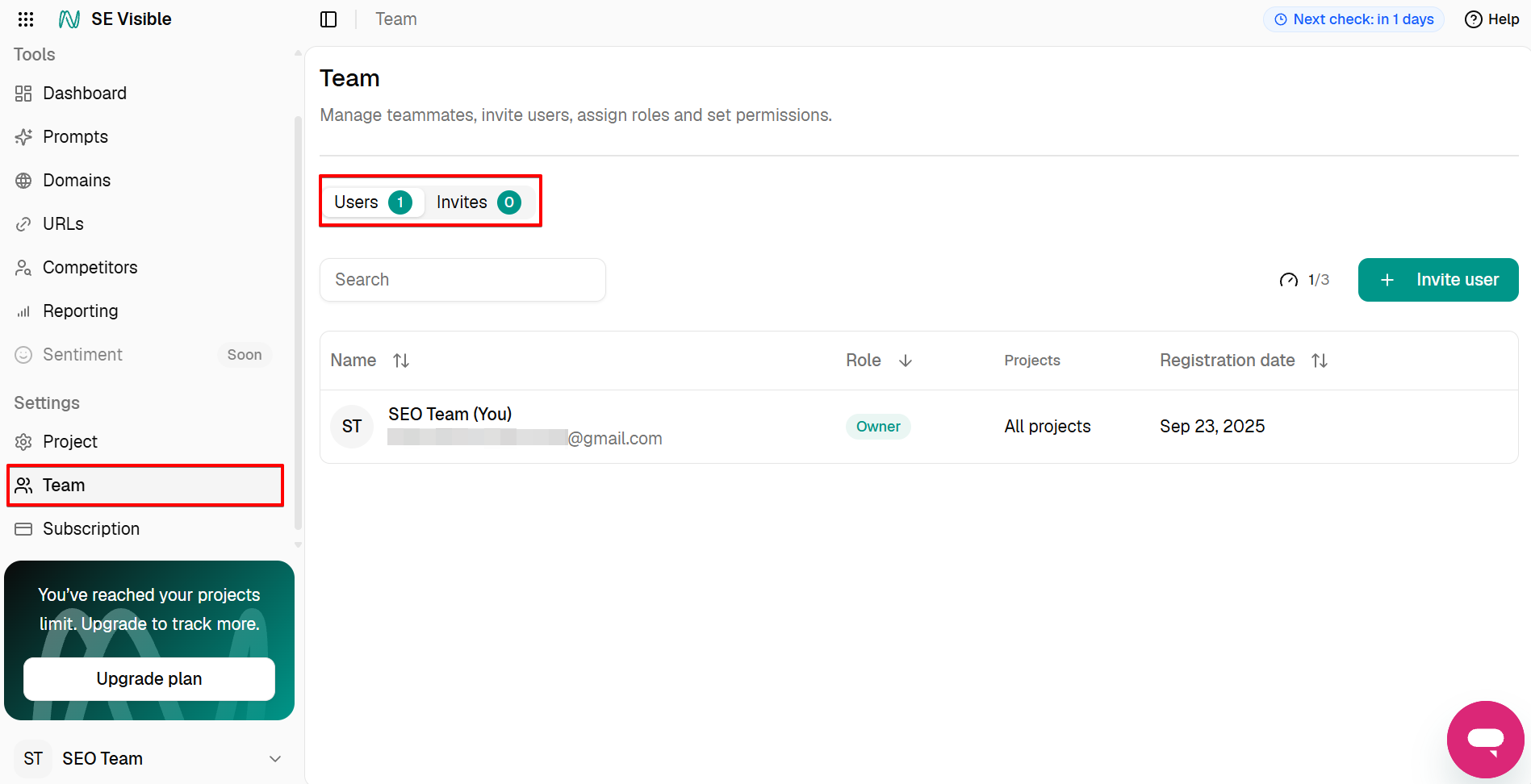
In SE Visible, user seats are unlimited on every plan. Projects aren’t: you get 3, 5, or 10 depending on the plan, and the prompt allowance is shared across all of them. Export is CSV, and there’s no white-label reporting yet (it’s on the roadmap).
Pro tip: Ask to see the platform with more than one client project set up, not just one. Switching between accounts and pulling a single client’s data is the part that either fits how your team works or doesn’t.
Does it fit your business niche and size?
The right tool for your business depends on what your category needs most from an AI-visibility platform, and that need varies more by business type than by company size alone.
Niche fit breaks down like this:
- E-commerce and travel brands run higher page and prompt volumes than most categories. These businesses need product, comparison, and price prompts tracked as separate groups instead of one blended number.
- Finance and health brands operate in regulated, high-stakes categories, where a wrong AI answer about your product carries real risk, so compliance checks on answer accuracy matter more here than elsewhere.
- Content and blog businesses need AI visibility software that recommends fixes, not just monitors where visibility is slipping.
- Enterprise accounts require room to add seats, projects, and data volume as the account grows, without a new contract at every step.
The best test is your own brand. Set up prompts from your category, not the vendor’s demo account. A tool can look great on a SaaS example and still miss what a travel or health brand needs to track. SE Visible’s 10-day free trial is enough time to run your prompts daily and see whether the numbers hold steady.
What does it cost relative to your budget?
Entry-to-mid AI visibility platforms run $99 to $500 a month before custom enterprise pricing, and where you land depends on prompt volume, project count, and seat requirements.
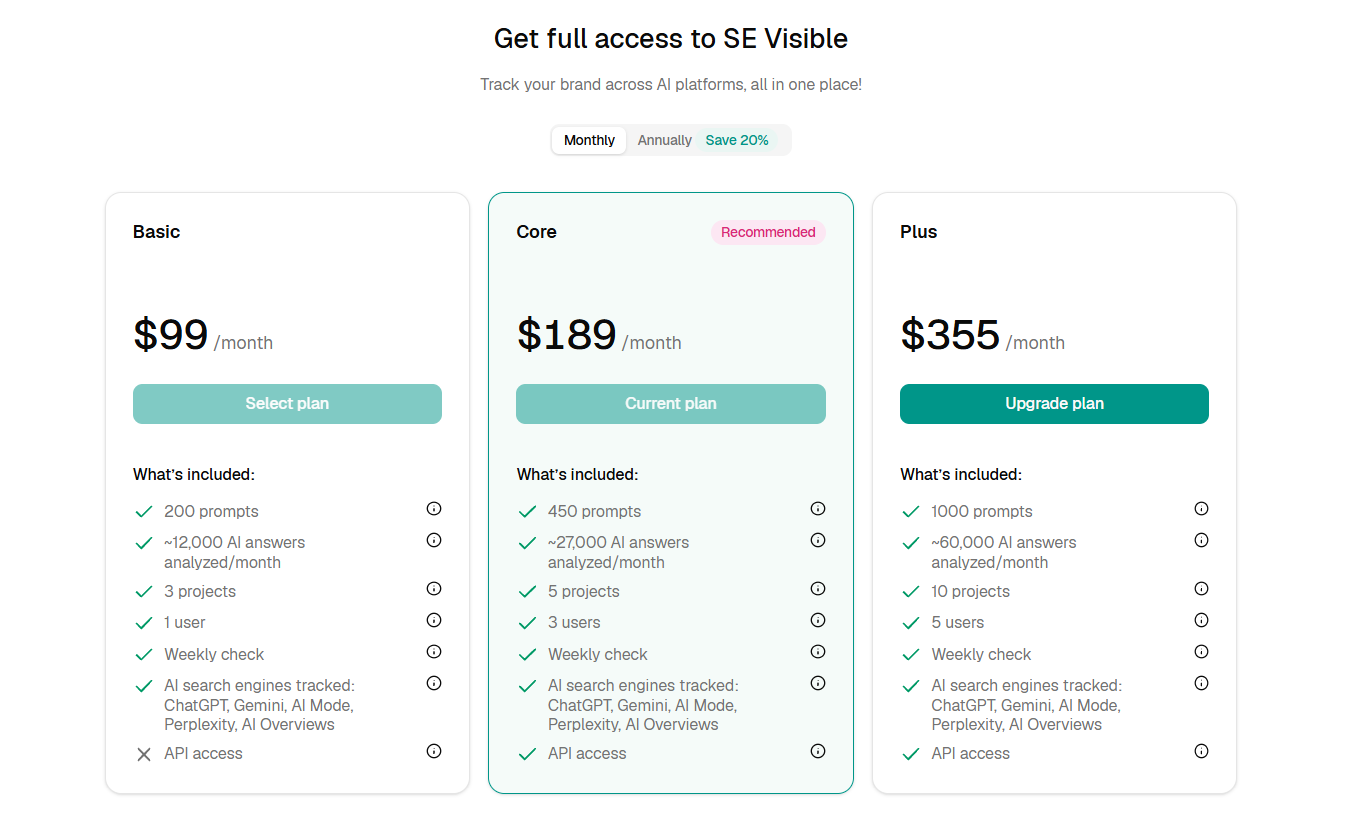
SE Visible by SE Ranking’s own pricing page is a useful reference for what actually changes between tiers:
- Basic: $99/mo, 200 prompts, 3 projects
- Core: $189/mo, 450 prompts, 5 projects
- Plus: $355/mo, 1,000 prompts, 10 projects
Pricing pages for ten of the most popular AI visibility platforms show entry tiers running from free plans and trials up to $295 a month, with most paid entry points landing between $20 and $129. Mid tiers climb from roughly $185 to $500, and most vendors route larger accounts into custom enterprise pricing once prompt volume, engine coverage, or seat count scales up. Some vendors price agency use as a separate, higher tier; others fold it into the same per-seat plan as everyone else.
Pro tip: Count the prompts you need before you compare prices. The prompt cap, not the monthly fee, is what decides which AI visibility platform and tier you end up on.
Which AI visibility platforms are worth shortlisting?
The five platforms below aren’t ranked. They’re built for different buyers – an agency roster, a single in-house brand, an enterprise under security review – so the question is which setup yours looks most like.
SE Visible
SE Visible by SE Ranking tracks brand presence across ChatGPT, Perplexity, Gemini, Google AI Mode, and Google AI Overviews, using real, browser-captured answers rather than simulated queries.
Sources, sentiment, and competitor benchmarking sit in one dashboard, and seats are unlimited. Plans start at $99/mo for 200 prompts.
That fits agencies managing a multi-client book, plus in-house brand and marketing leadership, including CMOs and PR teams.
Keep in mind: five engines (no Claude, Copilot, or Grok yet), CSV-only export.
Profound
Profound started as an AI visibility tracker and has grown into what it calls an “AI Marketer”, a platform that also researches and writes content for your brand.
Alongside visibility, citation, and sentiment tracking, it offers Agent Analytics, which shows how much traffic actually reaches your site from AI tools. On Enterprise, it covers up to nine engines and adds ChatGPT Shopping for e-commerce brands.
It suits larger brands and enterprises that want monitoring and content production on one platform.
Keep in mind: apart from a free trial, brand plans are custom-priced, so expect a sales call before you know what it costs.
Peec AI
Peec AI tracks visibility and sentiment over time alongside competitor share of voice, plus SKU-level AI shopping data for e-commerce catalogs, in a clean interface that’s quick to learn.
Plans run $95, $245, and $495 a month, each with three engines of your choice, unlimited users, and daily tracking. The platform stays focused on monitoring rather than content production, so editorial teams wanting fix recommendations will need a second tool alongside it.
That fits small in-house marketing teams and agencies with a short client list, where an interface new hires can learn in an afternoon matters more than breadth of features.
Keep in mind: brand plans let you track three AI models of your choice. Coverage of every model comes with Enterprise.
AthenaHQ
AthenaHQ tracks visibility across 11-plus AI models, adding Claude, Grok, DeepSeek, and Mistral to the usual four. It also recommends on-page and off-page actions.
There’s no real free plan – just a one-time $25 credit to test with. Paid tracking starts at $295/mo, and the Athena Citation Engine, SSO, and audit logs sit behind custom enterprise pricing.
That suits enterprises that need the security layer and brands wanting coverage past the main four engines. A small team can take a proper look before paying, but there’s no low-cost standing plan.
Keep in mind: the Citation Engine, SAML SSO, audit logs, and the advanced content agent are Enterprise-only, and there’s no low-cost standing plan.
Scrunch AI
Scrunch AI runs the widest workflow of the five, starting with monitoring and ending with AI-optimized delivery.
It supports nine AI platforms in total, though the entry plan covers four and the full set comes with Enterprise. Its Influence Score ranks cited sources by how often they’re cited and how many different prompts they appear across, which helps you decide where to focus outreach. And the starting price is $250/month.
That suits mid-market and enterprise brands plus agencies running client books.
Keep in mind: the entry plan covers 125 prompts on four AI platforms, and most of what sets Scrunch apart (all nine platforms, the Agent Experience Platform, integrations) sits on Enterprise.
Frequently asked questions
There’s no single best AI visibility tool. It depends on the engines and markets you need to cover, and how much reporting depth your team or clients require. Apply the criteria above to your shortlist, or see how different AI visibility tools compare for a ranked list of named tools.
A platform and a GEO agency solve different parts of the problem, so most teams use both rather than choosing one. The platform gives you the measurement layer, what’s cited and how you’re described in AI answers. A GEO agency turns that data into strategy and execution work your team may not have the capacity to run in-house.
Some LLM visibility tools in this category offer a limited, permanently free tier, usually capped at a handful of tracked prompts with no source-level detail. SE Visible doesn’t run a free tier. It offers a 10-day trial, no credit card required, so you can see how citation and mention tracking actually work before committing budget to a plan.
Measuring AI visibility means tracking a consistent set of prompts across the engines your buyers use, then logging whether your brand shows up and how it’s described each time. Layer in source-level data, which pages get cited alongside you, to see what’s shaping those answers. Track the same prompts weekly or daily so shifts show up as trends instead of isolated snapshots.
Weighting matters more than checking every box. If you’re choosing an AI visibility provider for a single brand, put the brand visibility dashboard and sentiment tracking at the top of your list. If you’re evaluating across a client roster, put multi-brand support plus reporting and export there instead, since that’s what gets the data into your existing reporting workflow.
See it yourself: start a 10-day free trial of SE Visible by SE Ranking, no credit card required.