Answer Engine Optimization: What Actually Works, According to Citation Data

Search for advice on answer engine optimization, and you will keep running into the same recommendations: add FAQ schema, create an llms.txt file, write shorter paragraphs, cite authoritative sources, and wait for AI engines to notice.
The problem is that much of this advice was published before anyone had enough citation data to test whether it worked.
But now, we have over 2M pages and 400,000 domains worth of data across ChatGPT and Google’s AI answers. That gives us a much better sense of what actually matters for AEO. Some widely recommended tactics hold up in the data. Others don’t. And there’s no single formula that works equally well across every answer engine.
So, in this guide, we’ll look at what AEO means in practice and how SE Visible helps you measure it, where AEO overlaps with SEO and GEO, and which factors influence citations across different LLMs. As we work through the recommendations, we’ll show you exactly which SE Visible reports and metrics to check for your own brand.
1. What is answer engine optimization?
Answer engine optimization (AEO) is the practice of structuring content so AI systems can retrieve it, break it into citable passages, and pull those passages into a generated answer with your source attached.
Here’s what that looks like mechanically, in four steps:
- Retrieve. The system pulls a set of candidate pages for the query.
- Chunk. Each page gets broken into passages rather than treated as one document.
- Synthesize. The passages that score highest for directly answering the query get woven into the response.
- Cite. Some of those passages get attributed back to their source.
That changes what you’re optimizing for. In traditional SEO, the page is usually the main unit of competition. In AEO, individual sections and passages matter much more. Even if a page isn’t the top organic result, a clear, self-contained passage can still be pulled into an AI-generated answer and cited as the source.
And that passage-level competition matters more as AI-generated answers become a bigger part of how people search.
In practice, AEO extends SEO into search experiences where the user receives a synthesized answer instead of (or before) a traditional list of links.
OpenAI says around 1 billion people use ChatGPT weekly. Google says AI Overviews reaches more than 2.5 billion monthly users, while AI Mode has surpassed 1 billion monthly users.
So, the audience is huge.
That makes AEO an essential extension of any search strategy: brands need to understand when, where, and how LLMs mention and cite them. And SE Visible helps teams do exactly that: track brand mentions and citations across AI platforms, benchmark their visibility against competitors, and turn those insights into focused actions.
2. How does AEO differ from SEO and GEO?
AEO and SEO optimize for different endpoints: SEO gets you to a ranked link a user has to click, while AEO gets your content pulled directly into the answer itself.
Here’s how that plays out across the areas that actually matter for how you build content:
| SEO | AEO | |
| Unit of competition | The page | The passage or chunk within a page |
| What earns the win | Ranking position on the results page | Getting selected and cited inside a generated answer |
| Discovery mechanism | Crawl, index, rank against a query | Retrieve, chunk, score for direct relevance, synthesize |
| User outcome | A click to your site | An answer, often with no click at all |
| Success metric | Position, organic traffic, CTR | Citation frequency, share of voice inside AI answers |
| How it’s measured | GSC and GA4 for traffic and conversions; traditional SEO tools for rankings, keywords, and backlinks | AI visibility tracking platforms like SE Visible for mentions, citations, prompt coverage, and AI share of voice |
| Content requirement | Topical authority, backlinks, page experience | Answer-first structure, factual density, clear entity definitions |
The rows share more than they split. Crawlability, entity clarity, and topical authority feed both columns. You’re not starting a separate discipline. You’re extending the same one to a new surface.
Where does GEO fit? Generative Engine Optimization covers the same territory as AEO: getting cited as a source inside AI-generated answers.
In practice, most practitioners use the two terms interchangeably, and the industry hasn’t settled on one.
For instance, Aleyda Solis, one of the more visible voices in this space, said in 2026 that she doesn’t spend energy on which acronym wins. Her concern runs the other way: when a new label makes AI search optimization sound like a discipline separate from SEO, it risks handing the work to people without SEO’s grounding in how search systems actually crawl, rank, and evaluate content.
That’s the practical position worth taking here too. Whether your team calls this work AEO, GEO, or just SEO for a new surface, the underlying tasks are the same: structure content so it can be retrieved, chunked, and cited.
If you want the fuller history of how these labels emerged, SE Ranking’s guide to AI search visibility covers it.
3. How do AI engines actually decide what to cite?
There’s no universal formula for getting cited across AI search. What works for ChatGPT may matter less in AI Mode, AI Overviews, Gemini, Claude, or Perplexity.
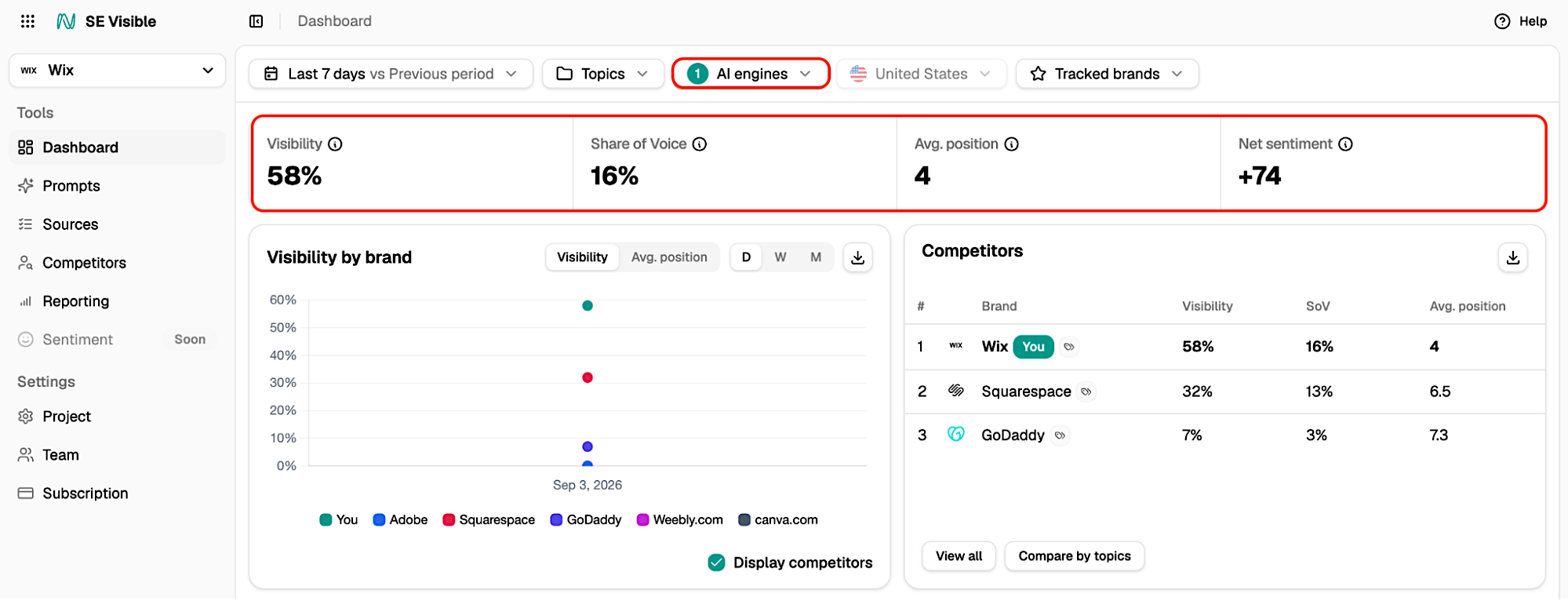
That’s why it makes more sense to evaluate each engine separately. And you can see these differences for your own brand in SE Visible.
Filter your results by AI engine, then compare your visibility and share of voice across engines to identify where your brand is most prominent and where competitors are ahead.
What ChatGPT cites
SE Ranking analyzed 129,000 domains, 216,524 pages, and responses to 100,000 prompts to see which signals were most strongly associated with ChatGPT citations.
A few patterns stood out.
Authority came first. Referring domains were the strongest signal in the study. Sites with more than 32,000 referring domains were 3.5x more likely to be cited than those with 200 or fewer. Domain Trust showed a similar pattern: sites with a DT above 90 earned almost 4x more citations than those with a DT below 43. In other words, ChatGPT tended to favor sources that already had strong external validation.
Organic visibility mattered too. URLs with an average ranking position of 1–45 earned about 60% more citations than those ranking in positions 64–75. The same was true at the domain level. Sites with more than 190,000 monthly organic visits received nearly twice as many citations as those with lower traffic. That does not mean ChatGPT simply reproduces Google rankings. But it does suggest that both systems reward many of the same underlying qualities.
Content depth, freshness, and structure helped, but less than authority. Pages above 2,900 words averaged 5.1 citations, compared with 3.2 for pages under 800 words. Pages updated within the previous three months averaged 6 citations, versus 3.6 for older content. Structure mattered as well: pages with roughly 120–180 words between headings earned more citations than pages split into very short sections.
Signals beyond the website also showed up. Domains with a strong presence on Reddit and Quora saw roughly four times the citation levels of domains with very few mentions. A presence across review platforms such as G2, Trustpilot, Capterra, Sitejabber, and Yelp was associated with 4.6–6.3 citations on average, compared with 1.8 for domains absent from those platforms.
What may be even more useful is what didn’t seem to matter much.
An llms.txt file had negligible predictive value. FAQ schema did not improve citation rates: pages using it averaged 3.6 citations versus 4.2 without it. Linking to highly authoritative domains had little influence, and even .gov and .edu domains did not receive an automatic citation advantage.
ChatGPT citation visibility does not appear to hinge on one technical AEO trick. Strong authority, existing visibility, useful depth, fresh content, and external validation seem to matter much more.
What Google AI Mode cites
Google AI Mode shows a somewhat different pattern.
SE Ranking analyzed more than 2.3 million pages from nearly 300,000 domains across 20 niches, using responses to more than 500,000 prompts.
Existing visibility and authority came through as the strongest signals. Organic domain traffic was the strongest predictor in the model, followed by referring domains. Sites with more than 1.16 million monthly organic visitors averaged 6.4 citations, compared with 2.4 citations for sites getting fewer than 2,700 visitors. Backlinks showed a similar gap: domains with more than 24,000 referring domains averaged 6.8 citations, versus 2.5 for sites with fewer than 300 referring domains.
In practical terms, that means AI Mode is much more likely to cite established, visible domains than sites relying on a handful of on-page optimizations alone.
Content quality still made a noticeable difference. Longer pages, recent updates, semantically relevant URLs and meta descriptions, and clear section structure were all associated with more citations. The effect was smaller than the authority signals, but consistent enough to matter.
For example, longer pages received roughly 20–25% more citations than very short ones, while recently updated content saw about a 25–30% advantage over pages that had not been refreshed for years.
FAQ content is a good example of a smaller but still useful optimization. Pages with FAQ sections featured within their content receive 4.9 citations on average, versus 4.4 for pages without.
But FAQ schema itself showed no meaningful impact.
The overall pattern is straightforward: authority and existing Google visibility create the strongest advantage, while content depth, freshness, relevance, and structure can improve the odds further.
What AI Overviews cite
AI Overviews sit even closer to Google’s traditional search ecosystem.
SE Ranking’s research has repeatedly found substantial overlap between organic results and AIO sources. The dataset referenced in its AI Overview optimization guide found that 92.36% of AI Overviews linked to at least one domain already ranking in Google’s organic top 10, while 63.19% of source pages themselves ranked in the top 10.
That share is not a universal constant. Overlap changes across markets, query sets, and Google updates. For example, SE Ranking’s August 2026 France study found 60.46% of cited URLs in the organic top 10.
But the direction is clear: pages that already perform well in organic search are much more likely to be in the running for an AI Overview citation.
Google itself says much the same thing.
There is no separate technical checklist for AI Overviews. To appear as a supporting link, a page needs to be indexed and eligible to appear in regular Google Search with a snippet. Google recommends the same fundamentals it already recommends for SEO: allow crawling, use internal links, provide a good page experience, and make sure structured data matches what users can actually see.
And notably, Google says you do not need special AI files, AI-specific markup, or a new type of schema to appear in AI Overviews.
So for AI Overviews, the starting point is not a new bag of AEO tricks. It is strong SEO.
Get the page crawled, indexed, useful, authoritative, and competitive in organic search first. Then make the content easy to extract: answer questions directly, keep important facts clear and self-contained, and structure sections so individual passages can stand on their own inside a generated answer.
Claude, Gemini, and Perplexity
Let’s start with Claude.
Website traffic from Claude grew 386% in 2026, but from a very small base. It still ranks fifth among AI referral sources, accounting for just 1.40% of AI-referred traffic.
Claude does have a web search layer, which uses Brave Search to retrieve current information and sources. This means your visibility in Brave can influence which pages Claude finds and cites.
Still, Claude may not be a platform where chasing citations should be a major AEO priority in the first place. Unlike search-first experiences such as AI Overviews or Perplexity, Claude is heavily used as a work tool for writing, coding, research, analysis, automation, and working with data.
Its value increasingly comes from being part of these workflows rather than simply sending referral clicks. Anthropic’s own research into roughly 400,000 Claude Code sessions also illustrates how deeply the product is being used for task execution rather than traditional search.
So for many businesses, the bigger opportunity may not be “How do we get Claude to cite our blog post?” It may be “How do we make our product, documentation, or data useful inside Claude?” That could mean comprehensive documentation, accessible first-party data, APIs, or integrations such as MCP that let users bring your product directly into their Claude workflows.
Gemini is a different case. It is becoming a much more meaningful discovery channel.
In fact, website traffic from Gemini grew 231% from 2025 to 2026, which makes it the second-largest AI traffic source, with 11.56% of AI-referred traffic. It has already overtaken Perplexity globally.
Gemini is also closely connected to Google’s search ecosystem. It can ground its responses in Google Search, using current search results to generate answers and provide citations. This makes strong Google Search performance a logical foundation for Gemini optimization: crawlability, indexation, rankings, topical authority, and credible backlinks still matter.
Its citation behavior also gives some clues about where to focus. Tinuiti’s study of commercial prompts found that Gemini gets only around 3% of its citations from social media, compared with much higher shares in some other Google AI surfaces.
So for Gemini, we wouldn’t make Reddit visibility the center of the strategy. Strong first-party content, expert articles, and mentions in credible third-party publications are likely a better place to invest.
Use SE SE Ranking to monitor and improve that search foundation, then use SE Visible to measure how your brand’s visibility and share of voice change within Gemini.
Perplexity is almost the opposite story. It ranks third for AI referral traffic, accounting for 7.23%, but its traffic has been fairly flat while Gemini has surged ahead.
Where Perplexity gets especially interesting is its source mix. Tinuiti found that Reddit alone accounted for 24% of Perplexity citations in January 2026.
That makes Perplexity more of an off-site visibility game. Alongside your own content, pay attention to independent comparisons, reviews, community discussions, and useful long-form videos where people research your category.
But don’t turn “get on Reddit” or “make YouTube videos” into another universal AEO rule. The better approach is to track which external sources Perplexity is actually citing for your topics and build visibility there.
Here’s how to do it in SE Visible:
1. Open Sources → Domains.
2. Filter the results by Perplexity and select the topic you want to analyze.
3. Review the Coverage column to identify the domains Perplexity cites most consistently across relevant answers.
4. Switch to the page-level view to see the exact URLs and types of content being cited.
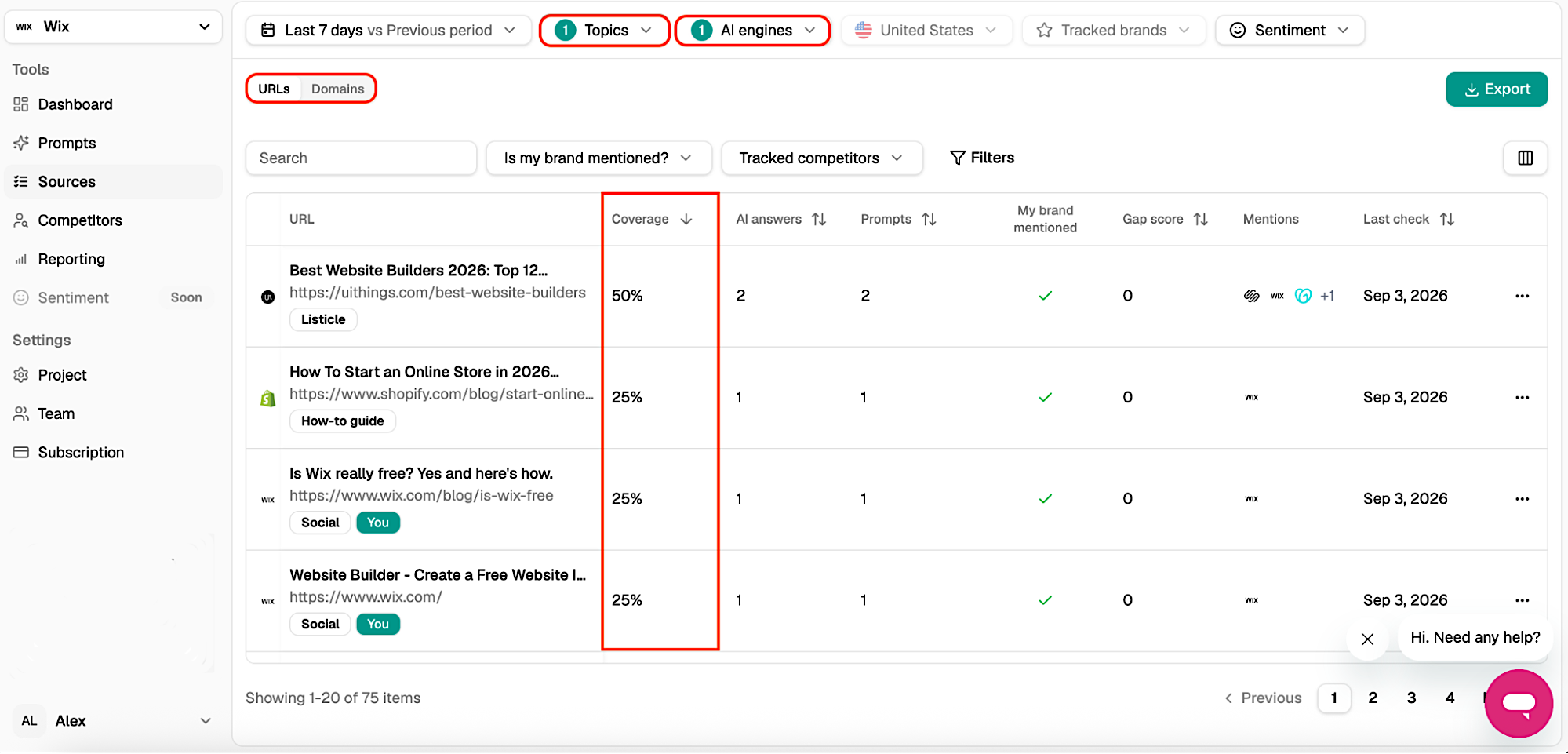
5. Compare sources associated with your brand and competitors to find publications, directories, forums, or other third-party sites where competitors appear but you don’t.
6. Prioritize the most relevant opportunities and work toward inclusion through expert contributions, original data, product listings, reviews, or digital PR.
Across all three platforms, the broader lesson is the same: there is no single AEO playbook. Claude may be more valuable as a workflow environment than a citation channel, Gemini currently leans much less on social sources, while Perplexity gives those sources substantially more weight. Your optimization priorities should follow how each platform actually works—not a universal list of “LLM ranking factors.”
4. Which AEO tactics actually move the needle (and which don’t)?
Once you compare the common AEO checklist with citation data, the priority order changes quickly.
| AEO tactic | What the data says | Verdict |
| Build organic authority and backlinks | Among the strongest predictors for both ChatGPT and AI Mode | Keep |
| Structure content into clear topical sections | Well-developed, focused sections outperform extremely short fragments | Keep |
| Cover the topic in depth | Longer, comprehensive pages correlate with more citations on ChatGPT and AI Mode | Keep |
| Update important content | Recently updated pages perform better on both engines | Keep |
| Add useful FAQ content | Context-dependent for ChatGPT; modest positive association in AI Mode | Conditional |
| Add FAQ schema for AI citations | No measurable ChatGPT lift; no meaningful AI Mode lift | Drop as an AEO tactic |
| Create llms.txt to earn citations | No correlation with citation frequency despite 10.13% adoption | Drop as a citation tactic |
| Make every section extremely short | Very short sections underperform more complete ones | Drop |
| Link to authoritative sites because “AI likes citations” | Good editorial practice, but outgoing-domain authority has little impact on citations | Conditional |
The llms.txt finding is especially useful because it has been tested separately across nearly 300,000 domains. Only 10.13% used the file, and SE Ranking found no correlation with AI citation frequency; removing the variable from its prediction model actually improved accuracy.
This does not mean you must remove llms.txt. If your CMS generates it automatically or maintaining it costs almost nothing, there is little reason to panic about its existence. Just do not prioritize it over pages, links, brand authority, or content updates on the assumption that it will unlock AI citations.
The same applies to chunking. “Write tiny paragraphs for LLMs” is an oversimplification. The research points toward coherent, self-contained sections, not fragmented prose.
In his content strategy and AI search analysis, Mike King (founder of iPullRank) has made a similar distinction: chunking is fundamentally about making information work for both human readers and passage-level retrieval (not chopping every idea into bite-sized sentences for an algorithm).
Think in retrievable units: one clear subtopic, enough context to understand it independently, an explicit answer or claim, and supporting evidence where needed.
5. Which answer engines actually matter for your brand?
Not every answer engine deserves the same amount of attention.
If the goal is referral traffic, ChatGPT is currently the clear priority. SE Ranking’s analysis of AI referral traffic found that ChatGPT accounted for roughly three-quarters of all visits sent by AI platforms. Gemini was a distant second, with ChatGPT sending around 6.5 times more referral traffic.
That makes the prioritization fairly simple: if you have limited resources and want to optimize for the AI platform most likely to send users to your site, start with ChatGPT.
To assess the opportunity for your own brand, filter your SE Visible data by ChatGPT and review your Visibility and Share of Voice.
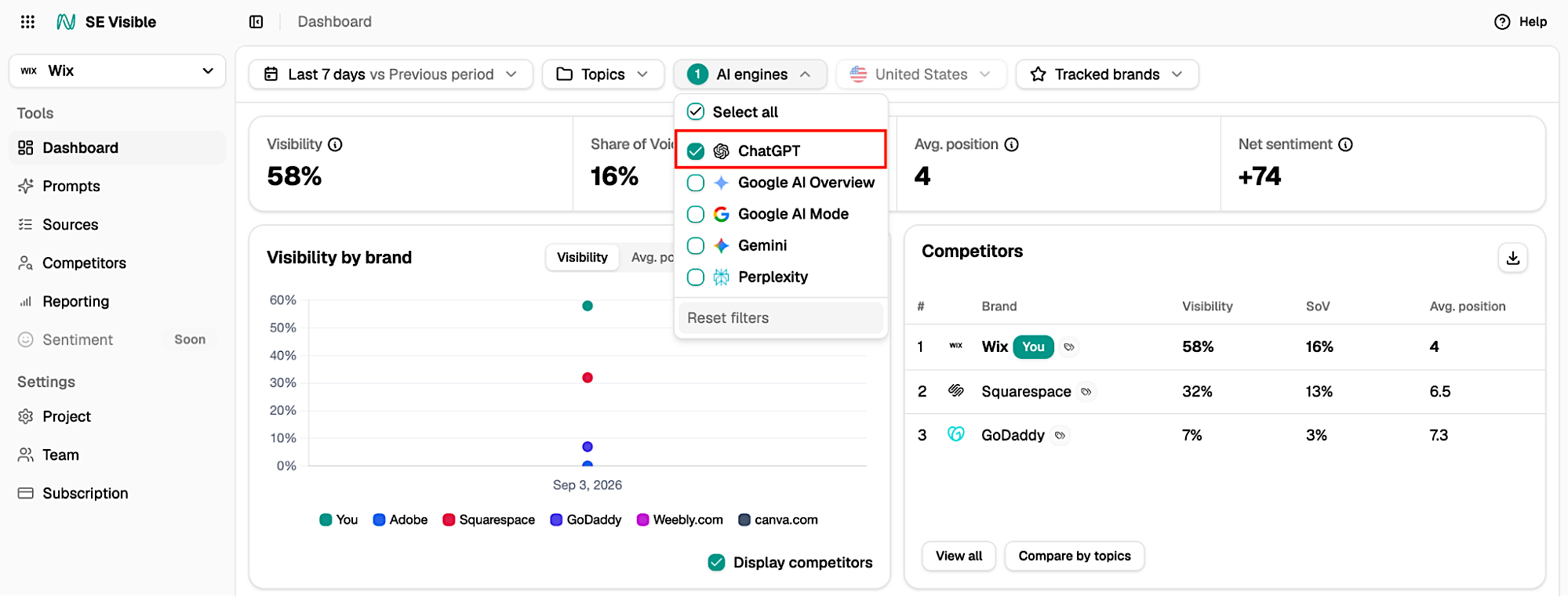
Compare these metrics with your results across other engines and with your competitors’ performance in ChatGPT. If your brand has weaker visibility than competitors on the platform responsible for most AI referral traffic, that gap is a strong signal to prioritize ChatGPT in your AEO strategy.
Keep in mind that SE Visible measures your presence inside AI answers, not the visits those answers generate. Use GA4 to verify how much referral traffic each platform actually sends to your site.
Google is more complicated.
AI Mode may have enormous reach, but appearing there does not necessarily mean getting a click to your website. SE Ranking’s research into AI Mode citations found that Google.com itself accounted for 17.42% of all citations in February 2026, up from 5.7% in June 2025. In other words, Google’s share of its own AI Mode citations more than tripled in under a year.
That changes how AEO performance should be evaluated.
For ChatGPT, referral traffic is still a useful outcome to watch. For Google’s AI features, visibility may increasingly happen without a direct visit to your site. A brand can be surfaced, cited, or used as part of the answer while Google keeps the user inside its own ecosystem.
So the question is not simply “Which AI engine has the most users?” It is what you want that visibility to achieve.
If traffic is the priority, ChatGPT deserves disproportionate attention today. If the goal is broader search visibility, brand presence, or influencing what users see during Google searches, AI Overviews and AI Mode matter even when the click never arrives.
That is also why AEO measurement should go beyond referral sessions alone. Track citations, brand mentions, share of voice, and prompt coverage alongside traffic. Because the engines with the biggest audiences are not necessarily the ones sending the most visitors back to your site.
6. How do you find the prompts and topics that define your AEO opportunity?
AEO starts with a different question than traditional keyword research. Instead of asking “What keywords do people search for?”, ask “What questions are people likely to put into an AI engine when researching this problem, product, or purchase?”
Here is how to turn that question into a practical workflow in SE Visible.
Step 1: Set up your brand and competitors
Create one project for the brand you want to analyze. Add:
- your primary brand name, website, and any genuine brand aliases
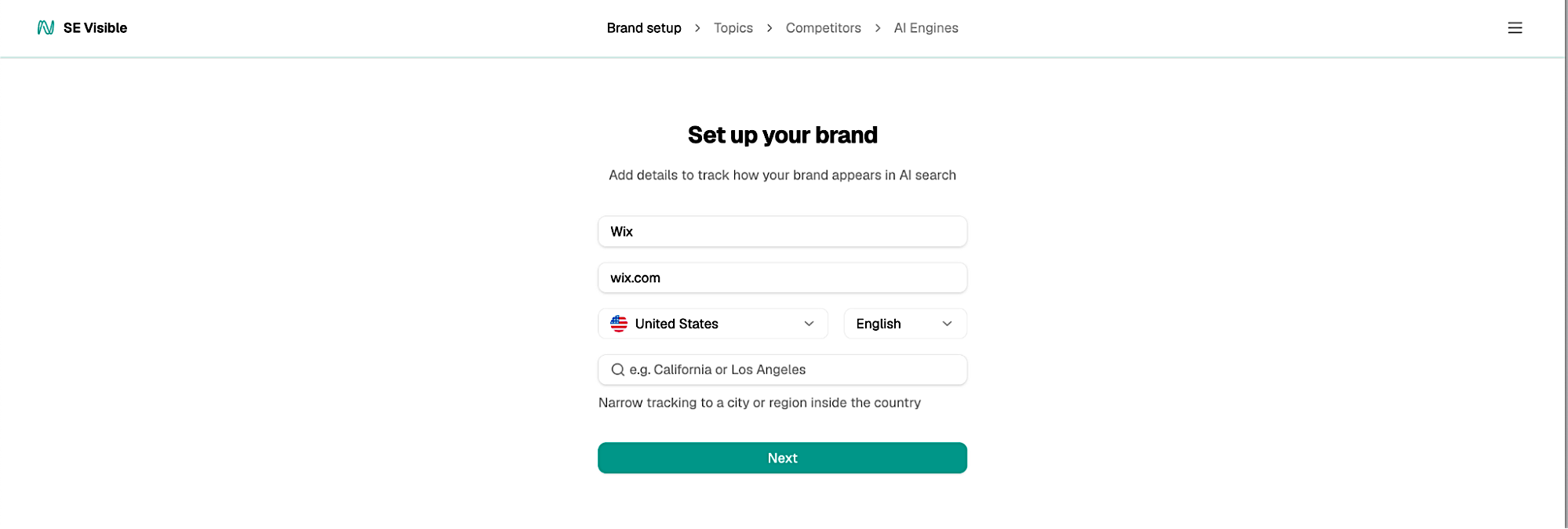
- the main topic clusters you want to monitor
- three to five direct competitors that customers realistically compare with your brand
- the AI engines where you want to track your visibility
Avoid adding generic product terms as aliases or distant competitors that serve a different audience. These settings determine which mentions SE Visible attributes to your brand and which companies it uses for competitive benchmarking.
Step 2: Build prompts around topics and journey stages
Start with the business categories you want AI engines to associate with your brand. For a website-building platform, for example, the topic inventory might include Website Builder, Web Hosting, E-commerce Platform, Domain Registration, and Software as a Service.
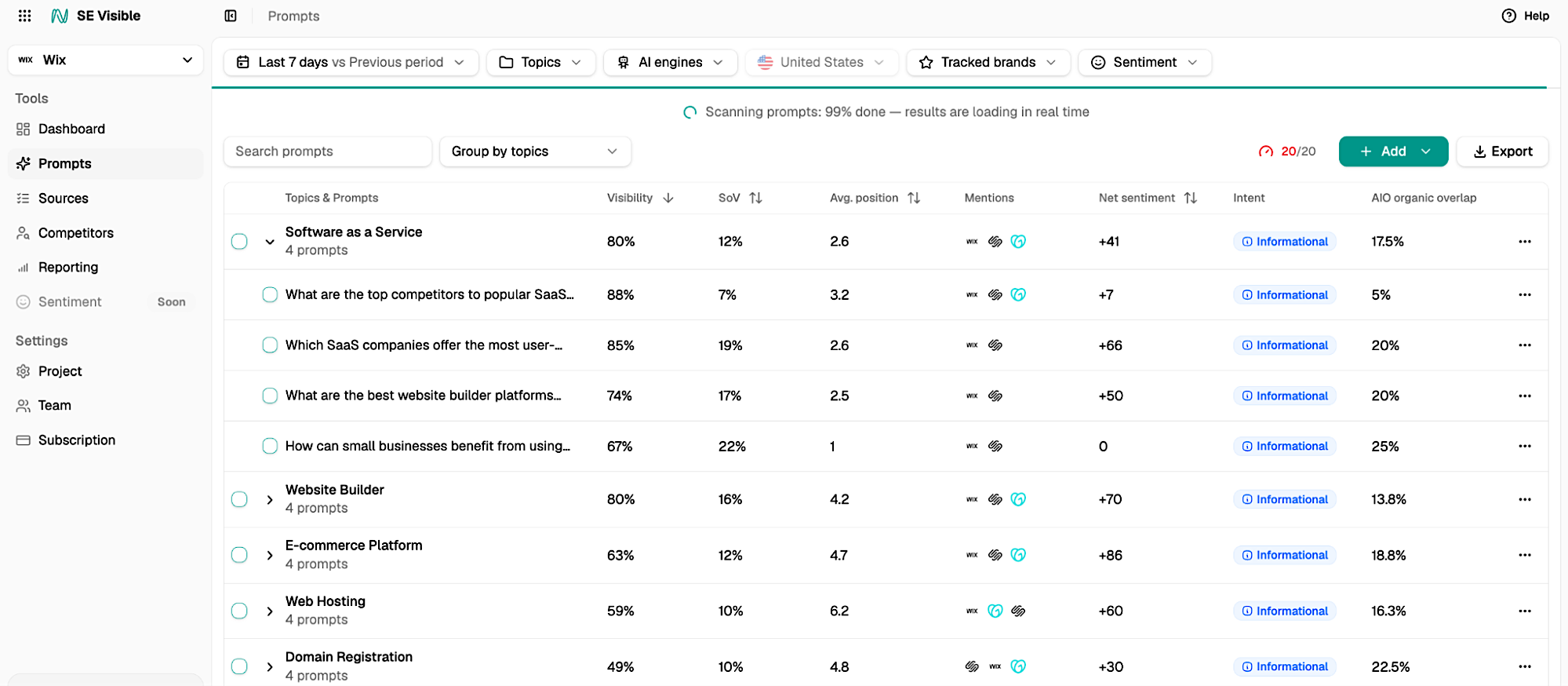
SE Visible can also suggest relevant prompts, but review them before adding them. Keep questions that reflect real customer problems, product use cases, comparisons, and purchase decisions instead of filling the project with minor variations of the same request.
On top of that, make sure to plan the structure before adding hundreds of prompts. SE Visible plans currently include:
- Basic: 200 prompts
- Core: 450 prompts
- Plus: 1,000 prompts
The limit is based on the number of prompts you add, not the total number of engine checks. If you track one prompt across all five supported AI engines, it still uses one prompt from your allowance.
A manageable starting point could be:
5 topics × 5 journey stages × 4 prompts per stage = 100 prompts
This leaves room on the Basic plan for brand-specific questions, new subtopics, and prompts discovered during the analysis. A smaller brand can begin with 20–30 high-priority prompts and expand once the first gaps become clear.
Step 3: Record your baseline before changing anything
Once SE Visible collects the initial answers, review your Visibility Score, Share of Voice, Average Position, Net Sentiment, and Competitors.
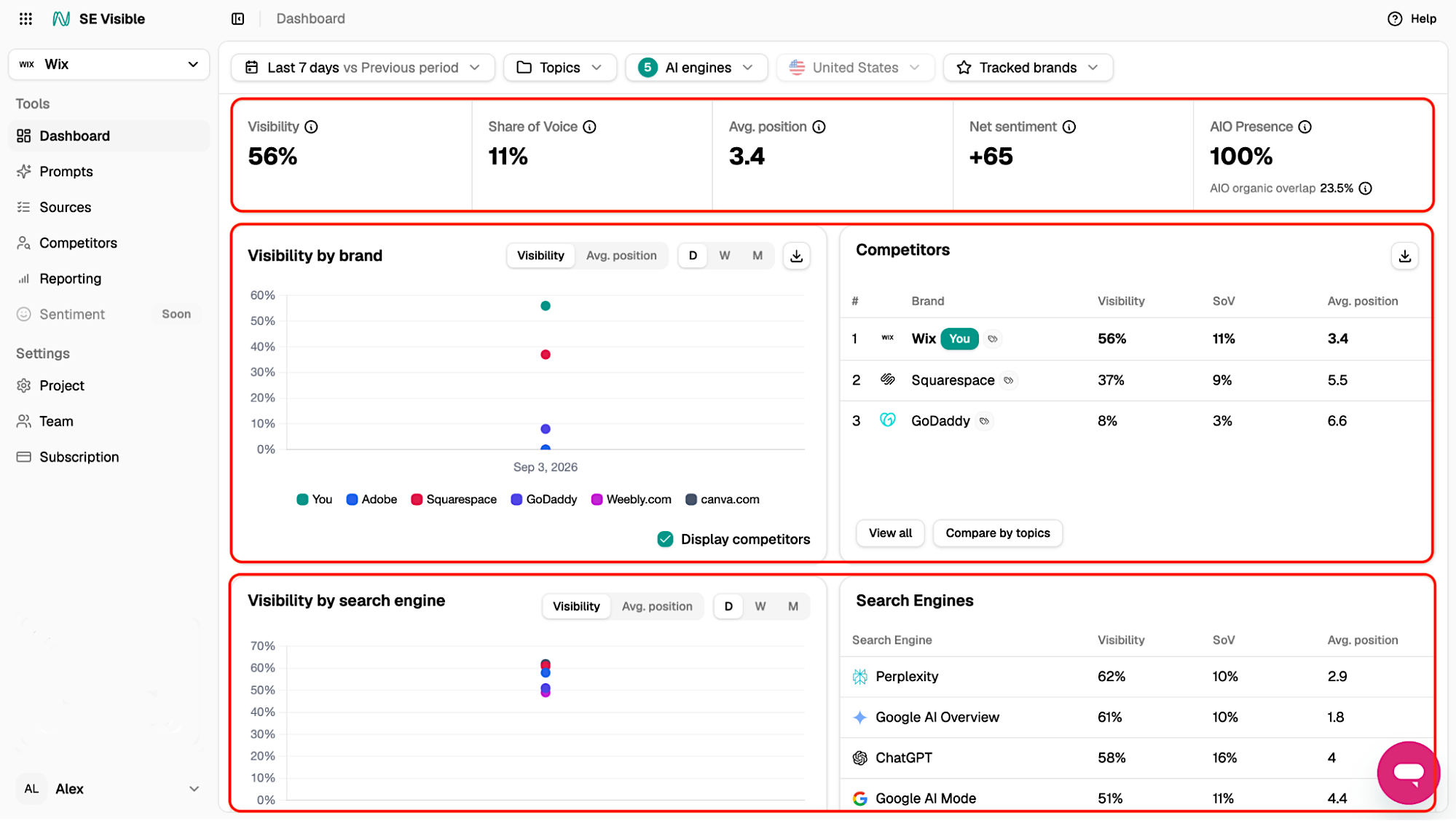
Break the data down by topic and AI engine. This shows whether the problem affects your overall AI presence or only certain topics, journey stages, or platforms.
Save this baseline before changing content, launching outreach, or creating new pages. Otherwise, you will have no stable reference point for determining whether the work improved your visibility.
Step 4: Find topics competitors own
Open the Competitors view and filter the results by topic and AI engine. Look for topics where competing brands have strong Visibility or Share of Voice while your brand has little or no presence.
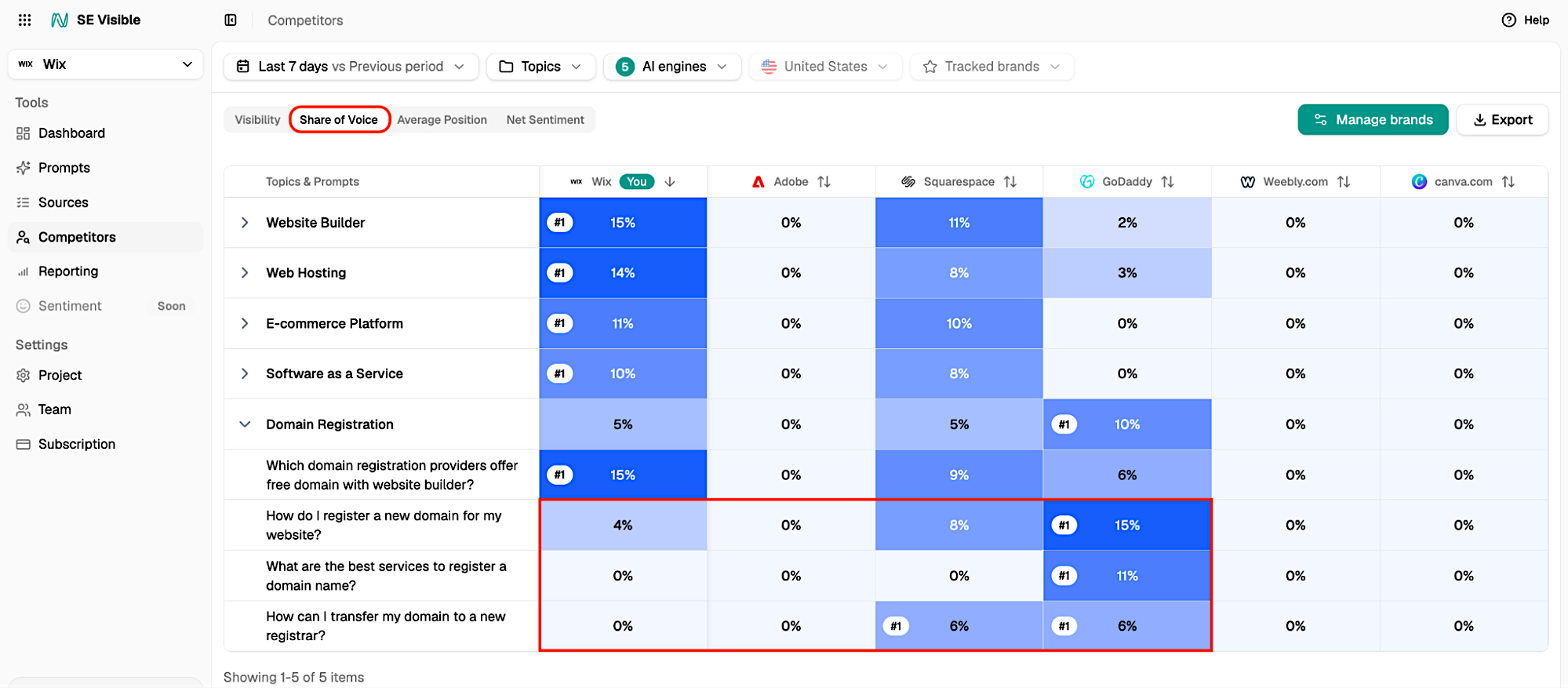
Pay particular attention to high-intent topics. A competitor appearing for broad informational prompts is useful context, but a competitor repeatedly appearing in comparisons and recommendations while your brand is absent represents a more immediate commercial gap.
Open the relevant answer snapshots to see which competitors are mentioned, how prominently they appear, and what claims or attributes the engines associate with them.
Step 5: Find where your coverage drops across the funnel
Next, open the Prompts view and compare your brand’s visibility across the topic clusters you created. Your brand may be strongly associated with one product category but have much lower visibility in another, even when both are important to the business.
For example:
- Higher visibility: Website builder prompts
- Lower visibility: Domain registration prompts
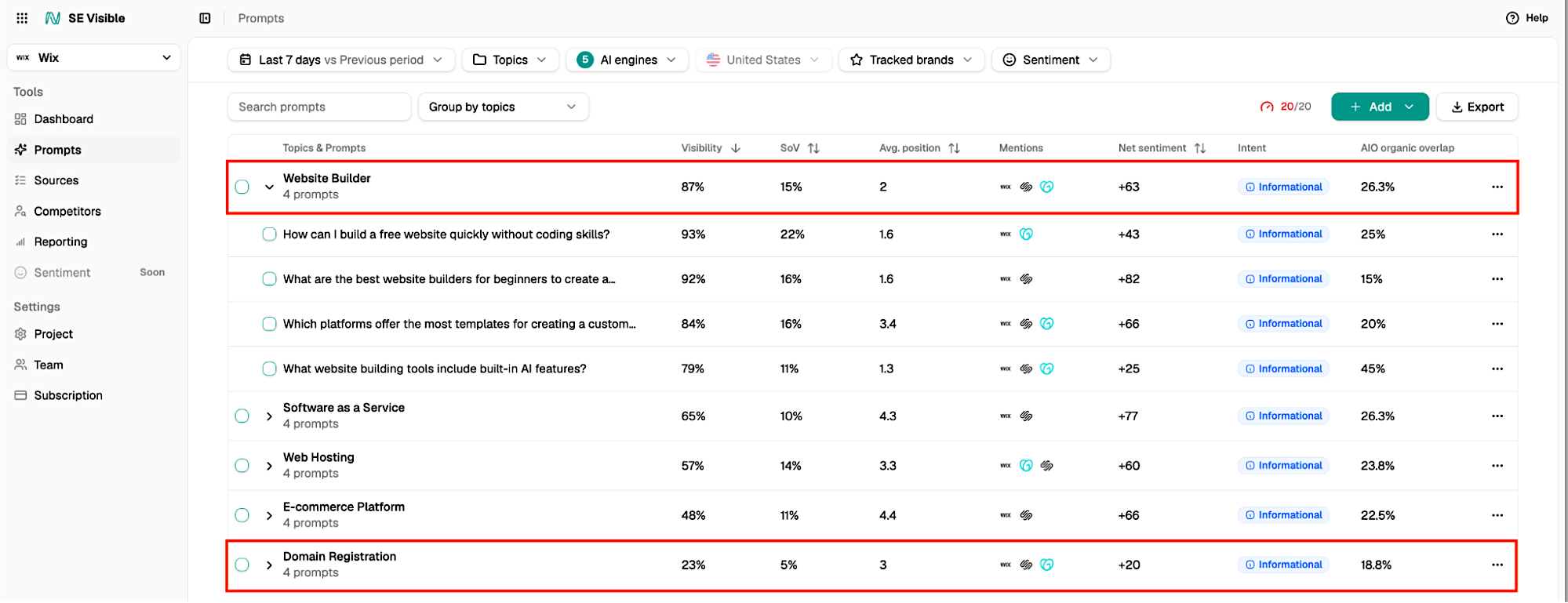
This pattern suggests that AI engines clearly associate your brand with website creation but do not yet recognize it as strongly for domain registration. Open the prompts in the weaker cluster to see where competitors appear instead, how they are positioned, and which sources support their inclusion.
Repeat the comparison by AI engine. If the topic gap appears across ChatGPT, Gemini, and Perplexity, it likely reflects a broader positioning or authority issue. If it appears in only one engine, the opportunity is more platform-specific.
Step 6: Identify the sources shaping those gaps
AI visibility is not only about your own website. Open Sources → Domains, then filter the results by the same topic and AI engine.
Review the Coverage column to identify the publications, review platforms, directories, forums, and other domains that repeatedly shape relevant answers. Switch to the page-level view to see the exact URLs being cited.
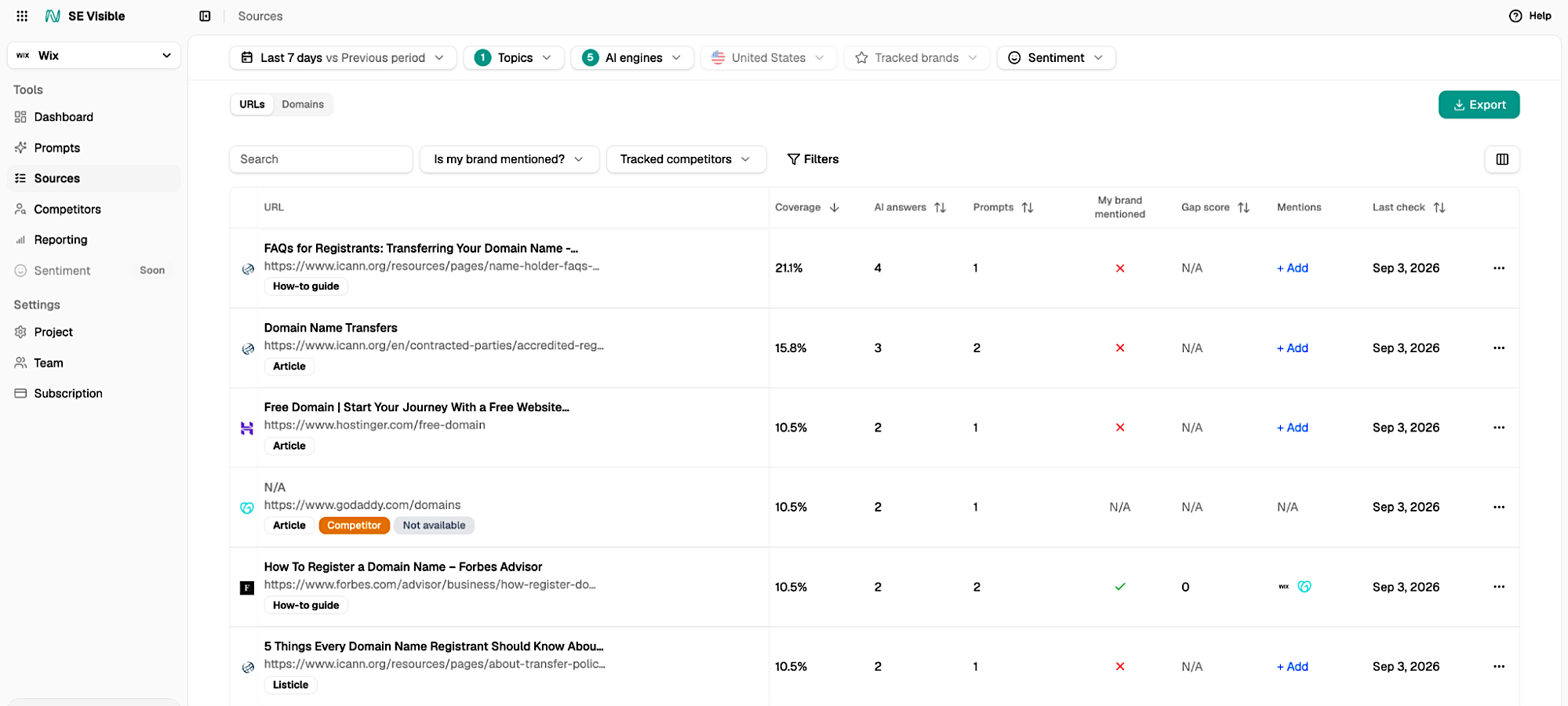
Compare sources connected with prompts where your brand appears against those where competitors appear and you do not. This helps you distinguish between two different problems:
- Owned-content gap: AI engines cite competitor pages or other first-party content because your site does not provide an equivalent answer.
- Third-party validation gap: Competitors are supported by independent reviews, comparisons, discussions, and authoritative publications where your brand has little presence.
SE Ranking’s ChatGPT research found that domains with profiles across major review platforms such as G2, Trustpilot, Capterra, Sitejabber, and Yelp had roughly three times higher chances of being selected as sources than domains without that presence. Domains with very high levels of brand mentions on Reddit and Quora showed roughly four times higher citation likelihood than those with minimal visibility there.
Treat these findings as correlations, not instructions to manufacture thousands of Reddit mentions or create profiles on every review platform. Larger and better-known brands naturally tend to have more reviews, discussions, backlinks, searches, and citations at the same time.
Still, if AI engines repeatedly encounter your brand in independent reviews, community discussions, comparisons, and authoritative third-party sources, they have a broader body of evidence to draw from.
Step 7: Turn the gaps into a prioritized AEO plan
Prioritize opportunities using three criteria:
- Commercial value: Does the topic influence comparison or purchase decisions?
- Gap size: Are competitors consistently visible while your brand is absent?
- Feasibility: Can you address the gap through your own content, product positioning, digital PR, reviews, or outreach?
Then match each gap to an action:
- Create or update first-party content when your site lacks a useful answer.
- Strengthen comparison, use-case, pricing, and validation content when visibility drops near the bottom of the funnel.
- Pursue coverage on external sources that repeatedly support competitor recommendations.
- Correct unclear positioning when your brand appears but is described inaccurately.
- Focus on one engine when the gap is platform-specific.
Keep the original prompt set stable while making these changes. That gives you a consistent benchmark for seeing whether your Visibility, Share of Voice, Average Position, and funnel coverage improve over time—and produces a much stronger AEO plan than generating another keyword list and adding “AI” to the column name.
7. How do you measure whether your AEO strategy is working?
Raw citation counts are useful, but they do not tell you whether your AEO strategy is actually improving.
Start with a Brand Visibility Dashboard and track the bigger picture: brand mentions, citations, share of voice, prompt coverage, sentiment, and competitor visibility across AI engines. The goal is not simply to collect more citations, but to appear more often for the topics and prompts that matter to your business. Because SE Visible collects answers through real browser sessions rather than API calls, this visibility baseline reflects what users actually see in each AI platform.
Then look at what happens after that visibility.
AI-referred visitors can be highly engaged. SE Ranking found that users arriving from AI platforms spent 68% more time on site than organic search visitors on average. That makes referral traffic worth tracking alongside engagement, conversions, sign-ups, and other business outcomes.
But there is another important caveat: being cited is not the same as being recommended.
In Lily Ray’s analysis of Google AI Overviews, when brands published self-promotional “best [category]” listicles ranking themselves, Google cited their pages as sources but left the publishing brand out of the actual recommendations 69% of the time.
You can detect this exact disconnect in SE Visible. Filter the Prompts view by AI Overviews, find answers that cite your domain, and open the answer snapshots to check whether your brand also appears among the recommendations.
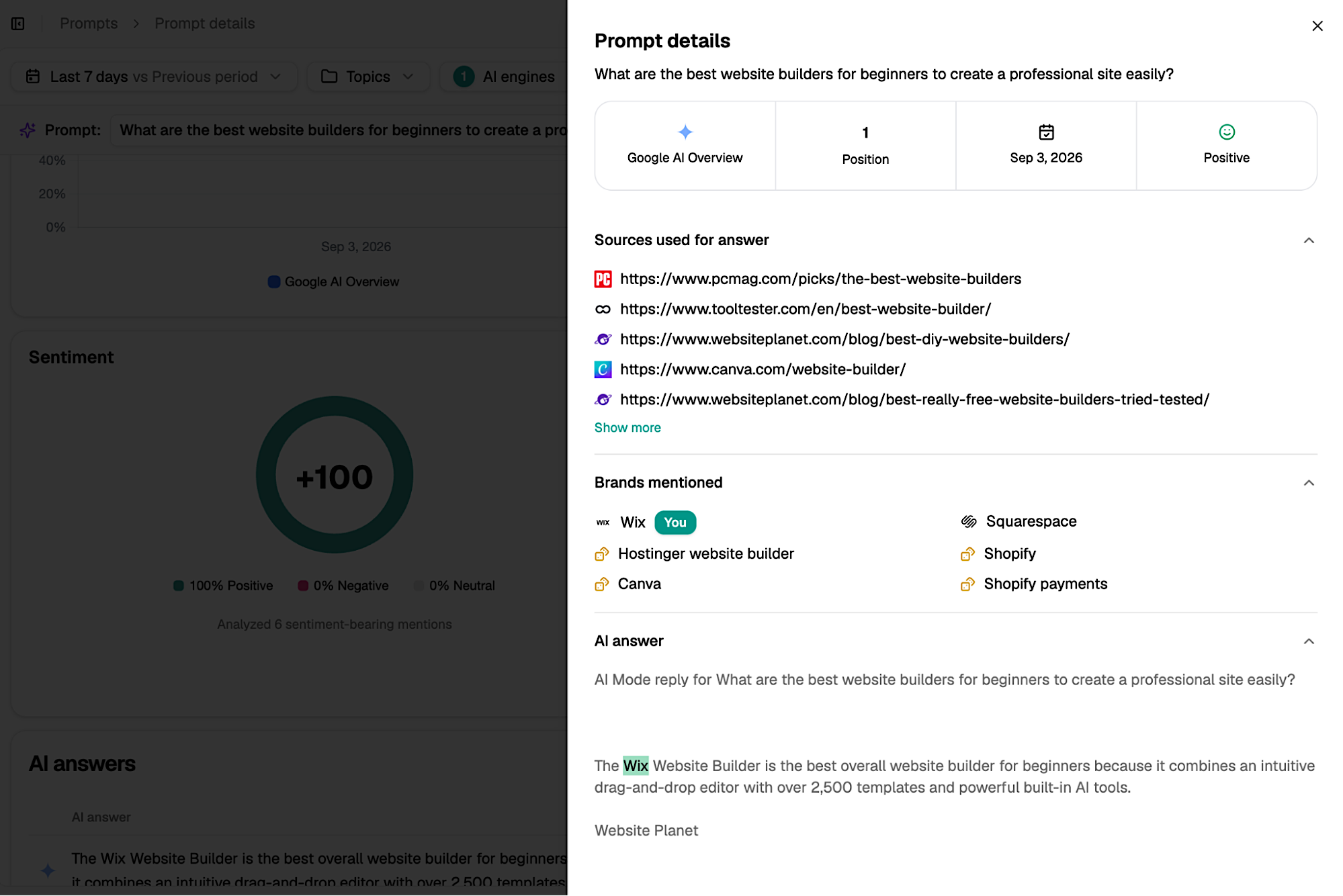
If your page is cited but your brand is absent from the recommended options, Google is using your content as a source without giving the brand visibility.
That is why AEO measurement should cover three layers:
- Visibility: Are you appearing more often across the prompts that matter? In SE Visible, use Visibility Score to track how often and how prominently your brand appears, Average Position to see where it tends to be placed in answers, and Share of Voice and Rank vs. Competitors to understand how your presence compares with other brands.
- Perception: Are you being mentioned positively and recommended, or simply used as a source? Track Net Sentiment in SE Visible to monitor the tone of brand mentions, then review individual answer snapshots to understand the context. Compare the Prompts and Sources views to identify cases where your pages are cited but your brand is not included in the recommendation.
- Business impact: Are AI-referred visitors engaging, converting, or moving further down the funnel? SE Visible does not measure website traffic, so connect this layer to GA4. Then, export your SE Visible data as a CSV and line it up with AI-referral data in GA4 to connect visibility and perception trends with referral sessions, engagement, assisted conversions, sign-ups, and revenue.
AEO is working when all three start moving in the right direction, not just when your citation count goes up.
FAQ
What’s an example of answer engine optimization?
Suppose the target prompt is “What’s the best accounting software for freelancers?” You check the AI answers and see that the cited pages give a direct recommendation, compare pricing and tax features, and have been updated recently, while your page is short, two years old, and mostly describes each tool separately.
An AEO update would add a clear verdict near the top, a comparison table for price, invoicing, expense tracking, and tax support, and focused sections such as “Best for solo freelancers” and “Best for freelancers who need tax support.” You would also refresh outdated facts and add a visible FAQ answering the follow-up questions users actually ask.
After publishing, track that prompt alongside variations such as “best bookkeeping software for freelancers” and “best accounting app for self-employed people” to see whether citations, mentions, and share of voice improve.
When should you invest in AEO?
Invest in AEO when both conditions are true: people in your category already use AI engines to research problems, products, or buying decisions, and your basic organic foundations are strong enough for your content to be discovered and trusted.
If important buyer prompts consistently trigger AI answers and competitors already appear in them, you have an AEO opportunity.
If your site still has indexation problems, weak product/category pages, almost no authority, and poor organic visibility, fix those fundamentals first. The citation research suggests that the same weaknesses will limit your performance in answer engines anyway.
What’s the best AEO tool?
The best AEO tool depends on whether you need prompt tracking, competitor benchmarking, citation analysis, source monitoring, or content optimization.
SE Visible covers the strategic AI visibility layer. It shows how your brand performs across ChatGPT, Gemini, Perplexity, AI Overviews, and AI Mode, including your Visibility Score, Share of Voice, Average Position, Net Sentiment, competitors, prompts, and cited sources.
SE Ranking covers the research and optimization layer. Its tools help you track search rankings, research keywords and competitors, audit your website, analyze backlinks, optimize content, and investigate individual AI prompts and answers.
Together, they support the full workflow: use SE Visible to identify where your brand is gaining or losing visibility, then use SE Ranking to investigate the underlying search, content, and authority gaps and decide what to improve.
For a detailed comparison of the available platforms, see our guide to the best answer engine optimization tools.
Why can’t GA4 alone measure AEO performance?
GA4 only captures what happens after someone clicks through to your website. It can show AI referral traffic, engagement, conversions, and revenue, but it cannot detect zero-click exposure or tell you when an AI engine mentions, recommends, or cites your brand.
It also cannot measure your Visibility Score, Share of Voice, Average Position, Net Sentiment, prompt coverage, or performance against competitors. Use SE Visible to measure what happens inside AI answers, then combine that data with GA4 to understand whether greater AI visibility leads to meaningful website activity and business results.
Conclusion
The strongest AEO strategy in 2026 is surprisingly unglamorous.
Keep the fundamentals that already build real authority: strong pages, backlinks, organic visibility, useful depth, clear structure, fresh information, crawlability, and genuine third-party validation.
Stop treating every new AI-specific implementation as a ranking factor. FAQ schema is not an AI citation shortcut. llms.txt has not shown a measurable citation advantage. Extremely short content chunks are not automatically easier for an answer engine to use.
And measure before you optimize. Find the prompts that influence decisions in your category. See which engines matter, which brands they recommend, which sources they trust, and where your own visibility is missing. Then make changes and compare the same prompt set over time.
You can do this by using SE Visible. Create one project, add your brand and top competitors, and track 20–30 prompts across the awareness, consideration, comparison, and decision stages. Use the initial results to establish your baseline for Visibility, Share of Voice, Average Position, sentiment, citations, and sources before changing anything. Then optimize one gap at a time and compare the results against the same prompt set. A 10-day free trial is available.