Best generative engine optimization (GEO) tools: Top picks for brands

68% of Google searches ended without a click in the first four months of 2026, up from about 60% in 2024, according to SparkToro’s Zero-Click Search Study. Users now look for direct answers from AI.
Appearing in systems like Google AI Overviews, ChatGPT, Gemini, and Perplexity is now essential for brand survival. This shift requires a new strategy known as Generative Engine Optimization.
Many marketers ask: “How does generative engine optimization work?” It involves structuring content so AI models can easily identify, trust, and cite it as a primary source.
Our guide explores the best generative engine optimization platforms available today. You will learn how to track your AI visibility and choose the tools that fit your brand.
What Is Generative Engine Optimization (GEO)?
In 2026, people choose to ask AI questions while searching for answers. You need to influence how AI describes your company to stay visible in AI responses.
Tools for generative engine optimization can help you with this process. Basically, GEO is the strategy of optimizing content, so AI models can cite your brand.
Google’s own developer documentation pushes back on part of this framing: its guide on optimizing for generative AI features states that “optimizing for generative AI search is optimizing for the search experience, and thus still SEO,” with no special schema markup or new file types required. The distinction that matters in practice: GEO is an emphasis inside SEO. It leans harder on citations and factual density than ranking-only tactics do.
Differences between SEO, AI SEO, AEO and GEO
Knowing the differences between search methodologies is important because they require different mechanisms to attract clients.
- SEO relies on keywords to rank on traditional search pages.
- AI SEO tools automate content tasks for traditional engines; some of them also cover AI search visibility tracking. See best AI SEO tools for how these compare.
- AEO targets zero-click answers for voice assistants or Google’s quick answer boxes.
- Generative engine optimization tools influence the narrative within AI responses, so your brand appears as a trusted source. The best generative engine optimization tools are crucial for visibility because they reveal how AI perceives your brand.
| Tool | Standout Capabilities | AI Platform Coverage | Best For | Starting Price | Free Trial |
|---|---|---|---|---|---|
| SE Visible | Visibility score, net sentiment score, prompts and topics insights, competitor benchmarking | AIOs, AI Mode, Gemini, ChatGPT, Perplexity | CMOs, agencies, businesses, PR and brand specialists | $99/month | 10-day trial |
| Rankscale AI | Citation source mapping, sentiment analysis, AI readiness audits | Major LLMs (ChatGPT, Gemini, etc.) | CMOs, agencies managing brand reputation | $20/month | 7-day trial (Pro plan) |
| GetCito | Open-source transparency, local & regional GEO tracking, trend alerts | Major AI engines | Agencies, B2B brands needing transparency | $599/month | Free self-host plan |
| Writesonic AI | Action Center for citation gaps, AI crawler analytics, prompt monitoring | Multi-engine (AI + traditional) | Marketing teams combining SEO & AI search | $99/month | 7-day trial |
| AthenaHQ | Prompt volume tracking, ecommerce (Shopify) integration, GEO score | Broad LLM coverage | Enterprise teams, data-driven agencies | $295/month | Limited free version (300 credits) |
| Goodie AI | Optimization hub, AEO writer, AI attribution | Global, multi-language | Growth teams, PR & SEO specialists | ~$478/month | 7-day trial |
| Peec AI | Prompt management, competitor source analysis, daily tracking | Selected high-impact models | In-house marketing teams | $95/month | 7-day trial |
| Profound AI | Context Manager, AI search volume data, enterprise security | ChatGPT + enterprise focus | Large brands, high-profile agencies | $99/month | 7-day trial |
| Otterly AI | Multi-engine prompt tracking, ChatGPT ads tracking, agent analytics | ChatGPT, Google AI Overviews, Perplexity, Microsoft Copilot | Solo marketers and small teams starting AI-visibility tracking | $29/month | 7-day trial |
| Scrunch AI | Site diagnostics, agent-traffic analytics, content optimization recommendations | ChatGPT, Claude, Gemini, Perplexity, Google AI Mode & Overviews, Meta AI | Teams benchmarking AI visibility before scaling | $250/month | 7-day trial |
| HubSpot AEO | Brand visibility score, competitor share of voice, citation analysis, prioritized recommendations | ChatGPT, Gemini, Perplexity | Marketing teams already using HubSpot’s CRM and content tools | $50/month | Limited free version (25 prompts) |
How The Best GEO Tools Were Evaluated
To find the most effective software for generative engine optimization (GEO), I scored each tool against five weighted criteria instead of a single first impression:
- AI platform coverage (30%): how many of the major answer engines (ChatGPT, Gemini, Perplexity, AI Mode, AI Overviews) a tool actually tracks versus claims to support.
- Data quality and citation depth (25%): whether the tool captures real AI responses rather than simulated ones, and whether it shows which sources and domains AI models actually cite.
- Actionability (20%): platforms lost points here if they only reported numbers. The ones that scored well told you what to fix.
- Workflow and integration fit (15%): how easily a tool slots into an existing SEO or content stack versus requiring a separate process.
- Pricing and scalability (10%): whether the entry tier is usable for a small team and whether the top tier scales to an agency managing multiple brands.
Pricing and scalability carried the lowest weight on purpose. A visibility tool with strong data and an awkward price is still worth using. One with weak data at any price is not.
Top Generative Engine Optimization Tools
Brands must adapt to stay visible where users now ask questions directly. Choosing the right software helps you monitor citations. Use it to manage your brand reputation.
Below is a list of the best generative engine optimization tools for AI that provide the data needed to succeed as search habits change.
SE Visible
SE Visible is a generative engine optimization (GEO) analysis software with a clear focus on visibility, perception, and competitive positioning across AI search. The platform shows how your brand appears in ChatGPT, Perplexity, Gemini, AI Mode, and AI Overviews. It collects real AI responses (not simulations) so the data reflects what users actually see.
SE Visible is built by SE Ranking, which has long been recognized for providing highly accurate rank tracking. That same commitment to data quality powers SE Visible. The platform draws on SE Ranking’s deep expertise to deliver reliable AI visibility insights.
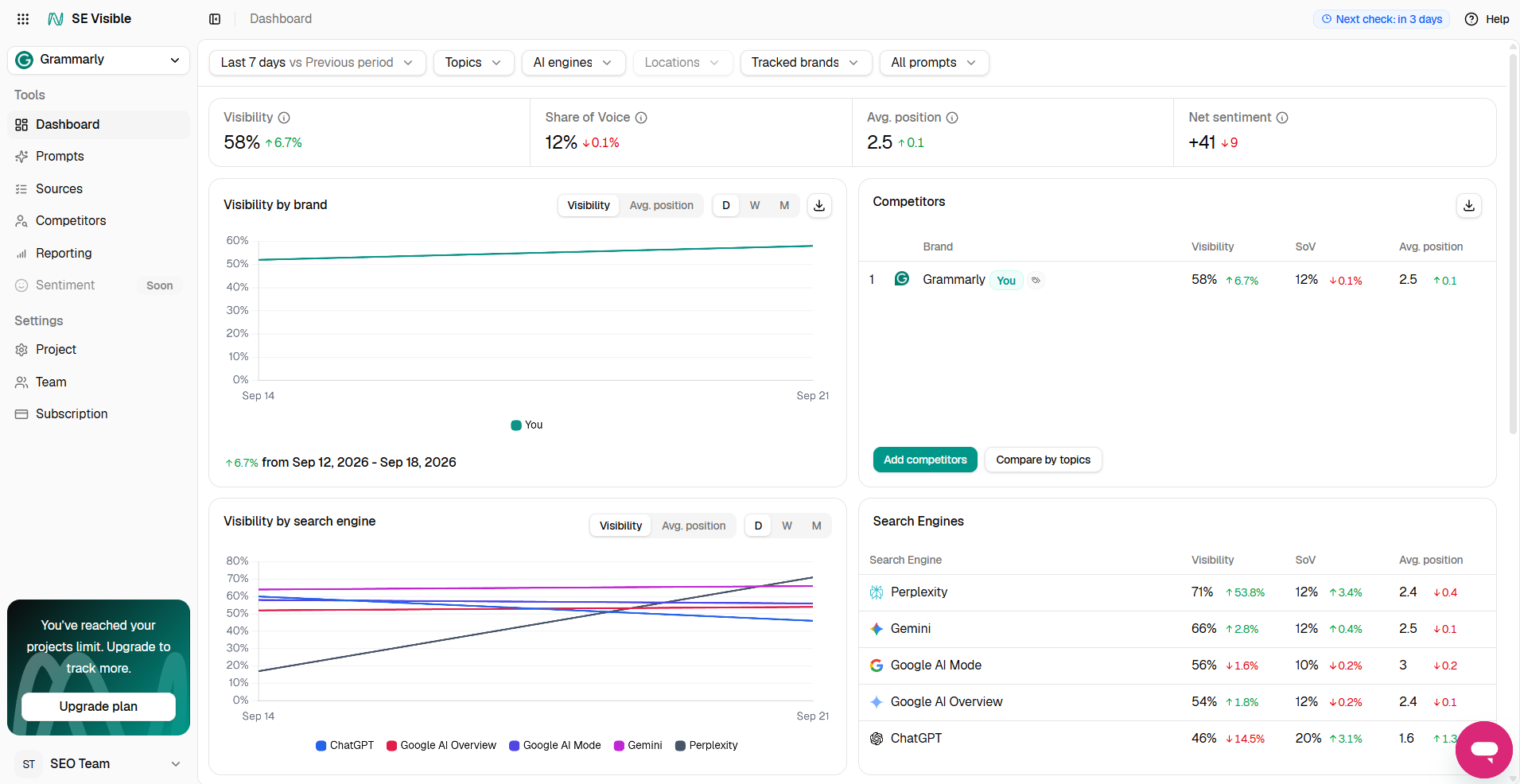
I tested SE Visible and found several features that stood out for assessing brand AI visibility:
- Visibility score shows how often your brand appears in AI answers and how high it is placed in responses.
- Competitor benchmarking shows rivals appearing in the same AI answers and compares their visibility and sentiment against your brand.
- Prompt and topic insights show the questions and themes driving AI mentions.
- Source insights reveal which domains and URLs AI engines rely on most.
- Sentiment analysis highlights whether AI presents your brand positively, neutrally, or negatively.
For teams that want to combine strategic insights with practical optimization, I found that SE Ranking and SE Visible work well together. If SE Visible shows where your brand stands in AI search, SE Ranking helps you optimize for better visibility with solutions for keyword research, site audits, content creation, and much more.
Best for
SE Visible is best for CMOs and marketing leaders building AI visibility strategies, agency owners expanding services into generative engine optimization, and teams that need clear AI insights without technical complexity.
Pros and Cons
Strengths of SE Visible:
- Focused platform built specifically for generative search visibility.
- Clean dashboards with clear visualization and minimal setup.
- Multi-platform AI coverage in one place.
- Backed by SE Ranking’s long-standing data quality standards.
- Supports multiple languages and countries.
Limitations of SE Visible:
- Data exports are currently limited to CSV.
- Does not handle optimization on its own. But combining it with SE Ranking will work for this purpose.
Pricing
Basic plan is $99/month for 200 prompts and 3 projects. Core plan is $189/month for 450 prompts and 5 projects. Plus plan is $355/month for 1,000 prompts and 10 projects. A Custom plan is available for larger needs through SE Visible’s sales team. A 10-day free trial is available, no credit card required. See what’s coming to SE Visible for the platform’s product roadmap.
SE Visible is also included in SE Ranking’s AI Search add-on for teams that need both monitoring and optimization in one package.
Rankscale AI
Rankscale AI is a generative engine optimization (GEO) software that monitors brand mentions across AI search engines. It turns AI responses into detailed data for easier reporting.
Rankscale software provides evidence from AI outputs instead of relying on random guesses. Tracking responses identifies how different models cite a brand. Such visibility helps marketers react to shifts in patterns of AI search. So, the platform is one of the best generative engine optimization (GEO) checker options for monitoring company reputation.

I noticed some features of this generative engine optimization (GEO) tracking software, which help you manage brand reputation and improve citations:
- Dashboard collects performance metrics, competitor insights, and citation data in one place.
- Performance tracking monitors visibility scores and mention positions across multiple AI.
- Competitor benchmarking to identify rivals in AI results and compare their sentiment and visibility against your brand.
- Citation analysis reveals which domains drive AI answers. This will help you find trusted sources.
- Sentiment analysis visualizes positive and negative keywords to understand how models perceive your reputation.
- Website audits: scans site structure to provide an AI Readiness Score and actionable optimization recommendations.
These features make Rankscale.AI the best generative engine optimization (GEO) tracker for teams monitoring daily visibility.
Best for
The Rankscale platform is best for CMOs and agency owners who need the best software for generative engine optimization (GEO) to manage company reputation.
Pros and Cons
Benefits of using Rankscale.AI:
- Maps third-party websites that influence AI citations.
- Tracks brand sentiment to identify and manage reputation risks.
- Provides response snapshots for proof of visibility.
Drawbacks:
- Requires manual effort to apply the suggested content optimizations.
- Technical dashboards may take time to master.
- Visibility scores often change due to AI updates.
G2 users share that despite “the UI feels a little bit overwhelming at first, Rankscale is actively working on improving the UX and UI, which makes it the best bang for the buck right now.”
Pricing
Essential costs $20/month. Pro is $99/month. Growth plan is $385/month. Enterprise is $780/month. Annual billing offers a 15% discount.
GetCito
GetCito is a tool for generative engine optimization (GEO), which helps track brand visibility across AI search engines. It provides data on how different AI describes a company in user responses to help manage brand reputation. Tracking these responses shows how different models perceive a company. Generative engine optimization (GEO) checking tools like this allow for monitoring market positions based on real-world data.
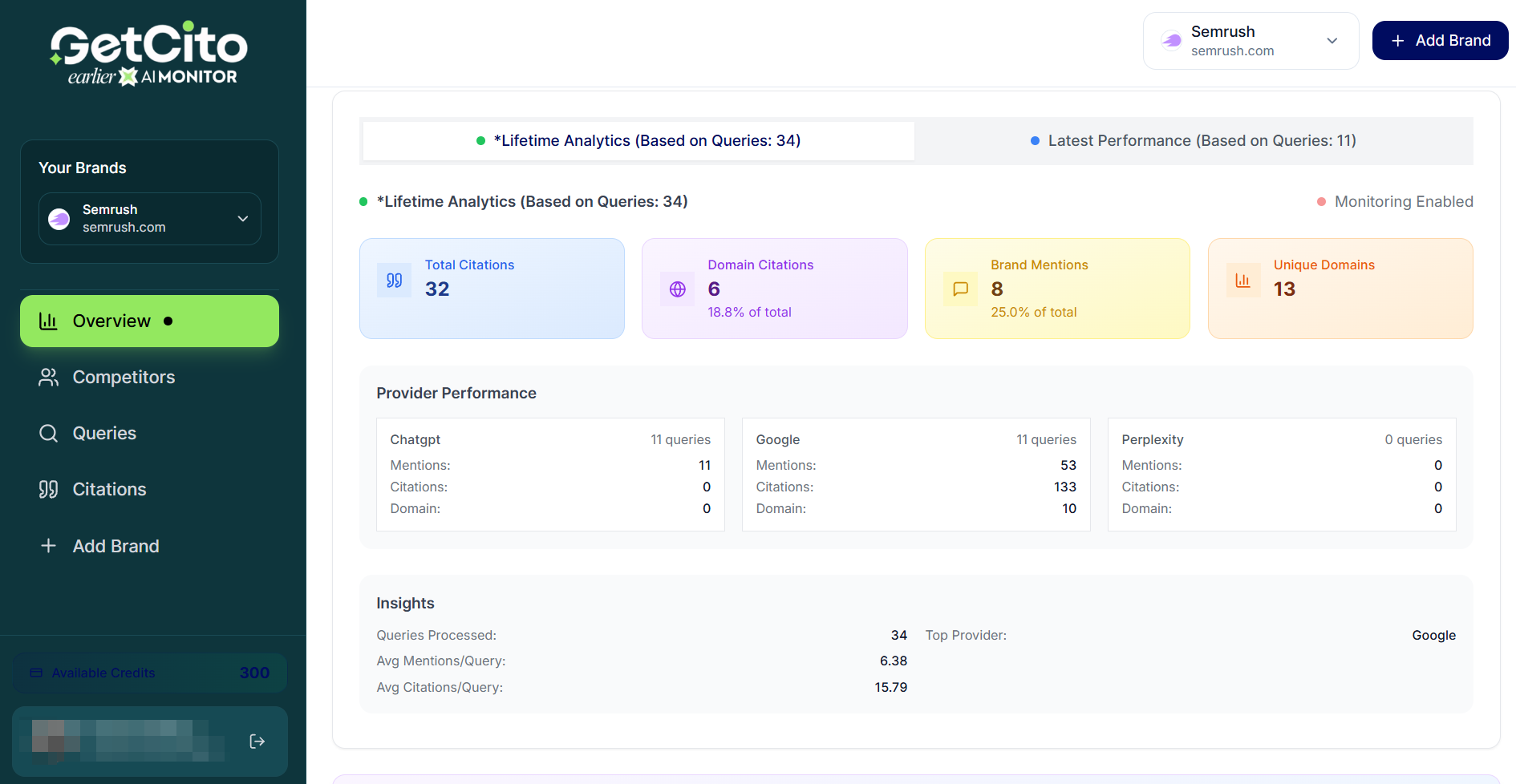
Capterra users share only positive experiences with GetCito: “The interface is clean, setup was fast, and the real-time tracking of AI citations and sentiment added real value.” Most essential generative engine optimization (GEO) analysis tools are present in the tool:
- AI Visibility Checker tracks brand mentions across popular AI platforms.
- AI Competitor Radar monitors rival presence in AI responses to identify strategy gaps.
- AI Crawlability Clinic tracks which AI bots visit your site, crawl frequency, pages crawled, and fake-bot detection.
- Prompt Volume Checker estimates AI prompt volume across ChatGPT, Gemini, Claude, and Perplexity.
To help you manage brand reputation, GetCito includes sentiment and perception analysis. Also, there are trend and activity alerts to notify you about market shifts. These features guarantee that the platform remains the best generative engine optimization (GEO) tool, B2B companies looking for open-source transparency in AI monitoring.
Best for
The GetCito platform would suit CMOs and agency owners who need the best generative engine optimization (GEO) tracking tools to protect client reputations. It’s also ideal for B2B companies looking for open-source transparency in AI monitoring.
Pros and Cons
Users often praise the tool for:
- Providing a single view of brand presence across AI engines.
- Offering transparency through its open-source code.
- Helping brands dominate local search and regional GEO results.
However, some users note limitations, such as:
- The lack of an API for automated data integration.
- Absence of multi-user features for larger teams.
- Not enough integrations with other tools.
Pricing
The Growth Plan is $599 per month. The Scale Plan is $999/month. Billing annually offers a 20% discount. There is an option to get a Self-Host Plan for free or a custom Enterprise plan.
Writesonic AI Search Visibility (GEO) Tool
Writesonic AI is an AI-powered platform that integrates traditional SEO with a layer of generative engine optimization software. It allows brands to track their presence across major engines from one dashboard.
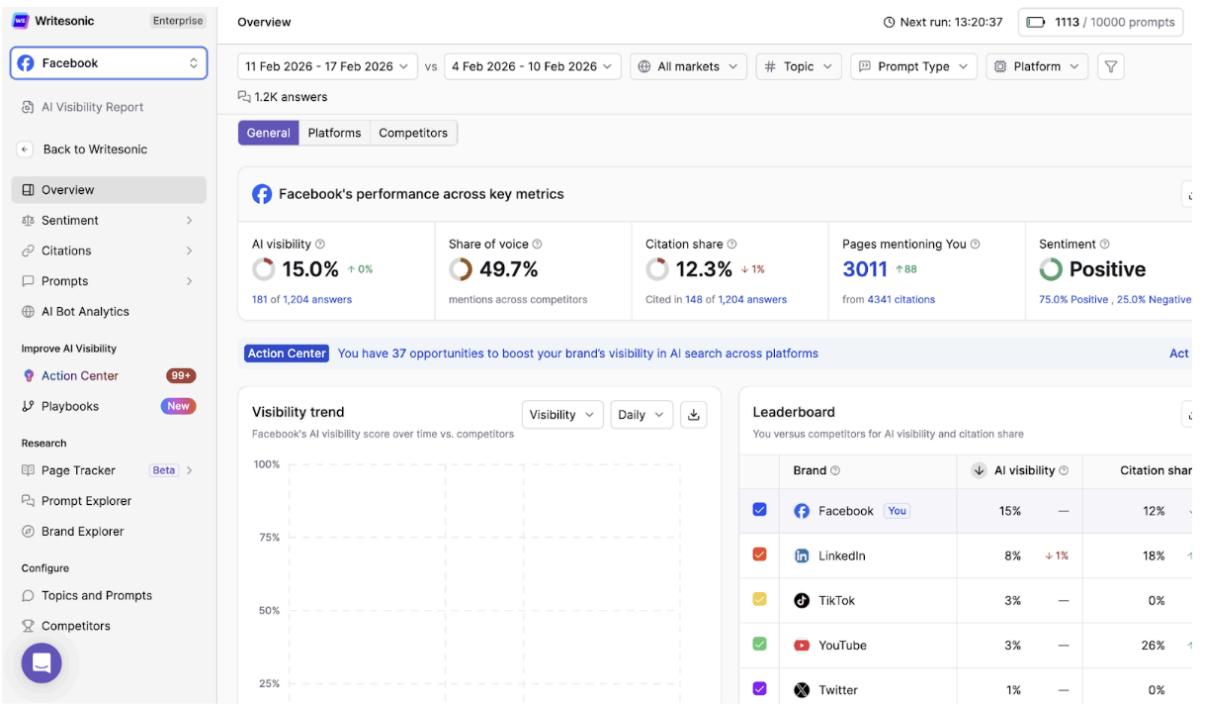
Writesonic AI is one of the best generative engine optimization (GEO) checking tools for staying ahead of search updates. It allows marketers to track brand narratives in AI models to guarantee they reflect specific information. It finds blind spots in visibility and provides Citation Share to guide content strategies.
Writesonic AI has several features:
- Multi-Platform Tracking monitors brand mentions and citations across AI models.
- Action Center identifies citation gaps and suggests ways to outrank competitors.
- AI Agent Analytics tracks bot visits.
- Sentiment Analysis measures the tone of mentions to protect brand reputation.
- Competitor Benchmarking compares visibility scores against rivals.
- Citation Tracking identifies sources that AI references for your brand.
- Prompt Monitoring reveals responses where your brand appears.
These features help track improvements in crawler activity and brand mentions. Implementing this best generative engine optimization (GEO) analysis tool guarantees that a brand remains a trusted authority in AI responses.
Best for
Writesonic AI is best for agencies and marketing teams who need the best generative engine optimization (GEO) tracking software to combine traditional visibility with AI search tracking.
Pros and Cons
The strengths of Writesonic AI:
- An intuitive dashboard makes monitoring easy.
- AI Traffic Analytics detects crawler visits that standard tools miss.
- Actionable suggestions help fill content gaps and improve citation rates.
The weaknesses of Writesonic AI:
- Sentiment analysis starts at the $499/mo Growth plan
- The web-only access.
- Users find inaccuracy in content requires additional editing and fact-checking.
Pricing
Starter plan is $99/month. Basic: $249/month. Growth: $499/month. Annual billing offers a 20% discount. As one of the best AI tools for generative engine optimization, it has a custom plan and a free trial.
AthenaHQ
AthenaHQ is a generative engine optimization (GEO) checker that helps businesses improve visibility in AI search. It tracks brand presence across the main AI models.
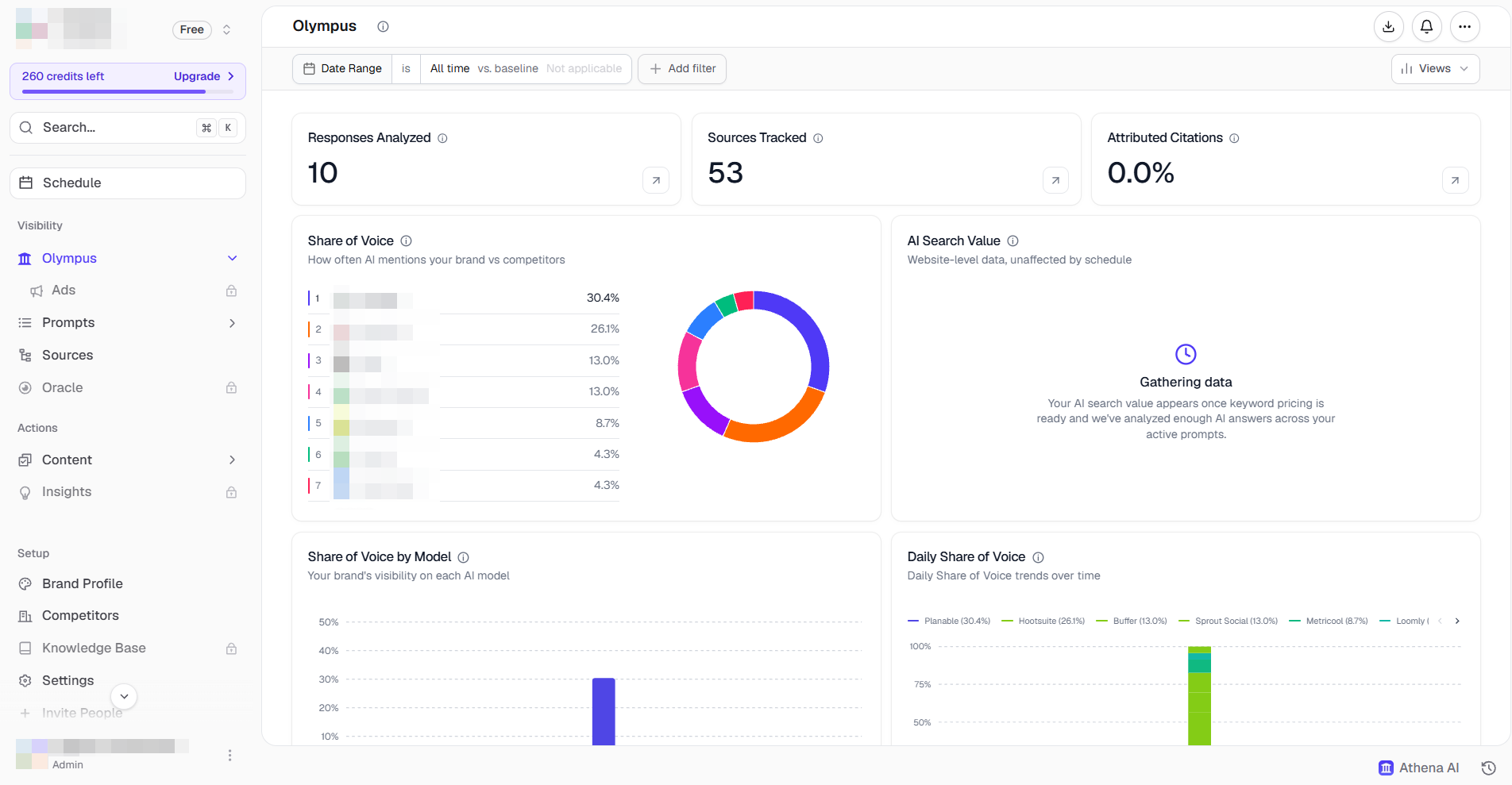
Several features that most generative engine optimization (GEO) tracking tools have and that enhance brand presence are also available in AthenaHQ:
- Prompt Volume estimates how often natural-language queries relevant to your brand are asked in AI search.
- Action Center suggests on-page and off-page improvements to protect your reputation and boost visibility.
- The Ecommerce feature includes a Shopify integration to attribute the impact of AI search and publish GEO-ready content.
- Pitch Workspace provides frameworks for agency client reporting.
- A unified GEO score measures overall AI visibility to measure impact.
- Source Intelligence shows which websites influence AI answers.
- Competitor Benchmarking: to monitor how often rivals are cited compared to your brand.
- Sentiment Tracking: to measure the tone of brand mentions.
These features guarantee that your brand stays visible as search behavior shifts toward AI models. Using this best generative engine optimization (GEO) tool allows teams to turn technical insights into marketing improvements.
Best for
AthenaHQ is the best generative engine optimization (GEO) tool for teams that want to attribute the impact of AI search directly to their website performance. It is built for enterprise marketing teams and data-driven agencies.
Pros and Cons
The advantages of AthenaHQ:
- Users highlight the ease of use and time-saving automation.
- The platform provides impressive competitor insights and actionable data.
- It offers broad visibility across major LLMs.
One important advantage of any tool is helpful support. A user working in an enterprise company says on G2 that AthenaHQ’s team “was also super responsive whenever we encountered platform issues and consistently used our feedback to help refine the product. (…) They often operated like an extension of our team, providing strategic guidance to help educate our team on the evolving AI search landscape and how to position ourselves for success within it.”
The disadvantages:
- Some users experience data limitations and inaccuracies regarding prompt volumes.
- Frequent upgrades can be challenging to follow.
- Initial content outputs can be generic and require manual editing.
Pricing
The Self-Serve plan costs $295/month. Annual billing offers a 17% discount. As one of the best tools for AI generative engine optimization, it has a custom plan.
Goodie AI
Goodie AI is a cloud-based generative engine optimization tool.
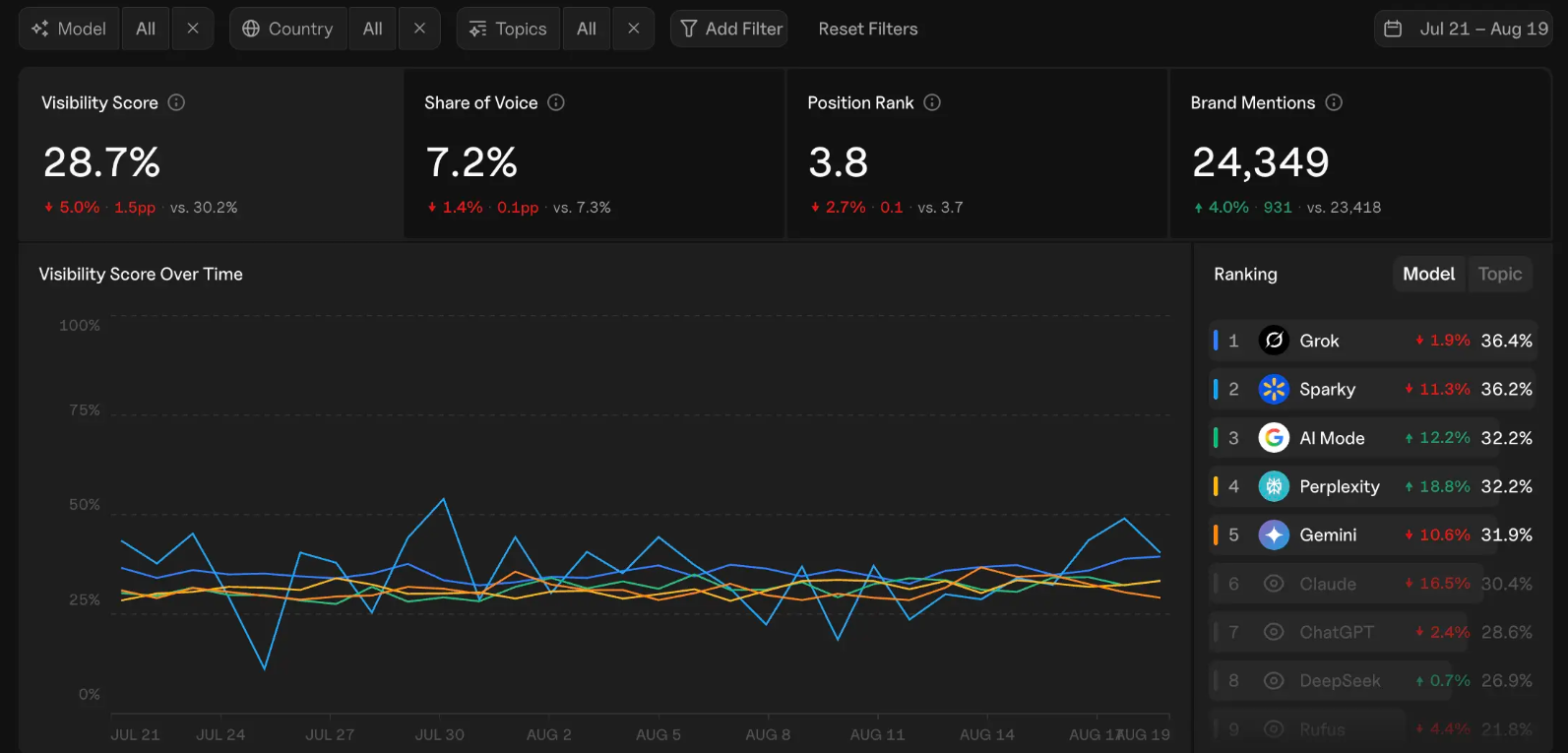
The platform monitors brand performance and global presence to help businesses with AI search. It acts as the best generative engine optimization (GEO) tracking tool for brands wanting to manage their digital image.
To optimize brand mentions, Goodie AI has several features:
- AI Visibility Monitoring tracks brand presence across AI platforms.
- AI Search Optimization feature suggests semantic content and schema tags.
- Prompt Research uncovers content gaps and related topics across AI platforms.
- Content Studio tool drafts text designed specifically for AI engines.
- Traffic and Attribution measures how AI mentions impact the brand.
- Agentic Commerce Suite monitors product visibility in shopping results.
- AI Crawler Analytics reveal how bots and agents index your site.
These features establish the platform as the best generative engine optimization software. Utilizing such generative engine optimization tools allows teams to adapt to the shift from search to AI questions.
Best for
Goodie AI is designed for startups, SEO specialists, and PR professionals to monitor brand citations and sentiment across AI models. It’s the best generative engine optimization (GEO) checking software for growth teams and agencies tracking AI search visibility’s business impact.
Pros and Cons
Benefits of using Goodie:
- It offers broad coverage across different AI engines.
- Actionable insights help users move from monitoring to content updates.
- Multi-country and multi-language support allows teams to segment and compare visibility by region.
Drawbacks of using Goodie:
- Full implementation requires human management of content suggestions.
- Users report challenges with interpreting search queries.
- It lacks tools like backlink crawlers or site audits.
Pricing
The Core plan is $478.80/month or $1,198.80/month for the Pro subscription. There is also a possibility to get two months for free with annual billing. Enterprise plans require custom billing.
Peec AI
Peec AI is a generative engine optimization (GEO) analysis software that helps marketing teams track and analyze brand performance across AI models.
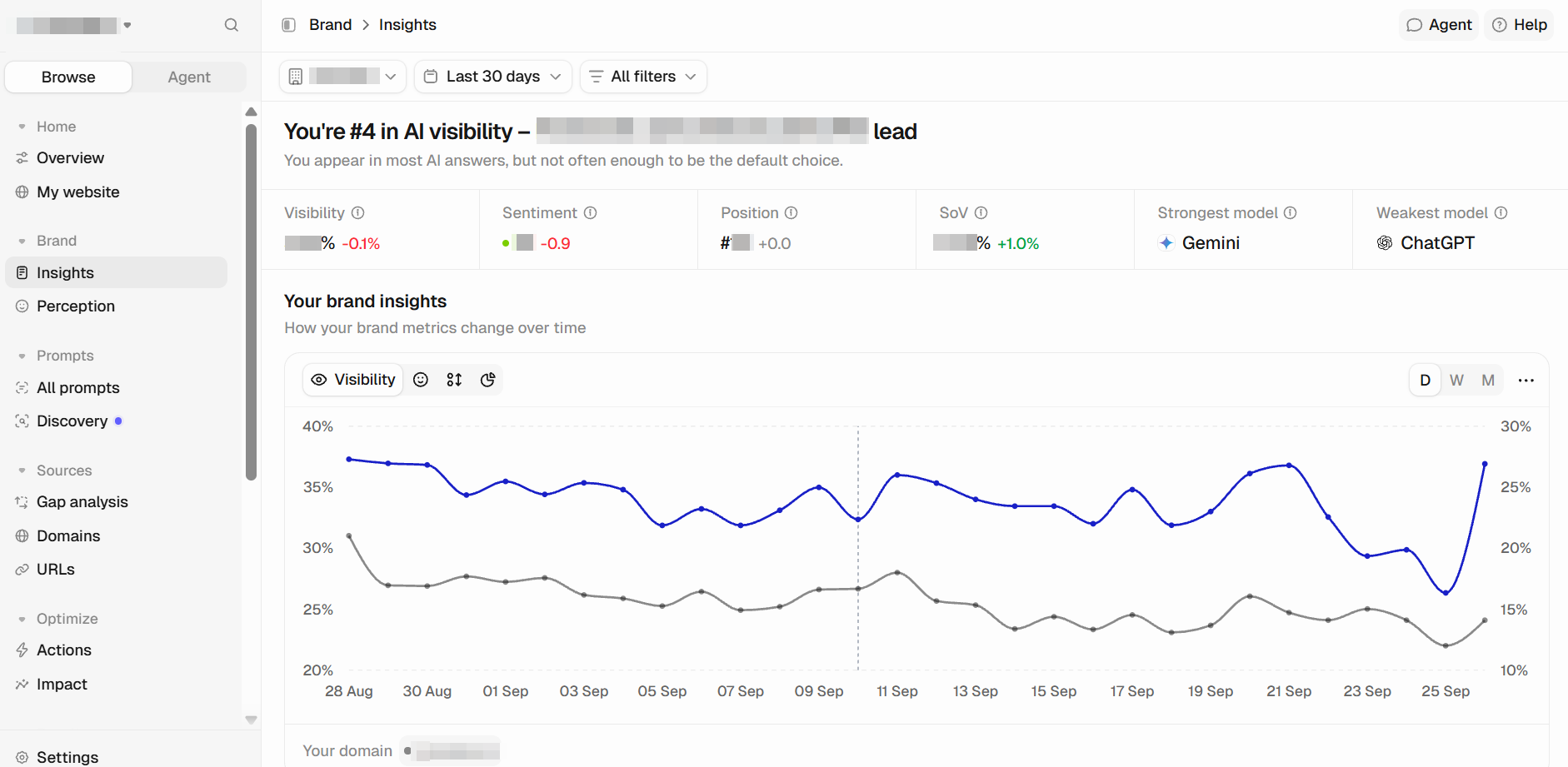
Like many other generative engine optimization (GEO) trackers that help improve brand presence, Peec AI covers the following features:
- Prompt Discovery uncovers and organizes the queries most relevant to your AI search strategy.
- Brand Ranking monitors your position against key competitors.
- AI Model Selection allows you two choose the most important engines for brand tracking.
- Source Identification spots the specific citations influencing your search results.
- Actionable Recommendations provides strategy insights to help your rankings.
- API and a native MCP server on every plan (except Starter) to query your AI-search data from AI assistants. SSO on the Enterprise plan.
These features ensure the platform remains the best generative engine optimization (GEO) analysis software for monitoring brand authority. And it didn’t go unnoticed. Users on G2 like how simple yet useful the tool is: “It’s easy to use, setup is extremely fast, you get immediate insights, and you finally get some data to better understand where and how your brand is mentioned in LLMs.”
Best for
Peec AI is built for marketing teams that need reliable multi-engine tracking. It is one of the best generative engine optimization (GEO) trackers for brands with in-house experts who can execute a strategy based on simple data.
Pros and Cons
The advantages of Peec AI:
- It provides fast data analysis, delivering easy-to-understand results.
- It identifies content gaps by showing which sources competitors use for visibility.
- Daily tracking updates allow teams to spot shifts in AI visibility quickly.
The disadvantages:
- The platform lacks deep technical insights into exactly why specific sources are selected.
- It doesn’t track the traffic volume coming from LLMs.
If Peec AI’s feature set doesn’t match what your team needs, our full Peec AI review breaks the platform down in more depth.
Pricing
The Starter plan is $95 per month. The Pro plan costs $245 per month. The Advanced plan costs $495 per month. Annual billing provides a 15% discount. It has a 7-day free trial and a custom Enterprise plan.
Profound AI
Profound AI is one of the best generative engine optimization (GEO) checkers for monitoring brand mentions in AI-generated answers.
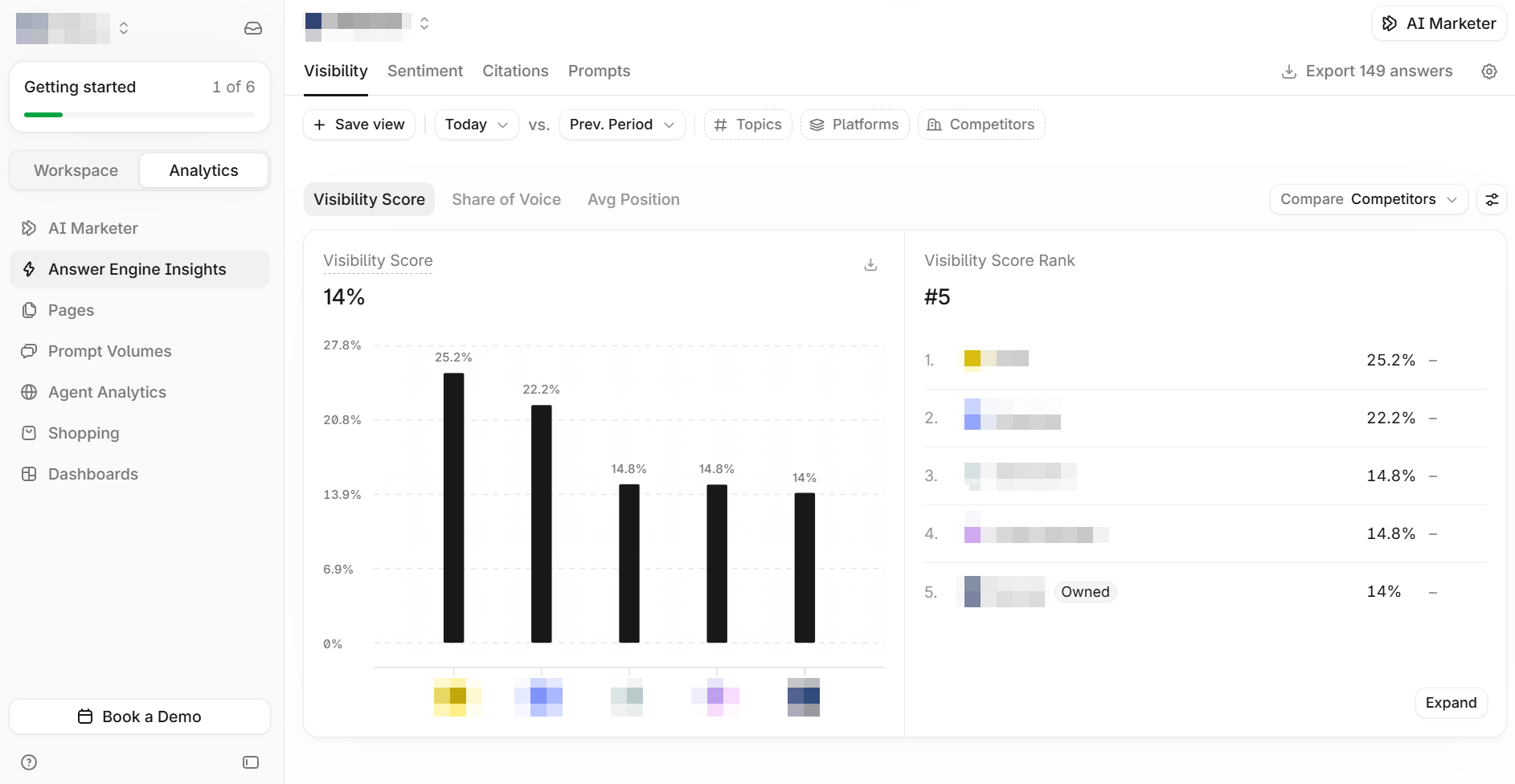
To manage your brand narrative, Profound AI has these features:
- Visibility Dashboard tracks the visibility score and compares your brand against competitors.
- Prompt Volumes reveals real-time AI search volume data and identifies trending keywords.
- Multi-Platform Coverage to monitor visibility across ChatGPT, Gemini, Google AI Overviews, etc.
- Prompt Designer for creating, organizing, and managing tracked prompts.
- The platform connects with AWS and Cloudflare with SOC 2 Type II security compliance.
Large firms often choose Profound AI as one of their best generative engine optimization tools to manage their presence in AI search results. What they say about the tool on G2 is, “I like how easy Profound is to use. The visibility tracking is particularly useful, allowing you to dig as deep as you see fit.”
Best for
This generative engine optimization (GEO) tracker is ideal for marketing leaders at large-scale organizations, marketing teams at big companies, and agencies managing high-profile clients.
Pros and Cons
The strengths of Profound AI:
- Creates optimized content based on real visibility data through the Agents feature.
- Uncovers conversational industry volumes that are often hidden in standard software.
- Has advanced security features for massive data handling.
- Integrated workflows speed up the creation of AI-optimized articles.
The weaknesses of Profound AI:
- Most advanced features are behind custom enterprise plans.
- The data-heavy interface requires analysts to interpret the results.
- AI Marketer runs on a credit system.
If Profound isn’t the right fit, we’ve also covered a set of alternatives built for smaller teams and budgets.
Pricing
Profound offers a free plan with 50 prompts tracked daily for 7 days across ChatGPT, Gemini, and Google AI Overviews. For full access, this generative engine optimization (GEO) tool offers custom Enterprise plans, priced on request after a demo.
Otterly AI
Otterly AI is a generative engine optimization (GEO) tracking tool built around prompt-level monitoring across the major AI answer engines.
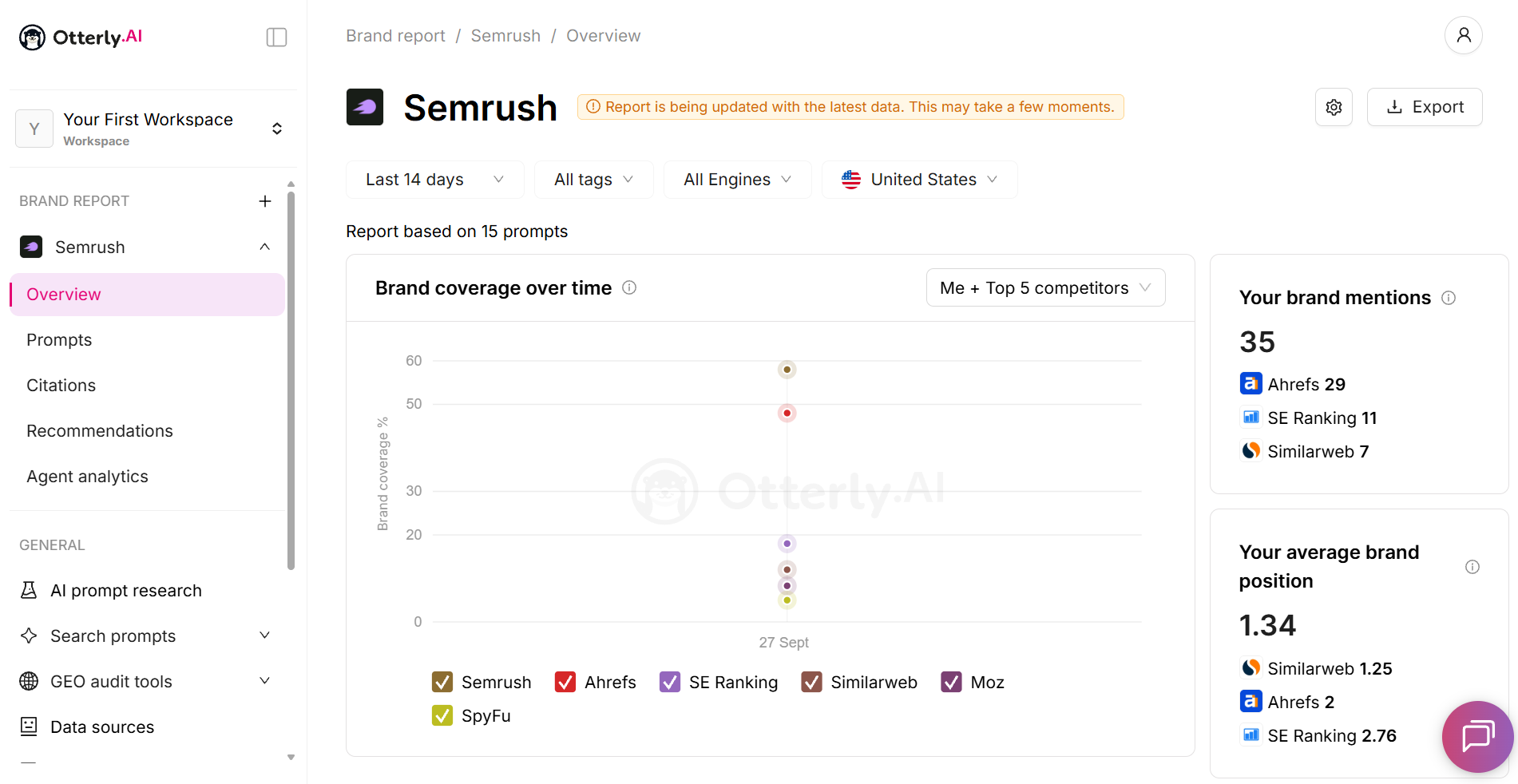
Otterly AI tracks how a brand shows up across ChatGPT, Google AI Overviews, Perplexity, and Microsoft Copilot from a single dashboard, with Claude, Google AI Mode, and Gemini available as add-ons on top of any plan. The platform is aimed at teams that want to start tracking AI visibility without a large setup effort.
Otterly AI’s core features:
- Multi-engine prompt tracking monitors brand mentions across ChatGPT, Google AI Overviews, Perplexity, and Microsoft Copilot.
- ChatGPT ads tracking flags when paid placements appear alongside organic AI answers.
- Agent analytics shows how AI agents and crawlers interact with a site, separate from human traffic.
- API and MCP server access (on the Standard plan and above) lets teams pull AI-search data into their own reporting stack.
- Unlimited team members on every plan, including the entry tier.
For a closer look at how the platform handles day-to-day tracking, our Otterly AI review covers the setup process and dashboard in more detail.
Best for
Otterly AI is best for solo marketers and small teams that want to start tracking AI visibility across the major engines without committing to an enterprise-priced platform first.
Pros and Cons
Strengths of Otterly AI:
- Entry-tier plan covers four major AI engines out of the box.
- Unlimited team seats at every price point.
- API and MCP access are available below the top pricing tier.
Limitations of Otterly AI:
- Claude, Google AI Mode, and Gemini require paid add-ons rather than being included.
- The entry tier’s 15-prompt allowance is limiting for brands tracking more than a handful of core queries.
Pricing
Lite plan is $29/month for 15 search prompts. Standard plan is $189/month for 100 prompts, plus API and MCP access. Premium plan is $489/month for 400 prompts. Enterprise pricing is custom, starting from 1,000 search prompts. A free trial is available for new users.
Scrunch AI
Scrunch AI is a generative engine optimization (GEO) platform that pairs AI-visibility tracking with site-level diagnostics aimed at making a brand’s content easier for AI crawlers to use.
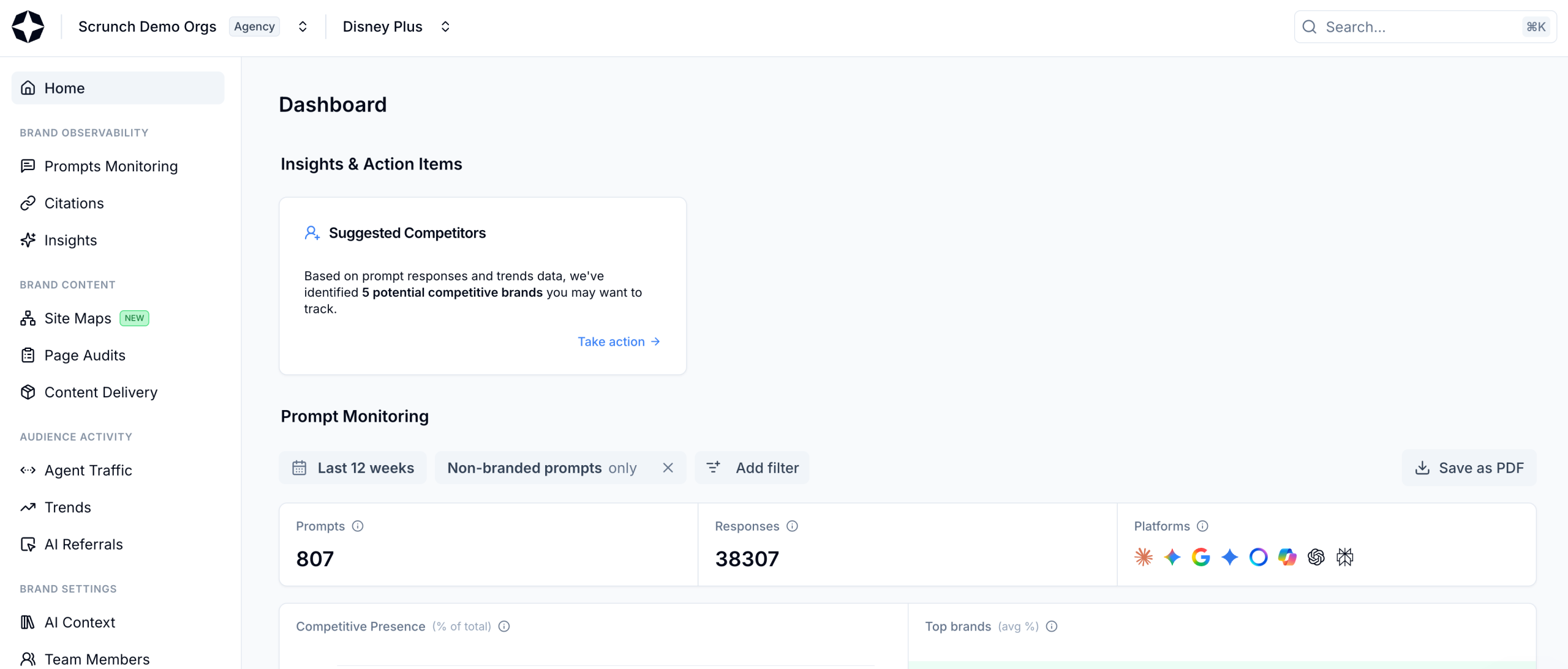
Scrunch AI monitors brand visibility and citations across ChatGPT, Claude, Gemini, Perplexity, Google AI Mode and AI Overviews, Copilot, Grok and Meta AI, and adds a technical layer most trackers in this list don’t: it audits how a site’s own structure and content affect whether AI systems can find and cite it, and can generate machine-readable versions of pages for AI agents to crawl.
Scrunch AI’s core features:
- Site diagnostics audit a domain’s structure and content for AI crawlability, separate from the prompt-tracking side of the platform.
- Agent-traffic analytics shows how AI agents and crawlers behave on a site compared with human visitors.
- Content optimization recommendations point to specific pages and gaps to address, rather than just reporting scores.
- An Agent Experience Platform (AXP) feature creates lightweight, machine-readable versions of pages for AI agents, without changing the page humans see.
Best for
Scrunch AI is best for teams that want to benchmark their AI visibility and check their site’s AI crawlability in one platform before scaling up to a larger, multi-brand tool.
Pros and Cons
Strengths of Scrunch AI:
- Combines AI-visibility tracking with technical crawlability audits in one platform.
- Agent-traffic analytics separates AI crawler activity from human traffic.
Limitations of Scrunch AI:
- The Core plan is capped at 4 LLMs supported (ChatGPT, Perplexity, Google AIO and Copilot), 5 user licenses and 5 page audits per month; larger teams need the Enterprise tier.
- Site diagnostics and prompt tracking are priced together, so a team that only needs one may pay for capacity in the other.
Pricing
The Core plan is $250/month for 125 unique prompts, 5 site audits, 4 LLMs supported, 1 brand workspace and 5 user licenses. The Agency Core plan is $500/month billed monthly for 250 custom prompts, 5 site audits/brand/month, 3 brand workspaces, and unlimited user licenses. Enterprise pricing is custom with 9 LLMs supported. A 7-day free trial of the Starter plan is available.
HubSpot AEO
HubSpot AEO is HubSpot’s answer engine optimization tool, built following its acquisition of XFunnel and aimed at marketing teams already working inside HubSpot’s CRM and content tools.
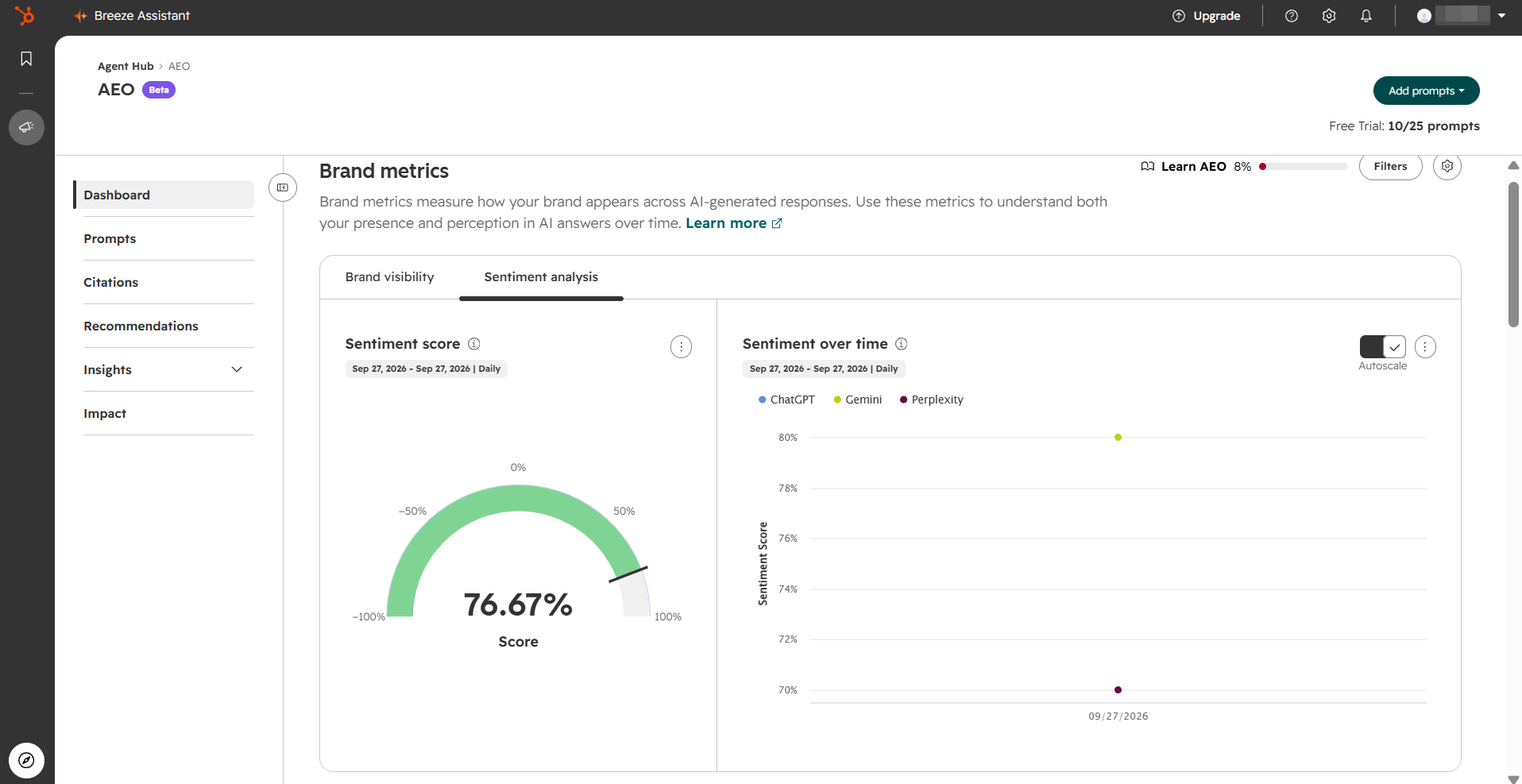
HubSpot AEO tracks brand visibility and sentiment across ChatGPT, Gemini, and Perplexity, and ties its recommendations directly to the marketing and CRM data teams already have in HubSpot.
HubSpot AEO’s core features:
- Brand visibility score tracks how often and how favorably a brand appears in AI answers.
- Competitor share of voice compares a brand’s AI presence against named rivals.
- Citation analysis identifies which sources AI models cite when discussing the brand.
- Prioritized recommendations flag which fixes are likely to move visibility the most, rather than listing every possible change with equal weight.
- Bundled availability inside HubSpot Marketing Hub Pro and Enterprise, with expanded prompts and CRM-linked recommendations for teams already on those plans.
Best for
HubSpot AEO is best for marketing teams already using HubSpot’s CRM and content tools who want AI-visibility tracking without adding a separate platform to their stack.
Pros and Cons
Strengths of HubSpot AEO:
- Ties AI-visibility data directly to CRM and marketing data already in HubSpot.
- A free trial with no credit card offers the same prompt allowance and engine coverage as the paid tier.
- Simple, single-plan pricing with no tiered feature gating.
Limitations of HubSpot AEO:
- Covers three AI engines (ChatGPT, Gemini, Perplexity), fewer than several other tools in this list.
- Full value depends on a team already using HubSpot’s broader marketing platform.
Pricing
$50/month ($45/month billed annually) for 25 prompts, with more prompts purchasable at any time. A free trial is available with no credit card required, at the same 25-prompt, 3-engine coverage as the paid tier.
Future of GEO Tools: Predictions for 2027
The clearest signal for where GEO tools are heading is where AI answers get their sources. So far, the data points one way: AI engines pull heavily from pages that already rank and from social platforms. Staying visible in AI means being present on the surfaces AI draws from.
AI traffic is still small, but it’s growing fast
AI platforms sent 0.32% of all website traffic in 2026, up from 0.02% in 2024, according to SE Ranking’s AI traffic study (June 2026). Organic search still sent 134 times more visitors. The visits AI does send behave differently, though: AI-referred visitors spend 68% more time on site than organic visitors. That’s why AI visibility is showing up in reporting while its traffic share is still under 1%.
AI answers lean on organic rankings
In SE Ranking’s study of French AI Overviews (August 2026), 60.46% of cited pages came from the organic top 10. ChatGPT shows a similar pull toward established sites. Sites with at least 7,900 organic visitors to their main page are about twice as likely to be cited, per SE Ranking’s ChatGPT citation research.
That weakens the idea that SEO and GEO are separate disciplines. For most brands, strong organic rankings are the entry point to AI citations.
Social platforms are part of the source pool
The other surface AI draws from is social and community content. In the same French study, social and video platforms made up half of the ten most-cited domains in AI Overviews, and YouTube alone accounted for 14.33% of citations. For ChatGPT, domains with millions of brand mentions on Reddit and Quora are roughly 4x more likely to be cited than those with minimal activity.
These surfaces also overlap. After Google’s May 2026 core update, Reddit held 10.24% of top 3 organic positions. A strong Reddit presence now feeds both your organic visibility and your AI visibility.
What this means for GEO tools in 2027?
These are predictions, and the market is moving fast enough that some of them will be wrong. The data above still points in a few clear directions:
- Source analysis will matter more than mention counts.
- GEO reporting will move closer to SEO and social reporting. If AI answers draw from organic rankings and social platforms, tracking AI visibility on its own shows only part of the picture.
- AI share of voice will likely sit next to rankings as a standard KPI, since it’s the closest measure of whether your brand is part of the answer.
Conclusion
Choosing generative engine optimization services depends on your team’s size. Large firms should use Profound AI for its scale. SE Visible is best for business owners, agencies and CMOs who want clear data and pairing it with SE Ranking will give you the fuller picture of your brand presence across LLMs and traditional search. Growth teams will benefit from Goodie AI. Marketing teams seeking a simple experience should try Peec AI.
If you want to see where your own brand already stands before picking a tool, SE Visible’s 10-day free trial shows your current AI visibility score and how you compare to competitors. If plain AI-visibility tracking without GEO’s citation-and-sentiment layer is closer to what you need, our best AI visibility tools list covers that ground too.
Choose a tool from our guide to grow your brand visibility in AI search.
FAQ
What is a GEO tool?
A GEO tool is software that tracks how often, and how accurately, AI systems like ChatGPT, Gemini, and Perplexity mention a brand in their answers. Instead of measuring clicks or rankings, it reports on citations, sentiment, and share of voice inside AI-generated responses.
How are GEO tools different from SEO tools?
SEO tools track rankings and traffic on traditional search engine results pages. GEO tools track something different: whether AI models cite, describe, and recommend a brand inside their generated answers. Many teams run both, since AI Overviews and chat-based search still draw on the same technical and content foundations that SEO tools help you build.
Which GEO metrics matter most?
The most critical metrics are brand share of voice, citation frequency and sentiment. Unlike traditional clicks, GEO focuses on how often an AI recommends your brand in their answers.
Which teams should use GEO tools?
GEO tools would be useful for CMOs, agency owners and marketers. These tools help leaders understand how AI sees their business.
Is GEO only about ChatGPT?
No. Effective generative engine optimization (GEO) tools analyze a variety of models, including Google Gemini, Perplexity and Claude. If you specifically want to track Google’s AI Mode results, our AI Mode tracking tools guide covers that in more depth.
Can GEO tools track brand mentions without direct links?
Yes. Since AI models often summarize information without hyperlinking, the best generative engine optimization (GEO) analysis tools identify “unlinked citations.” That is how you can discover that your company is visible even without a direct URL.
Can GEO tools support competitive benchmarking in AI search results?
The best generative engine optimization tools allow you to compare your visibility against competitors. I found that using a generative engine optimization (GEO) tracking tool is the most reliable way to monitor shifting market shares in AI responses.