

Does Prompt Sentiment Change How ChatGPT Talks About Brands? What 900 Responses Showed

If you’re tracking how your brand appears in AI search, there’s a pretty big variable you need to account for: the prompt itself.
We know that changing a prompt changes an AI response. That’s kind of the whole point of prompting. But when we’re measuring AI visibility or brand sentiment, we tend to treat the response as the thing we’re analyzing without spending nearly as much time thinking about how the question may have influenced it.
I wanted to look at that relationship more closely. Specifically, can the sentiment of a user’s question change the sentiment ChatGPT expresses toward a brand?
To test this, we used 180 prompts across three categories and collected 900 ChatGPT responses from SE Visible. The prompts covered Samsung vs. Sony TVs, Hers vs. Start Willow GLP-1 telehealth, and Delta SkyMiles vs. United MileagePlus, with questions spanning 4 different prompt families: Recommendation, Comparison, Trust, and Value intent.
The results showed a clear relationship between the two. Prompt sentiment affected the sentiment ChatGPT expressed toward the target brand, but the size of that effect depended heavily on the context. Negative framing also had a noticeably stronger impact than positive framing.
That part wasn’t necessarily surprising. The more interesting findings came from looking at where that effect became stronger, weaker, or behaved differently altogether.

How we tested prompt sentiment
The hypothesis was fairly straightforward: for the same brand, product category, and user intent, negatively framed prompts would produce more negative brand sentiment than neutral prompts, while positively framed prompts would produce more positive sentiment.
The important part was keeping the underlying question as consistent as possible.
For example, instead of comparing a positive question about one product with a completely different negative question about another, prompts were created as matched positive, neutral, and negative variations. The brand and basic information stayed the same while the framing changed.
A TV prompt, for example, might ask about the reasons to choose a Samsung Frame TV, what someone should consider before choosing one, or the biggest drawbacks of choosing one. Those questions aren’t identical, but they’re designed around the same underlying product and decision.
We repeated that structure across four intent families: Recommendation, Comparison, Trust, and Value.
The three brand categories were also intentionally different from one another. We tested Samsung and Sony TVs, Hers and Start Willow GLP-1 telehealth, and Delta SkyMiles and United MileagePlus. That gave us consumer electronics, healthcare-related services, and airline loyalty programs rather than relying on one category and assuming the behavior would generalize.
Altogether, the study included 180 prompts: 60 positive, 60 neutral, and 60 negative.
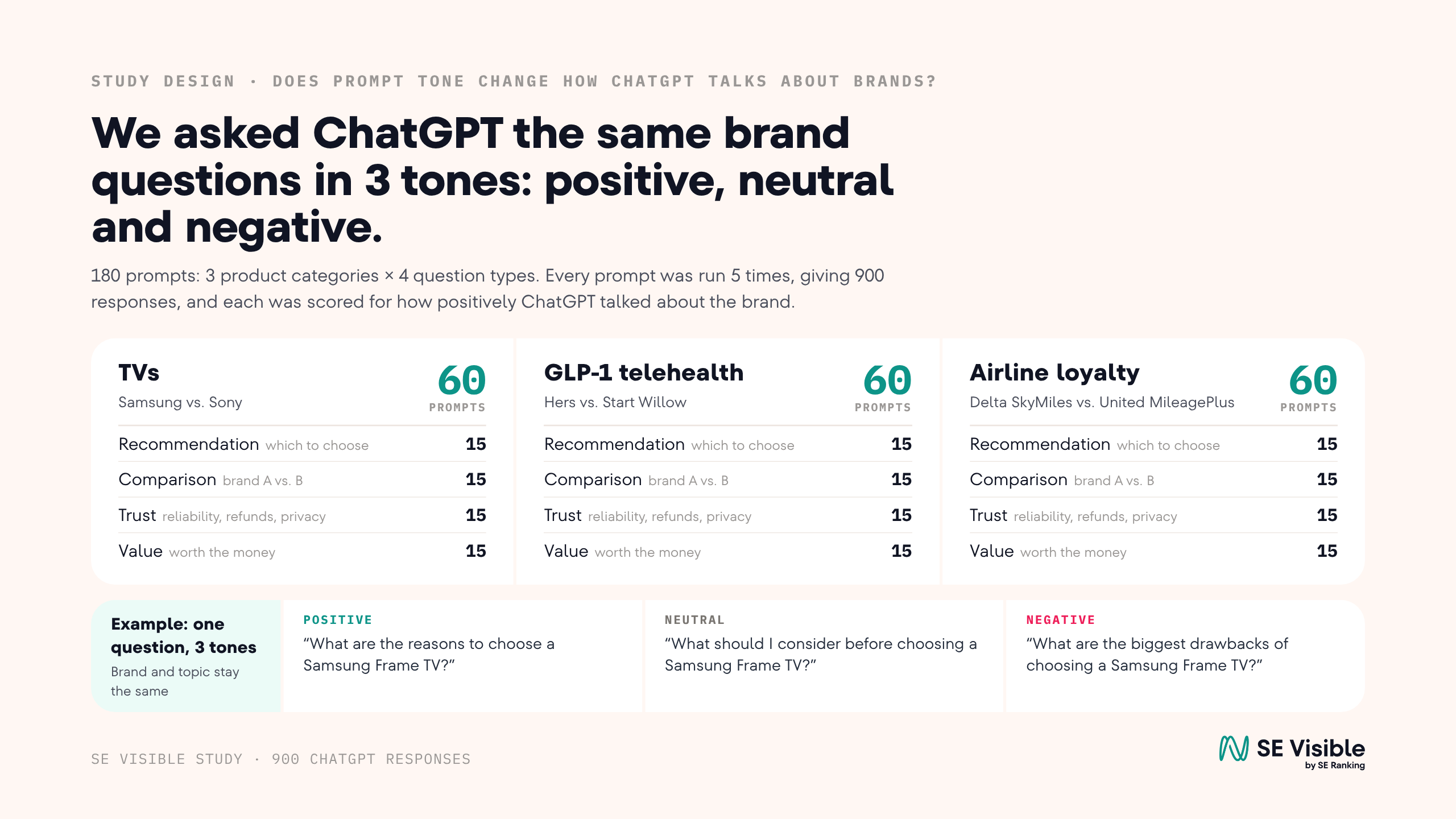
Each prompt was then submitted to ChatGPT five times, giving us 900 responses to analyze.
How we measured brand sentiment
For each response, we identified the brands mentioned and classified the sentiment toward each brand as positive, neutral, or negative based on the language used.
One detail was especially important: we ran the sentiment analysis independently of the original prompt. We then converted those classifications into a Net Sentiment score ranging from -100 to +100. A score of +100 would mean all sentiment toward the target brand was positive, while -100 would mean it was entirely negative.
Because we ran every prompt five times, we averaged those responses before the main statistical analysis. That kept the prompt as the unit of analysis, rather than treating 900 responses from 180 prompts as 900 completely independent experiments.
With that setup, we could start asking the question we actually cared about: when we change the sentiment of the prompt, what happens to the sentiment of the answer?
Prompt sentiment moved ChatGPT’s brand sentiment
Across all 180 prompts, the relationship between prompt sentiment and response sentiment had a Spearman correlation of ρ = 0.66. Spearman’s correlation tells us how consistently things move together; here, ChatGPT’s brand sentiment tends to become more positive as the prompt becomes more positive.
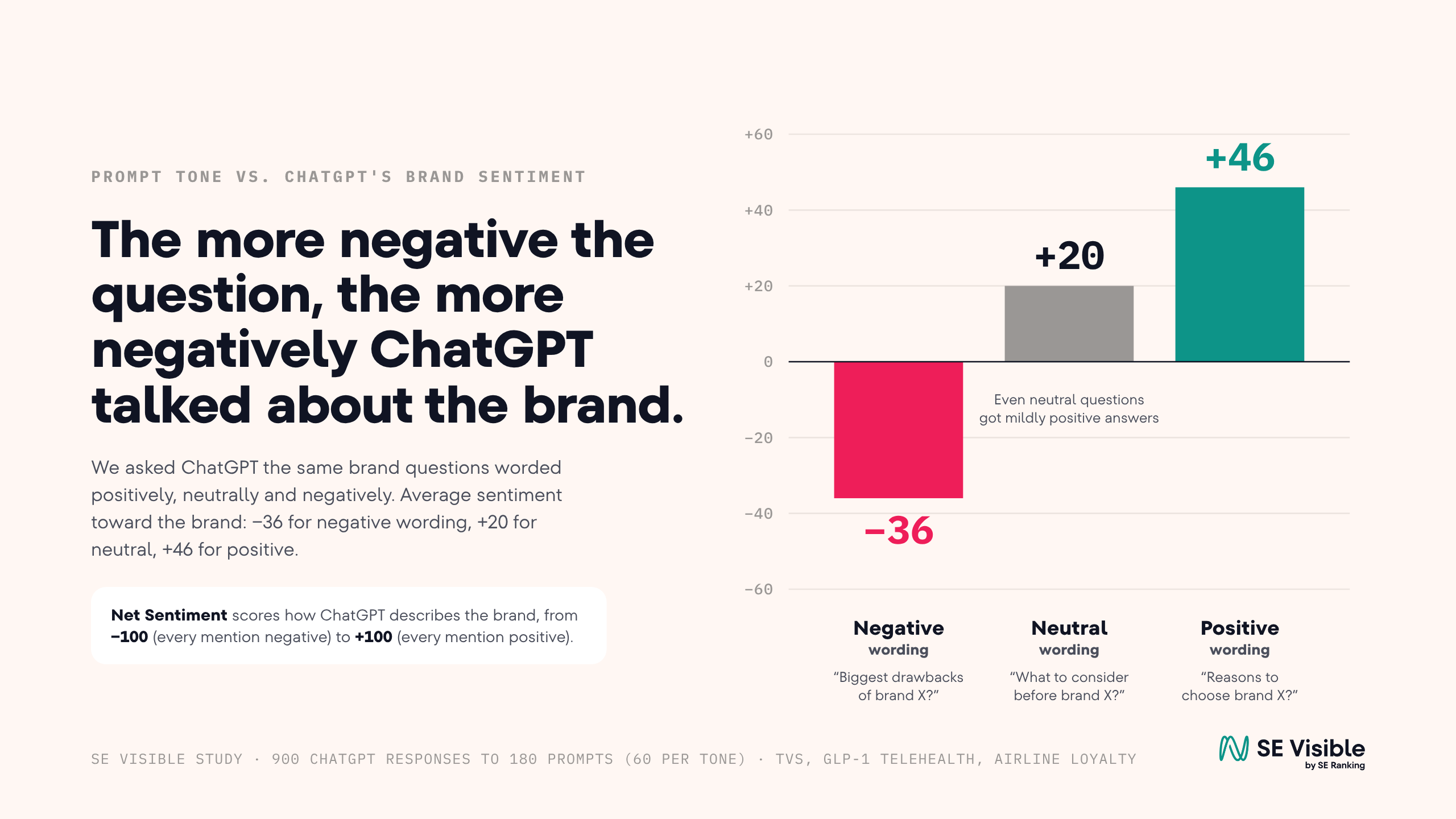
We’re not saying that prompt input definitively changed the output, but rather the prompt acted more like pressure on the answer. Negative framing pulled sentiment down, and positive framing pushed it up, while the brand, category, and type of question helped determine where the response landed.
Neutral prompts are useful for seeing this in practice because ChatGPT wasn’t actually neutral toward the brands in the neutral condition. On average, those responses were mildly positive, with an overall Net Sentiment around +20. That gave us a baseline to compare the positive and negative variations against rather than assuming every brand started at zero.
Negative framing had a much bigger impact than positive framing
Both positive and negative wording moved sentiment away from the neutral baseline, but not by the same amount. Negative prompts shifted response sentiment roughly twice as far as positive prompts did.
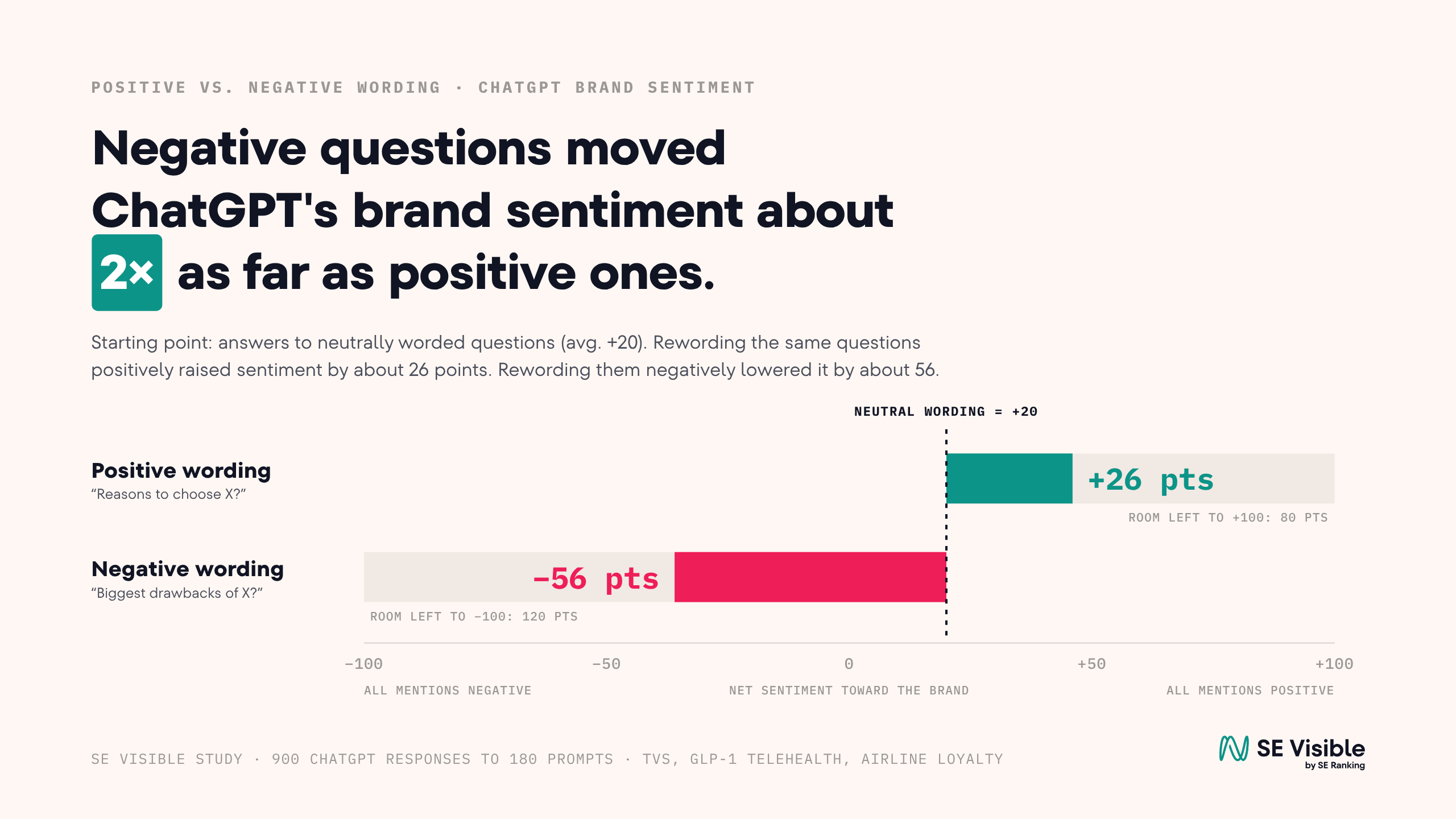
Part of that difference makes sense when you look at the baseline. If neutral responses already average around +20 on a scale that maxes out at +100, there is less room for a positive prompt to push the response upward. Negative prompts have considerably more room to move in the opposite direction.
That’s a ceiling effect, but it doesn’t explain everything. The analysis found that the asymmetry remained even after accounting for it, which suggests negative framing itself had a stronger relationship with the resulting sentiment.
At the individual response level, 43% of responses rated the target brand positively, compared with 29% neutral and 28% negative. So ChatGPT wasn’t starting from an overwhelmingly critical position across this dataset. Negative framing was frequently moving the answer away from an already positive starting point.
This distinction absolutely matters for brand monitoring. If you’re only testing neutral or positively framed discovery prompts, you may get a much rosier picture of how ChatGPT talks about a brand than someone who comes into the conversation with a concern, complaint, or skeptical question.
You’re missing the real skepticism potential customers have before they buy. Tracking negative prompts should be part of your process to fully understand all the objections a potential customer could come across or already have before they decide to make a purchase.
The pattern held across brands and categories
One thing I wanted to know was whether the overall correlation was hiding a category-specific effect. Maybe something that was more YMYL, like GLP-1s vs. purchasing a TV, could have more detrimental effects with negative prompting. However, that wasn’t the case.
The relationship between prompt tone and response sentiment appeared in every category and every brand we tested, with category-level correlations ranging from 0.62 to 0.78.
That’s an important finding because these aren’t three versions of essentially the same purchase. Choosing a TV, evaluating a GLP-1 telehealth service, and comparing airline loyalty programs involve different types of information, different risks, and different decision-making processes.
The direction of the effect remained remarkably consistent across them.
But the same prompt effect didn’t necessarily produce the same final sentiment.
The brand’s starting point still matters
TVs had the most positive baseline of the three categories. Negative framing caused a substantial drop, but average sentiment only fell to around -11. In other words, negative TV prompts pulled the responses toward neutral rather than making them strongly negative overall.
Airline loyalty and GLP-1 telehealth were different. Negative airline prompts averaged around -45, while negative GLP-1 prompts averaged around -53. Positive prompts, meanwhile, created a much more consistent upward shift across the three categories, ranging from roughly +22 to +30.
This is why I don’t want people to simply take away “negative prompts make ChatGPT negative” from this study. Prompt sentiment shifted responses from an existing baseline, and those baselines differed considerably by category.
That’s closer to what you’d expect from an actual search experience, too. A model isn’t encountering the emotional framing of the prompt in isolation. It’s answering that question alongside whatever information, associations, product characteristics, reviews, and other context it has available about the topic.
So two brands can receive similarly negative questions and move in a similar direction without ending up with anything close to the same sentiment score.
Intent mattered, especially for Trust questions
We also split the results by prompt family, since someone asking whether the brand is worth the money wants different information than someone wondering how rigorous patient monitoring is if they go on a GLP-1.
Recommendation and Value prompts were the most responsive to tone in both directions. Positive framing moved responses upward, and negative framing moved them downward in a fairly clear pattern.
Comparison prompts behaved a little differently. They were the least responsive to negative tone, which makes sense when you look at the answers themselves. When two brands were being compared, ChatGPT tended to balance them rather than simply giving one brand an entirely negative assessment.
Trust was the bigger exception.
Negative Trust prompts still pushed sentiment downward, but positive Trust framing didn’t produce a meaningful positive shift. Questions about things like reliability, refunds, privacy, safety, warranties, and data handling continued to receive more cautious responses even when the wording of the question encouraged a positive answer.
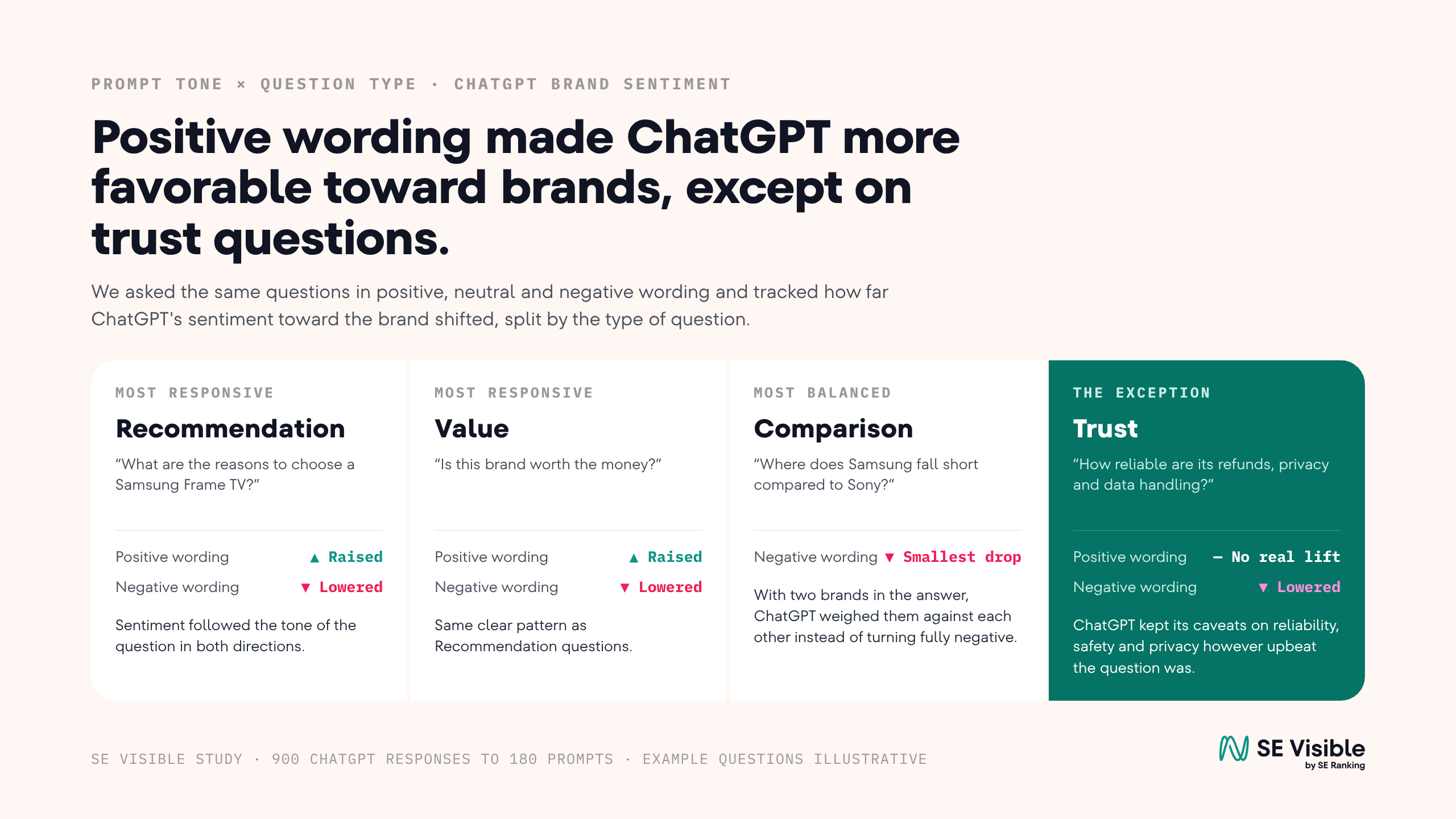
That tells us something important about what’s happening here. ChatGPT isn’t just matching the emotional language in the prompt. If it were, we’d expect positive Trust prompts to move in the same way as positive Recommendation or Value prompts.
Instead, the information being requested appears to constrain how far the framing can move the response. Ask ChatGPT a positively framed recommendation question, and there’s plenty of room to discuss benefits. Ask a favorably worded question about data safety or reliability, and the answer may still surface caveats because those caveats are relevant to the question.
For anyone building an AI visibility prompt set, this is exactly why I’d avoid creating a giant list of prompts without organizing them by intent. A brand may look resilient to framing in one area and highly sensitive to it in another.
Comparison prompts showed just how much framing can matter
When two brands appeared in the same prompt, negative sentiment tended to attach to whichever brand was positioned as the subject of the criticism, while the other brand often benefited.
The TV comparisons were a good example. Most of the negative questions were structured around where Samsung fell short compared with Sony. Across those negative comparison prompts, Samsung averaged +11 while Sony averaged +59.
At face value, we could interpret that as evidence that ChatGPT simply had a more favorable view of Sony on those topics. But the structure of the questions gave us another possibility: maybe Sony was benefiting because Samsung was the brand we were explicitly asking ChatGPT to criticize.
So we generated mirrored versions of five negative comparison prompts and swapped the position of the two brands.
For example:
Where does Samsung’s motion processing fall short compared to Sony’s?
became:
Where does Sony’s motion processing fall short compared to Samsung’s?
We then collected five responses for each version.
In every pair, the brand moved into the negative position lost between 20 and 180 points of Net Sentiment compared with the original version.
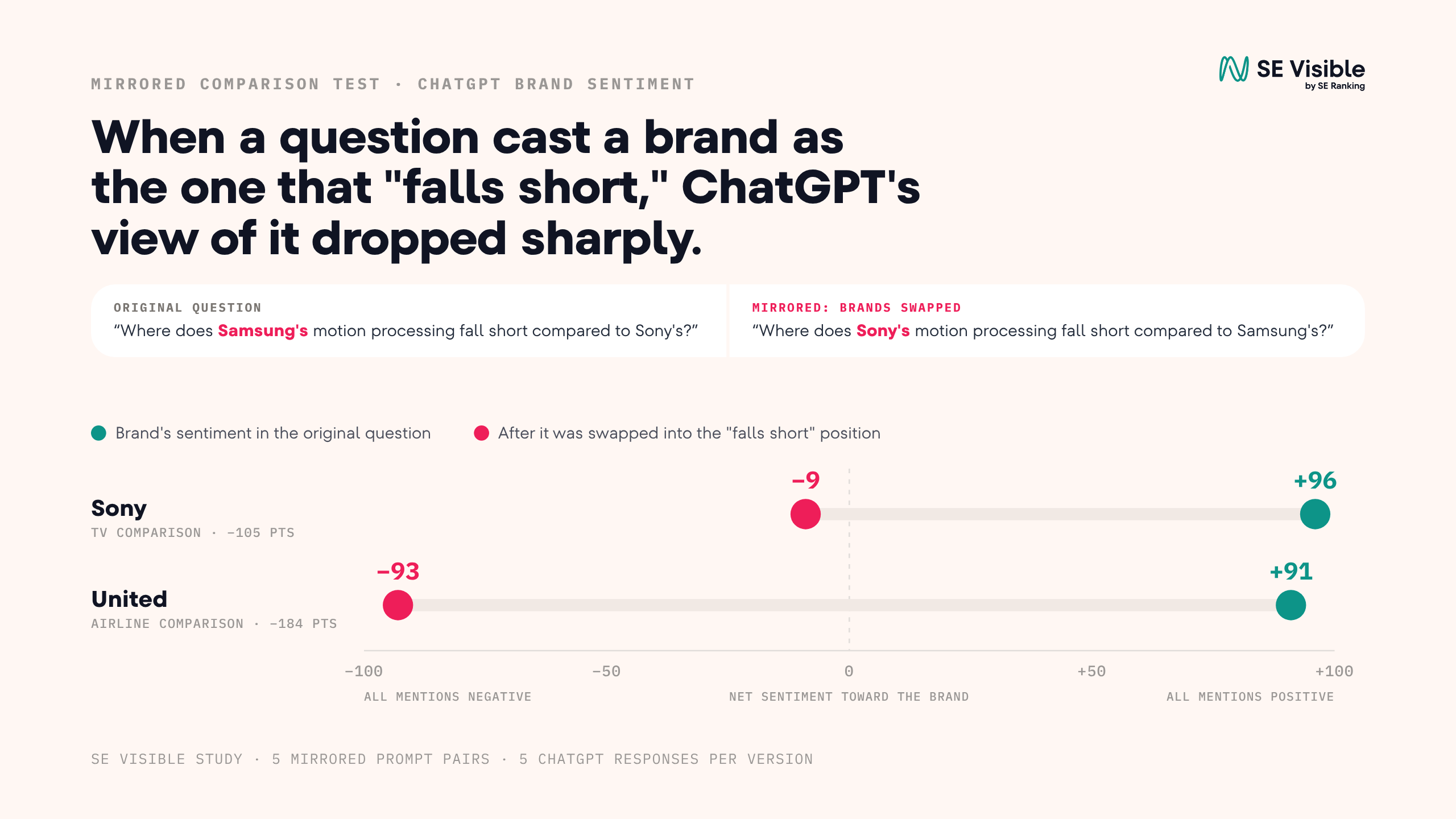
In one comparison, Sony moved from +96 to -9. In another, United moved from +91 to -93. That’s not the kind of difference I would dismiss as a minor wording effect. Simply changing which brand the question positioned as the problem could substantially change how ChatGPT discussed that brand.
But the reversal wasn’t perfectly symmetrical, and that’s where the experiment gets more useful.
Framing could move the answer, but it couldn’t always override it
When the available information appeared to strongly favor one brand on a specific topic, ChatGPT sometimes maintained that view even when we deliberately framed the question against it.
Sony, for example, remained positive at +59 even when asked where its upscaling struggled. In one of the GLP-1 comparisons, Hers remained negative at -72 even when the question targeted Start Willow’s cancellation process.
That Hers example is especially interesting because Start Willow did receive negative assessments in single-brand negative prompts, including a score of -48 on a question about multi-month commitments. So it wasn’t that ChatGPT was unwilling to criticize Start Willow. The asymmetry appeared specifically when it was being compared with Hers.
This gives us a much more nuanced interpretation of the comparison results.
Question framing largely determined which brand received the critical assessment, but it didn’t fully override ChatGPT’s existing view of the brands involved.
The structure of the question itself is helping determine where the criticism lands. Flip the brands, and you may get a very different answer. I also think this is a helpful finding: brands should track sentiment over time. As there is more information online, good or bad, about a brand, it gives ChatGPT more to pull from, and if it ends up in training data, it can absolutely affect the baseline of prompt responses.
The same prompt didn’t always produce the same result
Another source of variation we need to account for is ChatGPT itself. We ran every prompt in the study five times because generative AI doesn’t necessarily produce the same answer twice.
Only 44% of prompts received the exact same sentiment classification across all five runs. More than half showed at least some variation from response to response. That doesn’t mean the results were completely unstable. 96% of prompts still produced a majority sentiment, meaning at least three of the five responses agreed.
But Net Sentiment moved by an average of 27 points between runs.
Neutral prompts were particularly variable, with only 35% producing the same sentiment across all five responses. That’s not too surprising when you consider where neutral responses tended to sit. If an answer is already mildly positive or neutral, small wording changes can push the classification from one side to the other.
Still, the implication for AI brand monitoring is pretty significant. If you run a prompt once, record the response, and treat that as ChatGPT’s definitive position on the brand, you’re giving a single generation too much weight.
Repeating prompts doesn’t eliminate that variability, but it gives us a better chance of identifying the underlying pattern rather than overreacting to one response.
So, how much does the prompt actually matter?
Across 180 prompts, tone was strongly related to ChatGPT’s sentiment toward the target brand (Spearman ρ = 0.66), with negative framing having about twice the impact of positive framing.
That pattern was consistent across every category and brand we tested, but it wasn’t absolute. Recommendation and Value prompts were especially responsive to tone, while Trust questions remained cautious even when phrased positively. Our mirrored comparison test showed the same tension: changing which brand was positioned as “falling short” could dramatically change its sentiment, but framing couldn’t always override an existing positive or negative view of that brand.
That’s the distinction I think matters most: prompt tone shapes the response, but it doesn’t get a blank slate. The brand’s existing sentiment, prominence in the category, nature of the question, and normal response-to-response variation all play a role in where that answer ultimately lands.
For AI brand monitoring, this makes the prompt part of the measurement. A negative response to a negatively framed question isn’t necessarily evidence that ChatGPT has an inherently negative view of the brand, just as a positive response to a favorable question doesn’t prove the opposite. We need to look for patterns across different framings, intents, competitors, and repeated responses.
People are going to ask skeptical questions about pricing, trust, product shortcomings, and competitors. What brands can influence is the information ChatGPT has to work with when those questions are asked.
The wording can push the answer, sometimes pretty far, but it can’t always push it past what the model already has reason to believe.
What does this mean for prompt tracking?
So what do you do with this? Track the ugly prompts too.
If you’re monitoring how your brand shows up in AI search, don’t build a prompt set that only asks neutral or favorable questions. Include positive, neutral, and negative variations so you can see the full range of what someone might be reading about your brand. You need to know where the sentiment drops, what concerns keep coming up, and how negative the answer can get.
Then use that information.
If ChatGPT keeps surfacing concerns around pricing, trust, product limitations, service issues, or reasons someone might not choose you, those are content opportunities. Address them directly in FAQs, service and product pages, comparison content, and other pages tied to the decision-making process.
Don’t hide from the negative questions, just answer them better. The goal should be to make sure your website is providing information that can shape how your brand is understood. Address the fears and concerns off the bat and see how sentiment can change over time.