Promptwatch review: is it worth it for agencies in 2026?

If Promptwatch is on your shortlist of AI visibility trackers, it is probably there because it bundles AEO content agents with the monitoring. But does that combination hold up in practice? In this review, we walk through what each feature does, where it works well, where it falls short, and which plan makes sense depending on how many clients you track.
Promptwatch at a glance: our verdict
- Engine tracking: strong, with nine AI search engines, from ChatGPT to Google AI Mode, plus coding agents like Claude Code, though brand plans track only 4 of them and only Agency plans include all.
- Citation sources: strong, because the source-type split tells you whether a client’s gap calls for PR or for content.
- Crawler data: useful, as a real-time log of which pages AI agents read and which of them end up cited, though it’s only on Professional subscription and above.
- Content agents: useful only if you publish from Promptwatch, since articles start at Professional (5 a month, 10 on Business) and every draft depends on a knowledge base you have to keep up to date.
- Pricing for multi-client teams: the weak point, because Agency plans start at $199 a month with unlimited projects and prompts, but every client draws from one response pool (10,000 on Kick-off), so each new client cuts how many prompts you can track for the others.
Overall: a credible pick for one or two brands, but a weaker deal for agencies. Unlimited projects don’t mean unlimited tracking, because all clients draw from one monthly response pool, so each new client reduces the coverage of the others.
What is Promptwatch, and what do users say about it?
Promptwatch is an AI visibility platform that pairs prompt monitoring with AEO content agents. It runs the prompts you track through AI engines to see how your brand appears in the answers, then offers agents that draft content aimed at the gaps. More than 1,840 brands and agencies use Promptwatch, by its own count.
The independent signal is thinner. Promptwatch holds a 4.6/5 rating on G2 from 20 reviews. A score that high is encouraging, but a base that small cannot tell you much about agency workflows specifically.
For agencies, the review count matters less than two plan details. Agency tiers include unlimited client projects and branded, read-only client access, so the monitoring can feed monthly client reporting directly. Content production pays off only if your team actually ships the drafts and refreshes it suggests.
Verdict: worth a place on the shortlist. A trial on one real client account will tell you more than the review base can.
How does Promptwatch track visibility across AI engines?
Promptwatch tracks your prompts on all the AI engines it lists on agency plans (4 on brand subscriptions) and breaks down the pages they cite by source type, share DR, etc.
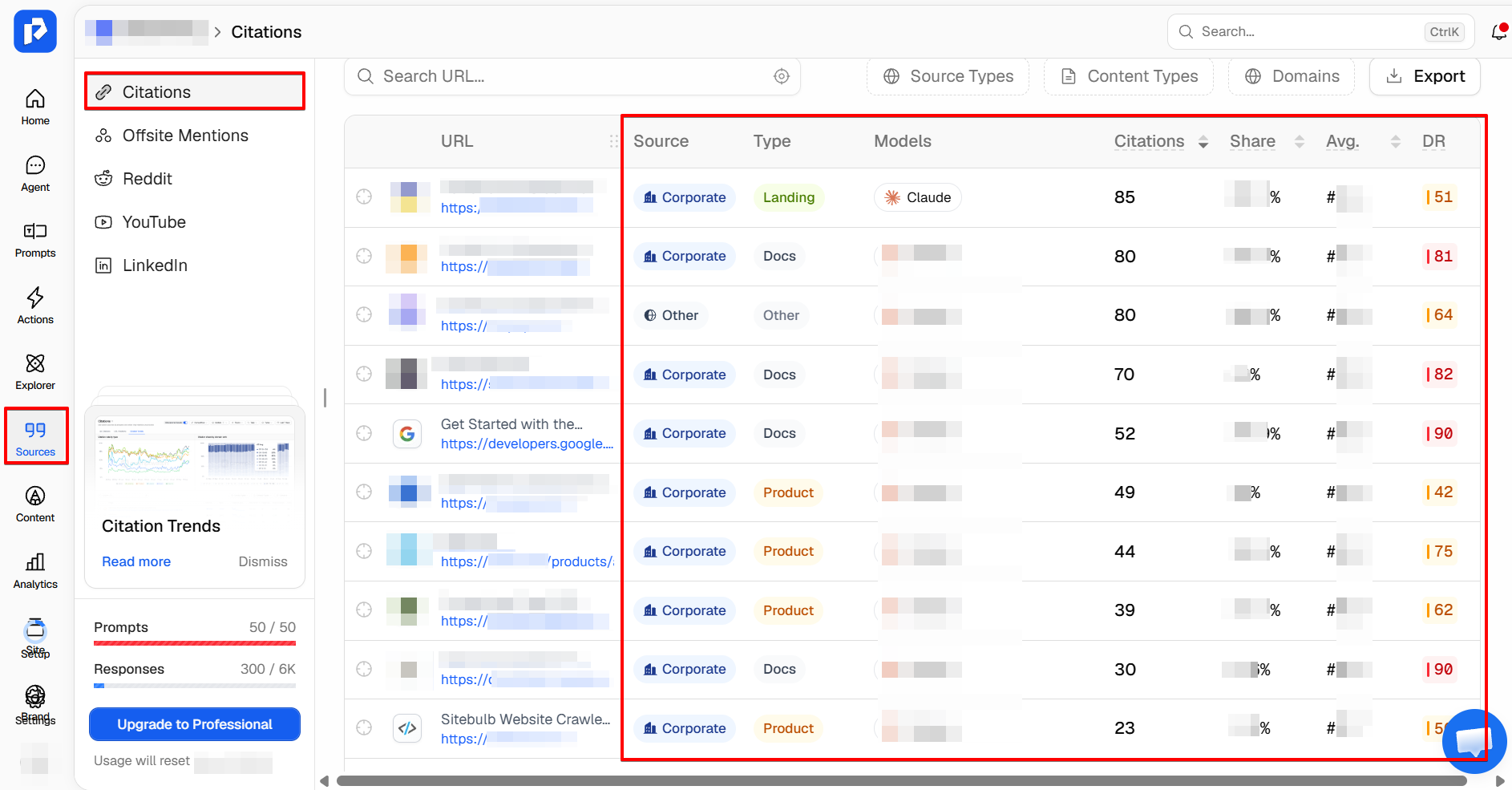
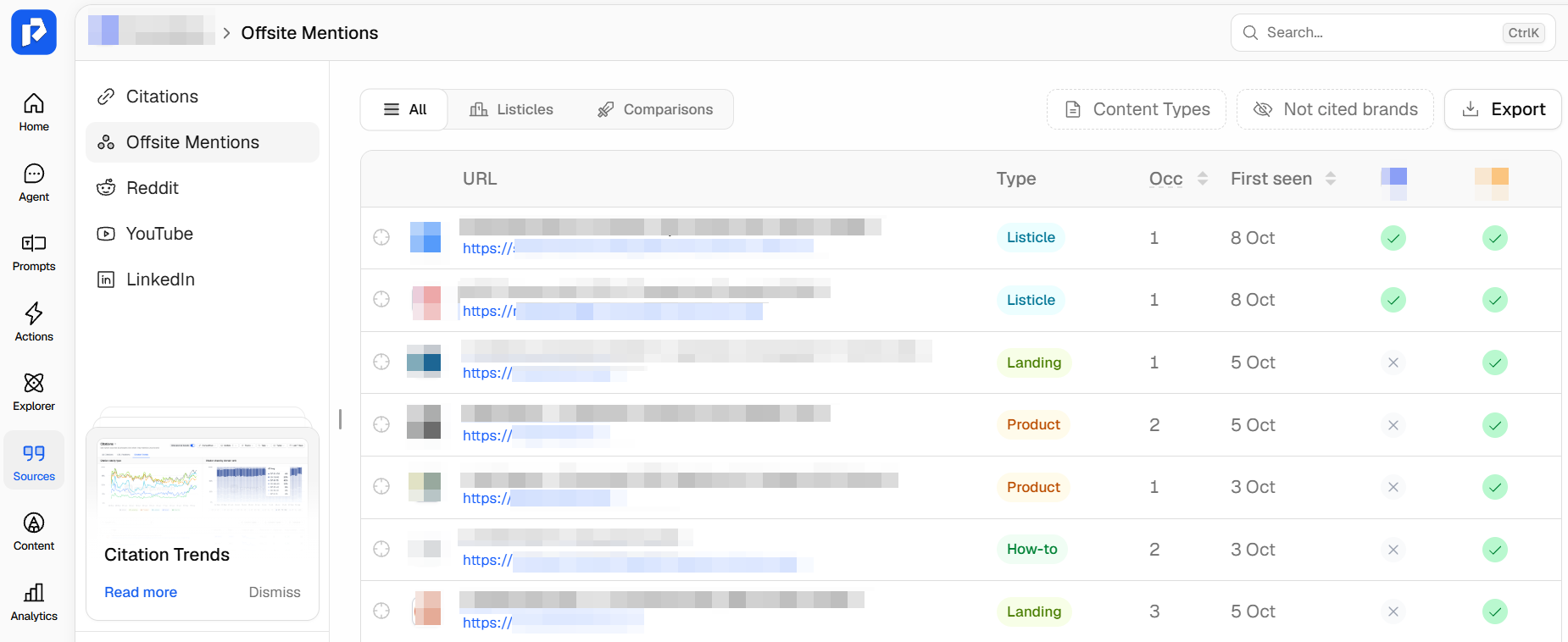
If a client’s gap sits in Review and News sources, the fix is PR and review-site work, and rewriting their blog will not close it. Promptwatch’s Offsite Mentions shows which of those sources to target, but the outreach is on you. If Corporate pages carry the citations and the client’s own pages are missing from them, the gap is on-site content, which is the gap Promptwatch’s agents are built for.
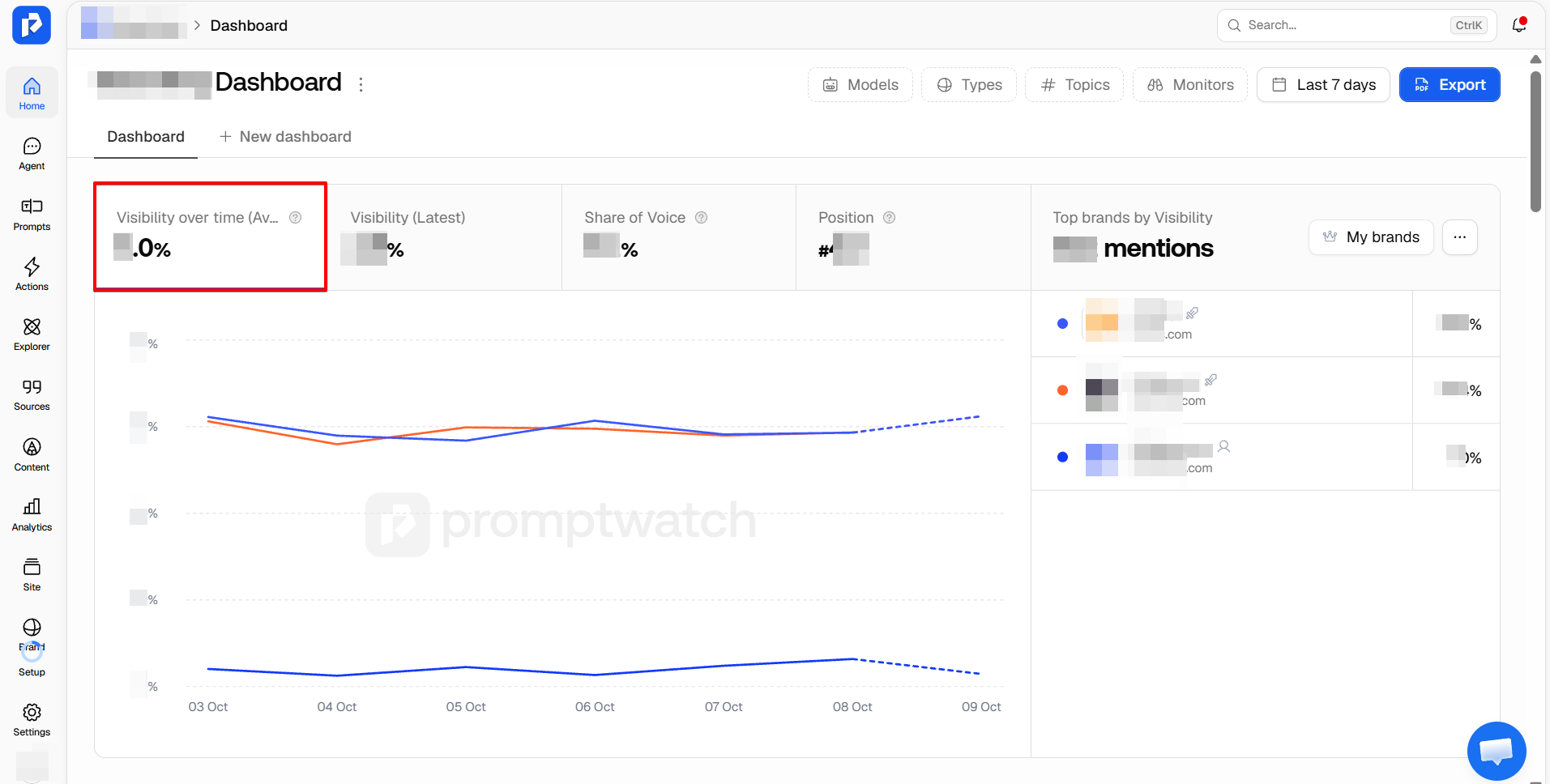
Promptwatch scores visibility instead of just counting mentions. Each AI response gets a score based on where the brand sits in the answer, how it’s talked about, and whether competitors dominate, and those scores are averaged into a single 0–100 number. Responses that don’t name the brand count as 0, and replies like “I’m not familiar with [brand]” score near zero, so a brand can appear in every answer and still score low. Prompts can also be tagged by type and intent, which splits share of voice by why someone is asking.
Promptwatch collects these answers from each engine’s user interface, not its API, so you see the same answer a user sees when they ask. Every tracked prompt runs on all the engines your plan covers at once, so a client’s visibility can be compared engine by engine.
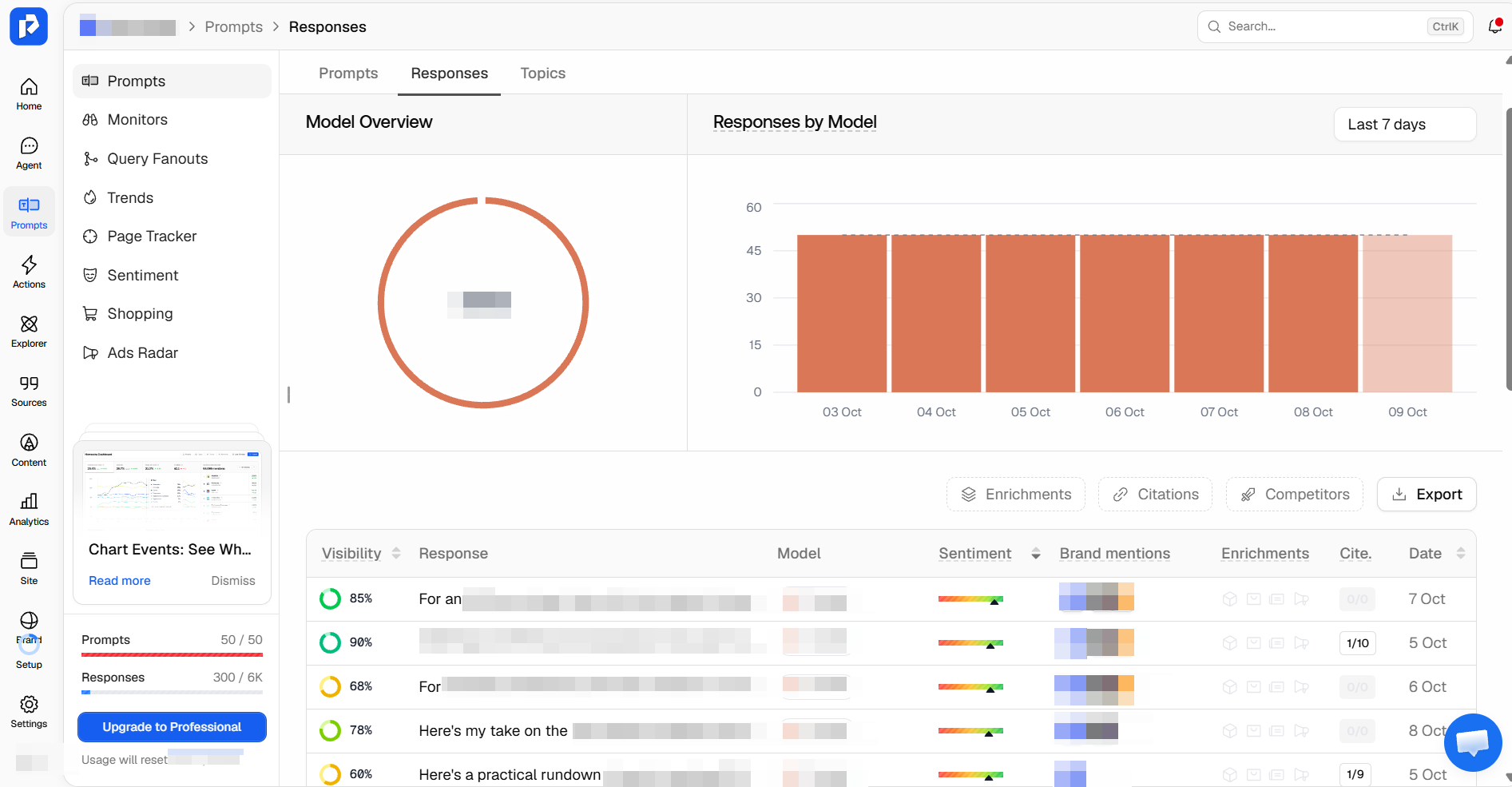
Here is the full engine list:
- ChatGPT (OpenAI)
- Perplexity
- Google AI Overviews
- Google AI Mode
- Claude (Anthropic)
- Gemini
- Meta Llama
- DeepSeek
- Grok
- Claude Code
- OpenCode
Agency plans track every model on that list. Brand plans track 4 (ChatGPT, Perplexity, Gemini and Claude), so on a brand plan, check that those 4 match the engines your clients ask about.
The 4-model limit matters most when your clients’ buyers research in Google. On a brand plan, Google AI Overviews and AI Mode fall outside the tracked set. SE Visible by SE Ranking tracks ChatGPT, Gemini, Google AI Mode, and AI Overviews on every plan, with no engine add-ons or model tiering. Promptwatch’s agency plans reach further into Claude, Grok and DeepSeek, so the right choice depends on which surfaces your clients’ buyers use.
Each tracked prompt also shows a visibility score for every competitor you add, measured on the same responses as your client’s. Each brand is scored on its own, and the competitor list decides which rivals you can see, so include every brand that regularly shows up in your client’s answers.
Verdict: a long engine list and a source split that points you at the right fix, provided the models your plan tracks are the ones your clients care about.
Does Promptwatch show which AI crawlers read your site?
Yes. Promptwatch’s Agent Analytics logs AI citation agents in real time as they visit your site and records which pages they fetch. It works through a CDN or log integration (Cloudflare, Vercel, Fastly, AWS CloudFront and others), so for client sites you’ll need access to their setup. If a page you want cited never shows a crawler visit, fix access before you rewrite a word of it: a blocking robots rule, a firewall returning errors, or a page with no internal links or sitemap entry will outlast any content change.
The logs cover agents from AI models, including:
- OpenAI
- Claude
- Perplexity
For engines that crawl with their own bots, a fetch usually comes before a citation, so crawler visits show up ahead of any movement in visibility. A new page with no crawler visits is likely not yet in contention for those engines, and a page that gets fetched regularly but never cited has a content, or authority problem you can now isolate, since Agent Analytics ties crawled pages to the citations they earn.
Verdict: a useful first diagnostic for any page that should be cited and is not.
Can Promptwatch’s agents produce usable AEO content?
The AEO agents draft articles grounded in your own documents. How publishable those drafts are depends on how well each client’s knowledge base is set up and how much editing your team is willing to do.
The decision rule is simple. Content generation earns its cost only if your team would publish from inside the platform, which connects to Webflow and Framer, with WordPress still listed as coming soon. If your writers draft in their own tools and publish through each client’s CMS, the article quota is capacity you fund and do not use. On Professional, that is 5 AEO articles and 5 content refreshes a month. On Business, it is 10 of each.
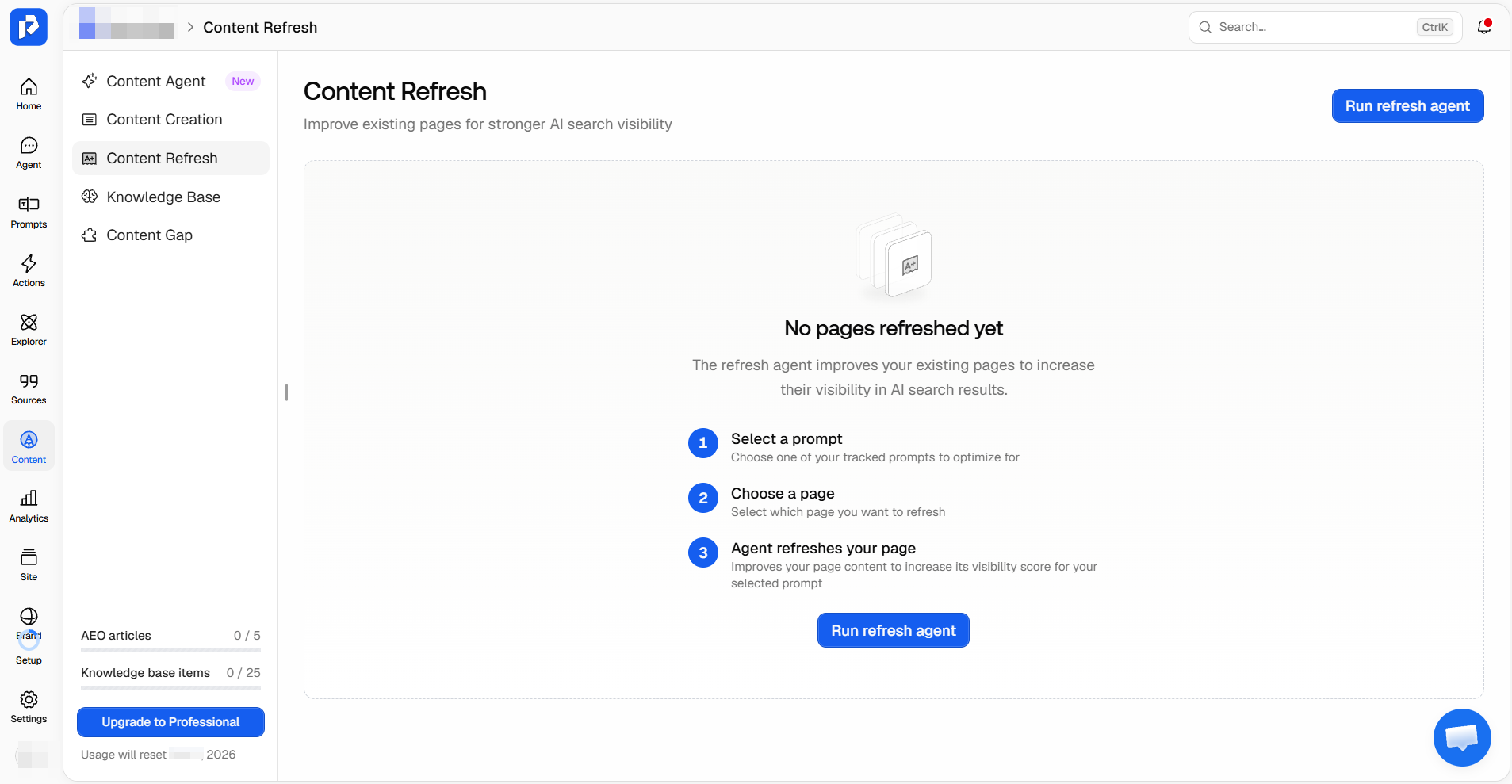
What the agents draw on is a branded knowledge base: you can ask Promptwatch anything and have it reference your docs inline while it drafts. Each client’s product docs and approved claims have to be loaded and kept current, and a draft grounded in last quarter’s docs will repeat last quarter’s claims with full confidence.
The entry brand plan, Essential, leaves this job out entirely: it is the only plan with no AEO articles, so content production starts at Professional.
If the content agents are part of why you’re considering Promptwatch, use a trial to test them on a client you know well. Draft one article and time how long it takes to edit it to the standard you would hold a new freelancer to.
The edit time tells you more about the quota’s value than any feature list, and it is the number you will need when the budget conversation comes round.
Verdict: drafts grounded in your own docs and citation data, available only on brand plans, so the price makes sense only for teams that ship drafts from Promptwatch itself.
Promptwatch pros and cons
Reviewers single out the interface and the MCP integration, and push back on how quickly agent credits run down.
What Promptwatch does well
- An MCP integration. Sam F., the VP of Marketing, wrote on G2: “The clean UI/UX, and MCP integration is a nice touch too – very forward-thinking and saves context-switching for anyone working across AI tooling.” MCP and API access come with every plan.
- Monitoring and content output in one subscription, on brand plans. From Professional up, the plan that tracks your prompts also carries a monthly AEO article allowance, so a team that would otherwise pay for a tracker and a separate writing tool can set one budget for both jobs.
Where Promptwatch falls short
- Credit consumption. Cherinda D., the online marketing manager, wrote on G2: “The tokens deplete quickly and the price is rather high“. Agent Credits start at 500 a month on the entry brand plan and 1,000 on the entry agency plan, and you can buy a larger monthly allowance on top of the plan price, so heavy agent use shows up as an extra line on the bill.
- A trade-off between model coverage and content tools. Brand plans track 4 models (ChatGPT, Perplexity, Gemini and Claude) but include AEO articles from Professional up. Agency plans track every model Promptwatch lists, but none of them includes AEO articles, the knowledge base or content refresh, so an agency still budgets for writing separately.
Verdict: the interface and MCP integration draw the praise, while the credit meter is the line item to model against your agent workload.
How much does Promptwatch cost per client?
Promptwatch’s default pricing view shows three brand plans, from $95 to $579 per month, billed monthly. For a multi-client agency the price per prompt barely moves between them while the price per project does, and 5 projects is the ceiling on this view. The pricing page also has a separate Agencies view, which removes that ceiling, and a Custom tier priced through sales.
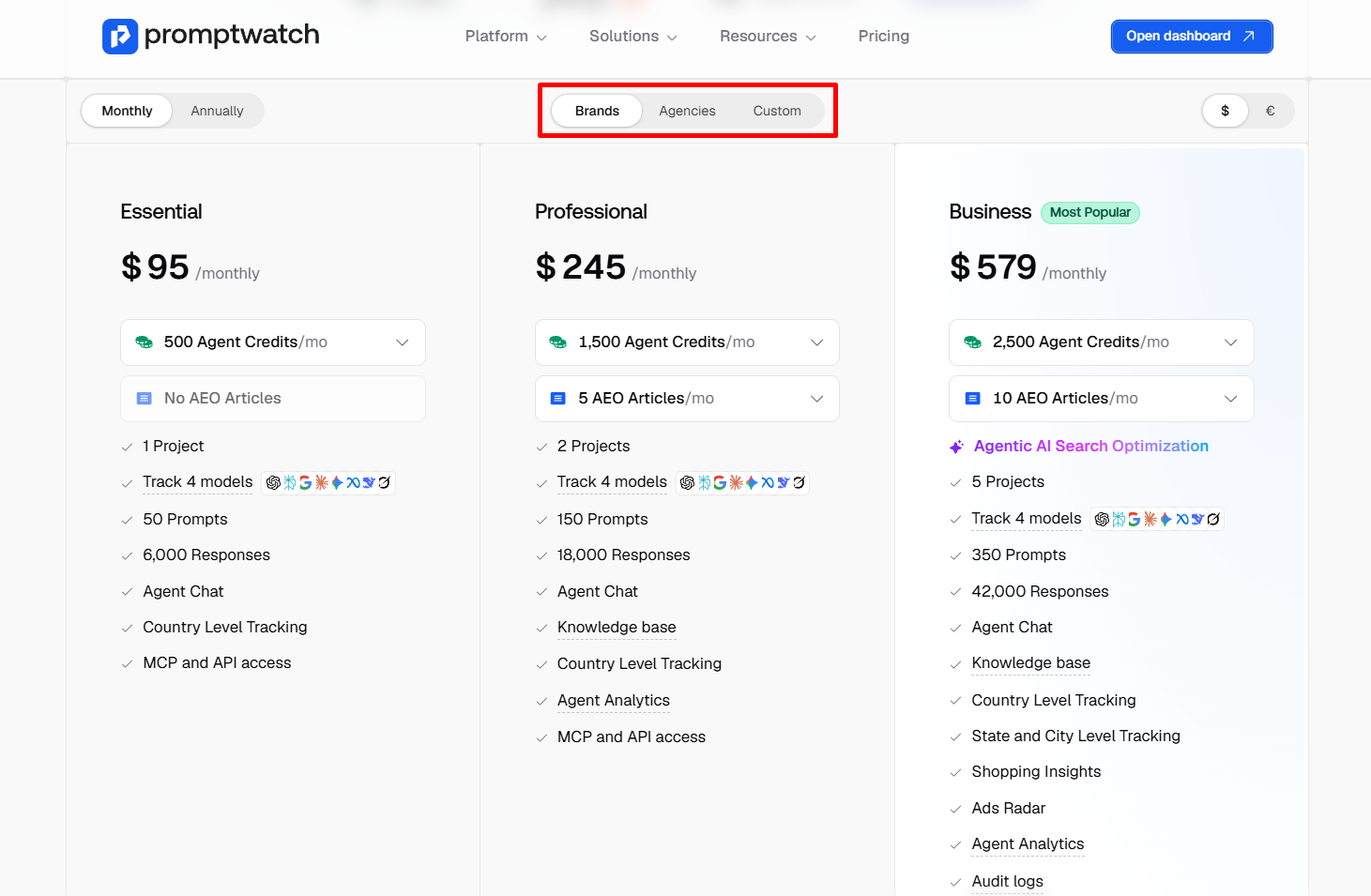
Divide each price by its prompt allowance and you get about $1.90 per prompt on the entry plan, $1.63 on Professional and $1.65 on Business. Divide by projects instead and the figures are $95, $122.50 and $115.80 per project per month.
| Plan | Price | Projects | Prompts | AEO articles |
|---|---|---|---|---|
| Essential | $95 per month, billed monthly | 1 | 50 | None |
| Professional | $245 per month, billed monthly | 2 | 150 | 5 per month |
| Business | $579 per month, billed monthly | 5 | 350 | 10 per month |
For comparison, SE Visible’s Basic plan covers 200 prompts across 3 projects, with all engines included, at $99 a month. On prompt and project count, that sits closer to Promptwatch’s Professional tier, without an AEO article quota. That’s the right trade if your writers already work outside the platform.
On the brand plans, the tier question for an agency is a client-count question. The Agencies view removes it: Kick-off ($199), Growth ($399) and Scale ($799 a month) all include unlimited projects and prompts, every model and 10 seats. What limits you there is the monthly response allowance (10,000, 25,000 and 65,000), and the trade-off is that no agency plan includes AEO articles or the knowledge base.
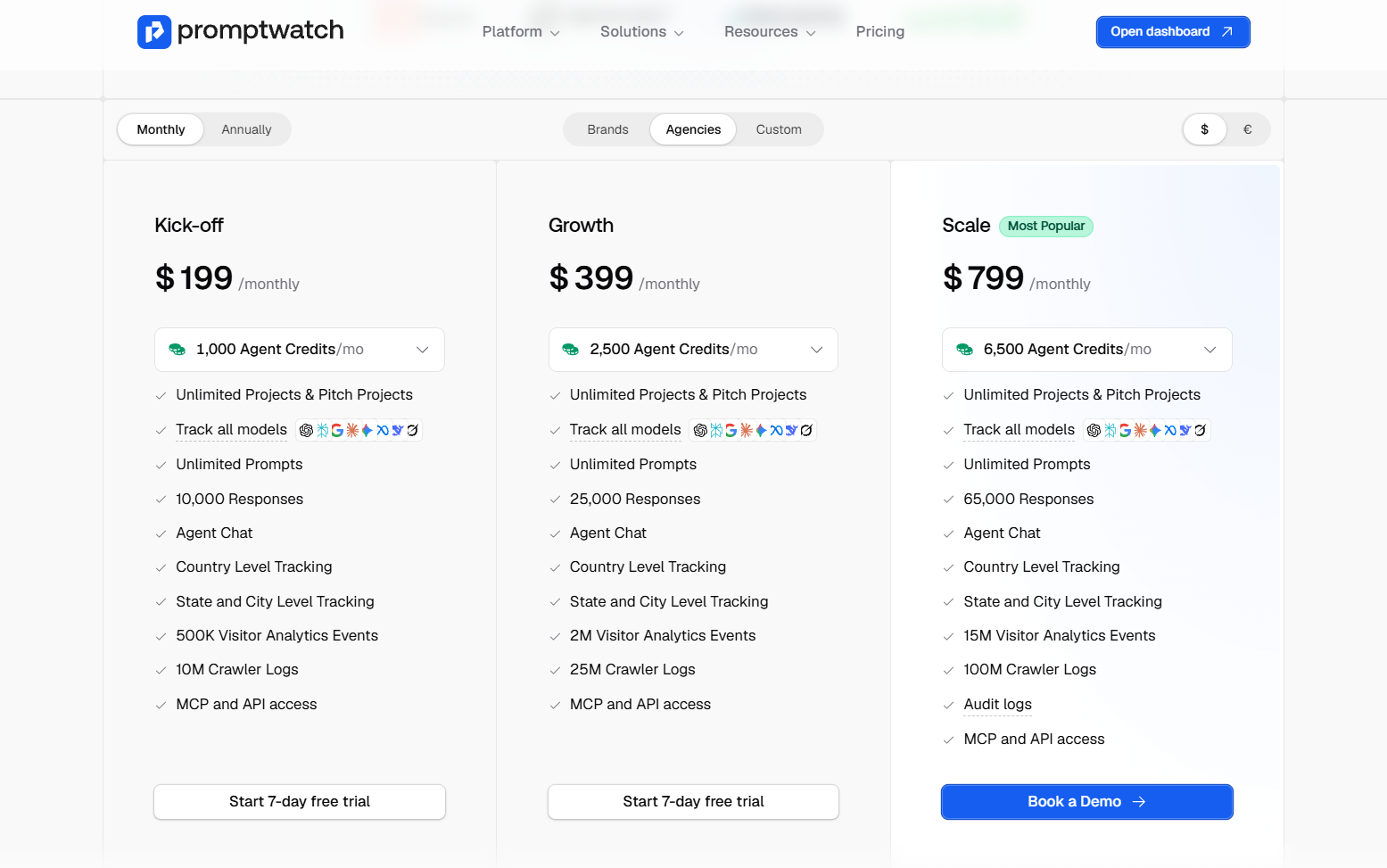
All three brand plans track 4 models, while agency plans include the whole list.
Promptwatch offers a 7-day free trial on every plan except Business and Scale, which start with a demo. Paying annually gets two months free.
Verdict: on the brand plans, fair per prompt with project count as the ceiling. On the agency plans, projects are unlimited, and the response allowance decides how many prompts each client gets.
Who should use Promptwatch, and who should look elsewhere?
Two questions settle it: how many clients you report on, and whether your writers will ship content from inside the platform.
- If you run one or two brands and want agent drafts ready to publish from the tool: choose Professional, the first tier that includes AEO articles alongside the monitoring. Publishing runs through Webflow and Framer, with WordPress listed as coming soon.
- If you report on three to five clients and want the content agents too: pick Business, and confirm its five-project cap still covers your book next year.
- If you report on six or more clients, or only need tracking: choose an Agency plan. All agency plans include unlimited projects, every model, and 10 seats, so you move up a tier for more monthly responses, not more clients.
- If your team reports on visibility and writes content elsewhere: the Agency plans are Promptwatch’s tracking-first option, with no article quota priced in. If you need AEO articles across six or more clients, that’s a Custom plan through sales.
- If you need tracking with Google’s AI surfaces and local markets covered at every tier: try SE Visible that include AI Overviews and AI Mode, on every plan, and lets you narrow tracking to a city or region in 42 countries. On Promptwatch, state and city tracking starts at Business.
If you want to see the wider field first, our roundup of AI visibility tools covers the category.
Is there a Promptwatch alternative for tracking-first teams?
If your team reports on AI visibility and writes content outside the platform, you’re paying for capabilities you won’t use on Promptwatch’s brand plans. On its agency plans, you’re splitting one response pool across clients instead.
Some othe alternatives, are built for that tracking-first workflow. For example, SE Visible that we mentioned above has ChatGPT, Gemini, Google AI Mode, AI Overviews visibility tracking included with, prompts, sources, sentiment, and unedited answers behind it, which matters when a client asks why a number moved. The Basic plan starts at $99 a month for 200 prompts across 3 projects, with a 10-day free trial.
The trade-off is that SE Visible doesn’t draft content. Content production lives in SE Ranking, SE Visible’s sister platform for SEO. Pairing the two covers both places your clients’ buyers search. SE Visible shows which prompts and topics leave a brand out of AI answers and which sources those answers rely on. SE Ranking turns those findings into briefs and tracks how the resulting pages perform in Google results. So, you get one vendor and a shared data foundation behind both your Google and AI visibility reporting.
For more platforms worth considering, check out our Promptwatch alternatives guide.
FAQ
Promptwatch connects with Webflow, Framer, Google Search Console, Slack and Data Studio, and every plan includes MCP and API access for pulling its data into your own reporting. For agent traffic, Promptwatch reads crawler logs from Cloudflare, Fastly, Vercel, Akamai, AWS CloudFront, Google Cloud CDN and Netlify, and any other server or CDN can be connected through manual setup.
Promptwatch scores every AI answer on where the brand appears, how it’s described and whether competitors dominate, then averages those scores into a single 0–100 visibility score. Answers that don’t name the brand count as zero, so the score reflects how often a brand shows up as well as how well. Prompts are tracked daily, and you can compare the score engine by engine.
Yes. Promptwatch comes with a 7-day free trial, while the Business plan for brands and the Scale plan for agencies start with a demo. Paying annually costs ten times the monthly price, so you get two months free.
Promptwatch review: final verdict
Use the 7-day trial on Professional, the cheapest plan with the content agents, to answer the two questions that decide this review. Take one client you know well, have the agents draft one article, and time the edit. Then price Business, $579 across five projects, against your client count. If the edit is short and the per-project math holds, Promptwatch earns your choice.
If your writers work elsewhere and your reports lead with perception and cited sources, look at a tracking-first setup instead. SE Visible is one such option. Start a free for 10 days and see how your clients show up across AI engines, from ChatGPT to AI Overviews, with net sentiment and cited sources list.