AI Overviews Appear on 82.5% of US Brand Searches. Here Are the Brand Pages They Cite the Most

Chris Long recently ran a simple test. He searched for 100 enterprise brands and found an AI Overview for 93 of them.
That got people talking about how branded search is changing. And for good reason: even when someone searches specifically for your company, your website may no longer be where they first learn about it. An AI Overview can describe your business before they click through.
This made us curious enough to dig into the data ourselves.
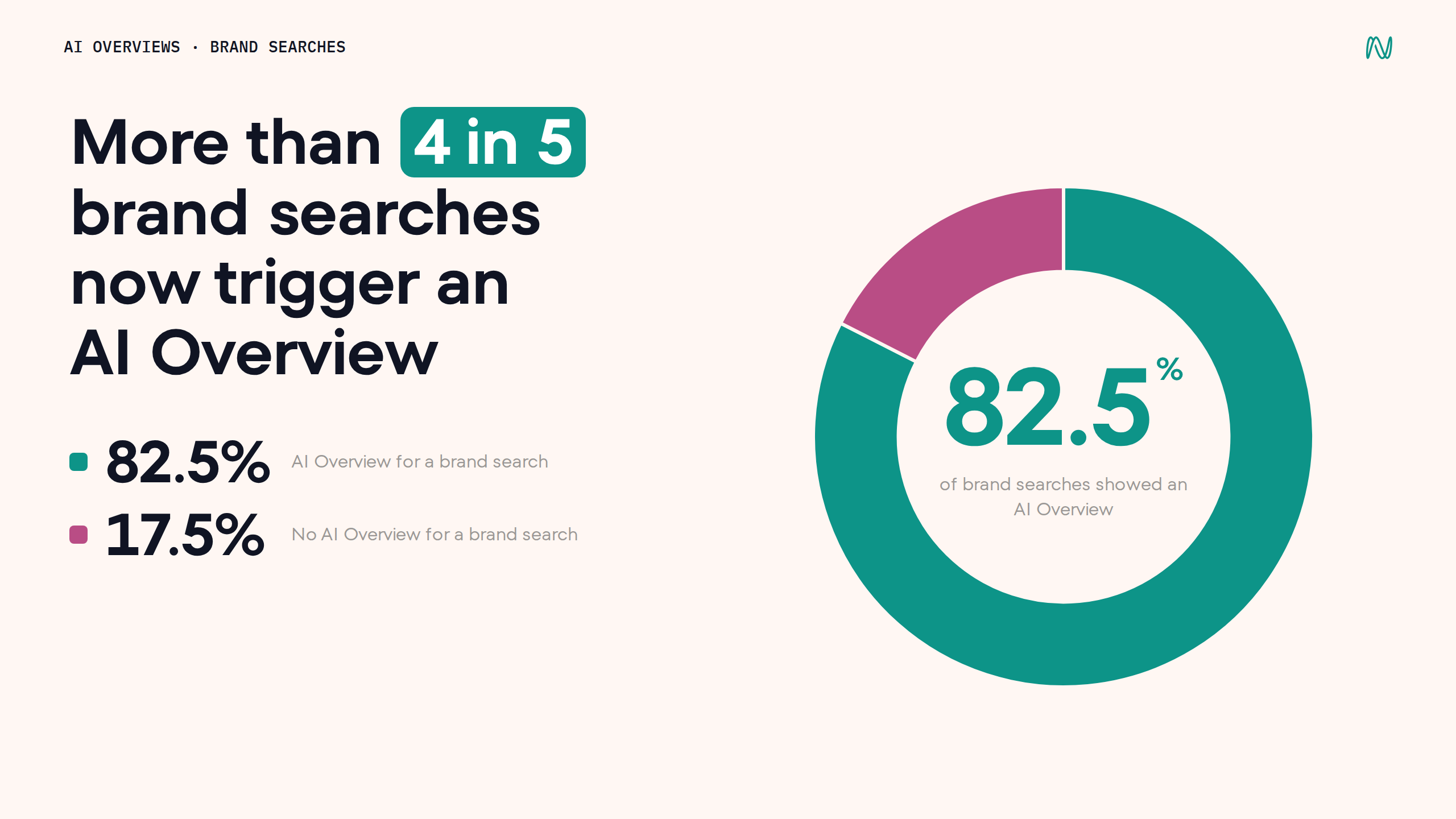
And we found a similar pattern: AI Overviews appeared on 82.5% of US brand searches in our sample. But we also wanted to know where those answers got their information.
That’s where things got interesting. What we found is that Google often cited pages beyond the homepage, including pages that weren’t in the organic top 10 for the same brand search.
Let’s take a closer look.

Germany shows a different picture, with AIOs appearing on just 40.4% of brand-name searches.
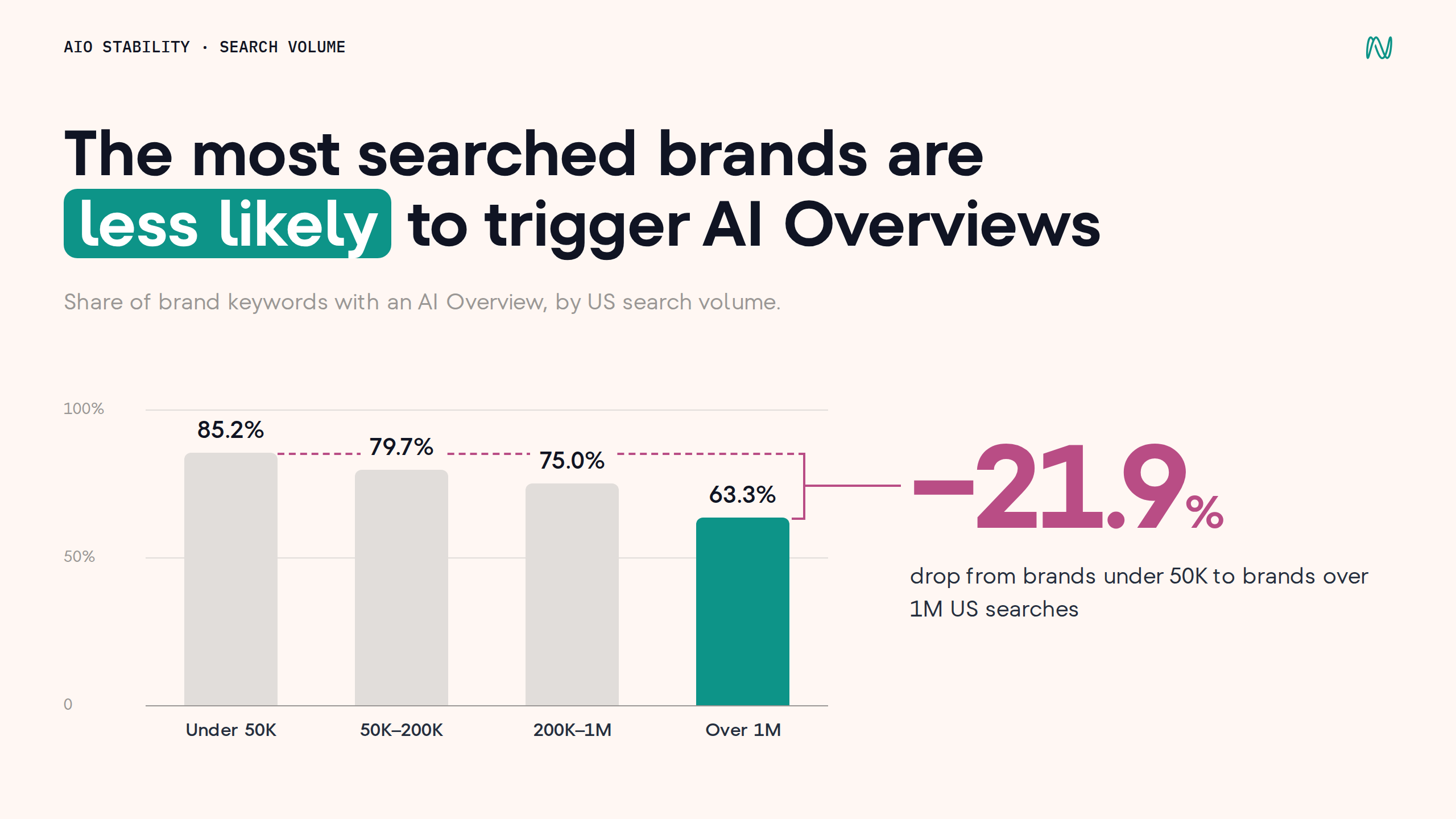
AI Overviews appeared for 85.2% of brand keywords with fewer than 50,000 US searches, versus 63.3% for those with over 1 million.
Homepages make up 71.1% of the brand-site URLs in the organic top 10, but only 36.8% of brand-site citations in AIOs.
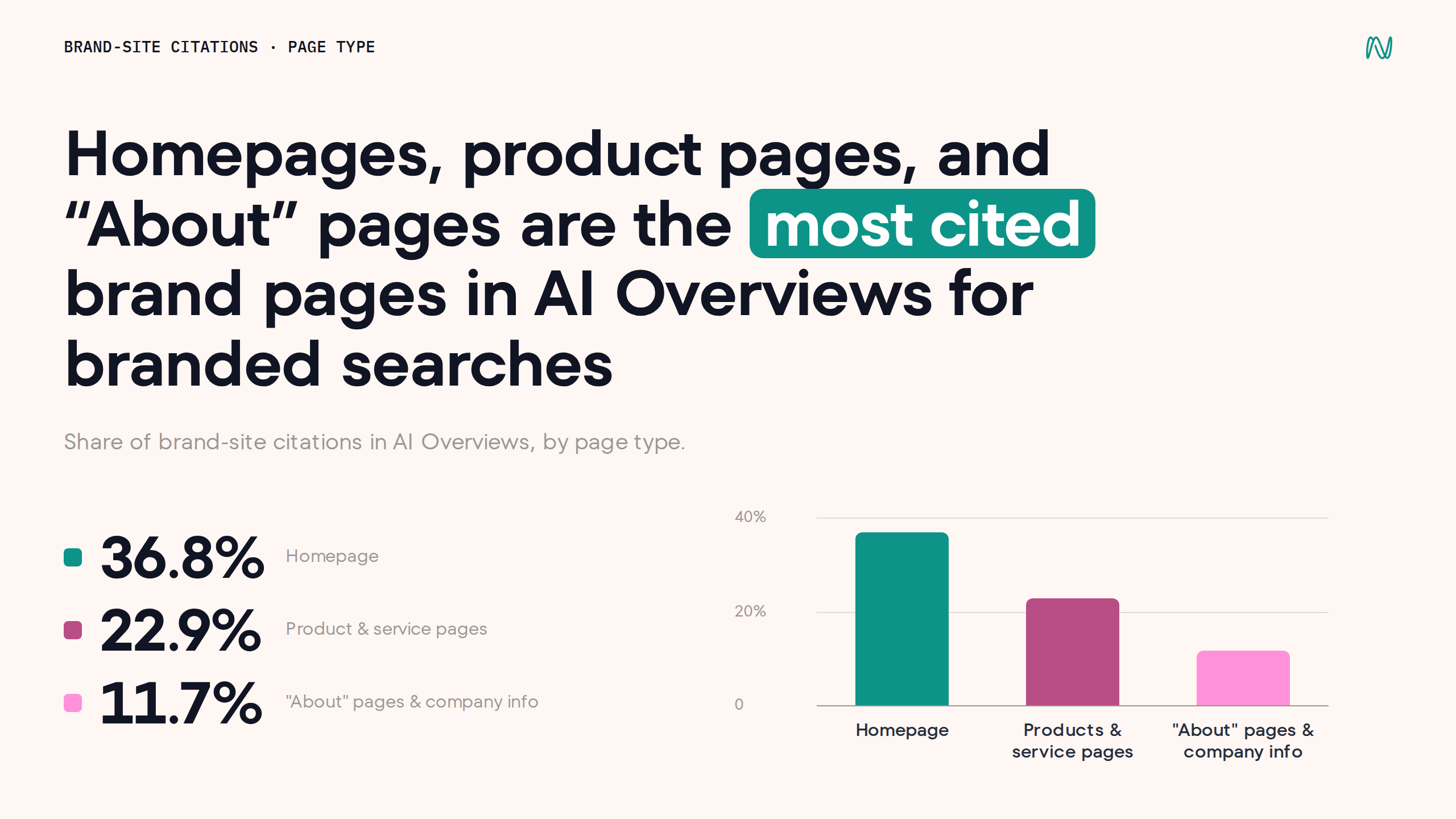
Product, service, and category pages account for 22.9% of brand-site citations, followed by “About” and company information pages at 11.7%.
That’s 62.2% overall, rising to 92.6% for product pages and 84.6% for “About” pages.
40.5% are brand-managed: the website (33.8%), app store listings (4%), and Google Business Profile (2.7%). Another 20.8% come from places where brands can publish or respond: social and video platforms (18.1%, mostly YouTube) and review sites (2.7%).
AI Overviews appear on 82.5% of US brand searches
So, let’s start with how often AI Overviews appear when someone searches for a brand.
We checked each of our 1,000 US brand keywords three times. The runs returned an AI Overview for 827, 827, and 820 keywords, an average of 82.5%. That means more than 4 in 5 checks in our US sample returned an AIO.
For Chris Long, Co-founder at Nectiv, this prevalence challenges the idea that branded search is safe ground for marketers:
“The biggest implication is that Google’s AI can now position your brand before a user ever clicks on your site. The SERP provides a perspective about your brand that’s aggregated from across the web. Negative reviews can surface. Competitors can influence what AI says about your company. So while we thought branded search was fully safe ground, now SEOs and marketers need to look at it much more closely.”
Chris Long, Co-founder at Nectiv
But does an AIO appear every time, or only occasionally?
For 756 of the 1,000 keywords (75.6%), it appeared in all three runs. That’s roughly 3 in 4. In total, 870 keywords (87%) showed one at least once, while 114 (11.4%) switched between showing an AIO and not showing one.
So, for most keywords in our US sample, then, AIO presence was consistent across the three checks.
Gus Pelogia, SEO & Product at Indeed, sees these findings as part of a broader shift in Google’s search experience (and in where it gets information about brands):
“Google is making another step into moving a regular SERP into an AI one. There’s a branded link inside the AIO, so you can argue users are still finding the pages they meant to. As more elements become AI-based, AI Mode might feel commonplace making it an easy change in the future. The second point is that Google keeps decreasing their dependency on Wikipedia. Remember how Knowledge Panels were largely fed by Wikipedia? This has been happening for years since AIOs were introduced; this is just another step to decrease external dependency.”
Gus Pelogia, SEO & Product at Indeed
We also looked at differences by industry. 92% of electronics and consumer tech brand keywords showed an AIO in all three checks, compared with 58.3% for food and beverages.
Still, even in the industry with the lowest rate, more than half of brand keywords triggered an AIO every time we checked.
| Industry | AIO share |
|---|---|
| Electronics & consumer tech | 92% |
| Telecom, internet & hosting | 88.7% |
| Industrial & B2B | 84.7% |
| E-commerce & marketplaces | 84.4% |
| Health, pharma & medtech | 84.3% |
| Energy & utilities | 83.7% |
| B2B SaaS & software | 78% |
| Fashion, beauty & D2C | 77.6% |
| Banking, fintech & payments | 76.7% |
| Consumer apps, media & entertainment | 73.9% |
| Education & training | 68.8% |
| Travel & transport | 68.1% |
| Grocery & retail | 67.2% |
| Insurance | 66.7% |
| Real estate, home & services | 66.7% |
| Automotive & mobility | 64.6% |
| Food & beverages | 58.3% |
AI Overviews were common across all industries in our sample. But grouping brands by size and search demand revealed a less expected pattern.
The most searched brands are less likely to trigger AI Overviews
You might expect the most searched brand names to trigger AI Overviews most consistently. Our data showed the opposite.
For brand keywords with fewer than 50,000 US searches, 85.2% showed an AIO in all three checks. For those with more than 1 million searches, that fell to 63.3% (a gap of 21.9 percentage points).
The company-size comparison showed a similar pattern. Enterprise brand searches were the least likely to return an AIO consistently:
- Mid-market: 78.7% — this group includes brands such as ElevenLabs and Taxfix.
- SMB: 77.5% — this group includes brands such as Basecamp and Metabase.
- Enterprise: 70.7% — this group includes brands such as BMW and Adobe.
Why might that be? Searches for well-known brands may already return plenty of information through knowledge panels, sitelinks, and top stories. That could help explain the lower AIO consistency, but we’d need further research to know.
What we can look at is what happens when an AIO does appear: which pages does Google use to describe the brand?
AI Overviews cite a wider range of brand pages than the organic top 10
An average AIO cites 2.57 pages from the brand’s website, compared with 1.72 brand pages in the organic top 10 (about 50% more).
| Search result type | Average number of pages from the brand’s website |
|---|---|
| Organic top 10 | 1.72 |
| AI Overview | 2.57 |
Note: Throughout this study, “organic top 10” refers to the ten standard organic results (“blue links”). We excluded sitelinks (the additional links displayed beneath a main result).
But which pages does Google choose?
In the organic top 10, homepages account for 71.1% of brand-site URLs. In AIOs, that share drops to 36.8%. The homepage is still the most cited page type, but Google looks beyond it much more often.
So, which other pages actually get cited? Product, service, and category pages make up 22.9% of brand-site citations in AIOs, compared with just 6.1% of brand-site URLs in the organic top 10. “About” & company info pages also have a bigger share: 11.7% in AIOs versus 3.8% in organic results.
Here’s the full comparison with Google’s organic top 10:
| Brand-site page type | Share of brand-site URLs in organic top 10 | Share of brand-site citations in AIOs |
|---|---|---|
| Homepage | 71.1% | 36.8% |
| Product, service, & category pages | 6.1% | 22.9% |
| “About” & company info pages | 3.8% | 11.7% |
| Locations, stores, and local pages | 1.8% | 4.9% |
| Support, help, and docs | 2.9% | 4.3% |
| Blog, news, and resources | 1.4% | 4.2% |
| Login, account, and app pages | 3.5% | 3.8% |
| Pricing and plans | 0.2% | 1.8% |
| Careers | 0.9% | 1.2% |
| Legal | 0.5% | 0.4% |
| Other pages | 7.6% | 8.1% |
These shares are calculated within brand websites. They describe the distribution of brand-site URLs and citations, not the percentage of AIOs containing each page type.
For SEO teams, this broadens the range of pages worth reviewing for branded search. It’s worth looking beyond the homepage and asking how well the rest of your site explains your business. Your product and About pages give you room to provide details that the homepage may only briefly cover.
Mordy Oberstein, Head of Brand at SE Ranking, SE Visible & Planable, sees this as a reminder to give these often-overlooked pages more attention:
“Seeing that AIOs cite what I call “contextualizing” pages is not a surprise. Digital marketers of all kinds have historically undervalued pages like an “About” page where you can explicitly speak directly to users and bots about who you are and what you do, unlike any other page on the site (beyond the homepage, perhaps). This data clearly points to the value in thinking more broadly about the context your website offers to LLMs.”
Mordy Oberstein, Head of Brand at SE Ranking, SE Visible & Planable
These are pages where you can explain your business in detail: what you offer, who it is for, and what someone should know about the company.
62% of the brand pages AI Overviews cite do not rank in the top 10
So, we know which types of pages AIOs cite. But do those same pages also appear in the organic results for the brand search?
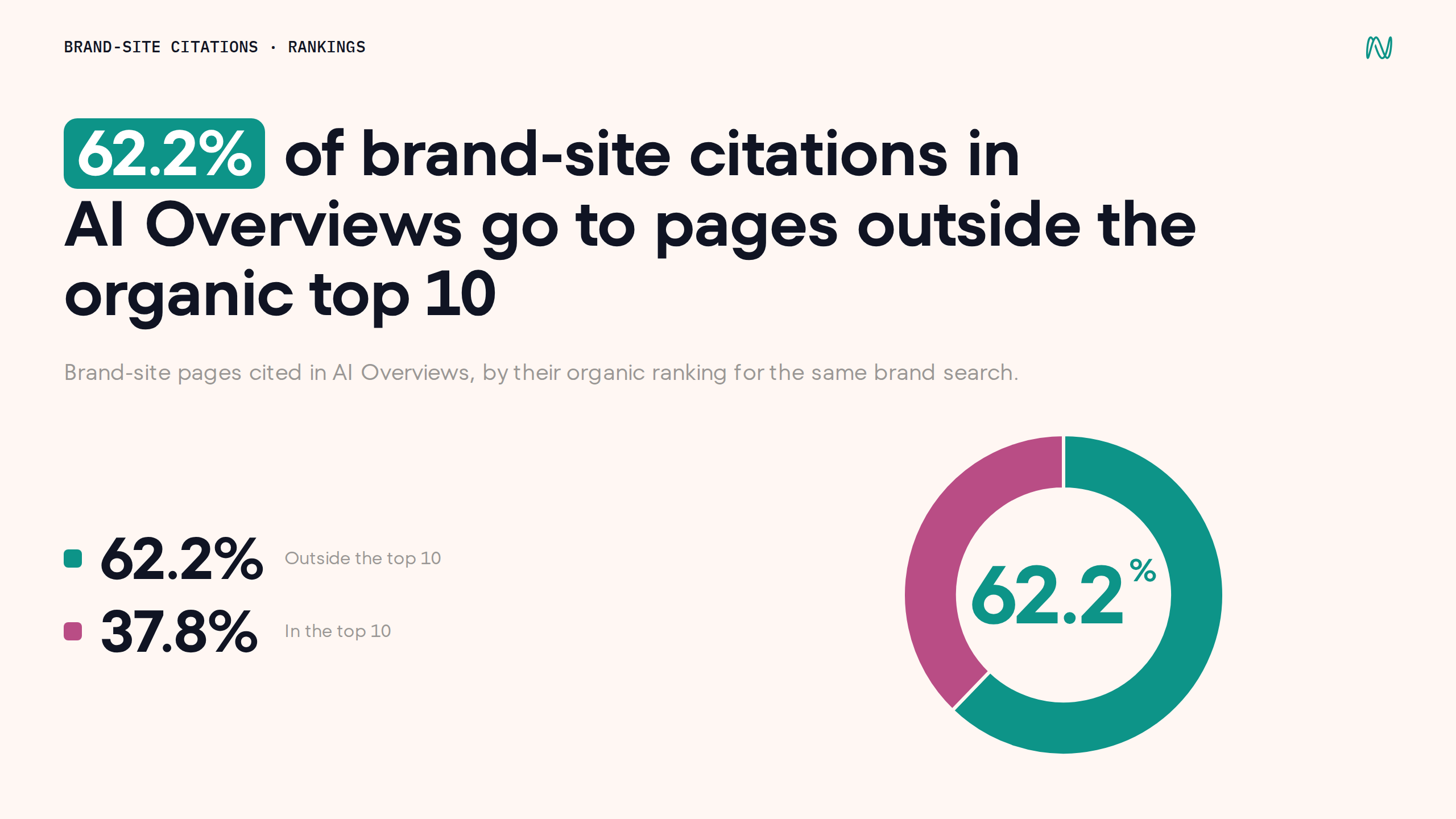
We matched every cited URL against the organic top 10 for the same search. Of 1,995 brand-website citations in US AIOs, only 37.8% pointed to a page that was also in the top 10. The other 62.2% came from pages that did not rank there for that search.
For example, a company’s homepage might rank for its brand name, while the AIO cites its product or “About” page. The website appears in both places, but the links lead to different pages.
But at the domain level, the overlap was 98.3%. In other words, Google was usually citing a website already represented in the top 10, while choosing a different page from that site.
Parth Suba, Human-led AI Search & SEO Systems Architect, sees this gap between domain and URL overlap as a reason to revisit overlooked pages:
“The stat that matters most is that 98% of cited brand pages come from a domain already in the top 10, but 62% of the exact URLs aren’t. Google decides to trust the brand first, then picks whichever page answers the question best. So your about, careers, returns and support pages are now part of your brand SERP. Most brands have not touched those pages in years, and that’s the real gap.”
Parth Suba, Human-led AI Search & SEO Systems Architect
To see which pages fit this pattern most often, we broke down the brand-site citations by page type.
| Page type cited in the AIO | Share of cited URLs outside the organic top 10 for the same search |
|---|---|
| Homepage | 16.5% |
| Product, service, and category pages | 92.6% |
| About and company pages | 84.6% |
| Locations, stores, and local pages | 87.6% |
| Support, help, and docs | 87.2% |
| Blog, news, and resources | 92.9% |
| Login, account, and app pages | 84.2% |
| Pricing and plans | 94.3% |
| Careers | 95.7% |
| Legal | 71.4% |
| Other pages | 84.5% |
The homepage is the exception: when an AIO cites it, it usually also ranks in the top 10.
For product and “About” pages, it’s the other way around. Roughly 9 in 10 cited product, service, and category URLs (and more than 8 in 10 cited “About” and company URLs) weren’t in the top 10 for that brand search.
These pages can contribute to AI Overviews for your brand even when they don’t rank in the organic top 10 for the same search.
One important note: we only examined the organic top 10. These pages might still rank further down for the same query. “Not in the top 10” does not mean “not ranking at all.”
For your own reporting, check which pages the AIO cites alongside your organic rankings. A top-10 ranking report alone won’t show you all the pages involved.
61% of AI Overview citations come from platforms brands can manage or participate in
Next, we grouped every citation in US AIOs by source type.
61% came from platforms the brand either manages directly or can publish on. Put simply, about 3 in 5 citations come from places where the brand can put its own content.
The split matters, so we keep the two groups separate.
Sources directly managed by brands account for 40.5% of citations:
- Brand website: 33.8%
- App store listings: 4.0%
- Google Business Profile: 2.7%
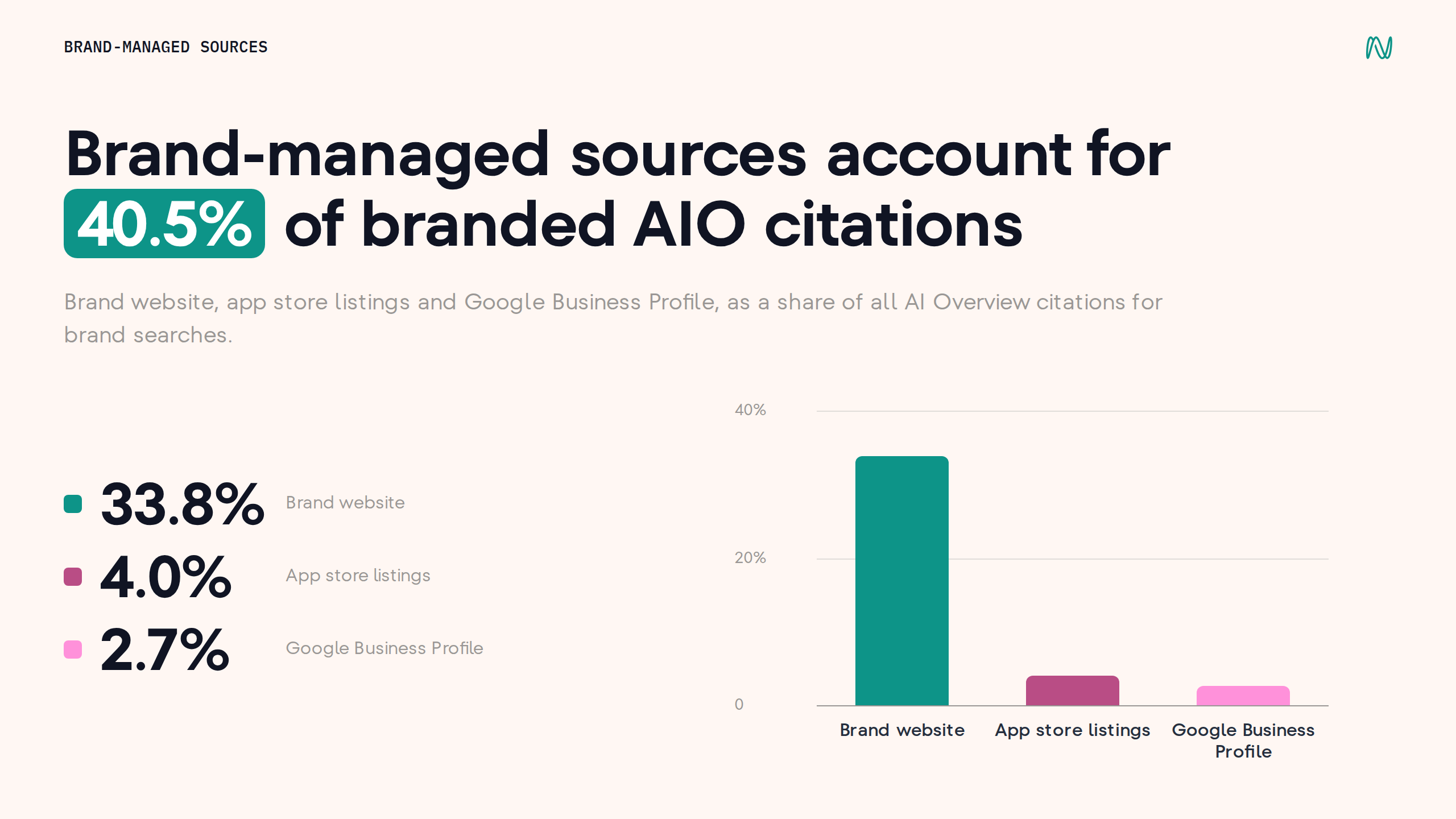
That gives brands a strong presence among the cited sources, but it doesn’t mean they control the answer. Your website can supply the information while Google determines how your business is described.
Platforms where brands can publish or engage, in turn, account for 20.8% of citations:
- Social and video: 18.1% (mostly YouTube)
- Review platforms: 2.7%
For Aleyda Solis, SEO & AI Search Consultant and Founder of Orainti, this also changes how brands should think about search performance:
“This is yet another proof that with AI, search is no longer a performance only channel, but a mix of performance and branding, and we should shift the way we measure it accordingly. This is also another reason to optimize for branded searches, beyond just a well optimized “About us” page and the relevant on-page actions, but through well aligned, up-to-date, third party presence in social channels, relevant reference, review sites, etc.”
Aleyda Solis, SEO & AI Search Consultant and Founder of Orainti
Brand-controlled sources reach almost every answer. 703 of 827 US AIOs (85%) included at least one citation from the brand’s website, app store listings, or Google Business Profile.
There’s one thing to keep in mind about the second group.
Brands can run a YouTube channel or reply to reviews, but they do not control what other people post on those platforms. So treat the 40.5% as control and the 20.8% as influence. For how review sites perform in AIOs outside brand searches, see our study of review platforms in AI Overviews.
The remaining 39% comes from sources outside the brand’s reach.
What to do with this: Keep your app store listings, Google Business Profile, YouTube channel, and review profiles accurate and up to date. AI Overviews may use these sources to describe your business.
All of this describes the US. On the surface, Germany looks quite different.
Germany has fewer branded AI Overviews, but brand websites take a larger share of citations
The US findings raised two questions for our German sample: are AI Overviews as common, and do they cite the same kinds of sources?
The first difference was how often AIOs appeared. Across three checks of 1,000 brand keywords in each country, the average was 40.4% in Germany, compared with 82.5% in the US. That’s roughly half the rate.
AIOs were also less consistent in Germany. To separate frequency from consistency, here’s how the two markets compare:
| AIO presence | US | Germany |
|---|---|---|
| Average across three checks | 82.5% | 40.4% |
| Appeared in all three checks | 75.6% | 29.6% |
| Appeared in some checks, but not all | 11.4% | 22.2% |
In the US, roughly three-quarters of brand keywords returned an AIO every time we checked. In Germany, fewer than a third did.
The gap is especially large in some industries
Some industries where branded AIOs appeared consistently in the US had much lower rates in Germany.
| Industry | US: AIO in all three checks | Germany: AIO in all three checks |
|---|---|---|
| Industrial and B2B | 84.7% | 10.2% |
| Health, pharma, and medtech | 84.3% | 15.7% |
| Energy and utilities | 83.7% | 9.3% |
| Fashion, beauty, and D2C | 77.6% | 10.4% |
For example, more than 8 in 10 industrial and B2B brand keywords showed an AIO in every US check. In Germany, that was about 1 in 10.
These figures describe our samples, and the smaller industry groups should be read as directional findings. Still, they show why a brand shouldn’t assume its US search results reflect what people see in Germany.
Where AIOs appear, the source pattern is similar
The difference in AIO presence doesn’t carry over to how much Google cites the brand’s website. In both markets, brand websites account for roughly twice the share of AIO citations that they hold in the organic top 10.
| Share held by the brand’s website | US | Germany |
|---|---|---|
| Share of organic top-10 results | 17% | 20.6% |
| Share of AIO citations | 33.8% | 41.2% |
Brand websites have a larger organic share in Germany to begin with. Their AIO citation share is also higher: 41.2%, compared with 33.8% in the US.
So while German AIOs appear less often, the answers that do appear devote a larger share of their citations to the brand’s own content.
The overlap with organic rankings follows a similar pattern too. In the US, 62.2% of cited brand-site URLs were outside the top 10 for the same search. In Germany, that figure rose to 68.5%.
In other words, in both markets, most cited brand pages weren’t among the ten organic results for that query. Checking only those rankings would miss much of the brand content cited in AIOs.
Brand-managed listings also have a larger share in Germany
The difference extends beyond the website. Brand websites, app store listings, and Google Business Profiles together account for 50.9% of German AIO citations, compared with 40.5% in the US.
Google Business Profiles stand out: they contribute 6.4% of citations in Germany versus 2.7% in the US, more than twice the share. That makes business-profile information particularly worth reviewing alongside website content in the German market.
The overall takeaway is similar for both countries: review the information AIOs cite across your website and managed profiles. What changes is how often those answers appear and how consistently you’ll encounter them, which is why each market needs its own tracking.
What this means for brand and SEO teams
Check what AI Overviews say about your brand
Being cited in an AI Overview doesn’t guarantee your business is described accurately. Look for outdated product names, incorrect company details, and descriptions that leave out important context.
Alli Berry, Founder of Alli Berry Consulting, LLC, recommends auditing both the information Google presents and the sources behind it, in collaboration with communications, brand, and PR teams:
“Brands need to audit what Google is actually saying about them, not just whether they’re appearing. As AI Overviews become more prevalent for branded queries, brands should understand which sources Google uses to describe their products, services, and business. Are those sources accurate? Current? Are they communicating the information the brand wants prospective customers to see? This introduces a different kind of visibility audit: not simply do we appear and what is our share of voice? But what information is Google surfacing about us, and where is it getting that information? Is it positive or negative? And what a good project to collaborate with your internal communications/brand/PR team on since they should be focusing on aligning messaging around the organization too.”
Alli Berry, Founder of Alli Berry Consulting, LLC
In SE Visible’s Prompts view, filter to branded prompts and select Google AI Overviews. Open a prompt to read the collected answers and see their cited sources. If something is wrong, follow those sources to identify information your team can update or ask a publisher to correct.
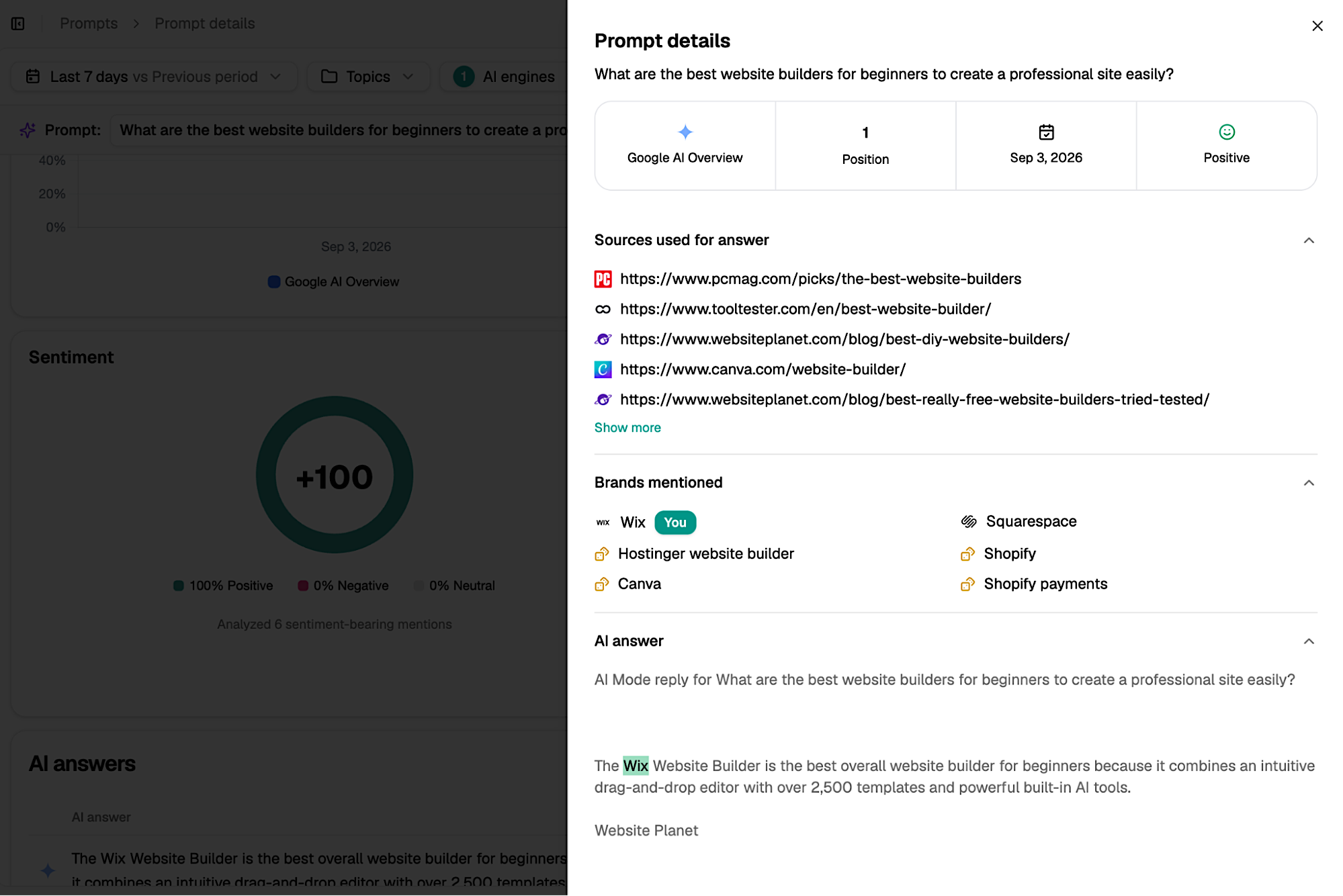
Saved answers let you compare the wording over time and check whether the issue persists.
Keep your homepage, product pages, and “About” pages clear and current
Start with your homepage, product and service pages, and “About” pages. Together, these account for 71.4% of brand-site citations in US AIOs: 36.8% go to homepages, 22.9% to product, service, and category pages, and 11.7% to “About” and company pages.
Make sure they clearly explain what you do, what you offer, and who you serve, with consistent names and details throughout.
Dana DiTomaso, Principal & Founder of Kick Point, highlights why this review should extend to pages that often get less attention:
“This should remind brands not to neglect the pages they often overlook, like the “About” page, careers and support docs, because Google will likely use them to describe you. If you don’t like what your branded AI Overview says, fix the pages it’s pulling from. Google can only work with what you tell it.”
Dana DiTomaso, Principal & Founder of Kick Point
To refine that list for your own brand, open SE Visible’s Sources view and look at the URLs from your website. Each row shows the page’s content type, its coverage (the share of analyzed answers citing it) and the prompts it appears for.
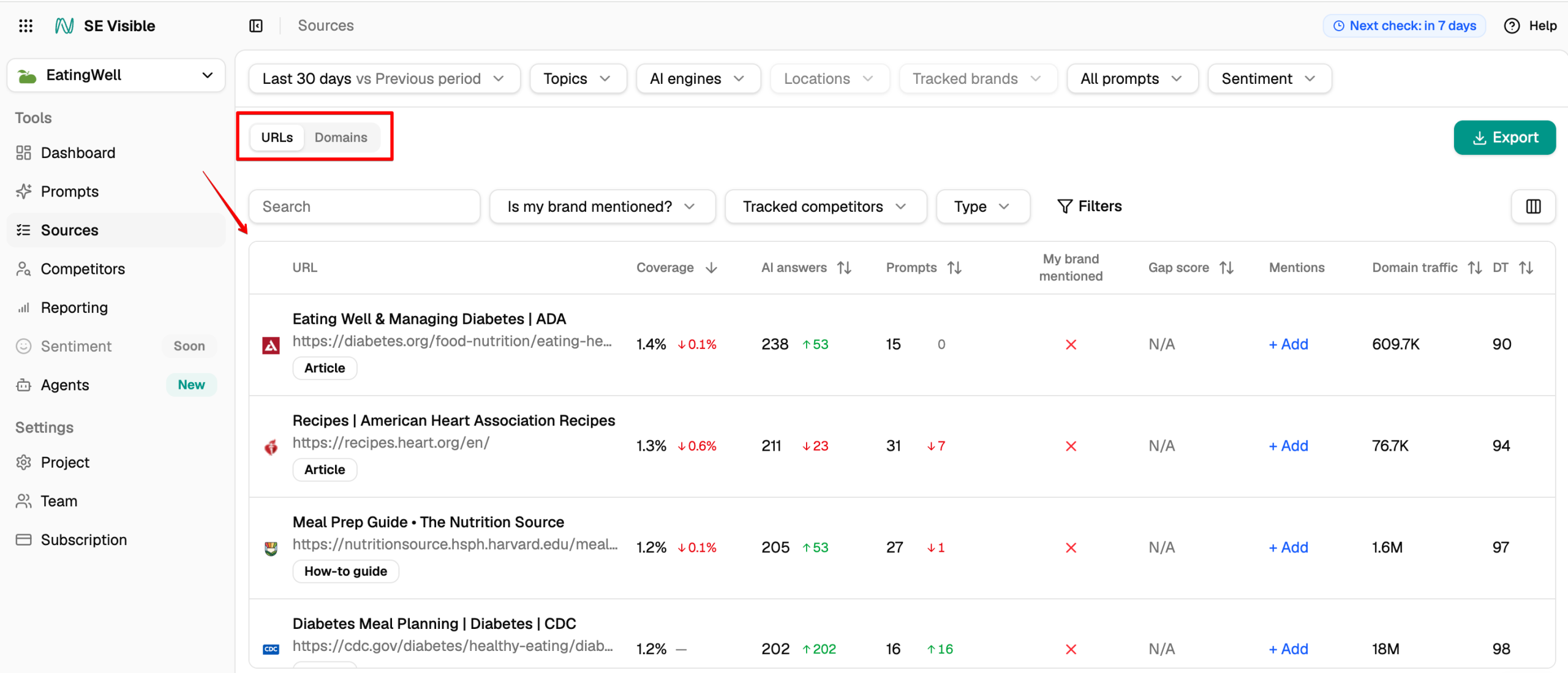
Use this information to prioritize frequently cited pages. Include support, location, or pricing pages when they appear regularly, and assign someone to keep each priority page current.
Include AIO citations in your branded-search reporting
In our US sample, 62.2% of cited brand-site URLs were outside the organic top 10 for the same search. Your reporting should therefore include both the pages that rank and the pages that get cited.
Jordan Koene, CEO and Founder at Previsible, explains why branded-search reporting needs to look beyond organic rankings:
“The number that jumps out to me is that 62% of the brand-site URLs cited weren’t in the organic top 10. That means pages we’ve historically treated as housekeeping, About, Support, or Careers can now help shape a consumer’s first impression. For SEOs, rankings alone don’t tell the whole story of discovery anymore.”
Jordan Koene, CEO and Founder at Previsible
SE Visible’s Dashboard includes an AIO organic overlap metric when Google AI Overviews is selected. It shows how many links from Google’s organic top 20 also appear in the AIO for the same query. Our study used the top 10, so the comparison covers a wider set of organic results.
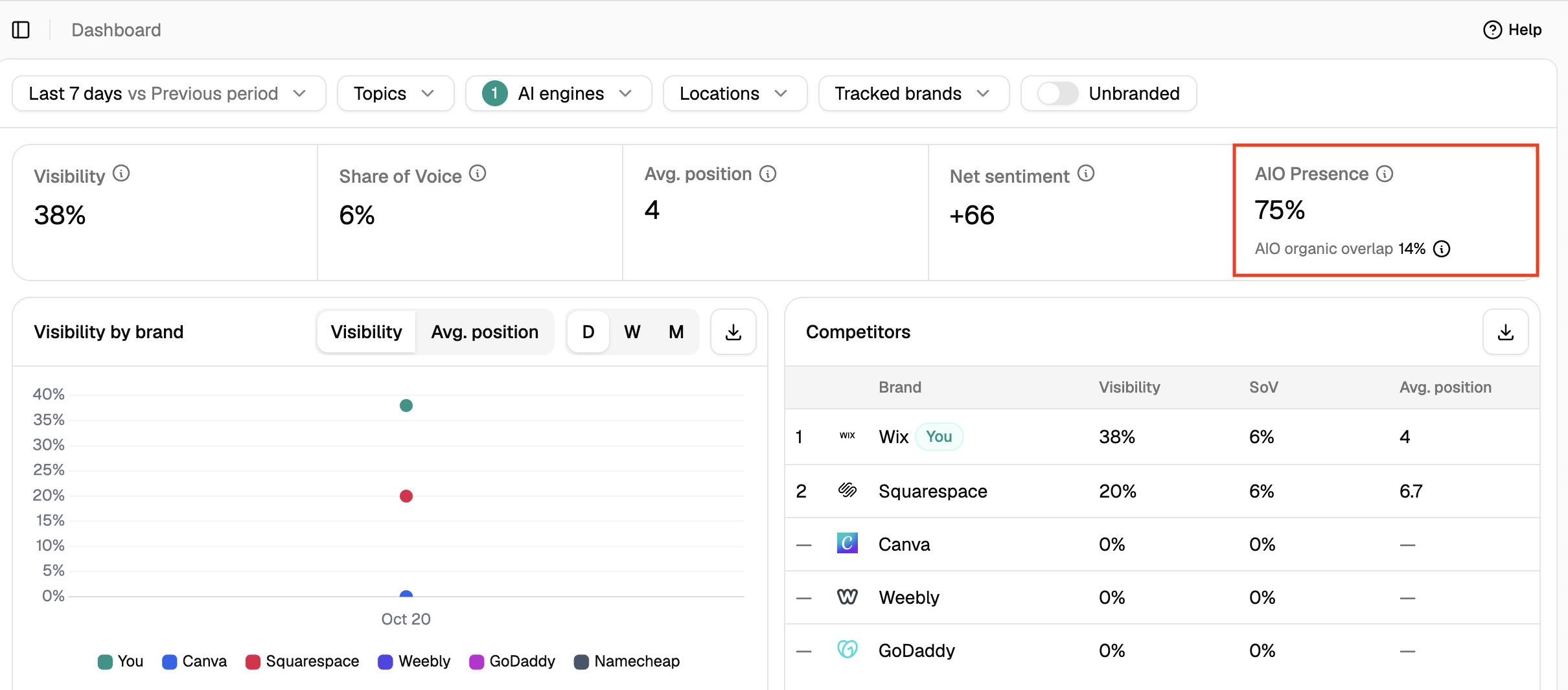
Use the Sources view to identify the individual cited URLs, then include them alongside your organic ranking data. This helps your team recognize pages that contribute to AI visibility even when they aren’t prominent in organic results.
Track each market separately and check regularly
AI Overviews appeared on 82.5% of US brand searches, compared with 40.4% in Germany. That’s roughly twice as often in the US (a difference you could miss by combining both markets in one report).
In SE Visible, create a separate project for each location. Filter the Dashboard to branded prompts and Google AI Overviews, then use AIO Presence to track how often those prompts trigger an AIO.
Compare periods of 14–30 days to see broader changes, then use Prompts and Sources to investigate what changed in the answers and citations. To assess traffic, review GA4 or Search Console alongside these findings; citations alone don’t tell you how many people visited your website.
Research methodology
We analyzed 1,000 brand keywords in the United States and 1,000 in Germany across 17 industries. Each keyword was checked three times on desktop in October 2026.
Each country’s sample included 333 SMB, 333 mid-market, and 334 enterprise brand keywords. We also grouped keywords by search volume: under 50K, 50K–200K, 200K–1M, and over 1M.
For each keyword, we recorded:
- whether an AI Overview appeared in each check;
- the URLs cited in the AIO and their order;
- source categories and brand-site page types;
- URLs and domains in the organic top 10.
The source analysis covered 827 US and 405 German AI Overviews. We compared their citations with the organic top 10 for the same query to identify overlapping URLs and domains.
For all organic comparisons, we counted only standard organic results (“blue links”), excluding sitelinks. A URL appearing only as a sitelink was therefore not counted as ranking in the organic top 10, even if it was visible on the results page.
Overall AIO presence was averaged across the three checks. Industry, company-size, and search-volume comparisons measured the share of keywords showing an AIO in all three checks.
Disclaimer: These findings describe a snapshot of desktop results in the two markets. AI Overviews and their citations can change. A page classified as “outside the top 10” may still rank further down for the same query. The study measures AIO presence and citation patterns, not answer accuracy, traffic, or conversions.
Conclusion
Ranking first for your brand name is only part of the picture. AI Overviews also shape what people learn about your business, using information from across your website and beyond.
Your own content gives you a place to start. Give the pages explaining your business the same attention as your homepage, and make checking what AIOs say about your brand part of your regular search reporting.