How to Build LLM Visibility for a New Brand: Lessons From Our Own Experiment

Most advice about LLM visibility assumes your brand already has something to work with. Years of content. Customer reviews. Media coverage. A name people recognize.
But a new product starts somewhere else. There may be little information for AI engines to find, and even fewer reasons for them to include it alongside established options. For teams launching a new product, it’s a difficult starting point.
We wanted to understand what could help at this stage. So, in February 2026, we created Civoryx.com, a completely new brand presenting a Global Fraud Index based on search interest in fraud-related keywords.
The brand started appearing in AI answers. But the results depended heavily on the question, the engine, and the sources it used.
Below, we’ll walk through what we’d prioritize based on the experiment, along with ways to use SE Visible to track your progress and decide what to work on next.
But first, a little context on how we set up the experiment.
How we set up the experiment
We published 93 content pages across Civoryx’s website and 11 external websites we owned. Throughout this article, “external articles” refers to content published on those 11 websites.
The content included:
- On civoryx.com: About Us, FAQs, How It Works, and a 5,000-word complete guide explaining the product.
- On external websites: reviews, comparison articles, “best” and “alternatives” listicles, how-to guides, and short 500–750-word articles focused on a single topic or question (for example, what a global fraud index measures or how fraud risk differs between countries).
We tracked the same 165 prompts daily across ChatGPT, Perplexity, Gemini, AI Overviews, and AI Mode:
- 75 branded prompts named Civoryx directly, such as “How accurate is the Civoryx index?”
- 90 non-branded prompts asked about the category, a problem, or alternatives without naming Civoryx, such as “What is the best global fraud index?” and “How do I track fraud keyword trends?”
For each answer, we recorded whether the engine mentioned Civoryx and which pages it cited as sources.
Publishing finished on March 31, 2026. We then left the articles unchanged and tracked the results through September 23 to see how visibility developed without further content updates.
1. Give AI engines a clear explanation of your product on your own website
Start by making your website useful to someone who has never heard of you. Explain what the product does, who it helps, how it works, and where its limits are.
For Civoryx, we created a homepage and four core pages on civoryx.com: About Us, FAQs, How It Works, and a 5,000-word complete guide. Together, they gave the engines information to use when answering questions about the brand.
Specifically, you need to cover the questions that would otherwise leave an engine guessing:
- What problem does the product solve, and for whom?
- What does using it actually involve?
- Where does its data or methodology come from?
- What makes it relevant to a particular use case?
- What can’t it do?
Civoryx was cited in 18.7% of AI answers to branded questions in mid-February, when only the brand website was live. By September, that share had reached 74.9%, even though we had stopped publishing at the end of March.
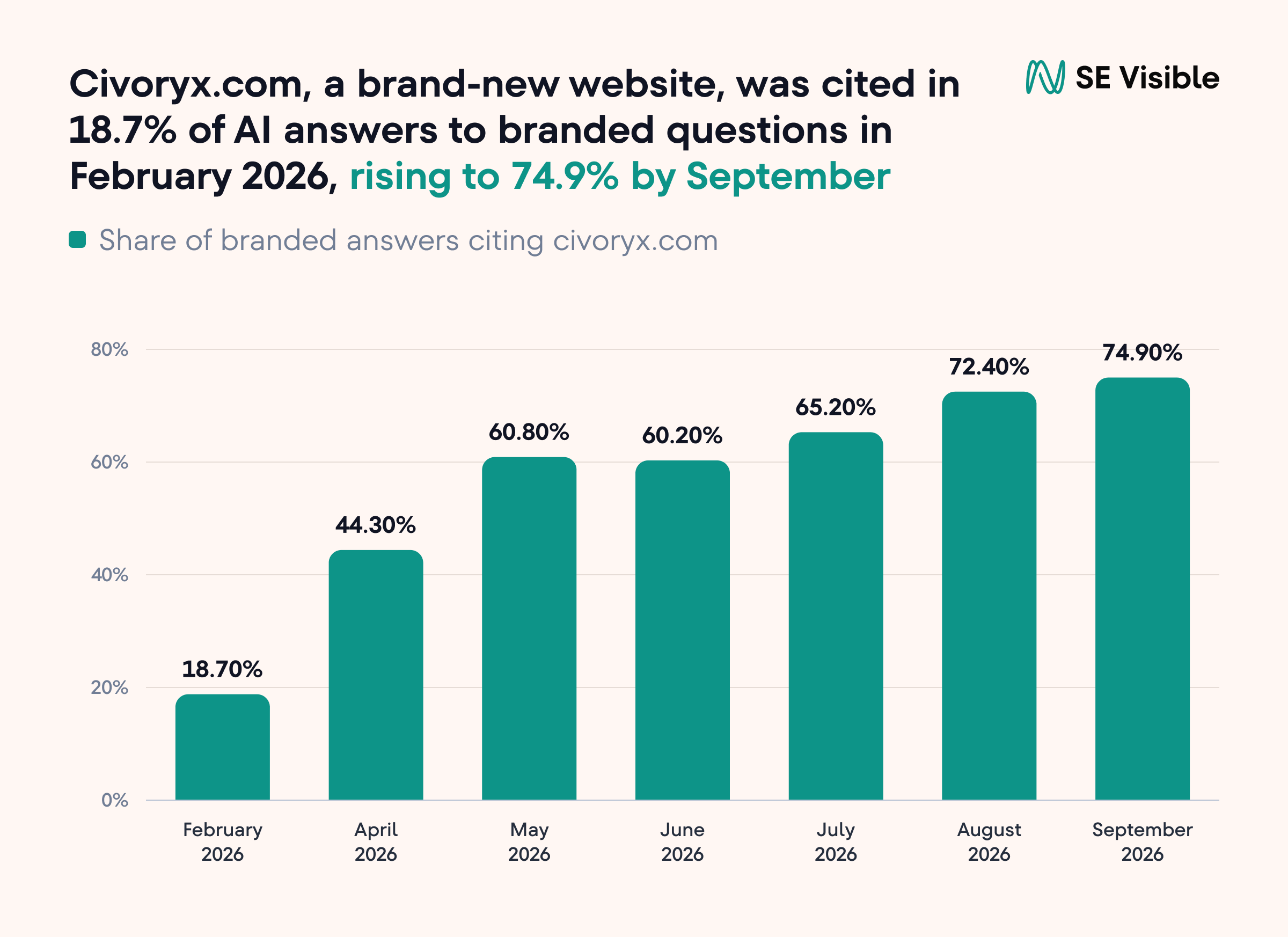
At first glance, this looks like our published content continued gaining visibility over time. But when we looked more closely at ChatGPT, we found that the engine’s citation behavior had changed too:
- On August 9, ChatGPT started citing longer lists of sources, often including several pages from the same brand website. Civoryx.com appeared in 92.9% of its branded answers during August 9–27, up from 81.8% in July. For non-branded questions, the increase was from 2.3% to 9.7%. Our external articles also appeared in more non-branded answers: 24.4%, up from 6.8%.
- On August 28, source lists became much shorter. The average fell from around 17 sources to five per branded answer, and from 23 to six per non-branded answer. Comparing August 9–27 with August 28–September 23, citations per answer declined sharply:
| Source group | Branded answers | Non-branded answers |
|---|---|---|
| Social sources | −96% | −94% |
| Our external articles | −78% | −86% |
| Competitor websites | −74% | −75% |
So far, after August 28, Civoryx.com accounted for a larger share of ChatGPT’s citations mainly because other sources were cited less often. The website hadn’t changed, and the proportion of branded answers citing it had actually dipped slightly, from 92.9% to 90.9%.
These ChatGPT findings don’t explain the entire increase across all five engines. They do, however, show why we can’t attribute that increase solely to our content or the time it had been online. Our foundational pages became recurring sources for answers about Civoryx, while changes in how engines selected sources also influenced the results.
That’s why it helps to look beyond the visibility trend and review the answers themselves: what are engines saying about your brand, and which pages are they using to support it?
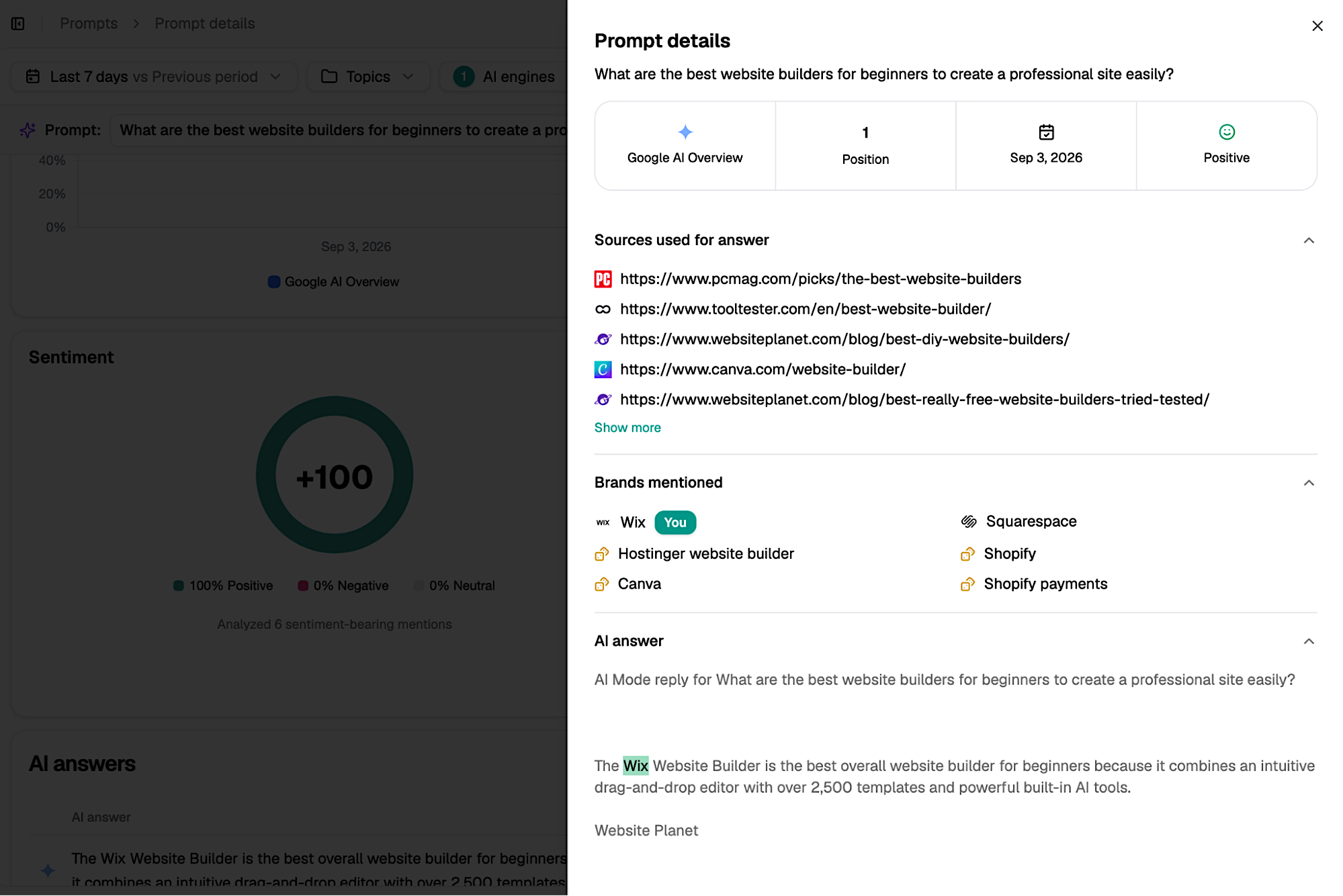
Once your pages are live, open your project in SE Visible and go to Prompts to review the AI answers to your branded questions. Check whether they describe the product accurately, include the right use cases, and explain important limitations.
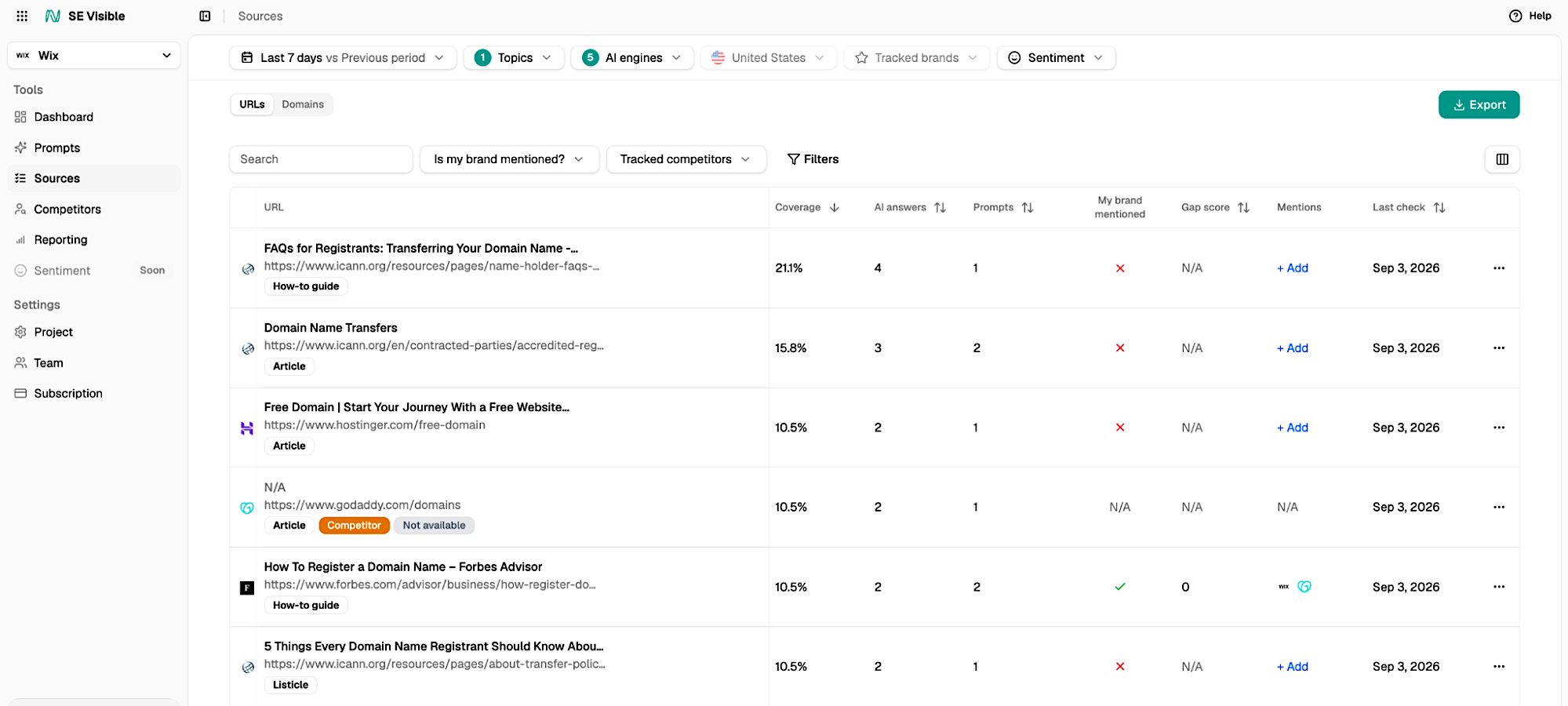
Then visit Sources to see which domains and URLs the engines cite. Are they using your product pages or getting information from other websites?
2. Don’t assume branded visibility will carry over to non-branded questions
In our experiment, 75 prompts named Civoryx, including questions such as “How accurate is the Civoryx index?” The other 90 did not name the brand and asked broader questions such as “What is the best global fraud index?”
Across April 1–September 23, the difference was substantial:
| What we measured | Branded questions | Non-branded questions |
|---|---|---|
| Answers mentioning Civoryx | 84.8% | 1.8% |
| Answers citing civoryx.com | 61.3% | 1.6% |
As expected, Civoryx was mentioned in most answers when the question included its name. But when people asked about the category without naming Civoryx, only 1.8% of answers mentioned the brand, and just 1.6% cited its website. The brand had become visible to AI engines, but it was rarely coming up as an answer to broader questions where it might be relevant.
The brand website played almost no part in those broader answers. For every page on civoryx.com, more than 98% of its citations came from branded questions.
That’s why tracking branded and non-branded prompts serves two different purposes:
- Branded prompts are mainly about brand sentiment: how AI describes your brand, whether that description is accurate, and whether it presents you positively, neutrally, or negatively.
- Non-branded prompts are your growth engine: they show whether AI includes your brand when people ask about a problem, product category, or solution without already knowing your name.
For a new brand, this gap is the main challenge. Nobody is searching for your name yet, so branded visibility alone can’t bring you new visitors. The work that matters most is getting into answers where people describe a need rather than a brand. Seen that way, even 1.8% was an early win: a few months after launch, engines had started including Civoryx in answers that never asked about it.
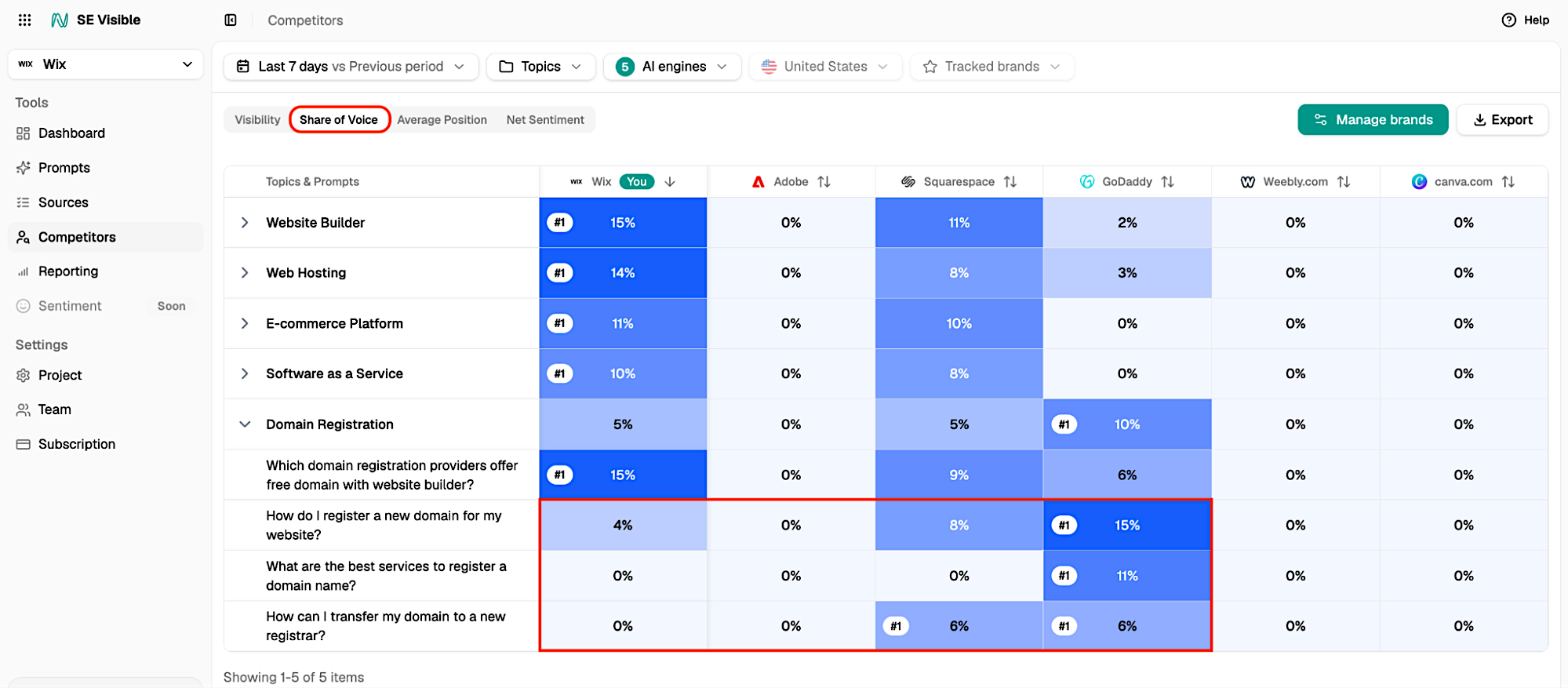
In this case, it helps to track branded and non-branded questions separately from day one. In SE Visible, organize your prompts by topic and compare your visibility and share of voice with competitors for the non-branded questions where you want to be considered.
Keep a consistent core prompt set over time. If you add new questions, review them separately before folding them into your headline reporting. Otherwise, a change in the questions can look like a change in performance.
Also remember what this measurement represents: visibility within the questions you track. It is not a count of people asking those questions or seeing your brand.
3. Give published content time, and check what changed before creating more
Limited visibility during the first month doesn’t necessarily mean a page has failed. Track it for longer to see whether AI engines start citing it over time or continue to overlook it.
The wait for a first AI citation varied considerably across the content we published on our external websites. Short articles of 500–750 words had a median wait of three weeks, while longer how-to guides, with a median length of 1,700 words, took just over four months:
| Content tested | Number of pages | Median time to first AI citation |
|---|---|---|
| Short articles | 30 | 21 days |
| How-to guides | 8 | 126.5 days |
These results don’t mean you should replace detailed guides with short articles. The pages differed in content and where they were published, and getting cited quickly didn’t necessarily mean getting the brand mentioned. They do show why a month without citations may be too soon to judge a page’s potential.
At the same time, the citation rate for civoryx.com on branded prompts continued growing after publishing ended:
| Period | Branded answers citing civoryx.com |
|---|---|
| April | 44.3% |
| May | 60.8% |
| June | 60.2% |
| July | 65.2% |
| August | 72.4% |
| September | 74.9% |
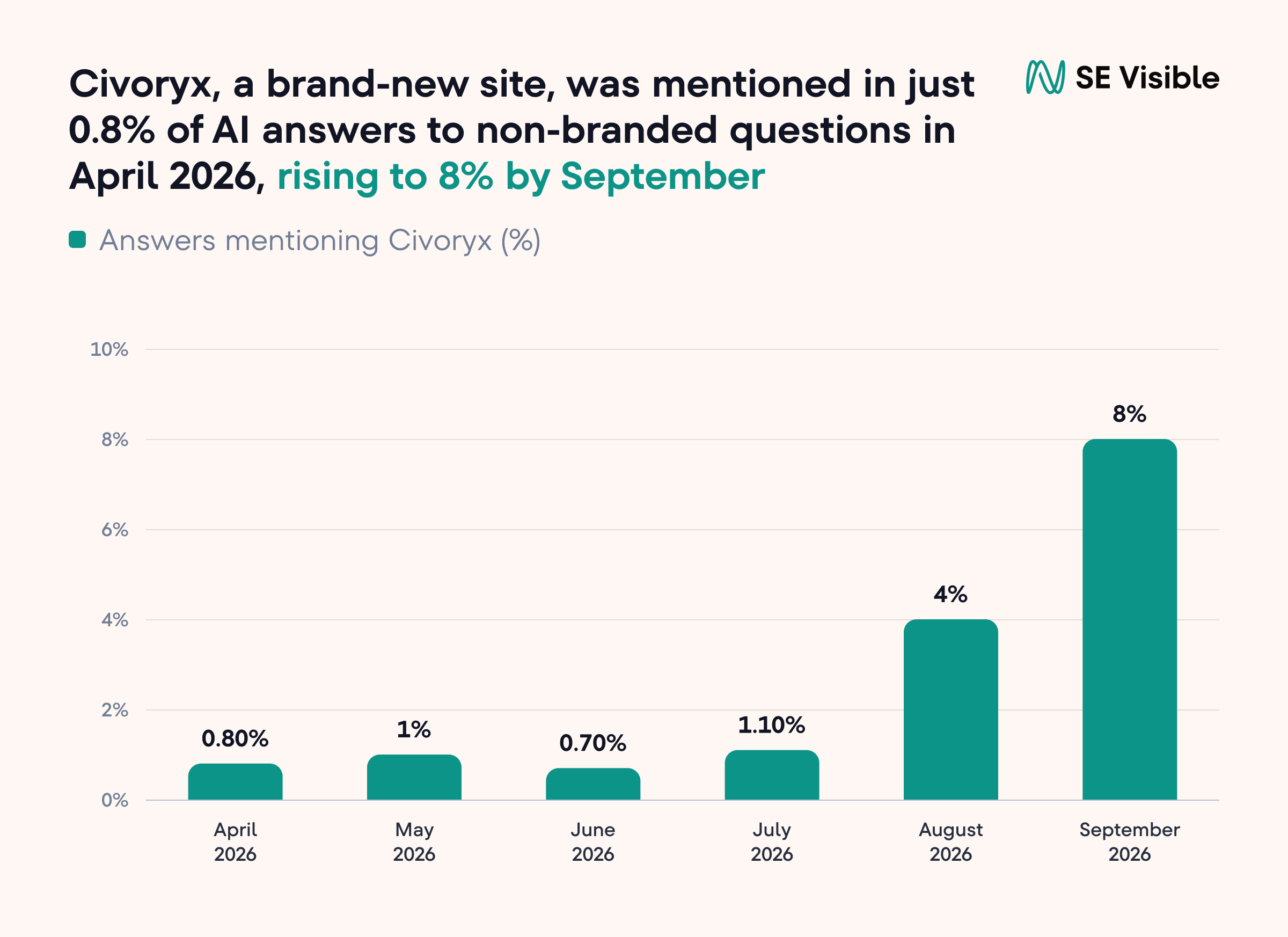
Non-branded mentions took longer. They stayed around 1% from April through July, reached 4.0% in August, and rose to 8.0% in September.
We also looked specifically at non-branded answers that cited at least one of our external articles. Over time, more of those answers included Civoryx in the response:
| Period | Share of answers citing one of our external articles that also mentioned Civoryx |
|---|---|
| July | 10.2% |
| August | 25.0% |
| September | 45.9% |
In July, roughly one in ten answers citing one of our external articles named Civoryx. By September, it was nearly half. The articles hadn’t changed, but engines were increasingly mentioning the brand when using them as sources.
So, before deciding you need more content, check whether the pages you’ve already published are still gaining visibility. Keep improving information that is missing or unclear, but give useful content time to show results.
4. Build relevant coverage beyond your own domain
Your website can explain the product thoroughly and still rarely appear when the question doesn’t name it. That happened to Civoryx.
Across the non-branded answers we tracked from April through September, our 11 external websites collected about 19,000 citations. Civoryx’s own website collected fewer than 2,000.
More importantly, 85.5% of non-branded answers that mentioned Civoryx also cited at least one of our external articles.
When one of our external articles appeared among the sources, 16.0% of answers named the brand. Without one, that fell to 0.29%. The brand was named roughly 55 times as often in answers that included one of our external articles.
| Sources in the non-branded answer | Answers mentioning Civoryx |
|---|---|
| At least one of our external articles cited | 16% |
| None of our external articles cited | 0.29% |
For a real launch, the next step is to identify the sources AI engines cite for your target questions and look for relevant opportunities to get your product included.
That could mean contributing to a category guide, reaching out for a review, or sharing information that helps a publisher update an existing comparison. Keep in mind that a brand mention is most useful when it comes with context: what the product does, who it’s for, or how it differs from the other options covered.
Start with the sources engines already use for your target questions. In SE Visible’s Sources view, inspect the cited domains and URLs, then open the pages themselves. Look for opportunities where your product would add a useful option, solve an uncovered problem, or contribute evidence the article lacks.
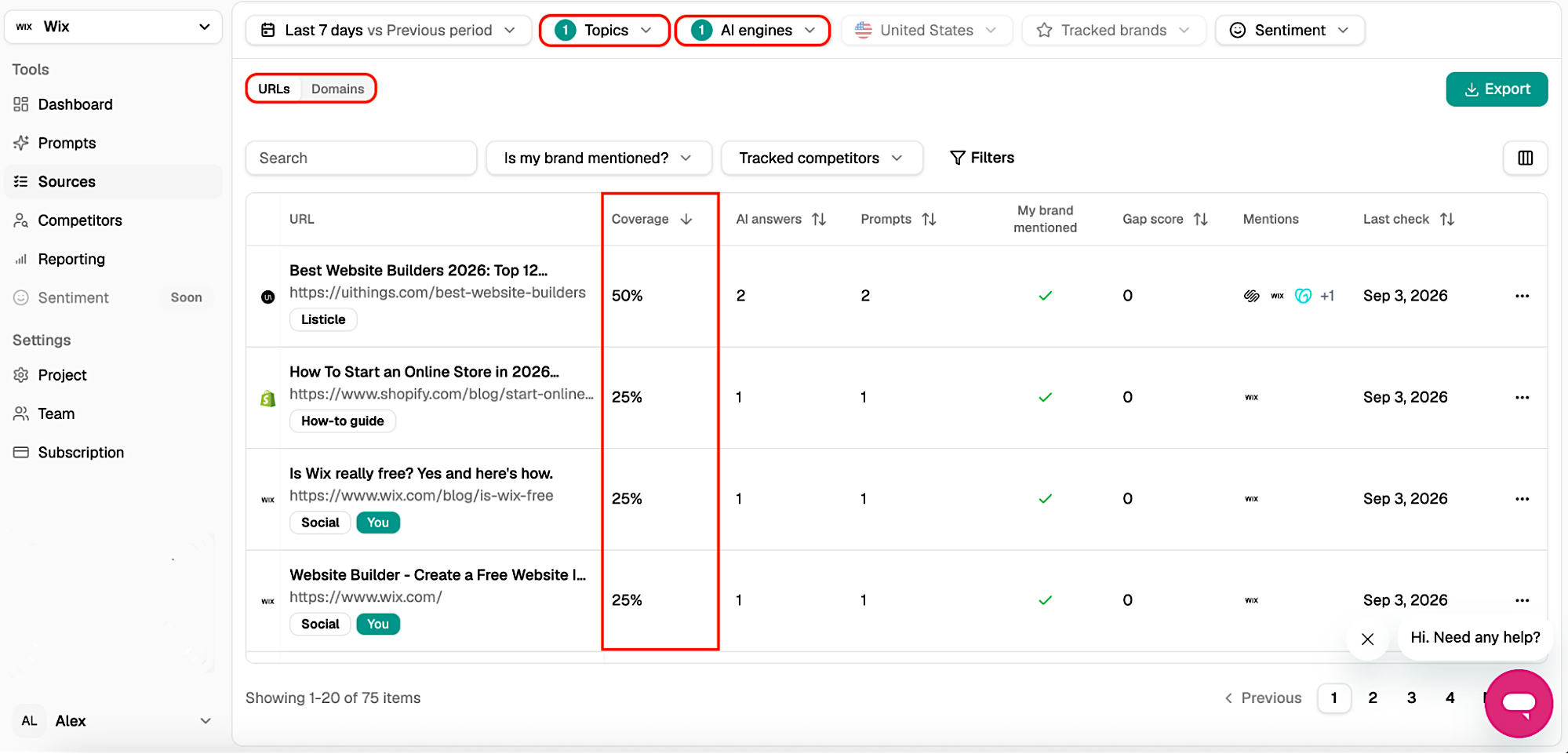
That gives your content and PR teams a more concrete brief than “get us mentioned on authoritative websites.” You can point to a specific question, the page used to answer it, and the information that would make your product worth including.
5. Choose content formats based on the questions you want to appear for
Before deciding whether to create a review, comparison, or category guide, think about the question that content should answer.
Someone asking “Is Civoryx reliable?” needs information about one product. Someone asking “What are the best fraud indexes?” wants to explore several options. In our experiment, AI engines drew on different formats for those two situations.
We published reviews, comparisons, and “best of” listicles on our external websites. Here’s how often each format was cited, on average, per page:
| Content format | Branded questions | Non-branded questions |
|---|---|---|
| Review articles | 2,312 | 140 |
| Product comparisons | 1,985 | 28 |
| “Best of” listicles | 713 | 767 |
Average citations per page, April 1–September 23.
Reviews and comparisons attracted more citations when questions mentioned Civoryx by name. Category listicles showed a more even split, with a slight lead for non-branded questions.
That gives you a practical starting point for planning content and pursuing coverage. If you want engines to answer questions about your product, provide detailed evaluations and comparisons that explain its capabilities, limitations, and differences from alternatives. If you want to appear in broader category answers, investigate relevant guides that help readers choose among several products.
You’ll likely need both. But evaluate each format against the questions it is meant to answer, rather than expecting every article to serve the same purpose.
SE Visible can help you check whether this pattern holds for your own topics. Look at the page types cited for your tracked questions: are AI engines drawing on reviews and comparisons, broader guides, or another format entirely?
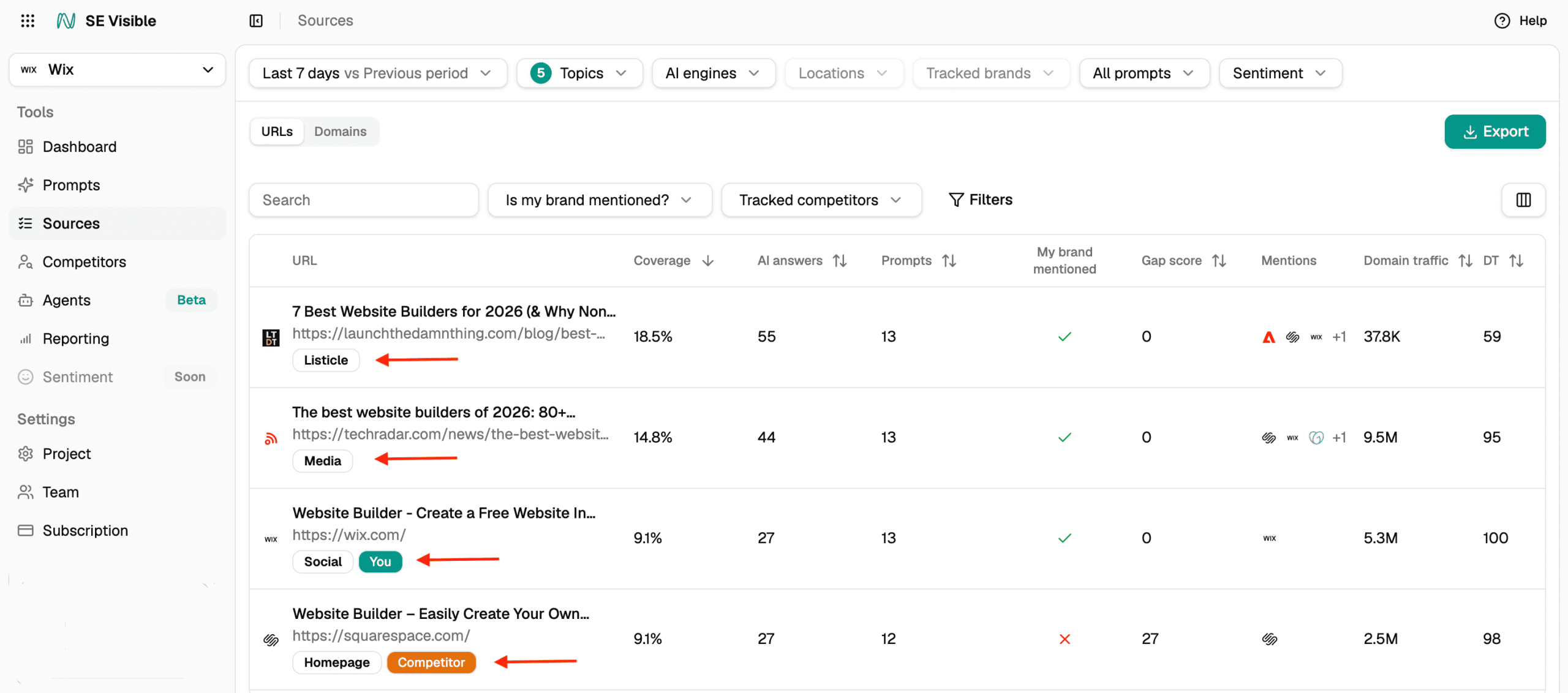
Compare the results for questions that mention your brand with those that don’t, then use that evidence to decide what to create or where to seek coverage.
6. Check whether cited pages also get your brand mentioned
Getting a page into an engine’s sources is useful, but it doesn’t guarantee your product appears in the response.
Imagine a guide listing six fraud indexes, including Civoryx. An AI engine could cite that guide and recommend three of the other products. The page earned a citation; Civoryx still didn’t reach the answer.
We checked how often this happened across our non-branded questions. For each content format, we looked at the answers citing it and counted how many also mentioned Civoryx.
| Content format | Non-branded answers citing it | Share of those answers mentioning Civoryx |
|---|---|---|
| “Best of” listicles | 4,399 | 14.2% |
| How-to articles | 1,114 | 38.3% |
| Review articles | 861 | 41.6% |
| In-depth product guide | 198 | 69.2% |
April 1–September 23. Answers could cite multiple formats, so the rows overlap.
Our category listicles appeared in far more non-branded answers, but only 14.2% of those answers mentioned Civoryx. For the detailed guide, the mention rate reached 69.2%.
That guide was a single 6,000-word article on one of our external websites, so its performance doesn’t establish that longer content works better. But the contrast shows why citation counts alone don’t tell the whole story: a frequently cited page may still leave your brand out of the answer.
Still, the results suggest a useful combination to test: category coverage that places your product among the options, alongside detailed content that explains when and why someone would choose it.
When creating that detailed content or providing information to a publisher, go beyond a product description. Include concrete use cases, explain the workflow, show supporting evidence, and make the limitations clear.
7. Compare engines before deciding where to focus
Your brand may appear frequently in one AI engine and remain almost invisible in another. Review the results for each engine separately to see where your visibility is growing and where more work may be needed.
During September, Civoryx’s mention rates looked like this:
| AI engine | Branded answers mentioning Civoryx | Non-branded answers mentioning Civoryx |
|---|---|---|
| Perplexity | 94.5% | 30.6% |
| ChatGPT | 97.9% | 8.3% |
| Google AI Overviews | 94.1% | 0.6% |
| Gemini | 89.1% | 0.6% |
| Google AI Mode | 99.2% | 0.0% |
AI Mode captures the difference particularly well. It named Civoryx in almost every branded answer, yet none of the non-branded answers.
Why was Perplexity so different? The sources help explain it. Across April through September, it cited at least one of our external websites in 37.2% of non-branded answers. ChatGPT did so in 8.0%; the other engines were around 1% each.
Perplexity was using the pages discussing Civoryx much more often, giving the brand more opportunities to appear. That is a more useful explanation than assuming it simply favors new brands.
SE Visible covers these five engines and lets you filter results by engine, topic, and date. Use that breakdown to investigate where progress is happening and which sources accompany it. An answer where a competitor appears and your brand doesn’t can be particularly useful: inspect what information supports the competitor’s inclusion.
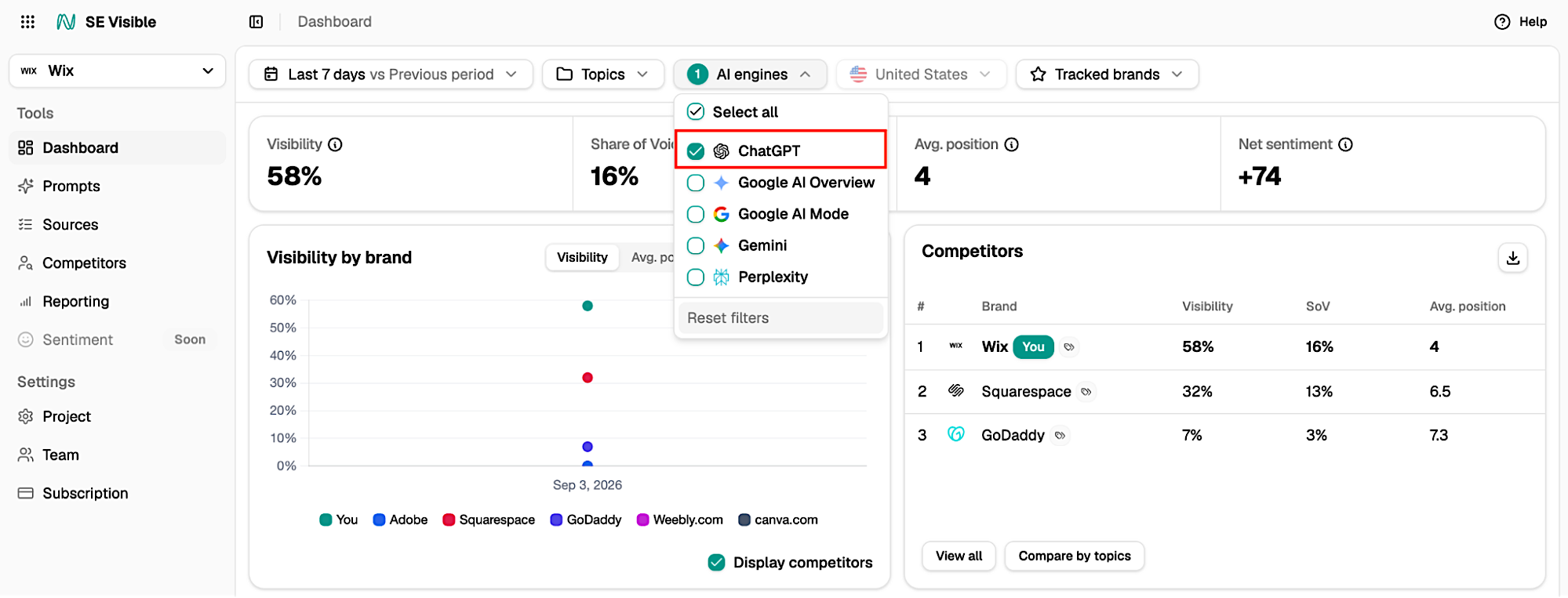
For Civoryx, Perplexity and ChatGPT offered the clearest early signs of non-branded discovery. Treat that as the result of this experiment, not a permanent ranking of platforms for new brands. Your category, sources, market, and audience may produce a different order.
8. Measure what happens after your brand appears in AI answers
More citations show that your brand is becoming more visible within the questions you track. But they don’t show whether people visit your website or take action.
Civoryx’s citations increased sharply after we stopped publishing:
| Month | Citations of civoryx.com |
|---|---|
| April 2026 | 17,023 |
| August 2026 | 42,435 |
By August, Civoryx was receiving roughly 2.5 times as many monthly AI citations as in April, a 149% increase. Almost all of the brand website’s citations came from questions that named Civoryx.
However, the website attracted very little traffic during the experiment:
| Traffic outcome | Result |
|---|---|
| Website users recorded in GA4 | 100 |
| Visits identified as coming from an AI assistant | 1 |
| Google Search clicks | 11 |
GA4 recorded 100 users from January to September. Google Search recorded 11 clicks in the report’s year-to-date data, while our server logs identified just one visit referred by an AI assistant, from ChatGPT.
Civoryx was a completely new brand without an existing audience or a broader launch campaign, so these results don’t tell us what conversion rate another business should expect.
They do show why citations in tracked answers shouldn’t be reported as people reached.
For your launch, keep three questions in view:
- Does AI include us? Use SE Visible to track visibility, competitor share of voice, and the sources appearing for your target topics.
- What does AI say about us? Read the answers to check whether the product is described accurately and presented as a relevant option. Review brand sentiment data to see whether those mentions are positive, neutral, or negative.
- Do people take action? Use GA4 to track visits, sign-ups, qualified leads, or purchases. Apart from that, use self-reported attribution to ask your leads where they came from.
You may not be able to connect every customer action to an AI answer. But reporting these measures together gives your team a clearer picture of what growing visibility is delivering.
Conclusion
Civoryx showed that a new brand can earn a place in AI answers without years of reputation behind it. Getting mentioned beyond questions about the brand itself was harder, and the sources engines used mattered.
For your launch, start with clear product information, pursue relevant coverage, and track which questions bring you into the conversation. Give that work time, while keeping visits and conversions in view.
Use SE Visible to see where your brand appears, how it’s described, and which sources are worth your attention next.