

Nearly 80% of websites now get AI traffic, 2x more than in early 2025

A couple of years ago, receiving traffic from AI platforms was more of an exception. Today, it’s becoming the norm.
But getting an occasional AI visit and having AI contribute a noticeable number of visitors are two different things. How many websites now receive AI traffic? And how much does it add up to compared with organic search?
To find out, we analyzed 28,500 randomly selected websites from our research index, all of which received organic search traffic every month from January 2025 to September 2026. We tracked how many also received AI referrals, how that share changed over time, and how AI visits compared with organic search traffic.
Here’s what we found.

The share grew from 39.7% in January 2025 to 79.2% in September 2026. For sites with at least 1,000 monthly organic visits, it reached 99.7%.
The share of websites receiving AI traffic jumped from 58.4% in May to 73.1% in June, reaching 79.2% by September.
By September 2026, this was the most common range, covering 34.2% of websites with at least 1,000 monthly organic visits.
Around 8 in 10 websites receive traffic from AI, double the share in early 2025
How common is it for a website to get visitors from AI platforms? We started with this question before looking at how much traffic those platforms actually bring.
In September 2026, 79.2% of the 28,500 websites in our sample received AI referrals. So if you’re seeing AI traffic in your analytics, you’re far from alone: nearly 8 in 10 sites in our sample did too.
Go back to January 2025, and the picture looked different. Back then, 39.7% of websites received AI referrals, or about 4 in 10. That share doubled in less than two years.
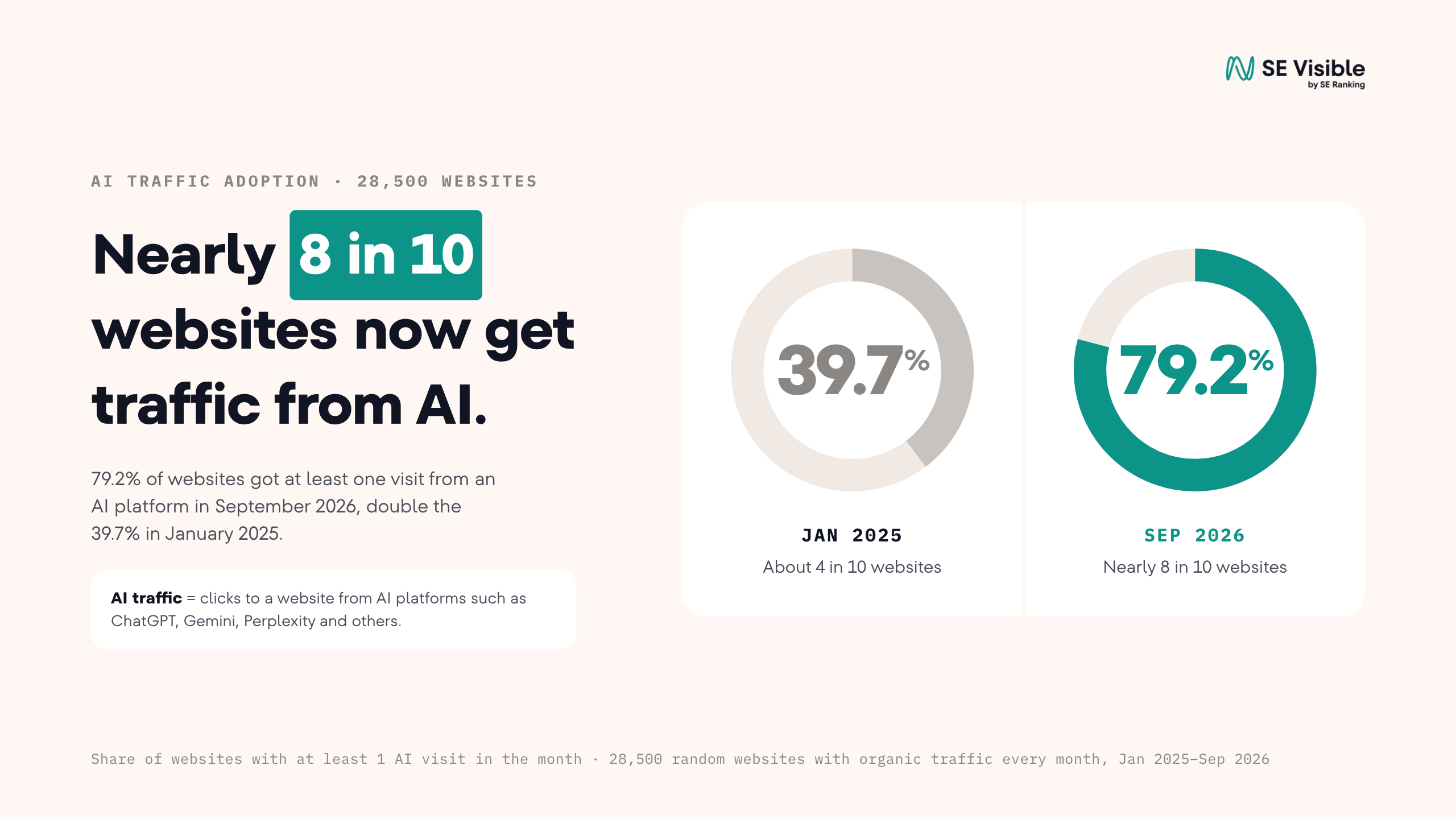
This increase tells us that AI referrals are reaching more websites, but it doesn’t show how much traffic each site receives or how meaningful that traffic is for the business. We’ll look at traffic volumes relative to organic search later in the article.
Among sites with at least 1,000 organic visits, AI traffic is almost universal
For established sites (those with over 1,000 organic visits per month), the figure is even more striking: 99.7% received AI traffic in September 2026.
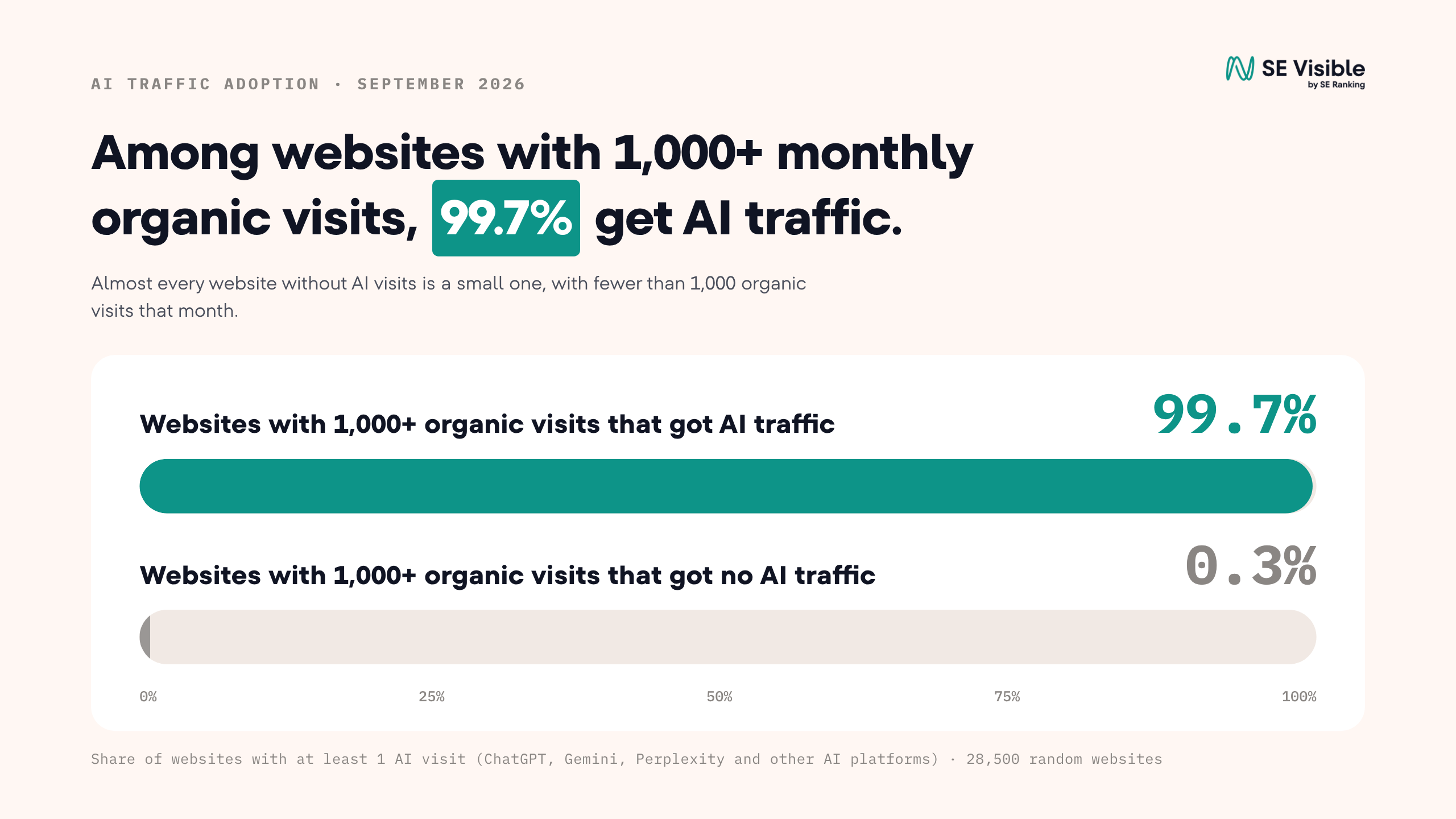
So almost all the websites still without AI referrals were smaller ones, with fewer than 1,000 organic visits that month.
Why the difference? Sites attracting more organic traffic may have more content, cover more topics, and already be easy for search engines to find. That gives AI tools more opportunities to discover and cite their pages (and users more opportunities to click through).
So when did AI referrals become so widespread? The biggest jump came over just a few months.
The biggest shift came between May and September 2026
For a while, AI traffic seemed to be spreading slowly.
The share of websites receiving AI visits rose from 39.7% in January 2025 to 54.3% in June 2025. It then stayed between 54.3% and 59.2% for nearly a year, through May 2026. AI referrals were reaching more sites than at the start of 2025, but that growth had largely stalled.
Then June 2026 arrived.
In one month, the share jumped from 58.4% to 73.1%. That single-month increase was almost as large as the entire increase between January and June 2025.
And it kept climbing.
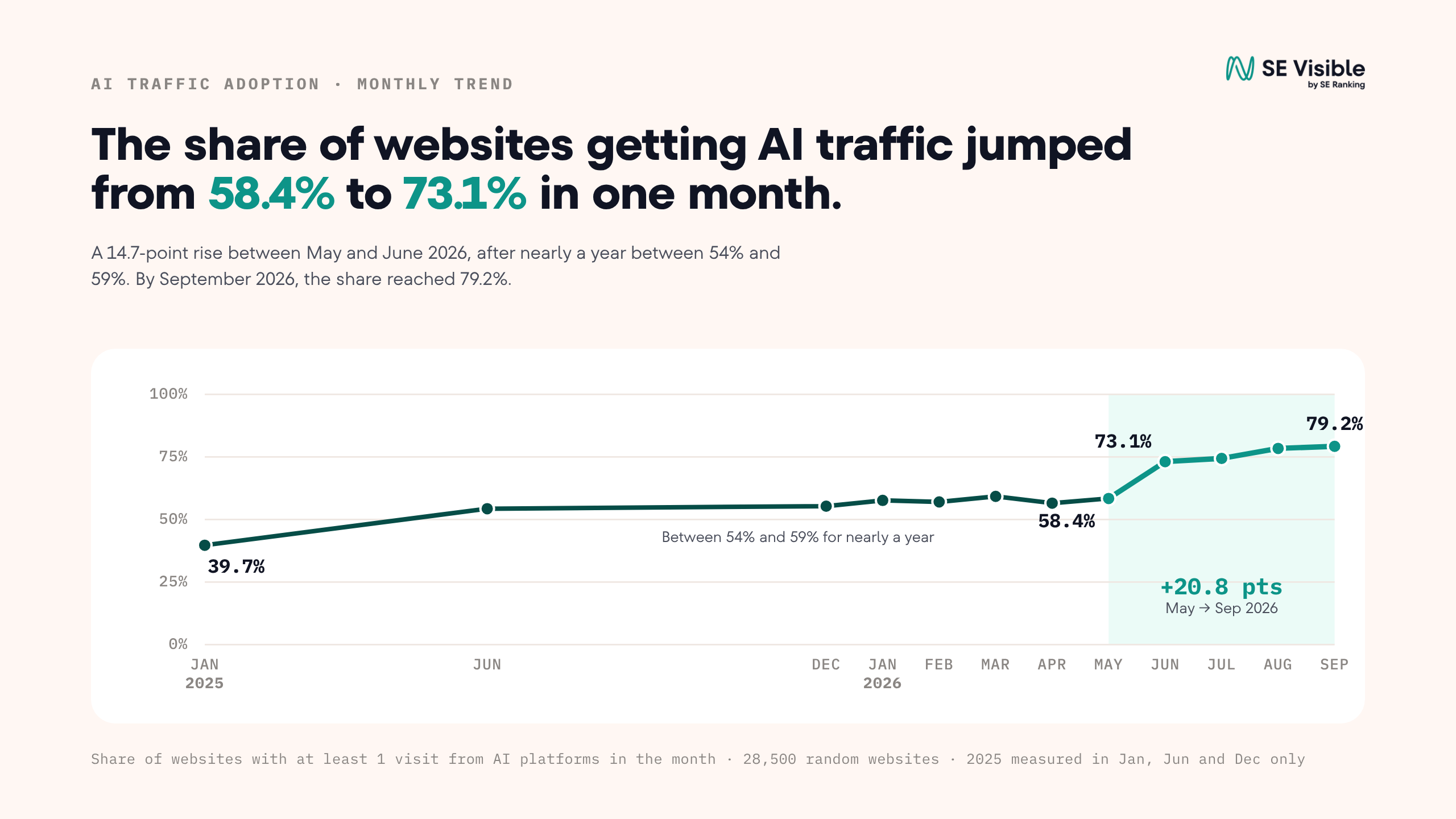
By September 2026, 79.2% of websites were receiving AI traffic. That doesn’t mean AI was sending large numbers of visitors to each site, but it was reaching far more of them.
What might explain the summer increase?
To understand what might be behind this jump, it helps to look at where most AI traffic comes from.
Our previous AI traffic study found that ChatGPT sent roughly three out of every four AI referrals worldwide in January-April 2026. So when ChatGPT changes how it links to websites, the effects could show up across the wider AI traffic picture.
And just before the summer increase, something appears to have changed. Around May 7, reports started pointing to more prominent, clickable brand names inside ChatGPT’s answers. Instead of just reading about a company, users had a clearer route to its website.
We explored this in our separate study of ChatGPT referral traffic in May 2026. That month, ChatGPT’s share of total website traffic rose 36.7% compared with April.
Making brand links easier to spot and click may have helped more websites start receiving AI traffic. Given how much of that traffic comes from ChatGPT, even a small change in how users interact with its answers could have had a wider impact.
But reaching a website is one thing. Sending it a meaningful number of visitors is another. So how much traffic are we actually talking about?
The typical site gets 2–5 AI visits for every 100 organic visits
To understand how much traffic AI actually brings, we looked at websites with at least 1,000 monthly organic search visits and compared the two sources.
A note on the sample: We focused on sites with at least 1,000 monthly organic visits because small traffic volumes can produce misleadingly large ratios. A site with 50 organic visits and 25 AI visits, for example, would have AI traffic equal to 50% of its organic traffic (but that’s still only 25 visits).
By September 2026, the median website in this group received 2–5 AI visits for every 100 organic search visits. In January 2025, it received fewer than 1. In other words, AI was still a much smaller traffic source than organic search, but its contribution had grown.
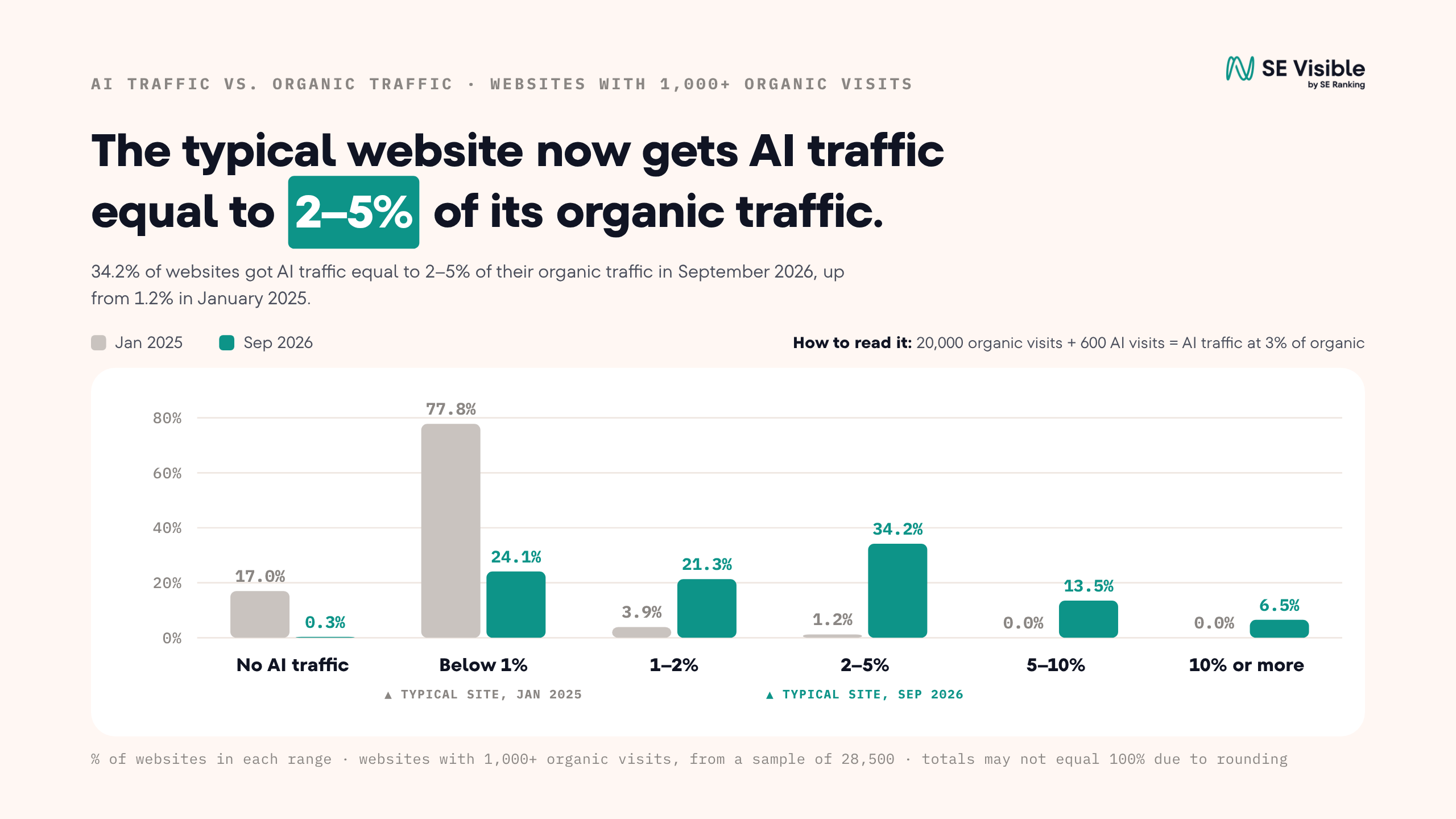
What could that look like for an individual website? Imagine a site getting 20,000 visits a month from organic search. At the 2–5% ratio, it would also receive roughly 400–1,000 visits from AI. That’s an illustrative example, but it helps put the percentages into perspective: AI wouldn’t rival organic search at that level, yet it could bring hundreds of additional visitors each month.
In January 2025, at the start of the study, receiving 2–5 AI visits for every 100 organic visits was fairly unusual: only 1.2% of sites in this group fell into that range. By September 2026, 34.2% did. What had once been rare was now the most common range, covering roughly one in three sites.
The shift extended beyond this range: 75.5% of sites in this group received at least 1 AI visit for every 100 organic visits in September 2026, up from just 5.1% in January 2025. AI’s contribution was growing across much of the sample.
For Garrett Sussman, Director of Marketing at iPullRank, this growth points to a bigger role for AI in the buying journey, even if referral volumes remain modest:
“While this is definitely an encouraging leading indicator that we’re seeing more traffic from AI Search (and maybe, in some ways, it’s replacing the traditional search engine buyer’s journey), it does not surprise me that the percentage of monthly organic visits is still a fraction of all traffic to websites.
I don’t anticipate it ever matching the original golden era organic search traffic, but people still need to buy. People still need to do research. As marketers, we do our best to attribute responsibly, but this indicates that everything continues to go in the direction of AI Search as a primary buyer’s journey organic channel. The faster brands focus on the channel, the better prepared they’ll be to meet their audience there in the ways they want to be seen.”
20% of websites receive at least 5 AI visits per 100 organic visits
Among the same sites with at least 1,000 monthly organic search visits, a growing share went well beyond that 1% threshold.
By September 2026, 13.5% received 5–10 AI visits for every 100 organic visits, while another 6.5% received at least 10.
Together, that’s 20% of websites in this group (one in five) receiving AI traffic equal to at least 5% of their organic traffic. In May 2026, the combined share was just 1.2%.
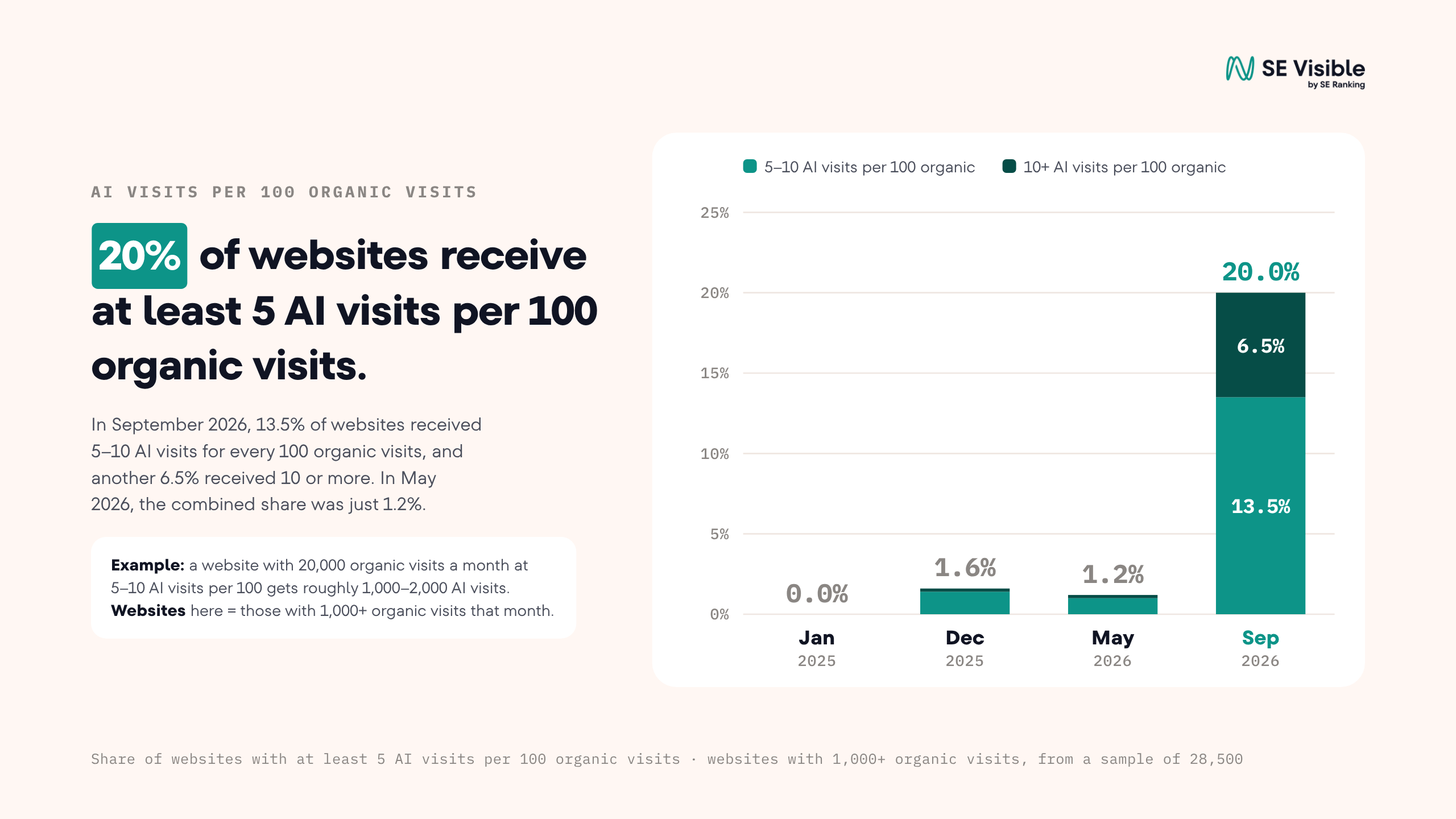
Returning to our example of a website with 20,000 monthly organic visits, a 5–10% ratio would mean roughly 1,000–2,000 AI visits. These are illustrative examples, but they show how even a seemingly small percentage can translate into hundreds or thousands of visits from AI platforms.
What this means for SEOs, marketers, and agencies
Give AI traffic its own place in your reporting
AI platforms are becoming a regular source of website traffic. By September 2026, 79.2% of websites received AI referrals, up from 39.7% in January 2025. Yet if those visits sit within your overall referral numbers, it’s easy to miss how this channel is growing and what it contributes.
Track AI referrals separately in your analytics and report them alongside organic search. Show how many visits they bring, how that changes over time, and what those visitors do on your site.
A small number of AI visits can still bring in a meaningful share of leads. Anastasia Kotsiubynska has seen this firsthand:
“Traffic from AI engines is still a small part of our organic traffic, around 2%. But what’s important is that it accounts for around 10% of organic qualified registrations, so its impact on lead generation is much bigger than its traffic share suggests.
In SEO reporting, I regularly track traffic and leads from AI engines, especially ChatGPT as the biggest one, to spot patterns and changes early.
However, let’s keep in mind that referral traffic is only part of AI search impact; it’s just the easiest and most straightforward metric to track. Many people discover us in an AI answer and then come directly later or through a branded search, so I treat the AI traffic numbers as a sample rather than the full picture.
Self-reported attribution is more accurate here, and it usually shows a much higher share for AI engines.”
Connect your AI visibility with your traffic results
AI referrals tell you how many people clicked through to your website. But someone can discover your brand, compare it with competitors, and form a preference inside an AI answer without clicking a single link. Traffic captures only part of that interaction.
As Jonas Sickler, Senior Brand Marketing Analyst at Terakeet, explains:
“Generative AI is less about visits or time on page, and more about influence. To measure that influence, I’d look at whether AI recommends your brand, your share of voice, how accurately it describes you, and the sentiment of those descriptions. These factors shape reputation and perception, even when they don’t lead to an immediate website visit. Ultimately, I’d want to connect that influence to transactions and revenue.”
To understand that influence, look at how often AI recommends your brand, what it says about you, and which sources support those answers. Then review those findings alongside your referral data.
SE Visible helps you explore this through three views:
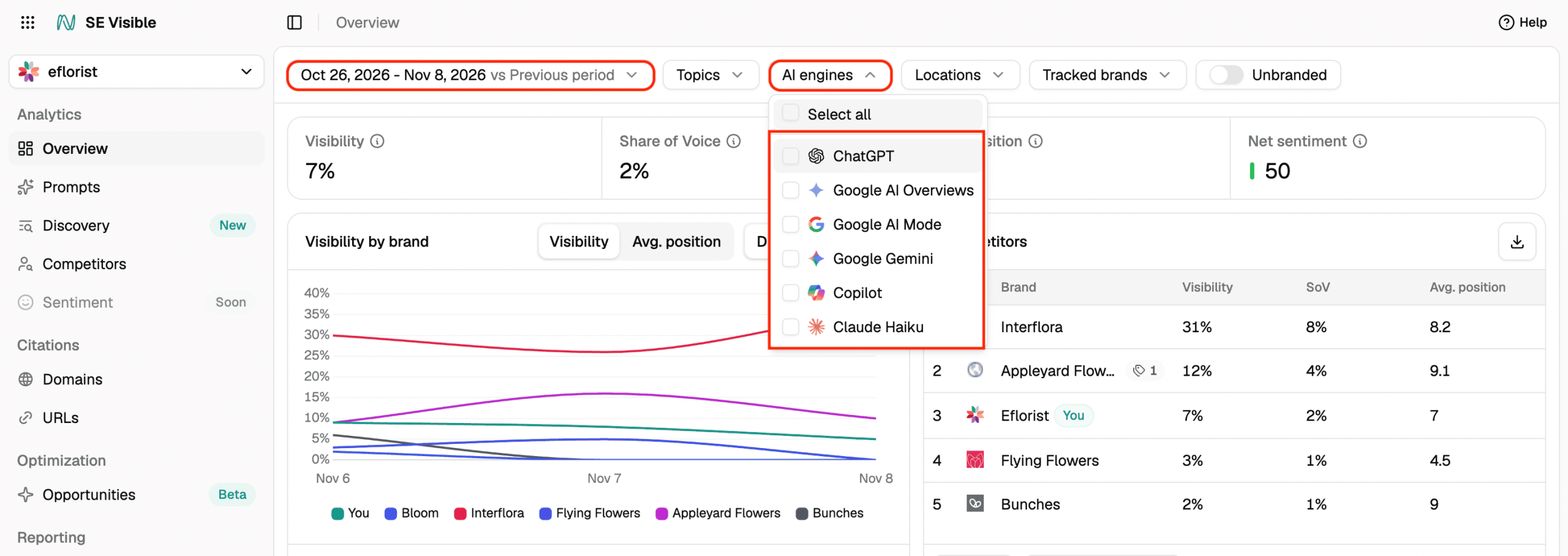
1. Overview: check whether your visibility changed. Open your project’s Overview and filter by the relevant AI engine (for example, ChatGPT if its referrals changed). Look at Visibility by brand to see how your visibility changed over time and how it compares with your tracked competitors.
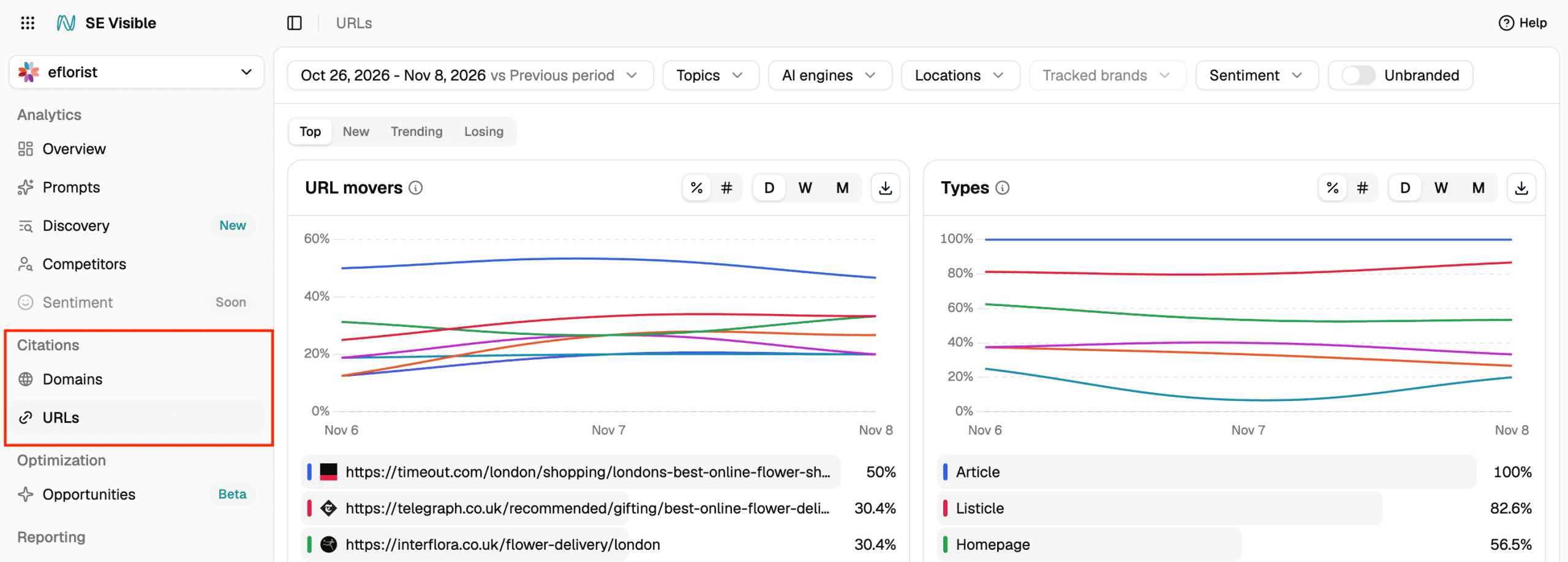
2. Sources: see which pages AI cites. In the sidebar, go to Citations → URLs. Select the same date range and AI engine you’re reviewing in your analytics. Use the Top, New, Trending, and Losing tabs to explore cited pages, and check URL movers to see how their citation presence changes over time. Look for your own pages, then compare those trends with AI referrals to the same landing pages in your analytics.
3. Prompts: inspect the answers behind the numbers. Open Prompts, select a relevant topic, and click a prompt to read the answers and see their sources. Check whether your brand is mentioned, whether your website is linked, and which competitors appear alongside you.
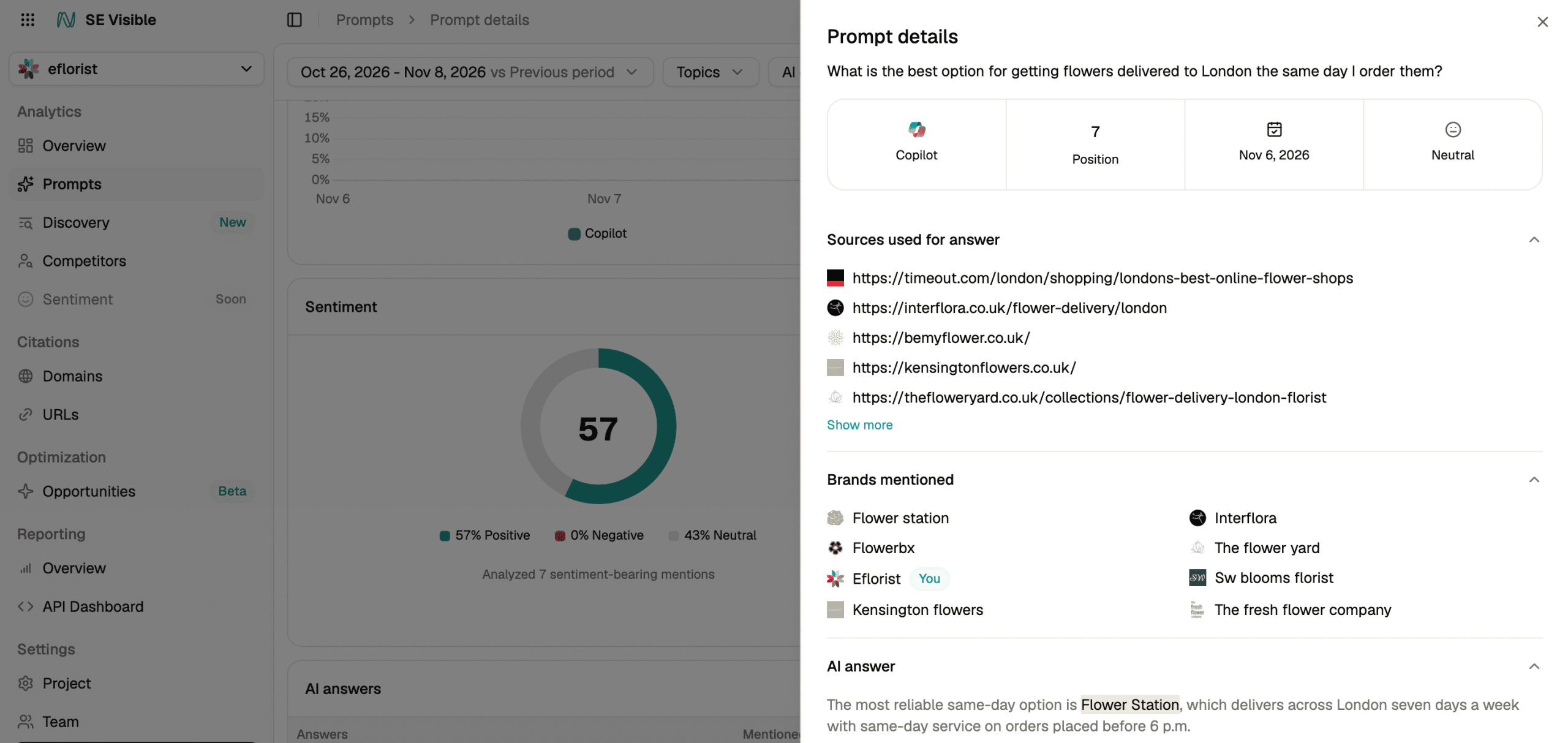
If visibility rises but traffic doesn’t, these checks can help you spot mentions without website links. If citations and referrals both decline, inspect the answers to see which sources are appearing instead. SE Visible shows what happens across your tracked prompts, so use it to investigate possible explanations rather than attribute individual visits to specific answers.
Check whether AI visits turn into business results
A few hundred AI visits can mean very different things depending on what those visitors do next. Do they read one page and leave, or do they explore your products, sign up, and become customers?
Track the actions that matter to your business, such as purchases, demo requests, or trial registrations. Compare both conversion counts and rates with other channels, keeping the sample size in mind. A handful of conversions can make a small traffic source look unusually strong, so look for a consistent pattern before deciding how much to invest.
Research methodology
We analyzed 28,500 randomly selected websites that received organic search traffic every month from January 2025 through September 2026.
For each month, we examined:
- the share of websites receiving at least one visit from an AI platform;
- the share receiving no AI referrals;
- AI traffic relative to organic search traffic among websites with at least 1,000 organic visits that month;
- how the distribution of these traffic ratios changed over time.
We calculated the AI-to-organic traffic ratio by dividing AI visits by organic search visits and multiplying by 100. For example, a website with 500 AI visits and 20,000 organic visits would have a ratio of 2.5%.
Websites in the 1,000+ organic visits group were divided into six categories: no AI traffic, below 1%, 1–2%, 2–5%, 5–10%, and 10% or more. The no-traffic category was counted separately from websites receiving some AI traffic below the 1% threshold.
We used this distribution to identify the most common range and the range containing the median website. The reported 2–5% median range does not mean that every website received AI traffic at that level.
Disclaimer: These findings describe patterns within our sample, not all websites. The sample includes only sites receiving organic search traffic throughout the study period, and eligibility for the 1,000+ group was assessed each month. Receiving AI traffic means recording at least one AI visit; it does not indicate a consistent flow of visitors or conversions. A higher AI-to-organic ratio can reflect rising AI traffic, falling organic traffic, or both. The timing of platform changes may suggest possible explanations for traffic shifts, but it does not establish causation.
Conclusion
AI referrals have become a regular part of website traffic, and the summer of 2026 marked a clear shift in both their reach and their size relative to organic search.
For marketers, the next step is to understand what that means for their own website: which AI platforms send visitors, what brings them there, and whether those visits lead to business results. That’s where a growing traffic source becomes a measurable opportunity.