Profound AI review: Is it still worth it in 2026?

The question with Profound was never really whether it works. It’s a serious platform with real funding and real enterprise customers behind it, and that’s not in doubt. The question is whether it’s built for a team like yours.
This review goes through Profound layer by layer, what it tracks and where it still falls short, so you can judge the fit before you get on a call with sales.
What is Profound, and what do users say?
Profound is an AI-visibility platform that tracks how your brand shows up in AI-generated answers across engines like ChatGPT, Gemini, Perplexity, and Google’s AI Overviews, and helps you act on what it finds. It started as a monitoring tool and has since grown into a wider platform that also spans content production and workflow automation.
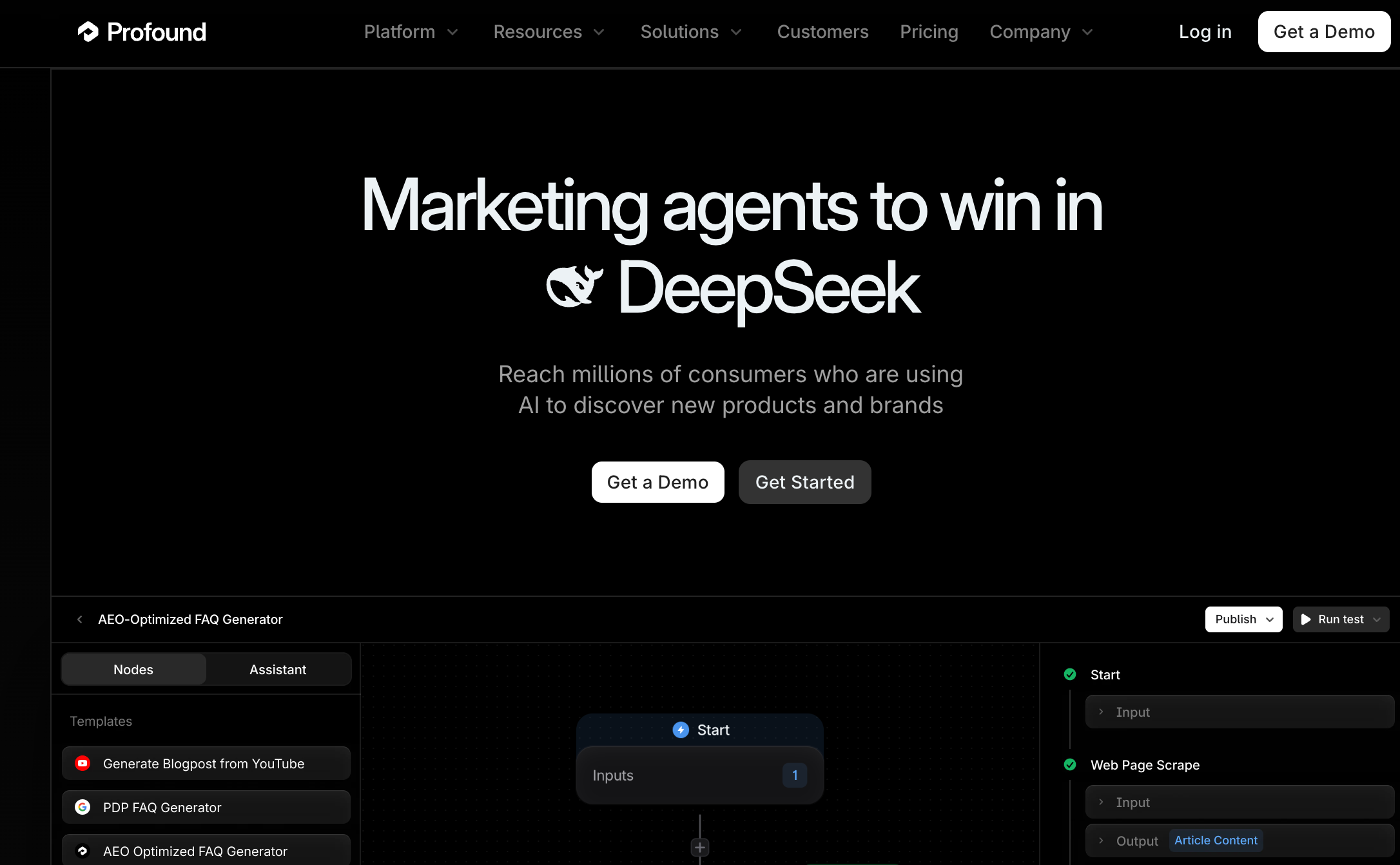
It’s a well-funded and widely adopted product. Fortune puts Profound’s total funding at $155 million through its February 2026 Series C, and the company says more than 700 businesses now run the platform, including 10% of the Fortune 500. It names Ramp, and Figma among its customers. On G2, it carries a 4.5 out of 5 across 1,129 reviews.
Reading those reviews, a clear pattern shows up on both sides. What users consistently praise:
- Teams that used to guess at how they showed up in ChatGPT or Gemini now have something they can track over time and report on with confidence.
- Users highlight the intuitive dashboards and the weekly summaries they can take straight to leadership.
- Teams also note how fast Profound ships new features.
What comes up just as consistently on the downside:
- Price comes up most, usually from smaller companies who find it steep next to everything else in their stack.
- There’s a lot of data, and it isn’t always obvious where to start, especially if GEO is new to your team.
- Engine coverage is limited to ChatGPT-only tracking in the Starter plan, and the next plan only covers 3 engines. To get all 9 platforms covered you need the Enterprise plan with custom pricing.
Which of those trade-offs matter depends on what you’d actually use Profound for. The sections below go through the platform piece by piece, and then to what each tier costs.
Does Profound show you what’s actually happening in AI answers?
Yes, in real detail, though how much detail depends on your plan.
Profound tracks up to nine AI engines and checks brand claims for factual accuracy. It also benchmarks AI-crawler traffic and ChatGPT shopping visibility.
The nine-engine figure is the Enterprise ceiling, though: Starter tracks ChatGPT only, and Growth covers three. Tools like SE Visible by SE Ranking tracks fewer, five, but they’re the major ones (ChatGPT, Gemini, AI Mode, AI Overviews, and Perplexity), and every plan includes all of them regardless of tier.
Answer Engine Insights and FactCheck: the core visibility tracker
Answer Engine Insights is Profound’s original product, and it’s the part of the platform you’ll spend the most time in. It tracks how your brand shows up across AI answers and benchmarks every metric against the competitors you’re measured against.
The Visibility tab leads with three headline metrics, each paired with a live competitive rank:
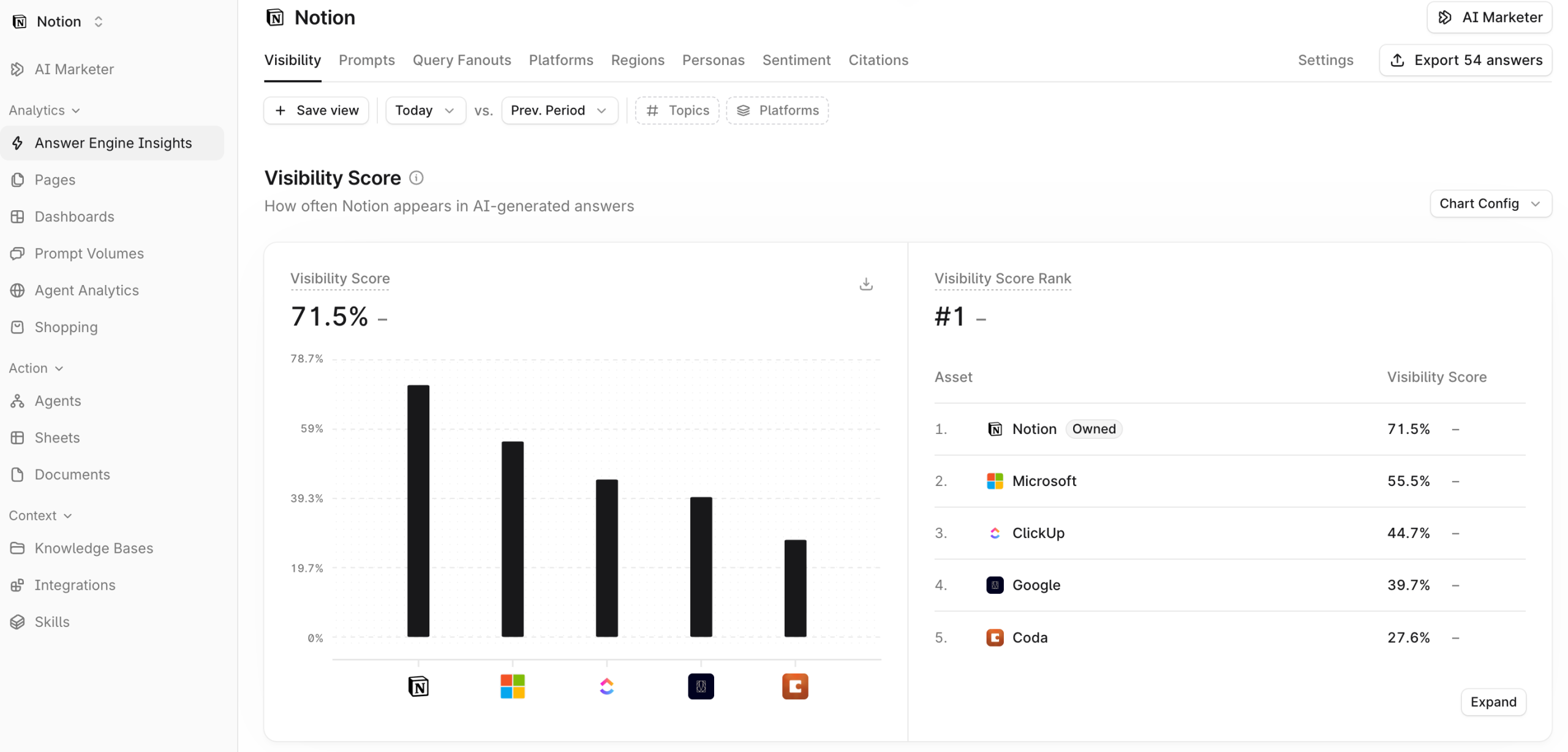
- Visibility Score measures how often your brand appears in AI answers at all, expressed as a percentage and ranked against the competitors you’re tracking.
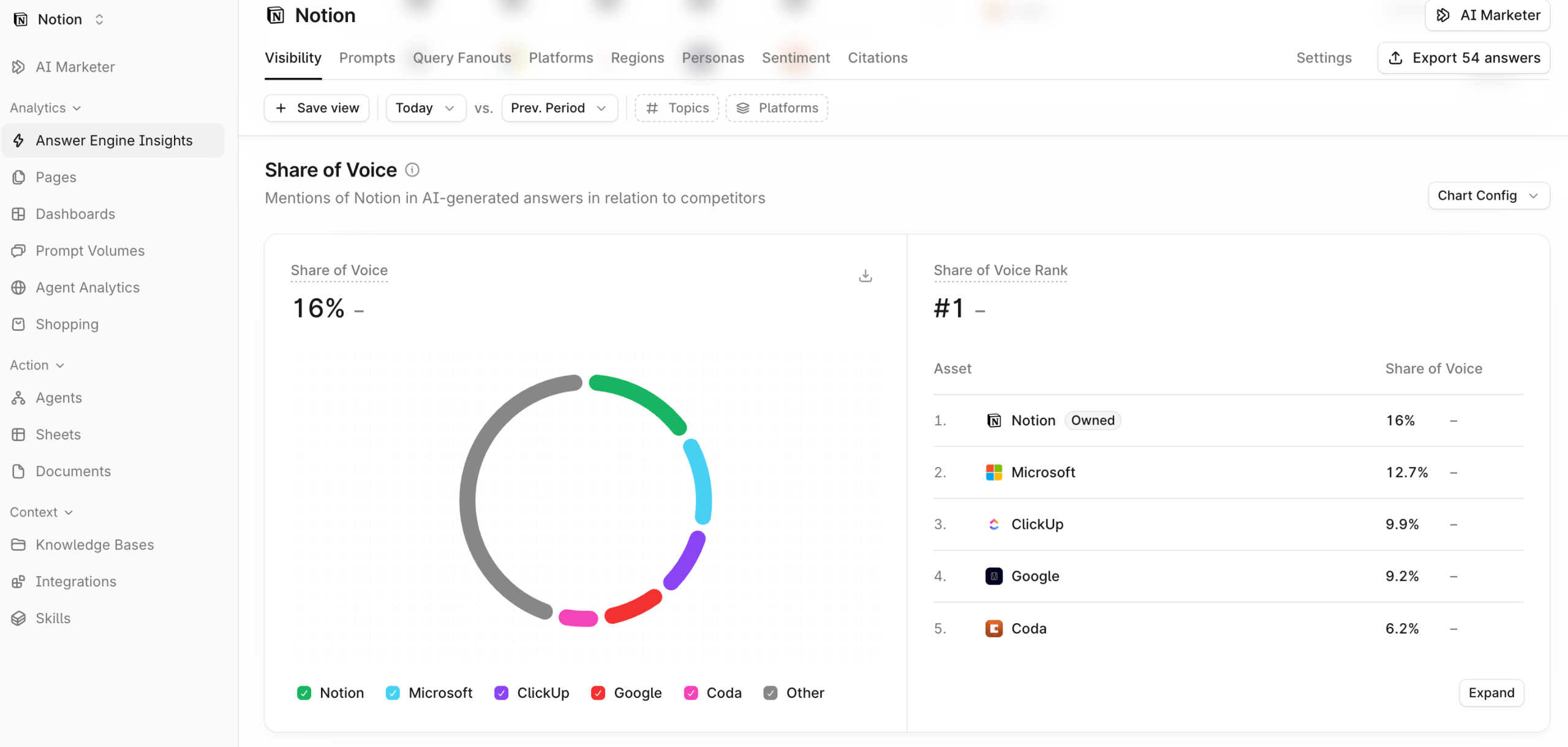
- Share of Voice shifts from presence to dominance: your mentions as a slice of the whole category conversation. It’s a quick read on how crowded your space is and how much of it you’re capturing.
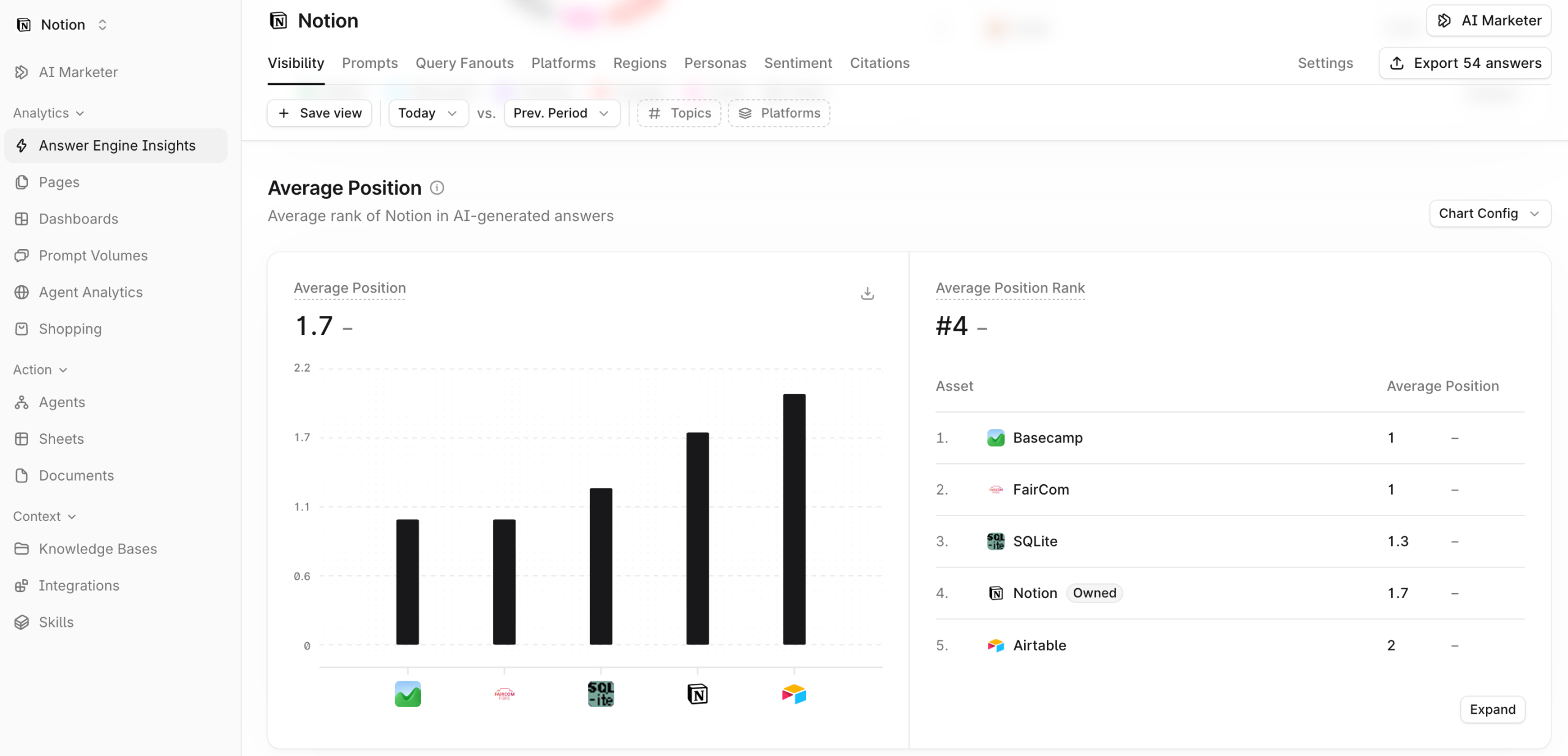
- Average Position is the honest counterweight to the other two: your average rank on the occasions you do appear. A brand can score high on visibility and still sit low here, which is exactly the gap worth watching.
Competitive data runs through all of this rather than sitting in one place. SE Visible, for instance, also shows competitors in a dedicated tab that compares share of voice, average position, and net sentiment side by side.
The more actionable view sits lower on the same tab. Visibility Rankings by Topic breaks your presence down prompt by prompt, so you can see which answers you own and which you’re missing from entirely. That topic-level detail is what turns a single visibility score into a list of things to actually work on.
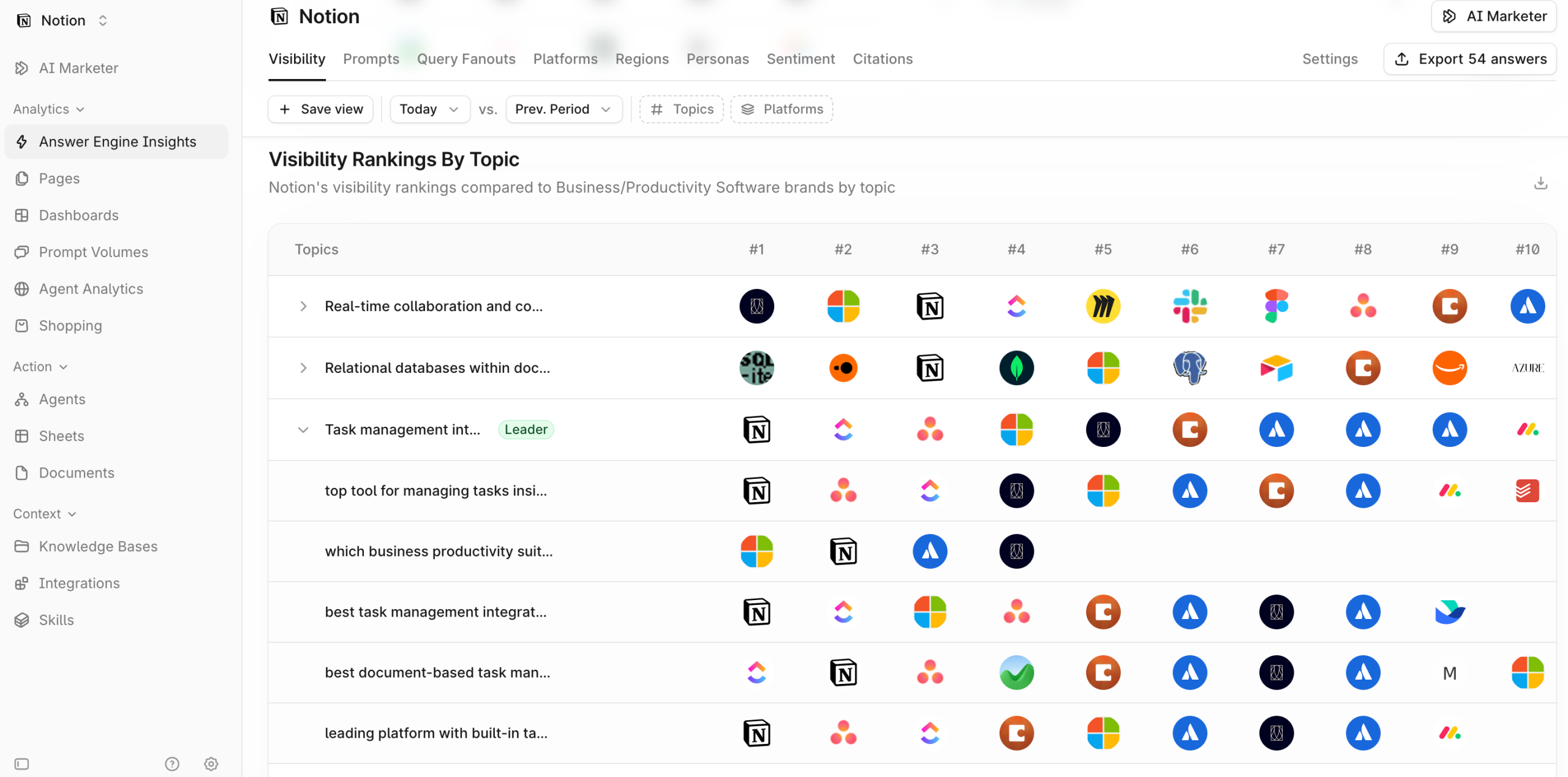
Answers are captured directly from each engine’s consumer front end rather than pulled through an API. This is important because API output and what a person actually sees in ChatGPT don’t always line up.
Beyond Visibility, Answer Engine Insights fans out into separate tabs for Prompts, Query Fanouts, Platforms, Regions, Personas, Sentiment, and Citations.
Sentiment scores the tone of how engines describe you. Citations shows which domains are shaping those answers, which is the thread you pull when you want to understand why a competitor keeps winning a prompt you don’t. Tools like SE Visible also provide this information, adding details like source type (listicle, alternative page, community, etc.)
FactCheck is Profound’s accuracy layer, and it tells you whether what LLMs say about your brand is right. It pulls out the individual claims AI models are making about your brand and checks each one against your own source of truth. From there, it traces the inaccurate ones back to the specific citation URLs feeding them, so instead of just knowing an engine has you wrong, your content team gets the exact pages to fix.
Prompt Volumes: prompt demand data for your strategies
Prompt Volumes shifts the question from what an engine says about a brand to what people are asking. It’s demand data for prompts, and it’s something not every tool can see.
According to Profound, the data comes from double-opt-in consumer conversation panels: more than 1.5 billion real user conversations, refreshed weekly with under a week of latency, across ten countries. Intent classification tags each query by type, informational, commercial, and so on, then breaks it into finer sub-intents, and a co-citation view flags prompts where a competitor gets cited and the tracked brand doesn’t.
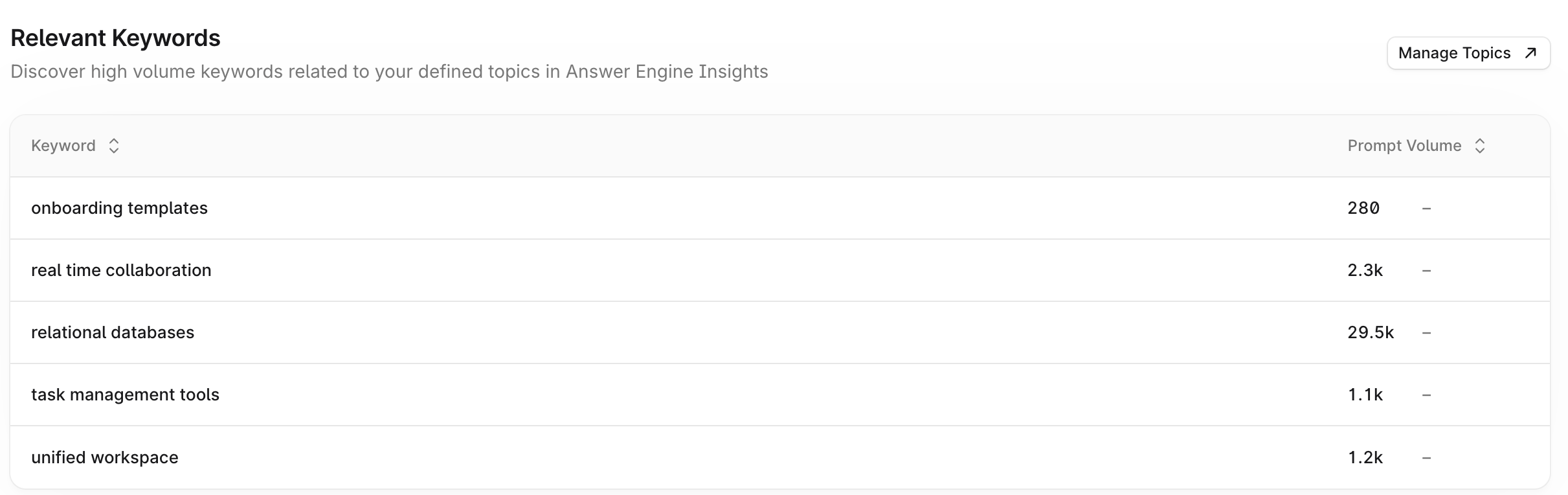
Two things to know before you lean on it:
- Full Prompt Volumes functionality sits behind the Enterprise plan. Growth users get just a slice of it: relevant keywords generated dynamically that Profound find relevant to you brand or niche.
- The data currently draws on ChatGPT, Gemini, Claude, and Perplexity, with Grok and DeepSeek listed as coming soon, so its engine coverage is narrower than Answer Engine Insights.
Shopping: tracking product visibility in ChatGPT
A product can show up correctly in a ChatGPT shopping answer and still send the click to a retailer the brand doesn’t control. Shopping is the product, built for that exact scenario: a tracker for product visibility inside ChatGPT’s shopping-triggered responses. It reports on attribute accuracy, how closely an AI answer describes a product’s actual specs, and pairs that with SKU-level citation analysis.
A Shopping Mode Rate metric shows how often a category query triggers the shopping interface instead of a plain-text answer, and a separate Merchant Layer flags which third-party retailers currently control the checkout experience an AI answer points a shopper toward.
It’s a narrow, ecommerce-specific slice of the platform, built for a DTC or retail brand rather than a generalist marketing team.
Agent Analytics and Benchmarking: AI-crawler traffic and network comparison
Agent Analytics is the crawler-facing side of Profound. This watches the bots themselves: which AI crawlers hit your site and how often. It also shows which of your pages they pull from.
It runs on server logs. You forward logs from your hosting or CDN provider, which Profound’s own setup flow tells you to do with someone technical on your team. Supported providers include AWS, Akamai, Cloudflare, Fastly, Google Cloud, Vercel, and Netlify, with WordPress and Shopify offering limited features. A few carry conditions worth checking before you rely on them: Cloudflare’s Logpush route, for one, needs a Cloudflare Enterprise plan of its own.
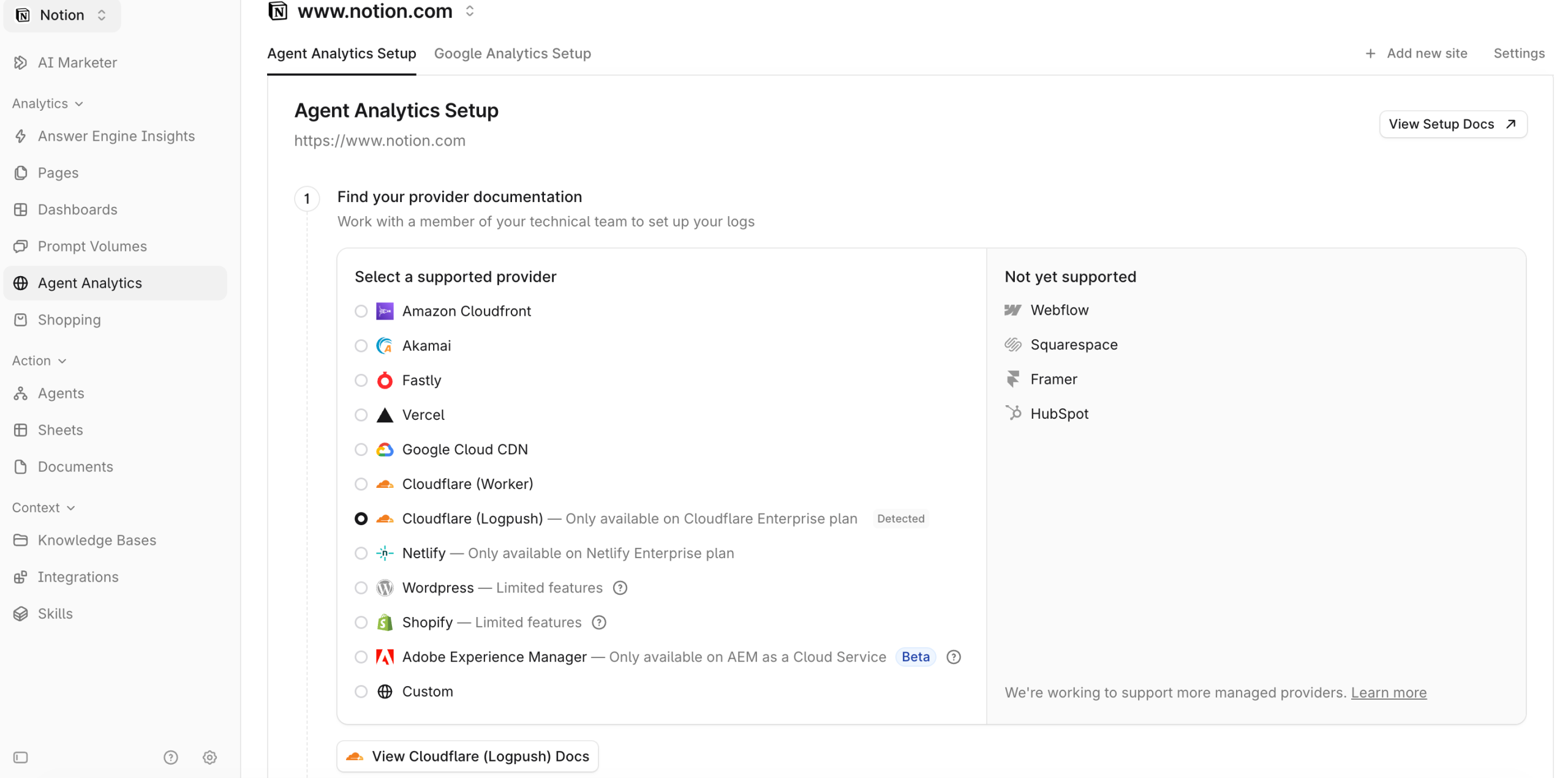
From there, it reports on a few distinct things:
- Crawler activity in real time: which AI bots are visiting and how often.
- Content performance: which of your pages AI systems reference and pull from most.
- Attribution: how much human traffic AI search sends you and whether it converts, connected to your existing analytics through a separate Google Analytics setup.
Benchmarking is the piece that gives those numbers a reference point. It compares your AI-citation performance against the Profound Network, a pool the company puts at more than 2 million pages and refreshes daily, so you can tell whether your citation rate is genuinely competitive or just looks healthy on its own.
Can Profound Agents actually produce usable AEO content?
Mostly yes, with two conditions: you review what it makes, and you’re on a plan with the credits to run it. Agents is Profound’s content-production layer, and it starts from citation data rather than a blank prompt.
On the build side, it’s a no-code workflow builder. You can describe the agent you want in plain language and let Profound assemble it, or build one yourself by dragging together configurable nodes for web scraping, LLM prompting, Answer Engine Insights lookups, and API calls.
If you’d rather not start from zero, there’s a template library sorted by job, content creation, optimization, research, reporting, and outreach, with ready-made agents like an AEO-optimized FAQ generator and a content-refresh workflow.
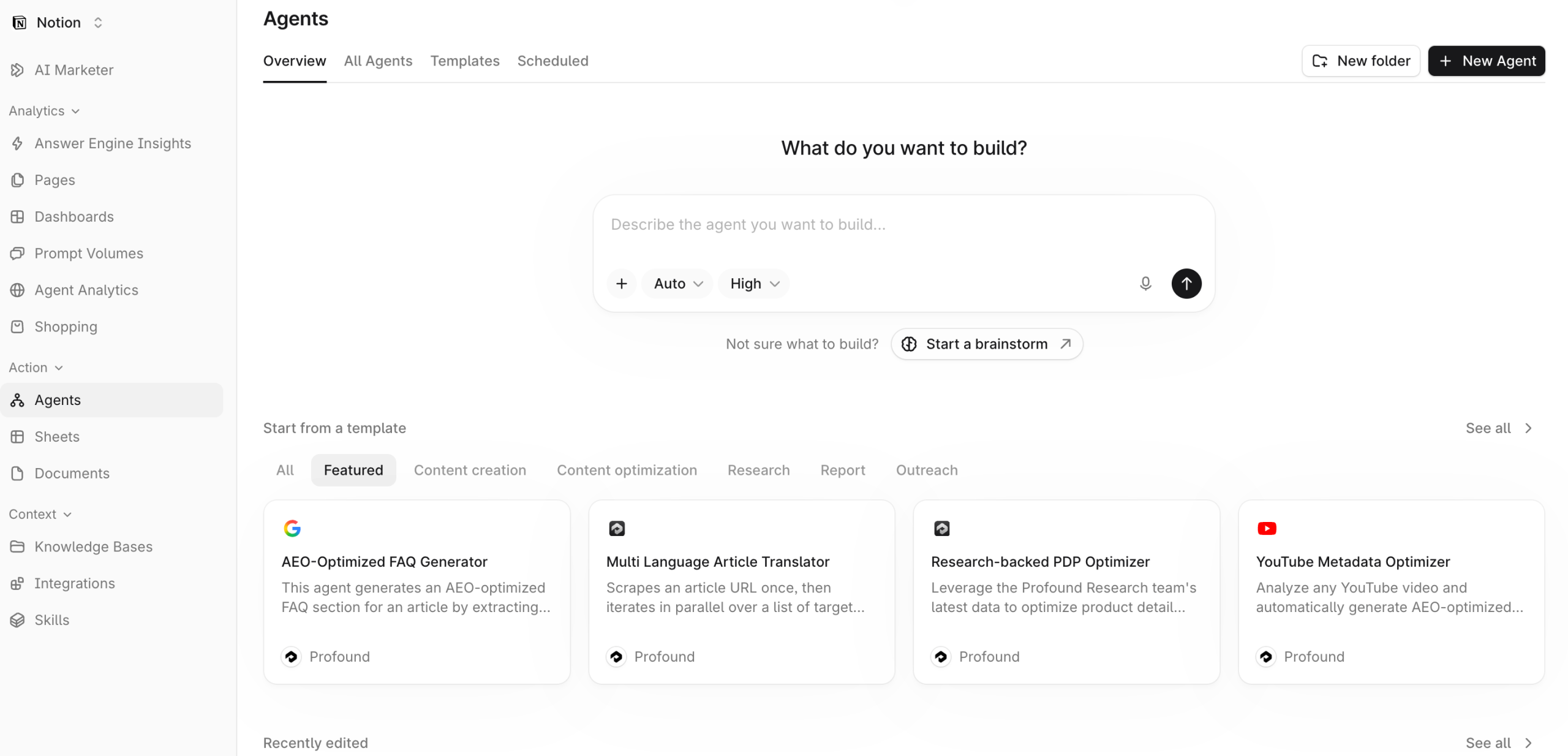
The part that matters for AEO quality happens before a word is drafted. Profound says each Agent first queries 16 reasoning models plus its own prompt data to see what AI engines are currently citing for your topic, then writes to that pattern.
For teams working across many pages or client accounts, Profound Sheets runs the same Agent logic across rows of structured data instead of one page at a time.
Publishing runs through a human approval step before anything ships, and Agents connects to CMS and collaboration tools such as WordPress and Slack, among others, so output lands where your team already works.
Keep in mind, though, that Agent runs are metered in credits, and your monthly allowance is tied to your plan, so heavy production is a budgeting question as much as a setup one.
Does AI Marketer (Aim) turn Profound’s data into action?
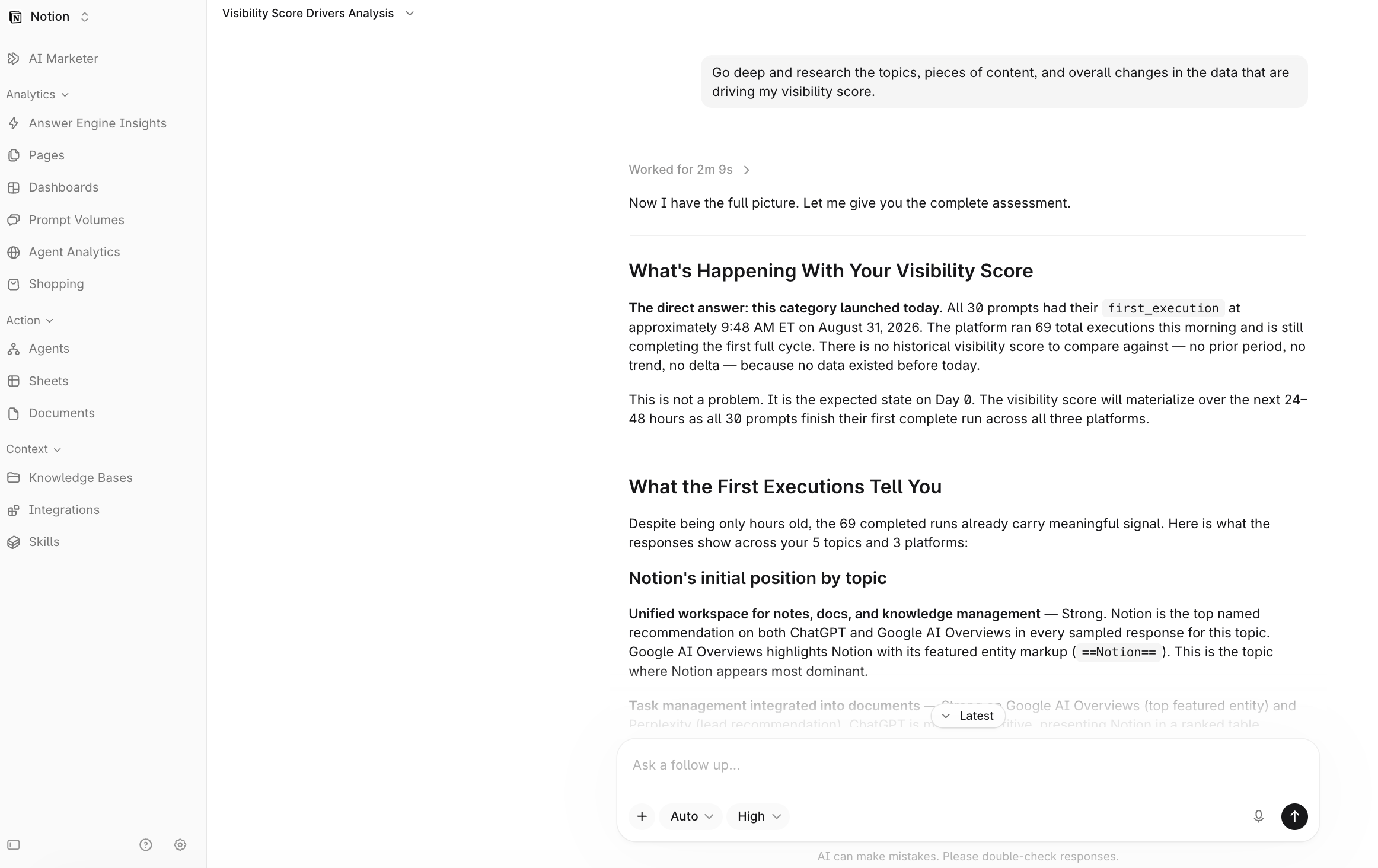
Yes. This is the layer that turns Profound’s data into a decision about what to do next. AI Marketer, which Profound also calls Aim, is a background agent that watches your data and, once a week, hands you a ranked list of opportunities worth acting on, each already worked into a plan. You can also start a Project yourself and let Aim populate it.
Aim runs continuously in the background, drawing on:
- Profound’s own answer-engine data
- The customer’s knowledge base and sitemap
- The competitors Profound already tracks for that account
Once a week, it packages what it finds into Projects: specific, data-backed execution briefs rather than vague alerts. A Project might flag:
- A visibility gap opening up in one answer engine
- A sentiment drop on a tracked brand mention
- Prompt volume a competitor is capturing that the brand isn’t
- Content showing signs of decay against newer AI-citation patterns
From there, Aim hands the Project straight to Profound’s Agents to execute, with a conversational co-work mode and shared Documents and Skills layers available for anything that needs a person in the loop. Keep in mind, though, that AIM is Enterprise-only.
How much does Profound cost, and who actually fits each tier?
Profound publishes two self-serve tiers, $99 and $399 a month, then reserves Enterprise for a custom quote.
Starter at $99 a month covers ChatGPT tracking only, capped at 50 prompts. Growth costs $399 a month and expands coverage to three answer engines with 100 prompts tracked, per the same source. Enterprise includes up to 9 answer engines, custom prompt tracking, SSO/SAML + SOC2 compliance.
All plans include agents, but limited at 100 credits/month in Starter and 400 credits/ month in Growth.
Profound also offers agency pricing:
- Agency Growth at $99/month + add-ons
- Agency Enterprise with custom pricing
One additional Client Workspace will cost you for $399/month.
Five additional Trial Workspaces come at $199/month.
FAQ
What are the best Profound AI alternatives?
SE Visible by SE Ranking is one of the alternatives worth considering. Its Brand Visibility Dashboard reports the core signals, visibility score, average position, and net sentiment across ChatGPT, Gemini, AI Mode, AI Overviews, and Perplexity. All LLMs are included in every thies. Another options are Scrunch AI, Peec AI, Otterly.
For a fuller side-by-side breakdown, see Profound alternatives worth evaluating.
Does Profound offer a free trial?
Yes. You can try it for free for 7 days with the Growth plan. But it won’t give you access to features like Prompts Volumes or Shopping.
Profound’s case comes down to scale. If your team needs deep, multi-engine AI-visibility data and the budget to act on it, the full stack earns its place. At the same time, the engines you can track and the features that turn data into action are mostly gated behind more expensive plans.
If you’re still deciding, it’s worth checking out alternative option and SE Visible by SE Ranking is one of them. This is a standalone AI brand-visibility platform that tracks how your brand shows up across ChatGPT, Gemini, Google AI Mode, AI Overviews, and Perplexity, pulling mentions, share of voice, sentiment, and the sources shaping those answers into one dashboard. All five engines are included on every plan, with no engine add-ons or model tiering, and the data refreshes daily and down to a specific country, city, or region.
You can check where your own brand currently stands in AI answers with SE Visible‘s Brand Visibility Dashboard (a 10-day free trial is available and doesn’t require a credit card) before committing either way.