


Comprehensive analysis of the best Profound alternatives for the modern CMO

Your brand could be cited in thousands of ChatGPT conversations today, influencing purchase decisions, without a single session appearing in Google Analytics. As search behavior migrates to zero-click AI answers, traditional SEO tools are going blind. Organic traffic is disappearing into a “black box”, leaving marketers with limited visibility.
Profound has established itself as the leader for the AI visibility category. With significant backing ($35 million Series B led by Sequoia Capital), Profound has positioned its platform as the definitive “read/write” operating system for the AI web. It offers robust capabilities, from analyzing server logs to detect AI crawlers (Agent Analytics) to tracking visibility across search engines. For Fortune 500 entities with vast resources, Profound serves as a centralized command center.
However, the market is nuanced, and a single enterprise solution rarely satisfies the diverse needs of the entire industry. Agencies, mid-market brands, and agile marketing teams are increasingly identifying friction points with the incumbent. Consequently, the search for Profound alternatives has accelerated.
How do leading GEO platforms compare?
| Platform | Strategic focus | Primary differentiator | Pricing model | Best for |
|---|---|---|---|---|
| SE Visible | Integrated SEO/GEO | Source detection & SEO data fusion | Add-on Subscription | SEO Agencies transitioning to AEO |
| Brandlight | Reputation & Governance | Governance prompts & entity control | Tiered + Service Fees | Corp Comms & Brand Safety Teams |
| GetCito | Technical Infrastructure | Open Source & Self-Hostable | Free / Low Monthly | Developers & Tech SEO |
| Scrunch AI | Technical Infrastructure | AXP “Shadow Site” Technology | Monthly | CTOs & Tech-Forward Marketers |
| ZipTie.dev | Tactical Content Ops | Granular “Success Scores” | Credit/Check Based | Content Operations & Editors |
| Ahrefs Brand Radar | Market Intelligence | Massive backlink/search data index | Integrated Suite | Existing Ahrefs Ecosystem Users |
| Peec AI | Monitoring | Simplicity & low entry cost | Low Monthly (€89) | Startups & SMBs |
| Advanced Web Ranking | Reporting Scale | White-label flexibility | Volume/Keyword Based | Reporting-Heavy Agencies |
What are the key selection criteria for a Profound alternative?
Selecting the right tool requires clarity of the metrics that matter in a search environment. Unlike traditional SEO, where a ranking is relatively static, AI responses are generated dynamically. Therefore, the criteria for selecting a Profound alternative must prioritize depth and actionability over simple metrics.
Coverage breadth: The multi-model reality
Profound competitors must recognize that the user journey is fragmented. A B2B software buyer might research Perplexity for its citation accuracy, while a consumer might use Google AI Overviews for quick answers. The tool must support a diverse array of engines, including:
- ChatGPT
- Google AI Overviews
- Perplexity
- Claude
- Gemini
- Microsoft Copilot
Tracking one search engine no longer works as “search everywhere” becomes the norm.
Types of metrics: Moving beyond the mention
Raw mention counts are vanity metrics in the world of Answer Engines. A sophisticated Profound competitor must offer multidimensional analysis:
- Citations vs. Mentions. There is a critical difference between being mentioned in a list and being cited as the authority for a claim. High-quality alternatives track the specific URLs that LLMs use as sources.
- Sentiment and positioning. Understanding how the brand is described is paramount. Is the sentiment positive, neutral, or negative? Is the brand positioned as a cheap option or a premium leader? Tools like SE Visible excel here.
- Prompt-level granularity. The tool should distinguish between informational prompts (“What is CRM?”) and commercial prompts (“Best CRM for enterprise”).
Still, not all Profound competitors offer these features, and this can influence your success.
Actionability: From insight to execution
The distinction between monitoring and optimization is vital. Some platforms are purely diagnostic—they tell you visibility is down. Profound competitors offer workflows that bridge the gap to execution. This includes generating content briefs based on winning answers, validating schema markup to ensure entity recognition, or identifying specific third-party reviews that need optimization to influence the LLM.
Pricing transparency and scalability
Profound’s custom enterprise pricing creates friction for scaling agencies. Cheaper alternatives to Profound should ideally offer transparent, predictable pricing models: per-prompt, per-project, or per-credit. Scalability is also a factor. Agencies need to know that adding a new client won’t require a complex contract negotiation.
User-friendliness and scalability
The Time to Value metric is critical. Enterprise tools often require weeks of setup and integration. Best Profound competitors like Peec AI or ZipTie allow for immediate self-service onboarding, enabling teams to see data within minutes. This usability is often the deciding factor for mid-market agencies that need to move fast.
What are the best Profound alternatives?
Here is a tool-by-tool review of the best Profound alternatives, dissecting their specific strengths, weaknesses, and suitability for different marketing personas.
SE Visible
Overview and standout features
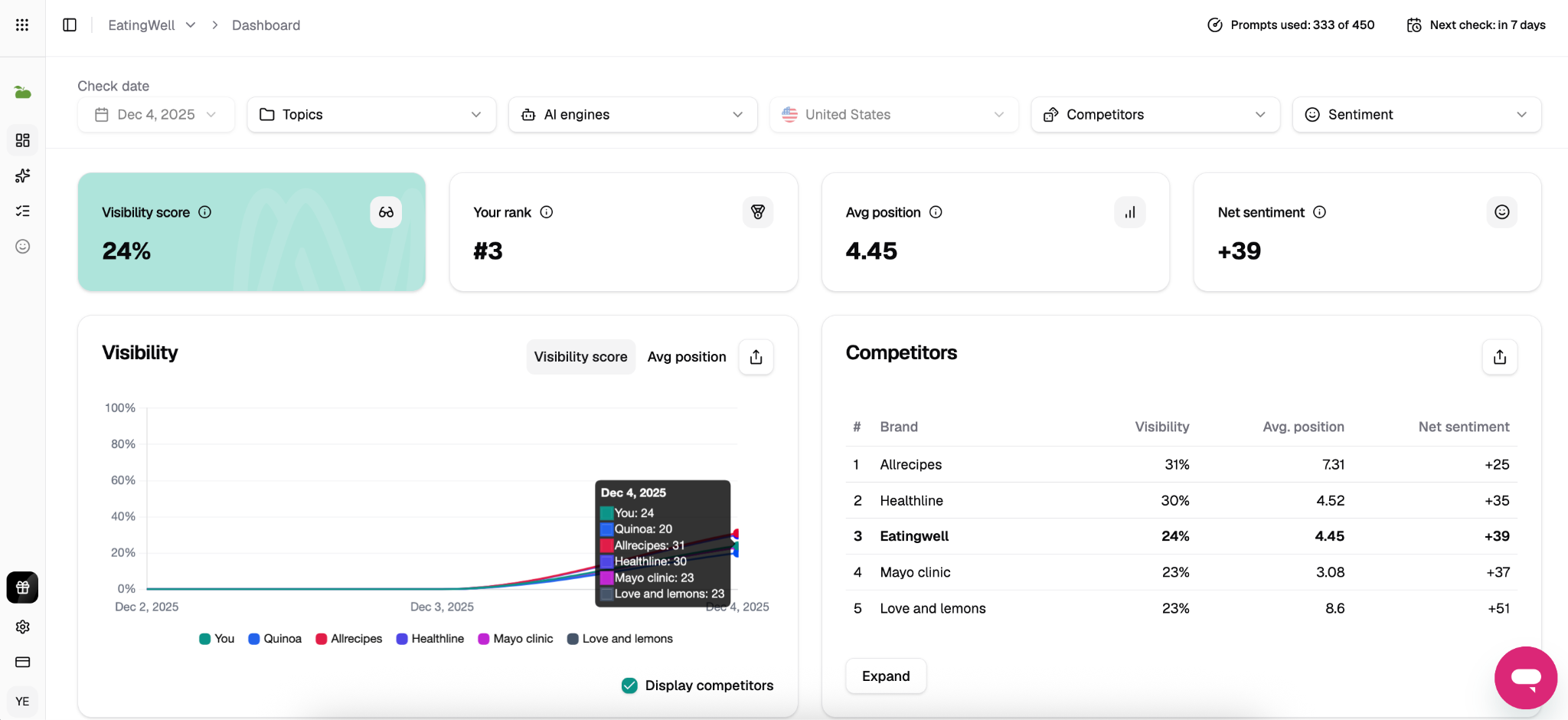
SE Visible is a strong Profound alternative due to its clarity and practicality. The platform offers simple onboarding, intuitive navigation, and weekly refreshed data. Backed by SE Ranking’s reputation for accuracy, SE Visible delivers reliable insights without the complexity or enterprise-only pricing.
The platform shows how your brand appears, performs, and is perceived across real AI-generated answers from ChatGPT, AI Mode, Perplexity, and Gemini. SE Visible provides a high-level, business-ready view of visibility, sentiment, competitor presence, and the prompts shaping those answers.
Key features:
- Cross-platform AI coverage: Track visibility across ChatGPT, AI Mode, Perplexity, and Gemini with real AI responses (not simulations) with weekly data updates.
- Prompt-level insights: Track visibility and sentiment per prompt; use suggested prompts or add your own for tailored monitoring.
- Competitor analysis: See which competitors appear in the same answers, compare visibility share and sentiment side-by-side, and identify gaps you can act on.
- Sentiment tracking: Analyze brand perception with a net sentiment score, highlighting positive, neutral, and negative mentions of your brands and competitors.
- AI sources: Get the list of the domains and URLs AI engines cite most often, so you can prioritize content partnerships and distribution strategies.
For teams that want to move beyond monitoring, SE Ranking’s AI Search Add-on provides optimization features alongside SE Visible’s tracking. SE Visible shows where you stand in AI search; SE Ranking helps you improve those results.
Best for
CMOs, brand leaders, agencies, and marketing teams who want strategic AI visibility insights, simple adoption, scalable monitoring, and dependable data quality without enterprise-tier complexity.
Pros & Cons
Pros:
- Accurate, real-response data from major AI engines
- Clear dashboards and simple onboarding
- Weekly updates for strategic decision-making
- Strong competitive insights
- Transparent pricing
- 10-day free trial to test the platform before committing
- Built by SE Ranking, known for data accuracy in SEO tracking
Cons:
- Focused on monitoring and insights rather than optimization workflows
- CSV export only in the current version
Pricing
SE Visible starts at $189/month (Core plan) for 450 prompts and 5 brands. The Plus plan is $355/month for 1,000 prompts and 10 brands, while the Max plan is $519/month for 1,500 prompts and 15 brands. All plans include unlimited user seats. Users can test the platform with a 10-day free trial.
Brandlight
Overview and standout features
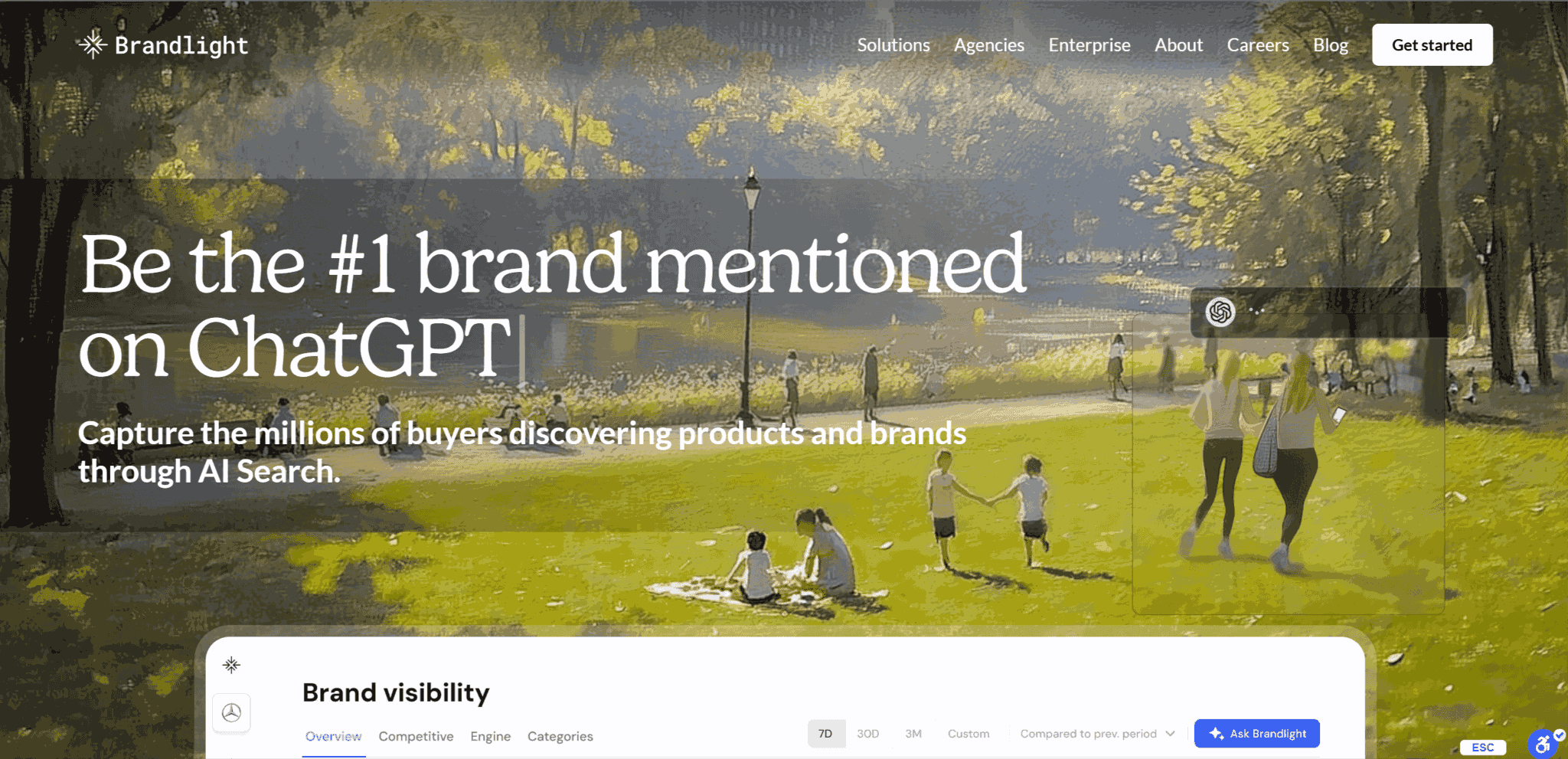
Brandlight distinguishes itself by focusing heavily on the governance and reputation aspects of AI visibility. While other tools focus on traffic, Brandlight focuses on truth. It positions itself as a Profound competitor for the corporate communications sector, where accurate representation is non-negotiable.
The platform emphasizes governance prompts—queries specifically designed to test brand safety, hallucination frequency, and narrative consistency across 11 different AI engines. Furthermore, it offers deep tools for entity management, helping brands structure their data (using advanced schema and JSON-LD) to ensure that LLMs correctly understand corporate hierarchies and product relationships.
Best for
Brandlight is the best Profound alternative for large enterprises in regulated industries, such as finance, healthcare, and pharmaceuticals. Here, a “hallucination” poses a legal risk. It is the tool of choice for the Chief Communications Officer and PR leads.
Pros & Cons
Pros:
- Risk mitigation. Superior capabilities for detecting and alerting on negative sentiment or factual errors in AI responses.
- Broad engine support. Monitoring across 11 engines ensures no blind spots in the reputational domain.
Cons:
- Complexity. The heavy focus on governance and schema may be overkill for a growth marketer whose primary KPI is simply more clicks.
- Service-heavy model. The presence of an activation plan and service fees suggests a model that may require more human intervention than a plug-and-play SaaS.
Pricing
Brandlight pricing plans:
- Entry plan—$199/month
- Activation plan—$750/month
- Enterprise—custom pricing
GetCito
Overview and standout features
GetCito offers an approach where technical teams can inspect and host the code themselves. The GetCito platform is built on three core pillars: AI Visibility Checker, AI Competitor Radar, and AI Crawlability Clinic.
Best for
GetCito is the best Profound alternative for developers, technical SEOs, and privacy-conscious brands. Because it offers a self-hosted version, it is ideal for teams that want full control over their data pipeline or have strict security requirements that prevent them from using shared cloud tools.
Pros & Cons
Pros:
- Open source transparency. You can see exactly how the tool works and customize it to your needs.
- Extremely low barrier to entry. It is one of the few tools with a free “self-host” capability.
Cons:
- Technical requirement. To get the most value (especially from the free/open-source version), you need the technical skills to set up and maintain the software.
- Manual API management. On the self-hosted plan, users must manage their own connections to third-party APIs (like OpenAI), which adds a layer of administrative overhead.
Pricing
GetCito offers the following pricing structure:
- Self Host Plan—free forever
- Starter Service Plan—$299/month
- Scale Service Plan—$499/month
- Growth Service Plan—$999/month
- Enterprise Service Plan—custom pricing
Scrunch AI
Overview and standout features
Scrunch AI enters the market with a provocative technological proposition: the Agent Experience Platform (AXP). Scrunch posits that the current web is optimized for human browsers, not AI agents. Their solution is a shadow site technology. It is a middleware that detects AI crawlers and serves them a simplified, highly structured version of the content, optimized specifically for tokenization and ingestion.
This approach positions Scrunch as a highly technical Profound competitor. Beyond the AXP, Scrunch offers monitoring features, including hallucination detection. It proactively alerts brands when an LLM is fabricating information.
Best for
Scrunch is the top Profound alternative for technical marketers and CTOs who view AEO as an infrastructure challenge. It is particularly well-suited for brands with complex, heavy websites (like Single Page Applications) that might struggle to be indexed by AI bots natively.
Pros & Cons
Pros:
- Innovative infrastructure. The AXP shadow site concept offers a potential shortcut to visibility by bypassing legacy code issues.
- Brand safety. Strong focus on identifying and mitigating hallucinations and misinformation.
- Technical rigor. Appeals to engineering-led marketing teams who want to control the bot experience.
Cons:
- High entry cost. With starting prices around $300/month and no free trial, it is a commitment compared to other alternatives to Profound.
- Efficacy debates. It is unclear whether the shadow site approach is as effective as optimizing the core site.
- Execution gap. It has a lack of integrated content creation tools.
Pricing
Scrunch AI pricing plans:
- Starter plan—$300/month
- Growth plan—$500/month
- Enterprise plan—custom price
ZipTie.dev
Overview and standout features
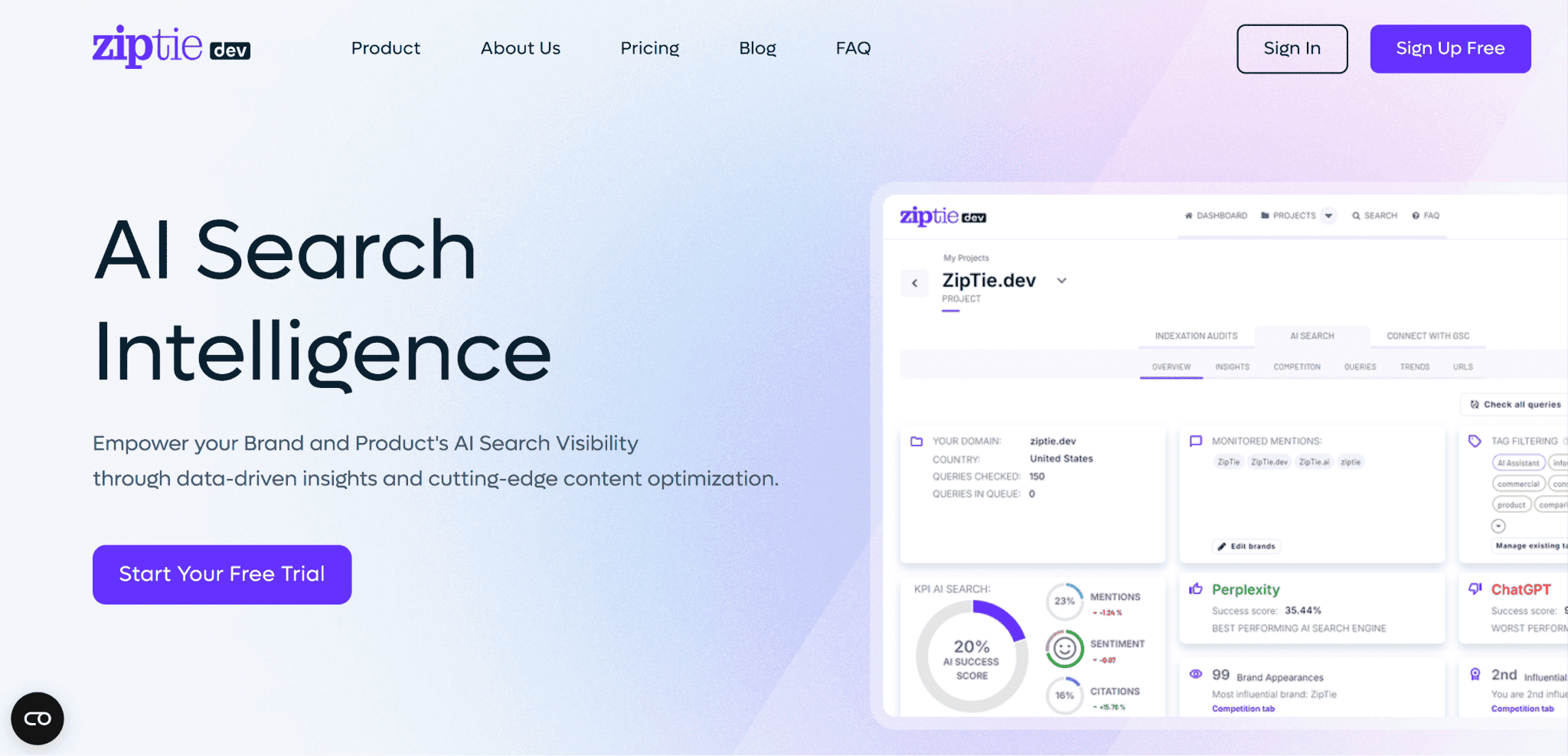
ZipTie.dev is laser-focused on execution and content operations. This platform differentiates itself by providing granular success scores for three specific AI search engines: Google AI Overviews, ChatGPT, and Perplexity.
ZipTie’s standout feature is the content optimization workflow. ZipTie analyzes the SERP and the AI response to generate highly specific recommendations such as required word counts, entity density, and structural changes. It helps a page win the coveted “zero-click” placement. It strips away the vanity metrics to focus on the specific levers that influence visibility.
Best for
ZipTie is the best Profound alternative for Content Operations teams and tactical SEOs who are tasked with recovering traffic lost to Google AI Overviews. It is a tool for “doers” (editors, writers, and optimizers) rather than just “managers”.
Pros & Cons
Pros:
- High actionability. Delivers clear, prescriptive advice on how to rewrite content to win AI placements.
- Focused coverage. Concentrates resources on the three engines that currently drive the vast majority of AI referral traffic.
- Accessible pricing. The credit-based model allows for granular control over spending, making it a flexible, cheaper alternative to Profound.
Cons:
- Narrow scope. It lacks the broad reputation management and sentiment analysis features of Brandlight or Profound.
- Credit consumption. The credit-based model can become expensive for very large sites monitoring thousands of pages daily, as frequent checks deplete the allowance.
Pricing
ZipTie pricing plans:
- Basic plan—$69/month
- Standard plan—$99/month
- Pro plan—$159/month
Ahrefs Brand Radar
Overview and standout features
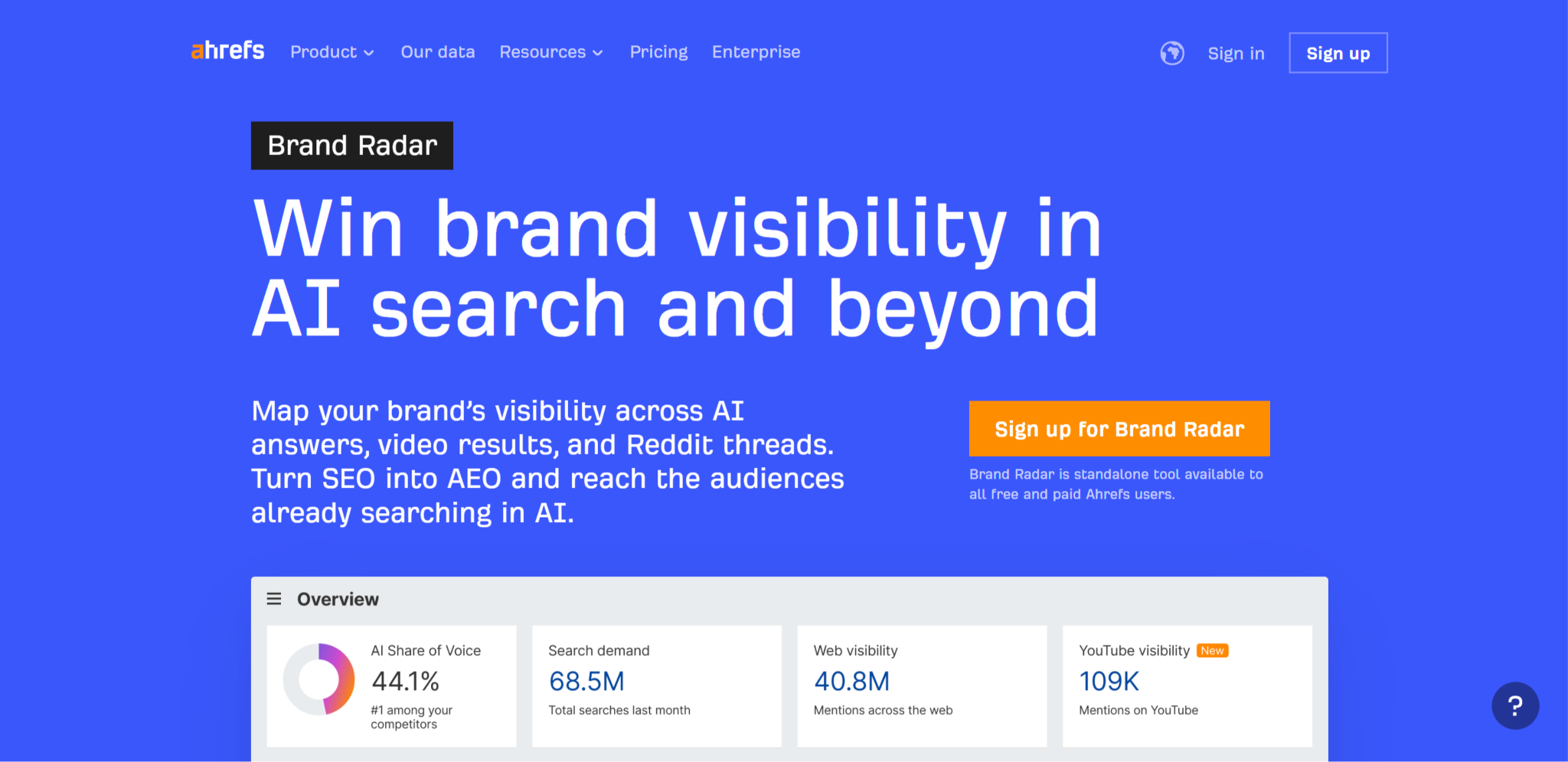
Ahrefs, a titan of the SEO industry, has entered the GEO space with Brand Radar. Unlike the standalone tools listed here, Brand Radar is an integrated component of the massive Ahrefs suite. It uses the company’s proprietary web index (one of the largest in the world) to provide a unique perspective that correlates search demand with web visibility.
Ahrefs’ standout feature is the contextual data. Because Ahrefs already possesses deep data on backlinks and organic traffic, it can overlay AI visibility metrics against traditional SEO metrics. This allows marketers to see if a spike in AI visibility correlates with a rise in branded search volume or backlink acquisition.
Best for
This is the top Profound competitor for any agency or brand that already subscribes to Ahrefs. The ability to access AEO intelligence without onboarding a new vendor or learning a new UI is a gain.
Pros & Cons
Pros:
- Data scale. Powered by a crawler infrastructure that rivals Google’s in some aspects, providing immense data depth.
- Ecosystem integration. Seamlessly connects AI visibility data with authority metrics like Domain Rating (DR) and backlinks.
- Cost efficiency for users. For existing customers, the integration provides high value without a separate contract.
Cons:
- Add-on costs. While some functionality is included, full AI tracking is often a paid add-on (~$199/mo per index), which can strain budgets.
- Beta feel. As a newer module in a mature product, some users feel the features are less specialized and “deep” than purpose-built tools like ZipTie or Profound.
Pricing
Ahrefs offers the following pricing plans:
- Lite: $129/month
- Standard: $249/month
- Advanced: $449/month
There is no separate trial specifically for Brand Radar, but Ahrefs as a whole sometimes offers a 7-day trial for $7 or similar deals.
Peec AI
Overview and standout features
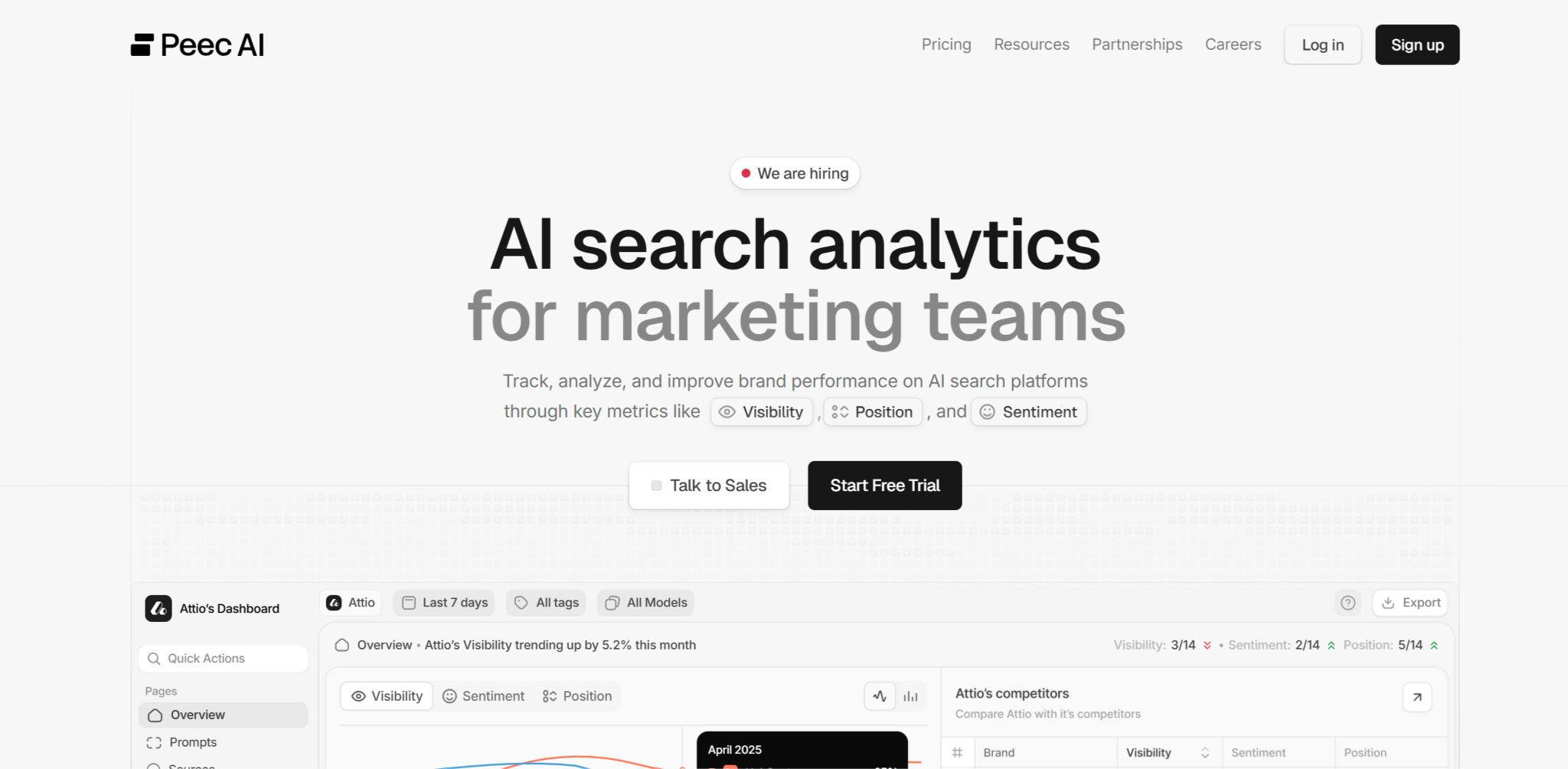
Peec AI positions itself as the democratizer of the GEO space. It strips away the complex technical forensics of Profound to offer a clean, streamlined monitoring solution. Peec focuses on the “Big Three” (ChatGPT, Perplexity, Google AIO) and excels in visualizing data simply for stakeholders.
For those specifically searching for Peec AI alternatives, the motivation is usually a need for deeper technical data or broader engine coverage (like Claude or DeepSeek). Peec limits it in the lower tiers. However, as a Profound alternative, Peec shines by being the most accessible on-ramp to AI visibility.
Best for
Peec AI is the best Profound alternative for startups, small agencies, and solo marketers who need to track visibility but cannot justify a four-figure monthly spend.
Pros & Cons
Pros:
- Accessible pricing. With an entry point of €89/mo (approx $99), it is one of the most accessible tools on the market.
- User experience. Highly intuitive interface that requires zero training to interpret.
- Competitor benchmarking. Excellent visual comparisons of share-of-voice against rivals.
Cons:
- Depth limitations. It lacks the log file analysis and deep technical infrastructure of Profound.
- Scaling costs. Costs can ramp up if you need to add many additional engines or prompts, with add-ons required for engines beyond the core set.
- Actionability. It tells you where you are but offers fewer tools to fix it.
Pricing
Peec AI offers the following pricing plans:
- Starter: €89/month (25 prompts)
- Pro: €199/month (100 prompts)
- Enterprise: starting at €499 (>300 prompts)
A free trial is available. Pricing is significantly less than enterprise-class, so Peec is more of a mid-level option.
Advanced Web Ranking (AWR)
Overview and standout features
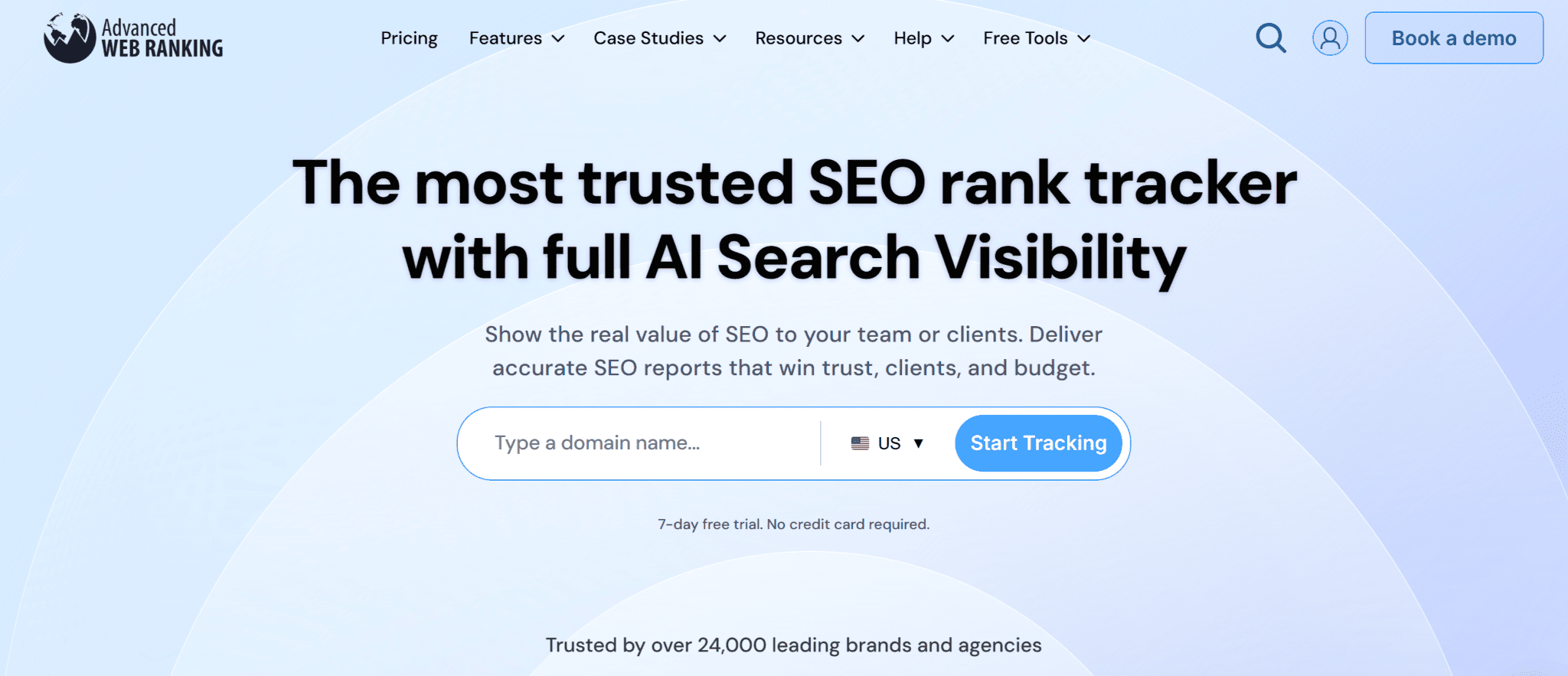
Advanced Web Ranking is a legacy player that has successfully pivoted to include AEO tracking. AWR treats AI visibility as another SERP feature. It allows agencies to track AI Overviews alongside Local Packs, Featured Snippets, and traditional rankings in a single view.
AWR’s standout capability is reporting. AWR offers a white-label reporting engine. Agencies can produce pixel-perfect, branded PDFs that show a client their total search dominance, combining Google Rank, Maps presence, and AI visibility. This makes it a powerful tool for client retention.
Best for
AWR is the best Profound competitor for large agencies managing hundreds of clients, where reporting efficiency is the primary operational bottleneck. It allows for scalable, automated communication of value.
Pros & Cons
Pros:
- Unlimited scale. The pricing model (based on keyword units) allows for unlimited projects and users, a massive advantage over per-seat pricing.
- Reporting power. Unmatched white-label capabilities for agency client communications.
- Unified view. Presents AI data as part of the broader search landscape, not a silo.
Cons:
- Lack of “Why”. It excels at tracking presence (“You are in the AI Overview”) but offers less insight into the why (sentiment, entity gaps) compared to Brandlight or Profound.
- Update frequency. On-demand updates can be slower or resource-intensive compared to real-time tools.
Pricing
Advanced Web Ranking offers the following pricing plans:
- Pro—$139/month
- Agency—$279/month
- Enterprise—$699/month
- Ent plus 50k—$980/month
What are the future trends in GEO / AI-Search visibility?
As we look toward 2026, the criteria for choosing a Profound alternative must account for the rapid evolution of the medium. The market is moving away from passive monitoring toward active, agentic optimization.
The rise of agentic SEO and structured data
Agentic SEO is the future—optimizing content not just to be read by an AI, but to be acted upon by an AI Agent. Future searchers will ask agents to “Book me a flight” or “Buy a CRM subscription”. Tools like Brandlight and Scrunch AI are already pivoting towards this by emphasizing structured data layers and machine-readable site architectures. We expect Profound competitors to increasingly compete on their ability to validate schema for transactional agent actions.
The convergence of Share of Voice and Share of Sentiment
In the probabilistic web, visibility is binary, but value is qualitative. A mention in a list of the worst tools is a negative visibility event. Future reporting will weigh visibility heavily by sentiment. Top Profound alternatives will likely incorporate more advanced NLP to grade the quality and context of the mention, effectively merging PR monitoring with SEO tracking. The sentiment score will become as important as the visibility score.
The hybrid toolkit becomes standard
The artificial separation between SEO and GEO will no longer exist. The user journey is fluid as a user:
- Searches Google;
- Sees an AI Overview;
- Clicks a citation;
- Verifies the information on ChatGPT.
Consequently, the best Profound alternatives will be those that integrate seamlessly with broader marketing stacks (like SE Visible), rather than standing alone as isolated point solutions.
Conclusion
The market for AI visibility tools has matured rapidly, offering a diverse array of Profound alternatives that cater to specific business needs. The idea that AI intelligence requires enterprise pricing is outdated. The best tool is entirely dependent on the organizational objective.
Which Profound alternative should you try?
- For the hybrid agency. If your agency is deeply rooted in SEO and wants to expand into AEO without breaking the workflow, SE Visible (SE Ranking) is the logical choice. They offer the best balance of data integration and cost.
- For the content ops team. If your primary goal is to win traffic from Google AI Overviews through tactical content updates, ZipTie.dev is the superior, focused tool. Its success score is unmatched for pure execution.
- For PR and corporate communications. If your concern is brand safety, crisis management, and narrative control, Brandlight offers the governance depth that pure SEO tools lack. It is the robust Profound competitor for the C-Suite.
- For the budget-conscious challenger. If you need to track visibility to prove ROI but have a limited budget, Peec AI serves as an excellent, cheaper alternative to Profound.
- For the tech-forward enterprise. If you buy into the theory of a shadow web for AI Agents and want to future-proof your infrastructure, Scrunch AI offers a differentiated path.
Define your goal. Is it monitoring (knowing where you stand), optimization (changing where you stand), or protection (ensuring you are represented accurately)? Profound attempts to do all three at a premium. Cheaper alternatives to Profound analyzed here allow you to pay for exactly the capability you need, often with greater agility and transparency.
FAQ
- Is there a free Profound alternative?
Yes. Ahrefs Brand Radar includes significant functionality within its standard plans for existing users, and Peec AI and ZipTie offer robust trial periods.
- What is the best alternative to Profound in 2026?
While “best” is subjective, SE Visible is a strong contender for best overall due to its massive data infrastructure and rapid feature iteration. However, for pure reputation governance, Brandlight is positioning itself uniquely for the future of Agentic reputation management.
- Can I use a GEO tool together with classic SEO tools?
Absolutely, and you should. The most effective strategy is the hybrid approach. Use a classic SEO tool (like SE Ranking) to handle technical site health and backlink authority. Then, layer a GEO tool (like ZipTie or Profound) to optimize the specific last mile of content formatting and entity clarity that LLMs require for citation.
- Do I still need traditional SEO if I focus on AI visibility?
Yes. LLMs are trained on the open web. High-ranking content in traditional search is more likely to be included in an LLM’s training data. Furthermore, Authority (backlinks) remains a primary heuristic for LLMs when deciding which source to cite. Therefore, traditional SEO is the foundation upon which successful GEO is built. A Profound competitor like SE Visible explicitly links these two disciplines for this reason.