AI Brand Sentiment Tracking you can explain, not just report.
See how ChatGPT, Gemini, Perplexity, Google AI Mode and AI Overviews describe your brand — positive, neutral or negative — and which cited sources sit behind each shift. That turns AI brand sentiment tracking into something you can talk through in a client review, instead of another number on a dashboard.
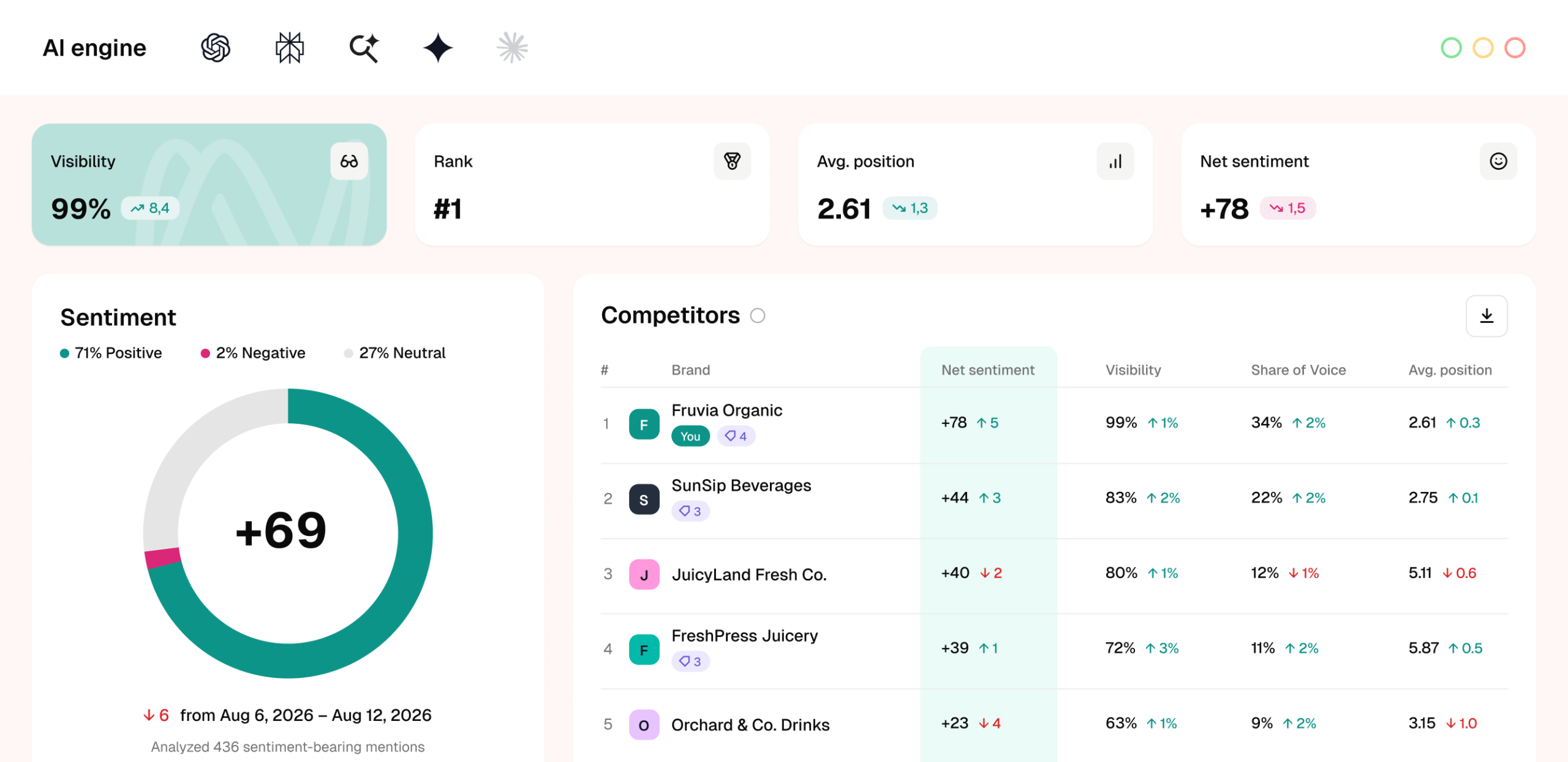
From a sentiment score to the reason behind it
Sentiment on its own is one more metric, and that is not what you are short of. Read next to the prompts that produced it and the sources the engines cited, it starts explaining what is moving across your search and answer layers.
Say how AI describes you, not just that it mentions you
Mention counts confirm the brand came up. They do not say whether the answer recommended it, hedged, or steered elsewhere. Sentiment puts a name on that difference.
Point at what is driving the description
A negative read with no cause attached is a finding you cannot act on. SE Visible ties sentiment to the prompts and cited sources it came from, so the finding arrives with a lever.
Show whether it is your problem or the category's
One brand's sentiment in isolation settles little. Set against the competitors returned by the same prompts, it points at either your messaging or your sources.
AI brand sentiment analysis that arrives with the cause attached
Polarity is the part that is straightforward to measure. What produced it — which prompts, which cited sources, and how it reads next to the brands beside you — is the part that decides whether you can do anything about it.
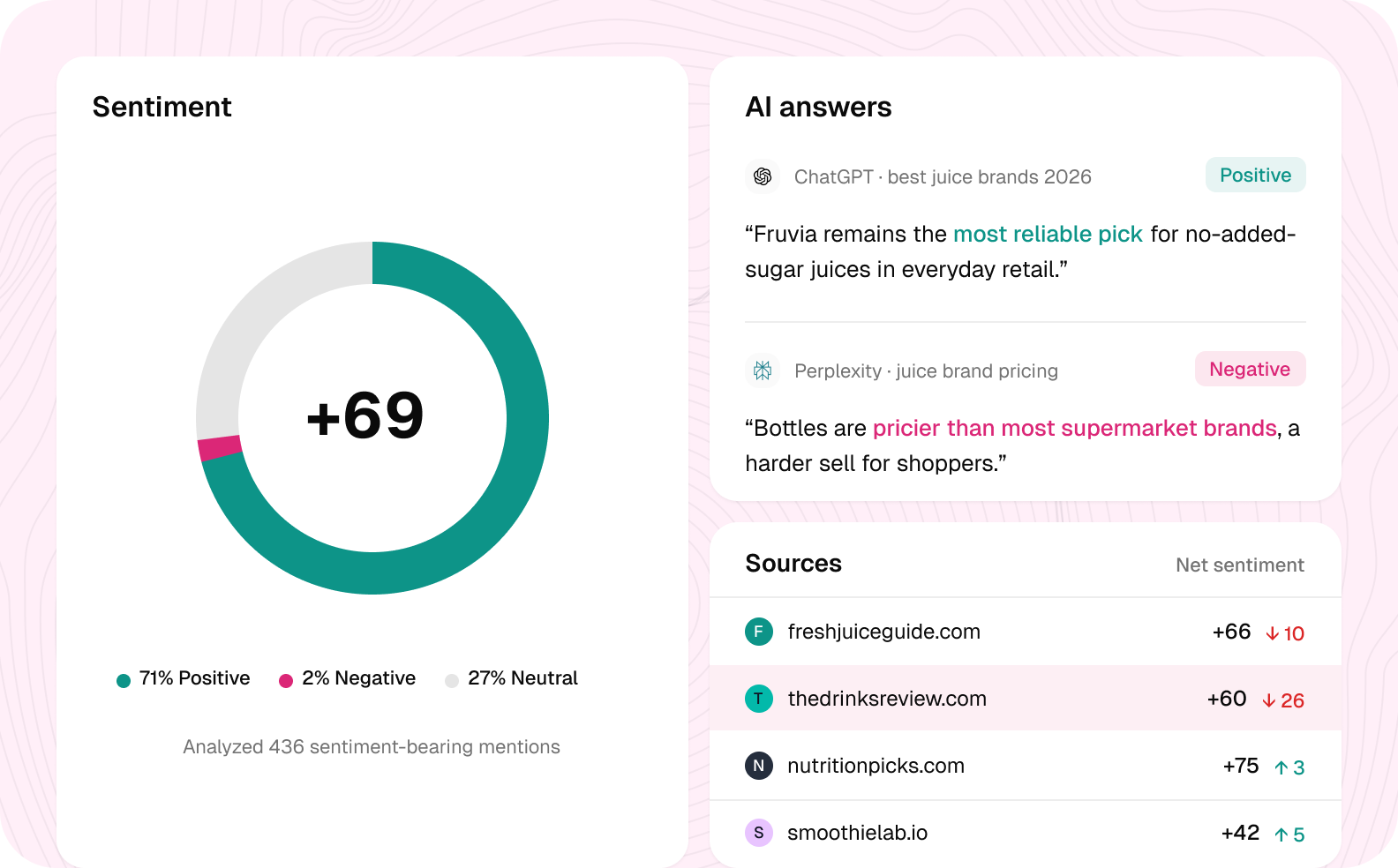
See how AI describes your brand right now
Each answer is scored as positive, neutral or negative, so you see the balance of how the brand is currently framed rather than one blended average.
The score stays attached to the answer text it came from, so you can read the wording an engine actually used instead of inferring it from a number.
Because polarity is read from the answer rather than from your own site, the picture reflects what a buyer is shown, not what you published.
Visibility by platform
Each sentiment reading is linked to the sources the engine cited, so a negative pattern resolves into a named page instead of a mood.
With the cited sources visible, a stale review roundup is distinguishable from a competitor's comparison page — two findings that call for different work.
The source list is where the work lands: outreach, a content correction, or a request to the publisher all need a named page to aim at.
Benchmark perception against competitors, and date the shifts
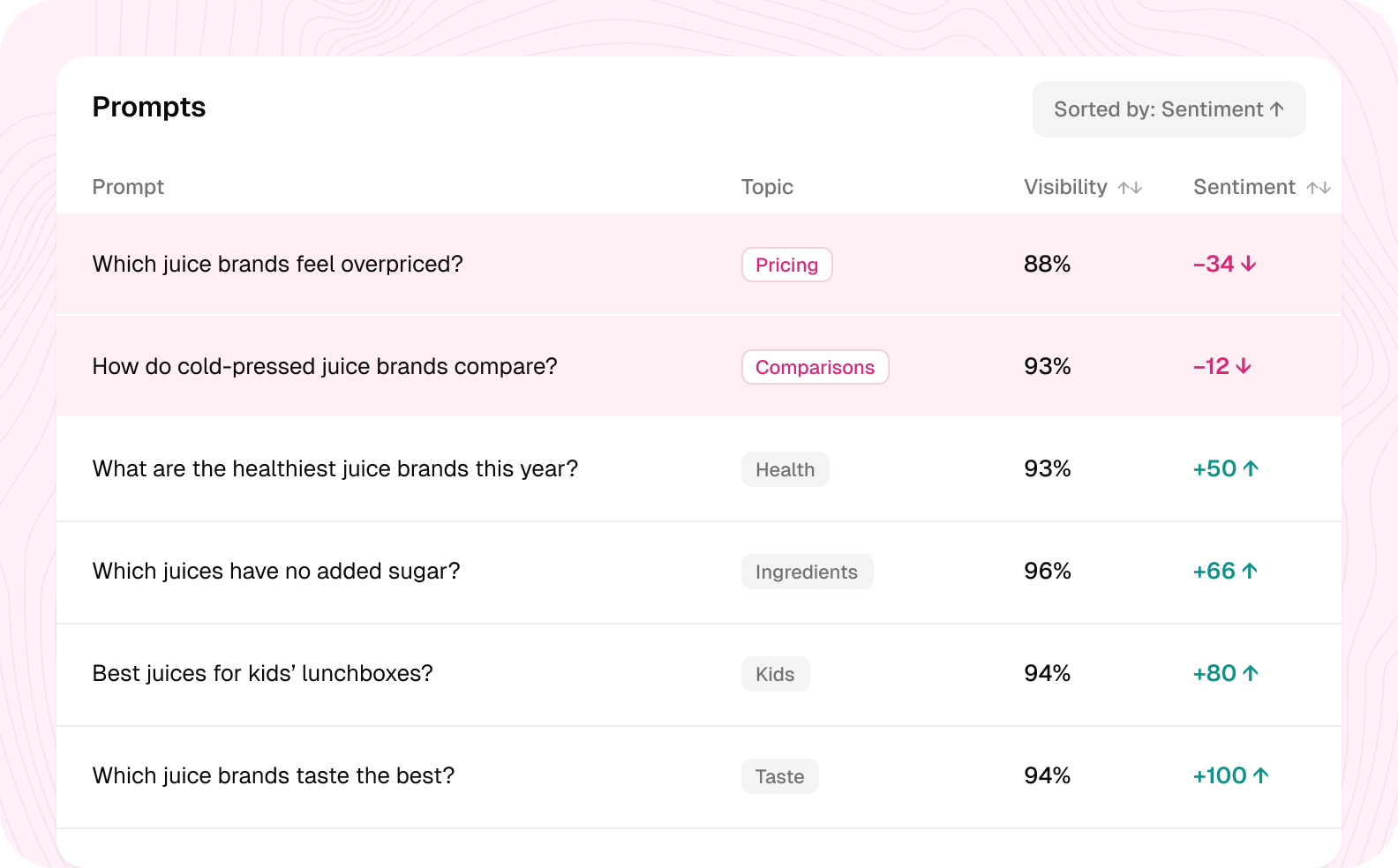
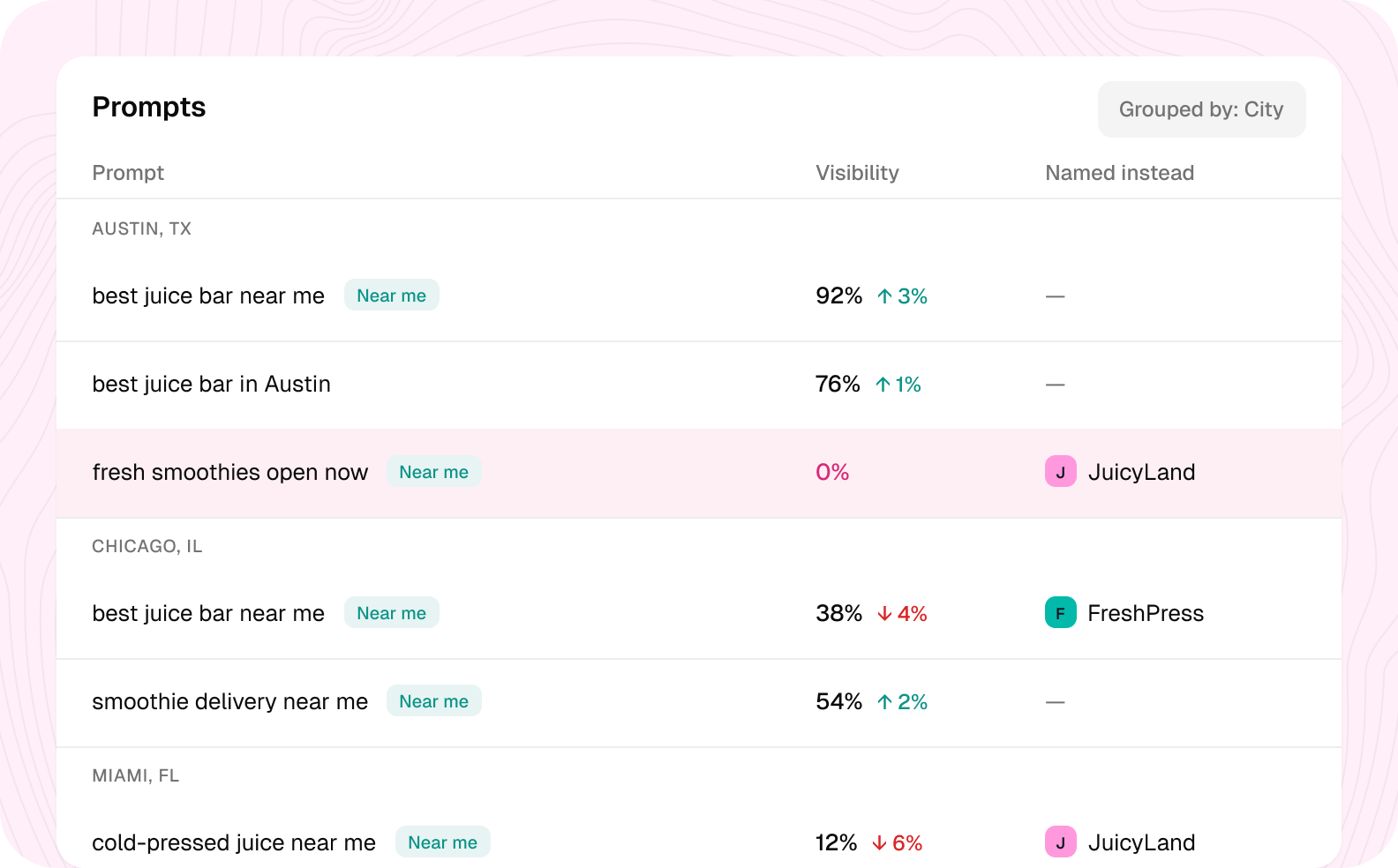
Prompts are tracked one by one, so a "near me" query and the same query with a city name in it stay two separate reads instead of one blended local score.
Competitive benchmarking scores the other brands your prompts return on the same scale, with share of voice and citation share beside it, so AI brand perception reads as a position rather than an impression.
Sentiment is re-scored on a set cadence and each historical point keeps its cited sources, so a shift arrives as a dated trend you can line up against the week a roundup was published.
Read alongside organic rankings from SE Ranking and traffic from GA4, that shift stops being an isolated metric — you can see whether the answer layer moved before the search layer or after it.
Find out which sources are shaping your sentiment today
A trial project scores your brand across ChatGPT, Gemini, Perplexity, Google AI Mode and AI Overviews, and shows the cited sources sitting behind each negative read.
Why marketing teams choosing us


Complete AI visibility tool with pricing that works for you
Choose the plan that fits your needs or explore SE Visible with a 10-day free trial
What is AI brand sentiment?
AI brand sentiment is how an AI assistant describes your brand when it answers a question — whether the framing is positive, neutral or negative — rather than whether your brand is mentioned at all. Two brands can appear in the same answer with the same frequency and be described very differently. Tracking it means reading the brand narrative that assistants build across many answers, not scoring one reply. It is a different measurement from social or review sentiment, because the text being scored is generated by a model rather than written by a customer.
How does AI sentiment analysis work?
Sentiment is derived from the answer text an AI engine produces for a tracked prompt. Natural language processing (NLP) classifies the language used about the brand into positive, neutral or negative, and the classification stays attached to the answer it came from so the reasoning is inspectable rather than assumed. This is worth separating from the more common use of the term: most tools described as AI sentiment analysis run classification over text you already own — reviews, support tickets, survey responses. LLM sentiment analysis is the opposite case: the text is generated, you did not write it and cannot edit it, which is why source attribution matters more here than volume does.
Why do ChatGPT and Gemini describe my brand differently?
Because they are drawing on different source mixes, and in some cases on different snapshots of the web. An engine that leans on a comparison roundup will frame you the way that roundup does; one that leans on your own documentation will frame you closer to how you frame yourself. Answers can also vary between runs of the same prompt on the same engine. That variance is the reason sentiment is worth tracking per engine, per market and over time rather than reduced to a single figure.
Can you tell which sources cause negative sentiment?
Yes — each sentiment reading keeps the sources the engine cited for that answer. When a negative pattern recurs, you can see which pages keep appearing behind it, which usually turns a vague reputation concern into a short list of named URLs. What you do with that list is still a judgement call: some are worth an outreach or correction request, some are competitor pages that will not move, and some are your own content saying something you no longer mean.
Which AI engines are covered for sentiment?
ChatGPT, Gemini, Perplexity, Google AI Mode and Google AI Overviews. [VERIFY] Claude and Grok are not covered, and neither is sentiment inside social platforms or review sites — if a brand’s exposure is concentrated in one of those, this will not see it. Coverage of the answer layer is still expanding across the industry, and we would rather name the gap than let you find it mid-trial.
What do I do about negative sentiment?
]Start from the source rather than the score. Because each reading keeps its cited sources, a negative pattern usually traces back to a small number of pages — an outdated comparison, a review roundup, a support thread, sometimes your own documentation. From there the work is ordinary: correct what is yours, approach what is not, and publish the answer to the question the prompt was actually asking. Sentiment will not be removed on demand, and any tool that suggests otherwise is overselling what is knowable about a model’s output.
Who is local AI visibility tracking built for?
It’s for anyone who needs to know whether a specific location shows up in AI answers for its own area — a single business tracking its own city, a chain or franchise covering many, or an agency doing it on behalf of clients. What they have in common is the unit: the question comes down to one location in one place, because that is what a customer’s prompt is about. What changes between them is how many of those they track and how the results need to be grouped — not what is being measured.
Walk into the next client review with the sentiment already sourced
Walk into the next client review with the sentiment already sourced