


8 best AI visibility tracking tools explained and compared

Search is gradually being transformed by AI-powered tools and models. Today, brands must both rank well in conventional web searches and become sources of information that are referenced in AI-generated answers. AI answers draw upon different pieces of content to create a new, fused version of a single reply. Traditional SEO indicators, like ranking on Google’s SERP, do not reveal the entire picture of a brand’s visibility anymore.
Now, AI visibility matters—the number of times and contexts in which your brand is referred to by LLMs. Your task is to ensure that your content is authoritative and present in those AI-driven answers.
What should be regarded as an instrument of AI visibility?
There is no straightforward answer to this. We tested 8 popular AI visibility tools to find out what features they offer and which of them really move the needle.
There are lots of exciting functionalities. What we liked the most can be divided into the following segments:
AI Overview appearance tracking
These AI search visibility tracking tools observe the answers given by the search engines (Google’s AIO/AI Overviews, Bing Chat). They ascertain in what way your brand or URLs come up in the AI-generated answers.
LLM answer presence tracking
The best AI search visibility tools are those that run queries on LLM chatbots (ChatGPT, Anthropic Claude, Google Gemini, Perplexity, etc.) instead of you and keep a record of the number of times and the contexts in which your brand or content is referred to.
AI brand mention monitoring
AI brand visibility tools track the generative answer outputs (from chatbots or search answer engines) to find brand mentions. They notify you of their occurrences (with location and sentiment/context) and present them to you.
AI search ranking & URL detection
These AI search visibility tracking tools rank your pages/prompts. They locate which of your URLs AI is referencing, frequency, citations position, and create an “AI Ranking” metric.
Content optimization (GEO/AEO) tools
Best AI search visibility tools compare your data with the demands of AI search and show inconsistencies in your content. Such tools could perform an audit on the level to which a website is “AI-ready,” suggest new topics/prompts for targeting, and even provide content that is optimized for AI visibility (rewriting pages, creating schemas, etc.).
What additional features to consider in AI visibility tools?
- Competitive AI visibility tracking. Benchmarking against peers is possible when you track competitors’ brands and prompts in AI search. This allows you to find out the places where others are getting the most citations.
- Evidence logs & screenshots. Some software takes the AI-generated raw responses or screenshots of the answer pages and stores them. This not only confirms the visibility but also helps with audits or client reporting.
- API access. An API or data export (CSV/JSON) makes it possible to connect AI visibility data with your personal dashboards or workflows (for example, by automatically feeding the mentions into analytics or custom reports).
AI visibility tracking tools: Comparison table
| AI visibility tracking tool | Key Focus/Unique | AI Platfroms | Starting Price |
|---|---|---|---|
| SE Visible | High-level overview of AI brand visibility for strategic decisions | ChatGPT, Google AIO, AI Mode, Gemini, Perplexity | $189/mo (450 prompts, 5 brands) |
| Ahrefs Brand Radar | Brand-centric insights from a massive AI index | ChatGPT, Google AIO, Claude, Gemini, etc. | $129/mo (Included with Ahrefs account) |
| Profound AI | Enterprise-grade insights + CDN integration | ChatGPT, Perplexity, Google AIO, Copilot, etc. | $399/mo (100 prompts across 3 engines) |
| Peec AI | Easy multi-engine tracking with clean UX | ChatGPT, Google AIO, Perplexity, Claude, Gemini, Copilot | €89/mo (25 prompts, 3-engine) |
| Scrunch AI | Prompt-level, multi-engine monitoring | ChatGPT, Claude, Perplexity, Gemini, Google AIO/Mode, Meta AI | $300/mo (350 prompts) |
| Rankscale AI | Budget AI rank tracking; clear UX | ChatGPT, Claude, Perplexity, Google AIO | $20/mo (480 responses) |
| Otterly AI | Detailed AI GEO audits (25+ factors) | ChatGPT, Perplexity, Google AIO/Mode, Copilot, Gemini | $29/mo (15 prompts, Lite) |
| Writesonic (GEO) | All-in-one content + SEO + AI monitoring | ChatGPT, Google AIO, Claude, Gemini, Perplexity | $249/mo (Professional plan) |
8 best AI visibility tools to use in 2026
1. SE Visible
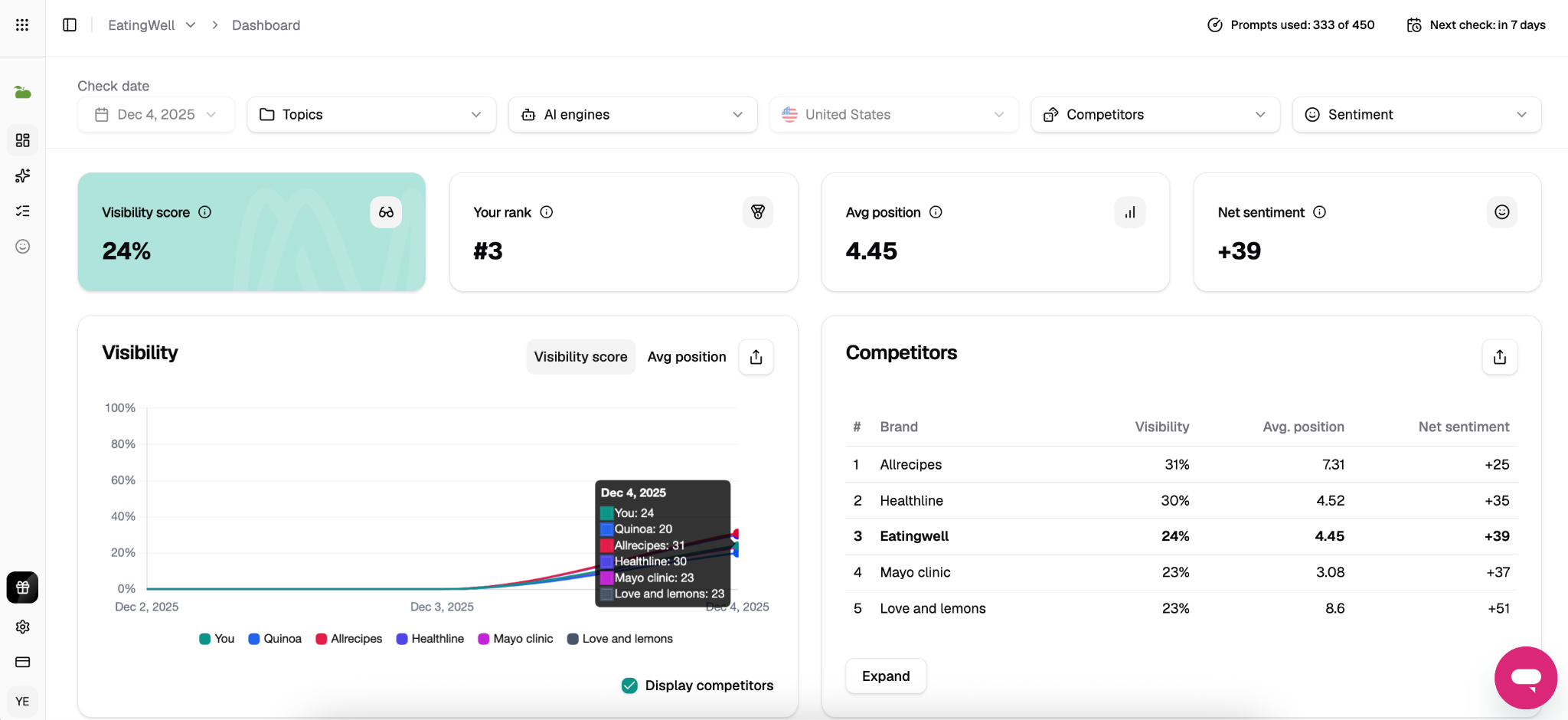
SE Visible is one of the most accurate and user-friendly AI visibility software solutions on the market. It gives you a clear, strategic view of how your brand appears across AI search systems like ChatGPT, Perplexity, AI Mode, and Gemini. You can see where your brand ranks, how often you’re mentioned compared to competitors, whether those mentions carry positive or negative sentiment, and more.
SE Visible draws on SE Ranking’s 13+ years of data accuracy to deliver dependable insights, but stays focused solely on AI visibility.
The platform simplifies AI visibility tracking with ready-made metrics and clear data visualization, so you don’t need technical expertise to understand your performance. Omi Sido, Digital Transformation Lead at Canon Europe, noted just that: “The dashboard is clean, intuitive, and easy to navigate. I particularly like how key metrics (visibility score, rank, average position, and net sentiment) are clearly highlighted at the top. The competitor comparison and sentiment analysis also give a quick, at-a-glance understanding of performance.”
What we liked most:
- Multi-platform visibility tracking: Monitor how often your brand appears across ChatGPT, Perplexity, AI Mode, and Gemini, track your average position, and measure visibility in one dashboard.
- Competitor benchmarking: Identify which competitors show up alongside you, where they stand, and how they are presented.
- Sentiment analysis: See whether AI-generated mentions are positive, negative, or neutral and track weekly sentiment shifts with a clear score.
- Prompt insights: Use suggested prompts or add your own and discover what people ask and how AI responds, including visibility, sentiment, and sources for each prompt.
- Source analysis: Identify which domains and URLs influence AI answers about your brand, informing your content strategy.
- Dashboard with filters: Get a complete high-level view with filters for date, region, topic, competitors, sentiment, and AI engine.
If you already use SE Ranking, you can add the AI Search Add-on to combine full AI visibility tracking in SE Visible with SEO and AI optimization tools inside SE Ranking.
Best for:
- CMOs, agency owners, marketing leaders
- Brand marketers who need strategic clarity on AI-driven brand perception and competitive standing.
Pros:
- Real AI answers tracking, not simulations
- Simple onboarding and intuitive dashboards
- Strong data quality inherited from SE Ranking
- Weekly updates for timely insight
- Clear sentiment tracking to catch reputation risks early
- Flexible prompt management
Cons:
- No built-in sharing formats beyond CSV export
Pricing:
- Core: $189/mo for 450 prompts and 5 brands
- Plus: $355/mo for 1000 prompts and 10 brands.
- Max: $519/mo for 1500 prompts and 15 brands.
A 10-day free trial is available.
2. Ahrefs Brand Radar
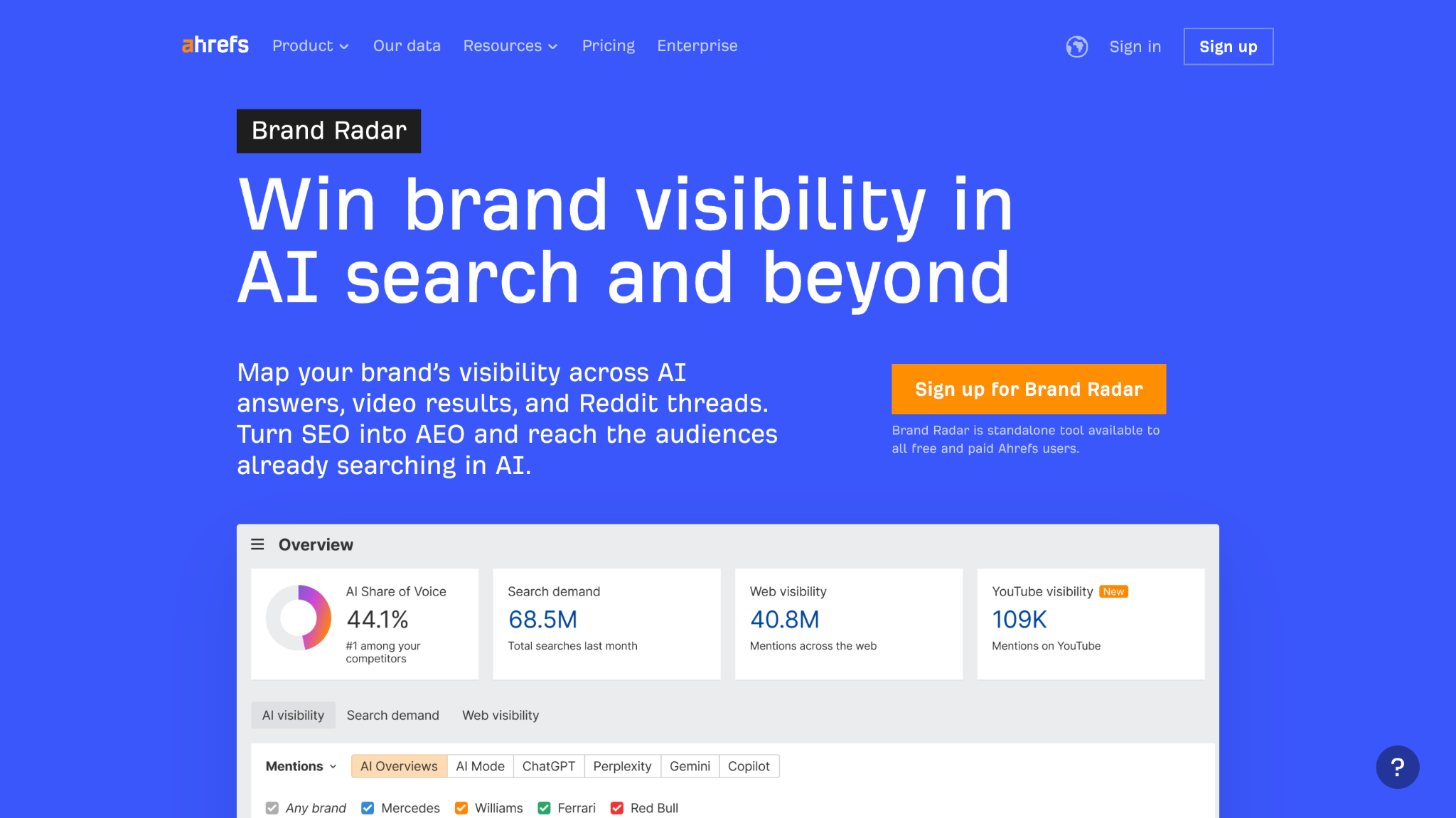
Brand Radar is the AI-visibility dashboard integrated into the Ahrefs platform. It keeps track of an extensive number of AI queries to determine the location and manner in which your brand is mentioned in LLM answers. Users on Reddit love Brand Radar because it’s one of the fastest-growing and promising tools, but also pinpoint it has room for improvement.
What we liked most:
- Huge AI Index. Brand Radar searches the six prompt indexes (ChatGPT, Google AIO, Claude, Gemini, etc.) to process billions of queries without any further action required from you.
- AI Share of Voice & Gap Analysis. Informs you what portion of AI answers feature your brand vis-à-vis competitors, and also the unbranded queries where you get mentions.
- Citation Tracker. Helps you to know which URLs or content are used as a reference by AI. Also, it helps to find the new prompts that we can target to get citations.
- Workflow Integrations. Custom prompts, complex filters, and AI prompts can be routed to your content strategy.
- Multi-Channel Monitoring. Apart from AI answers, Brand Radar gives the related metrics such as Reddit discussions, YouTube mentions, video visibility, etc., that together form a complete brand view.
Best for:
- Companies that are already making use of Ahrefs.
- Teams that concentrate on metrics at the brand level.
- Marketers who want to know about “AI SERPs” without manually configuring prompts.
Pros:
- Immediate AI tracking right from the start.
- Capable of handling very large scale (over 100 million prompts, millions of responses) coming from several AI engines.
- The use of different filters allows the creation of customer scenarios
- Enables comparison with any competitor brand internally.
Cons:
- No content suggestions.
- Though Brand Radar is a complimentary service, an Ahrefs login is necessary.
- It offers rich data, but not automated audits or step-by-step fixes.
Pricing:
Brand Radar comes with any Ahrefs account. An Ahrefs subscription starts at $129/month for the Lite plan.
3. Profound AI
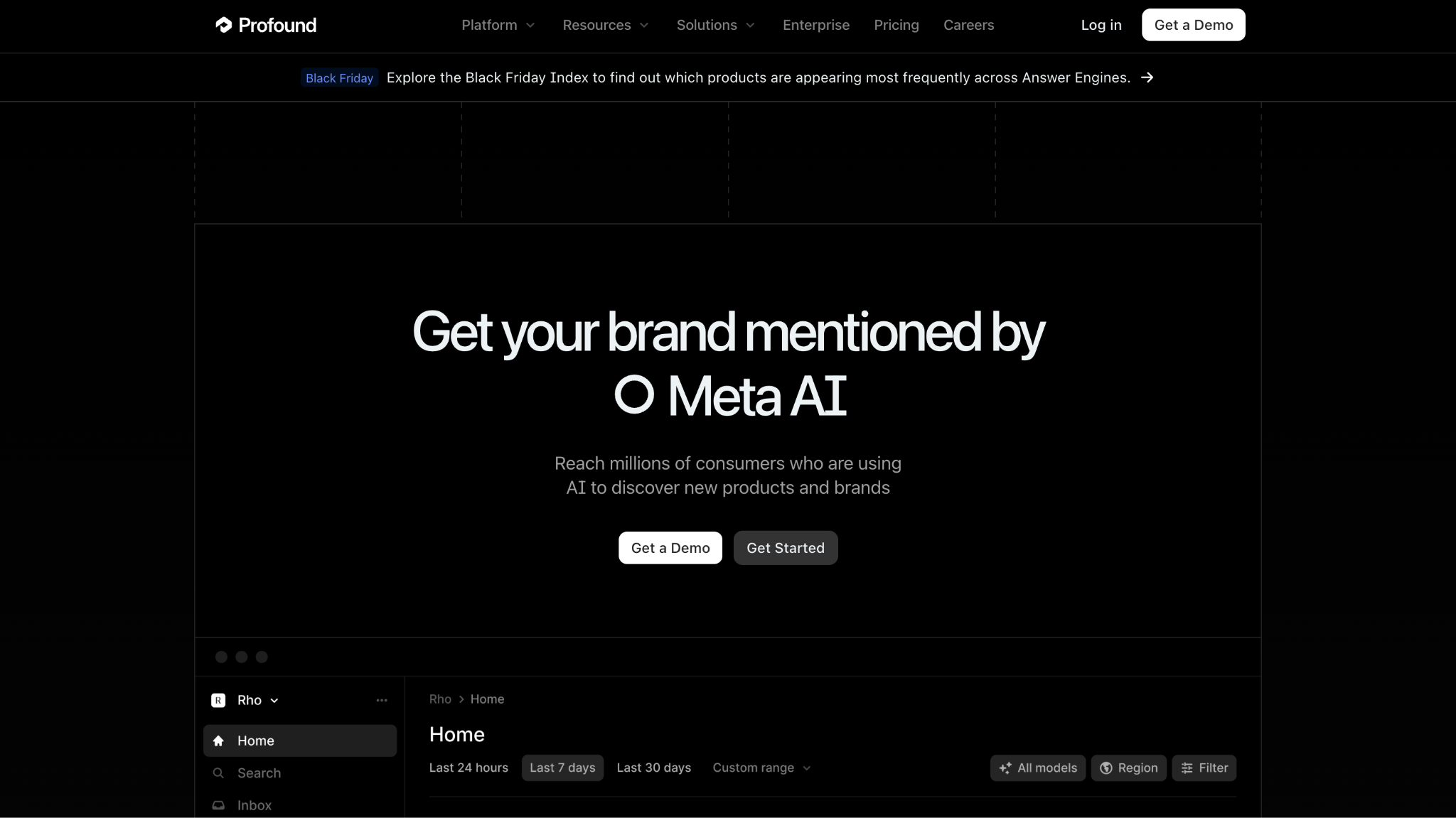
Profound is a top-tier AI search visibility platform for enterprises. The platform is venture-funded and is quite popular with Fortune 100 companies. In contrast to most tools, Profound keeps track of the real user interfaces of AI engines. It monitors your brand on a large source of answers and provides heavy analytics that are made for big sites.
What we liked most:
- Built-in Sentiment & Context. Profound constantly monitors brand mentions that are either positive or negative and automatically displays them in AI results through its detailed dashboards.
- CDN Traffic Integration. Direct links to Cloudflare/Akamai help in figuring out the real human site visits as a result of AI crawler activities.
- Prompt Volume Research. Get to know what kind of questions people are asking AI, enabling you to focus on high-impact queries.
- Competitive Intelligence. In Profound, you can monitor multiple competitors’ mentions and sentiment in AI. “Their competitive benchmarking is insane – you can see exactly how competitors are gaming AI engines,” shares a Reddit user.
Best for:
- Large enterprises and retailers that have strong web/CDN infrastructures.
- Content teams who are going to take the necessary steps based on the data with the presence of dedicated resources.
- Organizations that demand compliance and scalability: SOC2/SSO, role-based access, and an enterprise API for custom workflows.
Pros:
- Very comprehensive.
- The analytics are reliable since they are based on real AI sessions and CDN logs.
- The platform comes with “Workflows” which can be used in content generation and optimization with pre-made documents and API hooks.
- View real-time search-volume trends for AI across different platforms (very few tools provide this).
Cons:
- No way to handle multiple companies from one account.
- It is not possible to customize prompts or competitors in detail.
- The setup produces more insights but fewer DIY options to change.
Pricing:
The Growth plan costs $399/mo and offers 3 answer engines (ChatGPT, Perplexity, Google AIO) and 100 prompts. There is also a comparatively less expensive Starter available at $99/mo with the provision of ChatGPT-only (50 prompts) and a tailor-made Enterprise tier for large organizations.
4. Peec AI
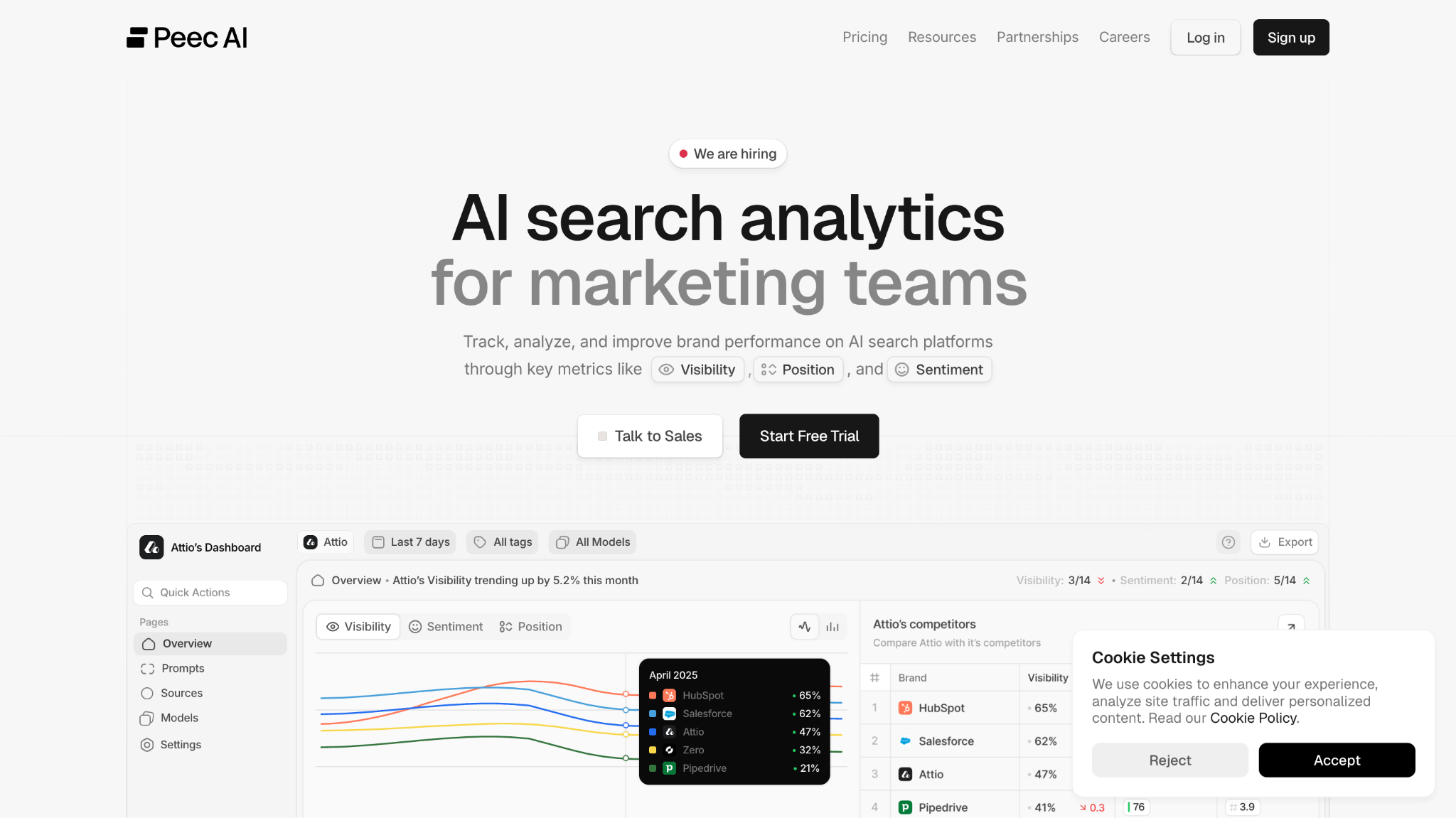
Peec AI is an AI visibility software that keeps track of your questions across all major answer engines. Setting up takes less than 5 minutes, the dashboard is neat, and there are live onboarding sessions. Michael Brito from Zeno says it’s “built to analyze how and why your brand is mentioned in AI results,” focusing on brand presence and sentiment across multiple LLMs.
What we liked most:
- Great UX & Onboarding. Peec is user-friendly and not too complicated. To give you a quick start with your work, it also offers a list of suggested prompts and even the initial session.
- Multi-Engine Coverage. Allows tracking of the user’s visibility at the leading AI answer platforms (ChatGPT, Google AIO, Perplexity, Claude, Gemini, Copilot).
- Sentiment Included. There is a brand sentiment (positive vs. negative mentions) analysis feature incorporated.
Best for:
- Small to mid-sized marketing teams (particularly B2B/SaaS) that value clean dashboards.
- Brands benefiting from great SEO traffic.
- Groups that prioritize sentiment and share-of-voice tools.
Pros:
- Setting up is straightforward (3-minute configuration).
- The sentiment monitoring feature is available in the middle-tier plan (a rare feature at €199/mo).
- The Starter plan allows unlimited users, which is very advantageous for agencies or distributed teams.
Cons:
- Peec serves primarily as a data center. No audit/playbook tool diagnoses problems for you—you obtain the signs (like “Competitor X is ahead on these prompts”) but you have to work out the solutions yourself.
- This AI visibility tool doesn’t provide estimates of how much website traffic the AI-generated mentions are driving.
- The sentiment indicator is simply a figure; you neither get sample responses nor suggestions for improvement.
Pricing:
The Starter plan costs €89 a month (25 prompts, 3 countries, tracking on ChatGPT/Perplexity/AIO, unlimited seats). The Pro plan is €199 per month (100 prompts, 5 countries). There is an enterprise-tier that provides 300+ prompts for €499 monthly.
5. Scrunch AI
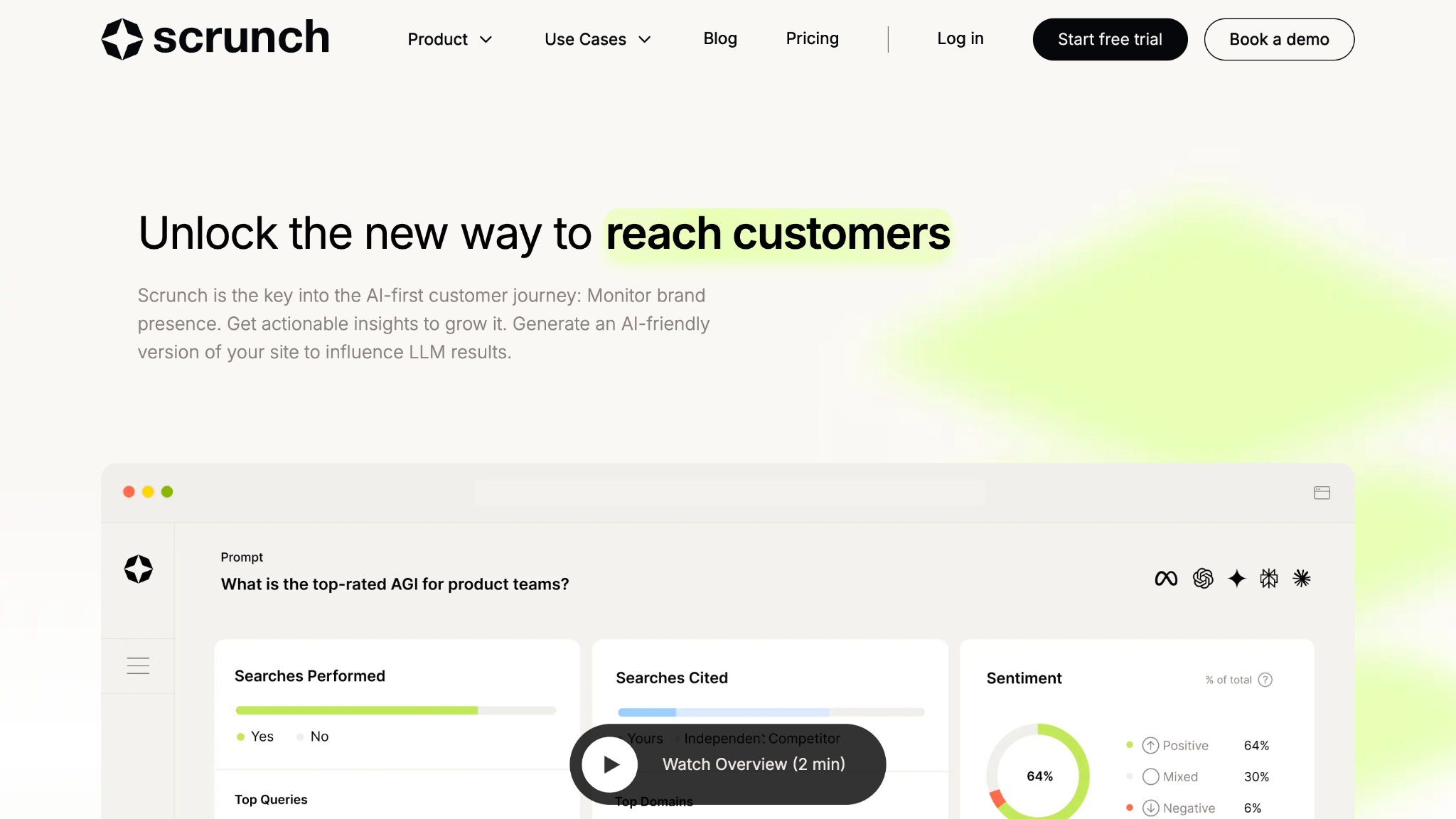
Scrunch is an AI search visibility tool and optimization platform that performs prompt-level, multi-engine monitoring.
Scrunch’s strong point is detailed analysis. In the Overthink Group report, Scrunch ranked near the top for “segmentation architecture, parameter definition, and intuitive filters and labelling.” You can label the buyer persona or theme for each prompt, and then check sentiment and share-of-voice for every prompt from all engines.
What we liked most:
- Broad Engine Coverage. Tracks every major LLM platform (ChatGPT, Claude, Perplexity, Gemini, Google AI Overviews/Mode, Meta AI).
- Prompt-Level Tracking. Scrunch helps you to manage prompts by persona, location, sales funnel stage, etc.
- Sentiment & SOV Analysis. For each prompt, Scrunch gives a report telling if AI presents your brand as positive or negative and compares it to competitors.
- AI Site Audit. Scrunch can indicate the areas where technical problems (broken links, indexing blockers, etc.) are present, affecting AI visibility.
Best for:
- Enterprises that need SOC2 compliance, role-based access, and an API for data integration.
- In-house SEO/content teams looking for raw data.
- Agencies and large companies that require detailed, multi-brand monitoring.
- Marketers who require reliable multi-engine visibility data (with minimum support).
Pros:
- Comprehensive data.
- Control over which queries to monitor.
- There is a real-time feed of AI bot visits to your site and GA4 integration.
Cons:
- Emphasis on monitoring.
- Has no features for schema/SEO editing.
- The UI is robust but complex.
Pricing:
Scrunch offers different plans: Starter at $300/mo (350 custom prompts, 3 users, 1,000 industry prompts, 5 page audits); Growth at $500/mo (700 prompts, 5 users, 10 audits); Enterprise AI visibility tracking is quote only.
6. Rankscale AI
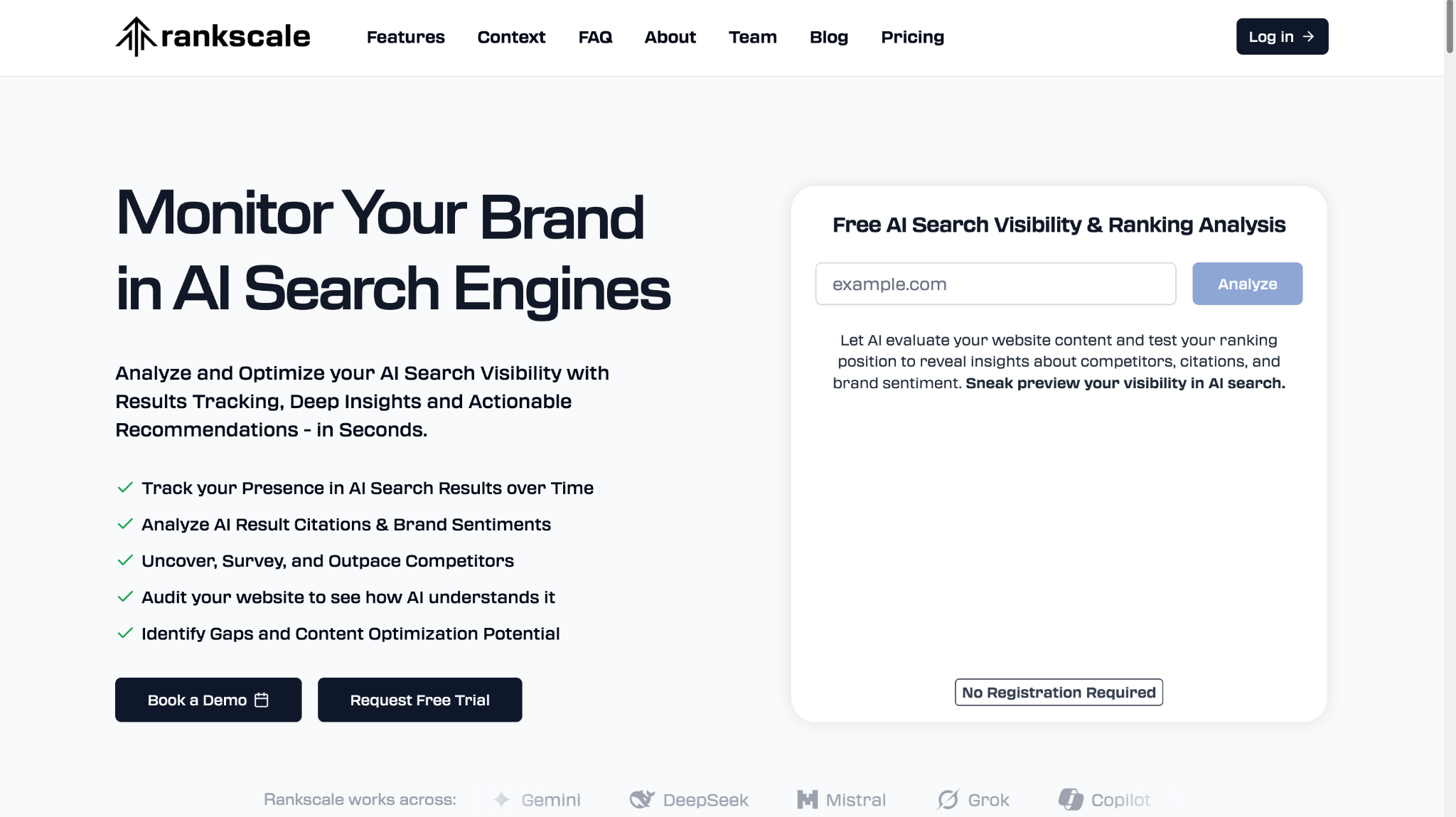
Rankscale AI is one of the most budget-conscious, relatively new, and simple AI visibility tools. It mainly monitors simple queries and provides key figures such as visibility score and average position. In a Nick Lafferty’s review, Rankscale is credited with being strong in “sentiment analysis” and as “a page-level AI citation tracker,” giving it value for people testing specific pages rather than brand-level presence.
What we liked most:
- Deep Monitoring. Tracks your brand’s “footprint” across major answer engines and LLMs (ChatGPT, Claude, Perplexity, Google AI Overviews).
- Brand Dashboard. Summarizes AI metrics (visibility, position, mentions) into one place for a quick overview.
- Competitive Benchmarking. It figures out who your top competitors are and then pits their AI visibility against yours.
- Content Optimization Tips. Offers clear, actionable instructions on how to make the content more AI-friendly.
- AI Citation Analysis. Helps you understand which URLs are most frequently cited by AI, implying the potential of link-building or content creation areas.
Best for:
- Small businesses, startups, and lean SEO teams in search of a simple, affordable AI tracker.
- Agencies that need more support.
- Any person who would like to have multi-engine visibility with limited funds.
Pros:
- Neat, user-friendly interface highly focused on what can be done with data.
- The founder is actively updating and upgrading the tool with new features being added regularly.
- It was designed specifically to cater to AI visibility tracking.
Cons:
- Export restrictions.
- The interface and metrics can feel technical for non-SEOs.
- The primary focus is on tracking and analyzing only. If you want automated content writing or deep SEO integration, then you need an additional tool.
Pricing:
Rankscale’s pricing model is based on usage. The Essential plan costs $20 per license per month (120 credits, 480 AI responses, 10 audits). The Pro plan costs $99 per license per month (25 brand dashboards, 4,800 responses, 50 audits, team workspace). The Enterprise plan (approx. $780/mo) is for extreme usage.
7. Otterly AI
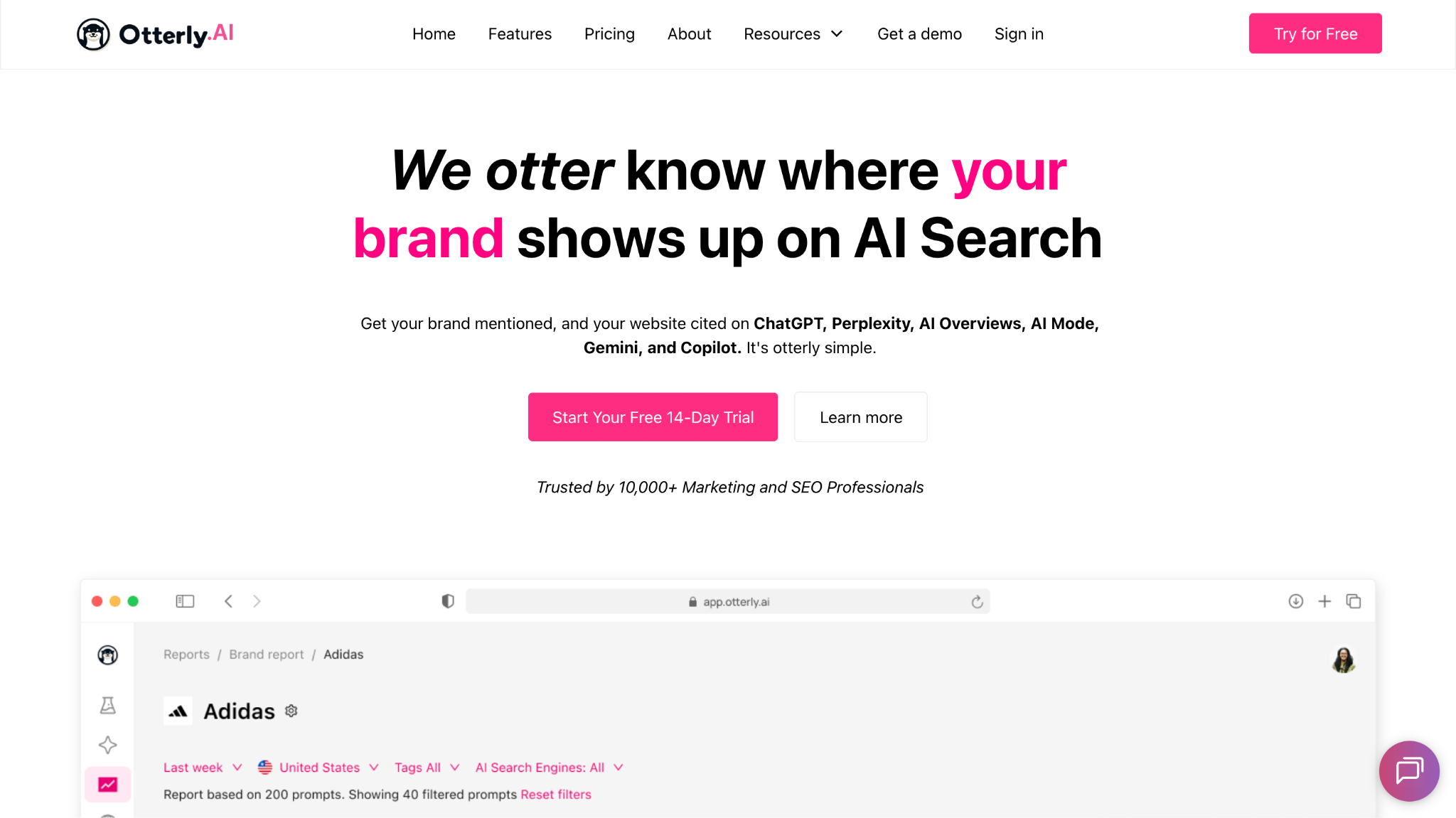
Otterly AI, a location-focused AI visibility tool, is heavily focused on providing in-depth audits. Among the users on the web, Otterly is appreciated as a practical “early warning” and monitoring tool rather than a heavy-duty analytics suite.
What we liked most:
- Comprehensive Coverage. Monitors six AI search platforms (ChatGPT, Google Overviews/Mode, Perplexity, Copilot, Gemini) with daily updates.
- Brand Visibility Index. It assigns a normalized visibility score to each brand, helping you to rank brands within your industry.
- Deep GEO Audit. Analyzes more than 25 technical and content problems per area (multilingual content, schema usage, page structure) and converts them into pointed out recommendations with the correct order of urgency and importance.
Best for:
- Agencies or brands that have a global or local SEO focus. Otterly is designed for large-scale, location-specific, AI-driven audits.
- Teams that highly prioritize automated recommendations.
Pros:
- The audit report makes it extremely clear what the next steps are (adding schema, content length enhancement, fixing crawl issues) to increase AI visibility.
- There is no restriction on the number of team members and brand reports.
- There is an AI-powered search keyword research tool that helps in finding the most relevant prompts for each target country.
Cons:
- Otterly lacks AI-driven traffic estimates.
- The UI consists of many tables and data. This abundance of information can make it difficult for newcomers to understand the interface.
- The data is updated on a weekly basis (not real-time).
Pricing:
The cost of Otterly is based on prompts. The main plans are Lite ($29/mo) with 15 prompts and Standard ($189/mo) with 100 prompts. There is also a Premium plan (400 prompts) that costs $489/mo.
8. Writesonic (GEO)
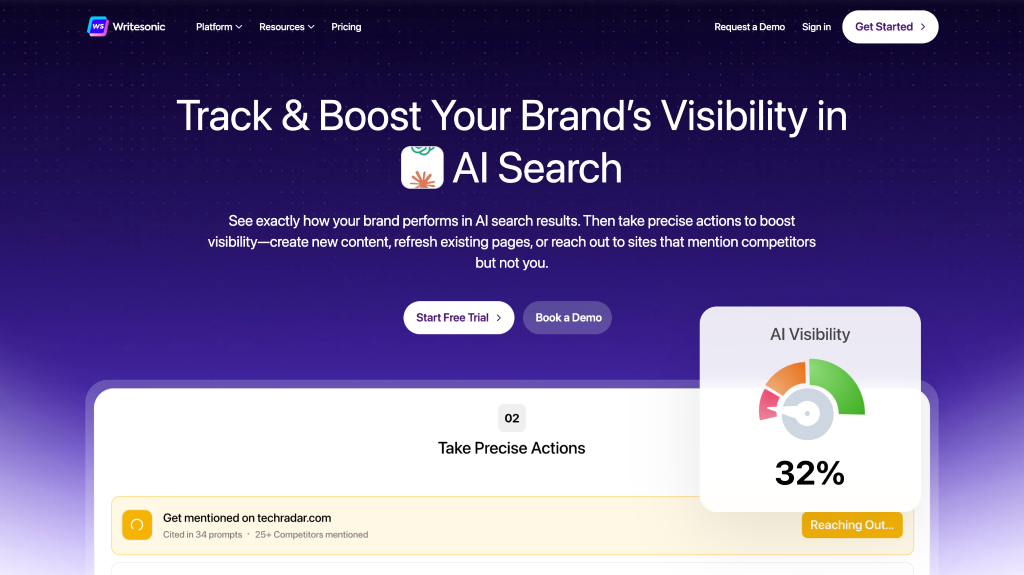
Writesonic is mostly recognized as an AI content platform. A content team can use Writesonic GEO to detect underperforming topics or content gaps via visibility data, and then directly write optimized articles or update existing pages within the same platform. Also, its GEO platform brings together content creation, SEO tools, and AI-monitoring in one place.
What we liked most:
- Geographic Intelligence. Locally simulates AI queries from different locations. In fact, one can track their AI visibility changes by country.
- Content Strategy Planner. Evaluates your site against competitors and recommends topics that could enhance your AI visibility.
- Action Center. An AI audit listing SEO and AI issues, most of which can be fixed if your site is on WordPress or Cloudflare by linking with Writesonic.
- AI Traffic Analytics. Writesonic boasts an “AI Visitors” dashboard that reveals the number of bot visits to your pages and accordingly which pages are the most valuable.
- Prompt & UI Scraping. Gathers AI-generated Q&A for your monitored prompts across various models, so you are able to understand precisely what AI communicates regarding your brand.
Best for:
- Marketers looking for one platform that can both generate AI-optimized content and track its performance in AI search.
- Agencies that need to improve the product’s visibility in ChatGPT Shopping.
Pros:
- Comprehensive functionalities such as writing assistance, prompt research, visibility tracking, and SEO.
- The platform offers templates, tutorials, and customer success service—thus, the user is not left alone with the learning curve.
- It can keep track of and improve the product’s visibility in ChatGPT Shopping, which is a plus for e-commerce.
Cons:
- This AI visibility tool has a limited LLM scope.
- The platform is large and diverse, so the learning curve can be steep.
Pricing:
The Professional plan (roughly $249 per month if paid annually) is the minimum required to track AI visibility fully. The plan also allows content creation (6 articles per month) and gives you access to basic analytics. With the Advanced plan ($499 per month), you get unlimited content generation and full sentiment monitoring.
Future of AI visibility: What to expect in 2026–2027?
In the following years, searches will be more like a conversation where users ask questions to chatbots such as ChatGPT and get the answers from them. The traditional click-based ranking becomes less relevant because what counts most is to be referenced as a source in AI-generated answers, wherever they come from.
Search won’t be just text. Voice assistants, camera-based search, and chat UIs will expand. An example of this can be seen in Google’s “AI Mode,” which merges voice, vision, and text functionalities. SEO strategies will have to cover these new interfaces to be effective, so AI search visibility tools will become more important.
Users will “go to ChatGPT” or “ask Gemini” as much as they do to Google, making it extremely important to keep track and have influence over each AI engine individually.
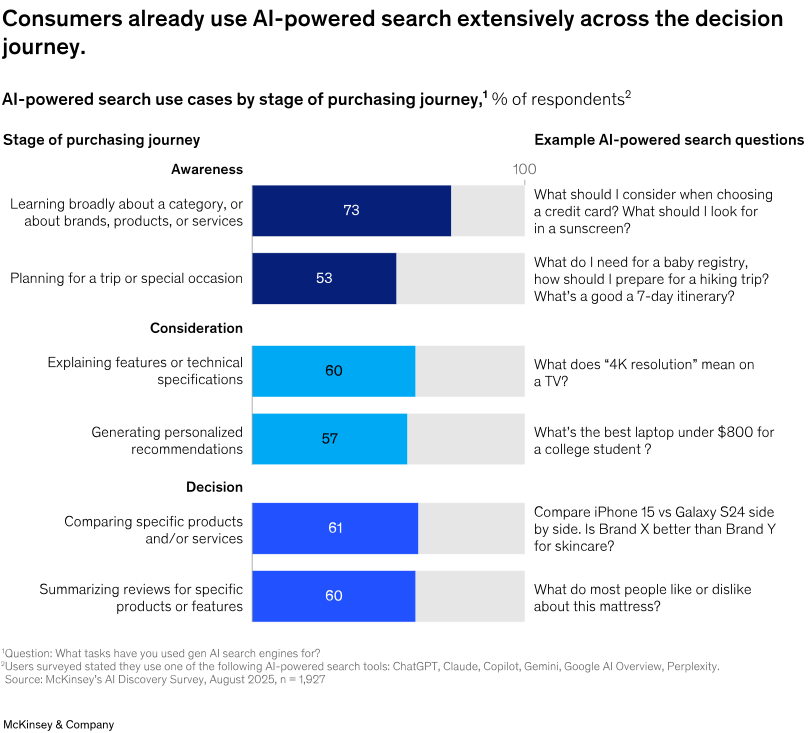
Industry reports like Bain & Company and McKinsey have shown that generative search is already the favorite of most users. The effect of this will be that by 2027-28, billions of dollars worth of commerce will be possible through AI searches alone. This will require a major change in tactics—writing content in a way that is understandable by machines will become equally important as traditional SEO.
AI models take advantage of knowledge graphs and depend on the credibility of sources. A clear understanding of entities and the use of schema markup will be very important by 2027. Implementing E-E-A-T (expertise, experience, authority, trust) elements in your content will be a wise move since AI answer engines will choose to refer to the ones that are authoritative among them.
Conclusion
AI answers are the fastest and most convenient way people find information these days. The moment your brand stops showing up in the answers of LLMs, you are losing the battle for the audience’s attention before the actual search results are displayed.
There is no best AI visibility tool for the job. Instead, it is made up of different AI visibility tools, each offering a different viewpoint. For example, SE Visible is good for full-spectrum tracking, Ahrefs Brand Radar allows you to get competitive insights, Profound helps you to find branded answer detection, and platforms like Peec, Rankscale, and Otterly enable quick, brief checkups. Writesonic GEO is the tool that helps teams to actively optimize their content for AI search.
If you’re unfamiliar with this area, it’s better to begin with a free plan or a trial. Just one scan might provide insight into whether AI systems can recognize your brand and pinpoint where you’re lacking.
FAQ
What is AI visibility?
AI visibility is the frequency at which your brand or content is featured in AI-generated answer models such as ChatGPT, Perplexity, Claude, or Google’s AI Overviews.
Why do websites lose visibility in AI answers?
The main reason is that their content is not authoritative, well-structured, or updated with the latest information. Thus, LLMs decide to use clearer and better-cited sources.
Can AI visibility improve SEO?
Yes, but only indirectly. Usually, content that ranks high in AI searches is also authoritative, well-structured, and of high quality—which are all factors that contribute to organic SEO. AI search visibility tools help to figure out strategies on how to improve it.